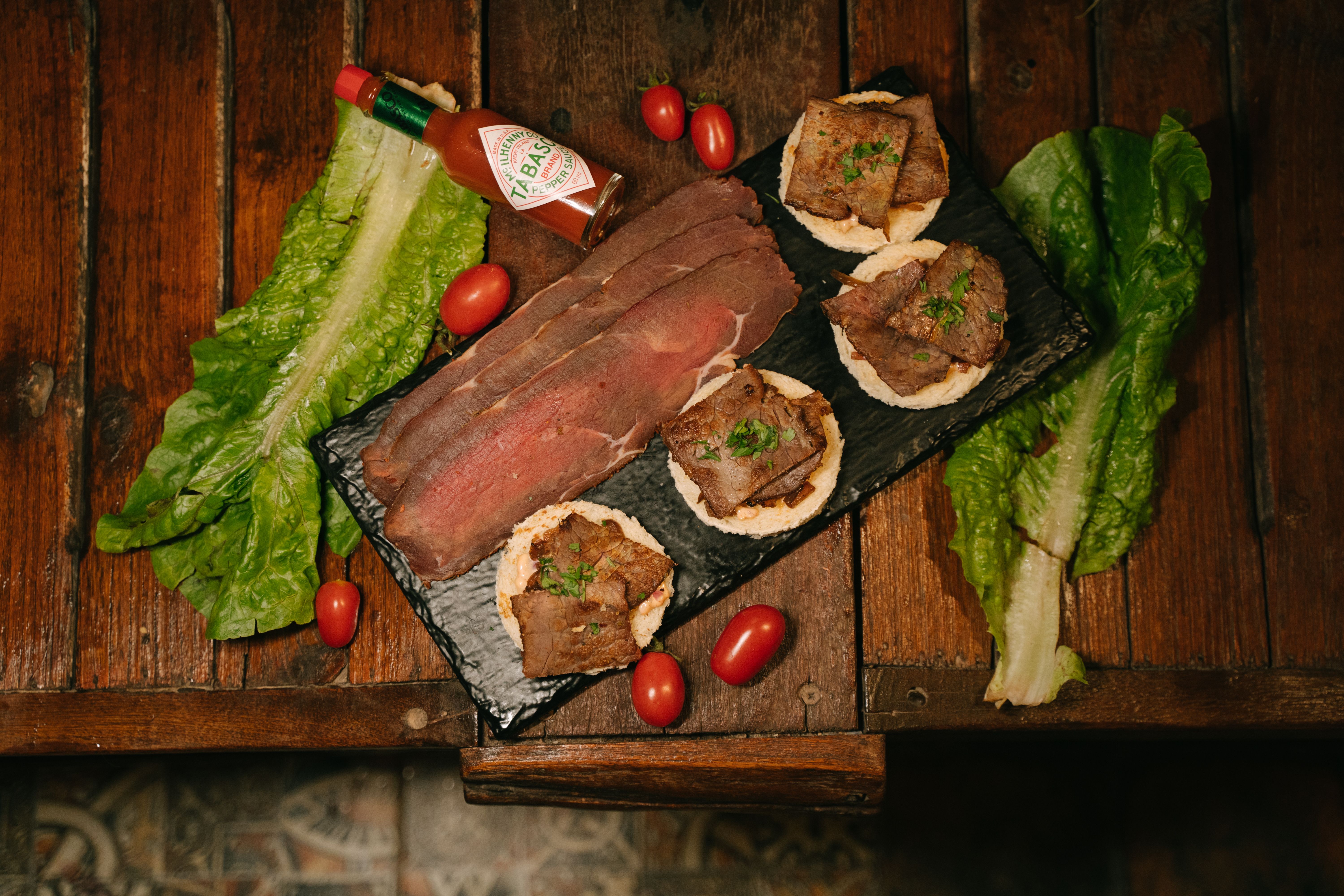
Photo: Radwan Menzer / Pexels
The diets react (see scores below)
Common Ingredients
- beef
- fenugreek
- garlic
- paprika
- cumin
- salt
Specific recipes may vary.
Incompatible with 5 of 11 diets
Diet Ratings
Basturma is a cured, air-dried beef product heavily spiced with fenugreek, garlic, paprika, and cumin. The base is pure beef, which provides high-quality protein and fat with zero carbohydrates. The spice coating (chemen) does contribute a small amount of carbs from fenugreek and garlic, but in the thin layer applied per serving, the net carb contribution is negligible — typically under 1-2g per standard serving (30-50g). No sugars, grains, or starchy ingredients are present. It is a whole, minimally processed cured meat that fits naturally into a ketogenic eating pattern, making it an excellent keto-friendly snack.
Basturma is a cured and air-dried beef product. Beef is an animal product and is explicitly excluded under all vegan dietary frameworks. The spice coating (fenugreek, garlic, paprika, cumin, salt) is entirely plant-based, but the primary ingredient — beef — disqualifies this dish completely. There is no vegan version of traditional basturma, as the meat is the defining and irreplaceable component of the dish.
Basturma is a cured, heavily salted beef product. While the base ingredients (beef, fenugreek, garlic, paprika, cumin) are individually paleo-compatible, salt is explicitly excluded under paleo rules as an 'added salt' processed food component. More critically, basturma is a cured/processed meat by definition — the curing process with added salt places it firmly in the 'processed meat' category that paleo excludes. The dish cannot be made without salt, making the processed nature intrinsic to the food itself rather than incidental.
Basturma is a heavily salt-cured, air-dried beef product — essentially a processed red meat. The Mediterranean diet explicitly limits red meat to a few times per month, and processed/cured meats are further discouraged due to their high sodium content, saturated fat, and preservation methods. While the spice crust (fenugreek, garlic, paprika, cumin) contains Mediterranean-friendly aromatics, the base product is fundamentally at odds with core Mediterranean principles. The high salt load and processed nature of cured meat push this firmly into 'avoid' territory.
Some Mediterranean diet scholars note that preserved and cured meats have centuries-long traditions in Eastern Mediterranean and Levantine cuisines (Armenian, Turkish, Lebanese), and when consumed in very small amounts as a condiment or flavoring — rather than a main protein — they may be contextually acceptable within a traditional dietary pattern. A strict 'avoid' classification may overlook this cultural nuance.
Basturma is a cured beef product at its core — the protein base is carnivore-approved beef. However, the traditional spice coating (chemen) contains multiple plant-derived ingredients: fenugreek, garlic, paprika, and cumin. These are all excluded under strict carnivore rules as plant-based spices. Most strict carnivore practitioners would avoid this due to the heavy spice crust, while more flexible practitioners who permit spices occasionally might include it given the high-quality beef base and minimal processing (no sugar, fillers, or seed oils). The spice load here is not incidental — the chemen paste is a defining, thick coating that is central to the dish, making it more problematic than a trace seasoning.
Some carnivore practitioners, particularly those following stricter protocols like the Lion Diet or Baker's meat-only approach, would avoid basturma entirely due to the substantial plant-compound load from fenugreek, paprika, cumin, and garlic — arguing that even if tolerated short-term, these phytocompounds undermine the elimination purpose of carnivore. Others in the more flexible community consider occasional spice use acceptable and would approve the beef base.
Basturma is a cured, air-dried beef product seasoned with a spice paste called çemen, traditionally made from fenugreek, garlic, paprika, cumin, and salt — all of which are Whole30-compliant ingredients as listed here. The beef and spices are inherently allowed. However, basturma as it commonly exists commercially may include additional ingredients such as added sugars, nitrates/nitrites, or other preservatives, so label-reading is essential. The dish as described with only these six ingredients is fully compliant. It is a whole, minimally processed cured meat rather than a recreated junk food, so it does not violate the spirit rule.
Some Whole30 practitioners and community members question whether relying on cured processed meats like basturma honors the program's whole-food philosophy, even when technically compliant. Melissa Urban's guidance generally encourages prioritizing fresh, unprocessed meats, and notes that processed meats (even compliant ones) should not become dietary staples during the 30 days.
Basturma is a heavily spiced cured beef that contains two significant high-FODMAP ingredients: garlic and fenugreek. Garlic is one of the highest-FODMAP foods tested by Monash University, rich in fructans, and is problematic even in small quantities. Fenugreek (methi) contains GOS and fructans and is rated high-FODMAP by Monash. Both ingredients are core to basturma's defining spice paste (chemen), used in quantities sufficient to coat the entire surface of the cured meat. While the beef itself is low-FODMAP, and paprika, cumin, and salt are low-FODMAP at standard culinary amounts, the garlic and fenugreek content make this dish unsuitable during the elimination phase. The FODMAP load from the spice crust is not trivial — basturma is defined by its thick, pungent coating, so the spice-to-meat ratio is high per serving.
Some FODMAP practitioners note that in very thin slices (as basturma is traditionally served), the absolute quantity of fenugreek and garlic consumed may be small enough to stay below symptomatic thresholds for some individuals. However, Monash University's elimination phase protocol advises avoiding garlic entirely regardless of quantity, making basturma non-compliant for strict elimination.
Basturma is a heavily cured, air-dried beef product preserved with large quantities of salt and a spiced paste (çemen) containing fenugreek, garlic, paprika, and cumin. The curing process requires substantial salt to preserve the meat, resulting in extremely high sodium content — typically 1,200–1,500mg or more per 100g serving, which can represent 50–100% of the entire daily DASH sodium allowance in a single small portion. Additionally, as a red meat product, it conflicts with the DASH guideline to limit red meat intake. The fat content, while variable depending on the cut used, further complicates compliance. Although the spices themselves (fenugreek, garlic, paprika, cumin) are DASH-neutral or even beneficial, the overwhelming sodium burden from curing makes basturma incompatible with DASH principles regardless of sodium target (standard 2,300mg or strict 1,500mg). NIH/NHLBI DASH guidelines explicitly flag cured and processed meats as foods to avoid or strictly limit due to their high sodium and saturated fat content.
Basturma is a cured, air-dried beef product heavily seasoned with fenugreek, garlic, paprika, and cumin. From a Zone perspective, the protein source (beef) is not ideal because cured beef tends to be fattier and higher in saturated fat than the lean proteins Sears recommends (skinless chicken, fish, egg whites). However, the spice coating adds negligible carbohydrates and no problematic macros. As a snack, a small portion (1-2 thin slices, ~30-40g) can deliver roughly 7-10g of protein (1 protein block equivalent), making it workable as part of a Zone snack when paired with a low-GI carb (e.g., a few raw vegetables or a small piece of fruit) and a monounsaturated fat source. The key concerns are the curing process adding significant sodium, the saturated fat content of the beef, and the fact that Sears consistently classifies fatty red meats as 'unfavorable' protein sources. It is not impossible to incorporate, but it requires careful portioning and pairing to hit the 40/30/30 ratio, placing it firmly in 'caution' territory.
Some Zone practitioners following Sears' later anti-inflammatory writing (Zone Diet and Inflammation) note that the polyphenol-rich spice blend (fenugreek, garlic, paprika, cumin) adds anti-inflammatory value, partially offsetting concerns about saturated fat. Additionally, if sourced from grass-fed beef, the omega-3 to omega-6 ratio improves, which aligns better with Sears' anti-inflammatory emphasis in his post-2000 works. In that context, a small portion could edge toward a low 'approve.'
Basturma is a heavily spiced, cured beef product. The spice blend is genuinely impressive from an anti-inflammatory standpoint — fenugreek (trigonelline, anti-inflammatory saponins), garlic (allicin, sulfur compounds that suppress NF-κB), paprika (carotenoids, capsaicin), and cumin (thymoquinone, antioxidant flavonoids) are all well-regarded anti-inflammatory ingredients. However, the protein base is red meat, which anti-inflammatory guidelines consistently flag as something to limit due to saturated fat content, arachidonic acid, and heme iron, all of which can promote inflammatory pathways at regular intake. Additionally, basturma is a cured meat with notably high sodium content, and cured/processed red meats are associated with elevated inflammatory markers (CRP, IL-6) in epidemiological research. The processing method (salt curing, drying) doesn't add trans fats or artificial additives in the traditional recipe, which keeps it out of the 'avoid' category, but the combination of red meat base plus curing process places it clearly in 'caution' territory. Occasional consumption in small portions is acceptable; it should not be a dietary staple on an anti-inflammatory protocol.
Some anti-inflammatory practitioners would rate basturma more leniently, arguing that the dense spice crust — particularly fenugreek and garlic — meaningfully offsets the red meat concern at the small portion sizes typical for this dish (used as a flavoring or snack, not a protein main). Conversely, stricter anti-inflammatory and autoimmune protocol (AIP) adherents would push this toward 'avoid,' treating any cured red meat as pro-inflammatory regardless of the spice profile, citing processed meat associations with colorectal inflammation.
Basturma is a cured, air-dried beef charcuterie coated in a spiced paste (cemen) made from fenugreek, garlic, paprika, and cumin. It provides a meaningful amount of protein per serving, which is a genuine positive for GLP-1 patients. However, several factors push it into caution territory. As a cured meat, basturma is very high in sodium, which can worsen fluid retention and is generally discouraged. The fat content depends on the cut used — traditional basturma often includes moderate saturated fat from the beef itself. More significantly for GLP-1 patients, the strongly aromatic spice coating (particularly fenugreek and garlic in concentrated form) can act as a GI irritant and worsen nausea, reflux, or bloating — side effects that are already common with GLP-1 medications. It is also a highly processed preserved meat, placing it in a category of ultra-processed or cured meats that are generally limited in clinical GLP-1 nutrition guidance. Portions are typically small (30–50g), which is a structural advantage, and it requires no preparation, making it snack-convenient. Net assessment: real protein value in small servings, but the sodium load, saturated fat, and GI-irritating spice profile make it a conditional choice rather than a recommended one.
Some GLP-1-focused dietitians may permit basturma in very small quantities (1–2 thin slices) as a high-flavor, protein-dense snack that satisfies cravings with minimal volume — which aligns well with reduced appetite. Others would flag the sodium content, saturated fat, and cured meat classification as sufficient reason to steer patients toward leaner, lower-sodium protein sources, particularly in the early high-side-effect phase of GLP-1 therapy.
*See how scores were generated at our methodology page.
Nutritional profile
Six traits that cut across every diet.
Fiber & Plants
How much whole-plant food and fiber it delivers.
Healthy Fats
The quality of its fats (unsaturated, omega-3).
Whole / Unprocessed
How close it is to its natural, unprocessed form.
Gut Gentle
How easy it is on digestion (low FODMAP, few irritants).
Low Glycemic
How little it spikes your blood sugar.
Protein Density
How much protein it packs per calorie.
Controversy Index
Higher controversy = more disagreement between diets.
Diet-Specific Tips
 Keto — 9/10
View tips
- Pure beef base with zero net carbs from the protein source
- Spice coating (chemen) adds negligible net carbs per serving
- No added sugars or grain-based ingredients
- High-quality animal protein aligns with keto macros
- Naturally preserved through curing and air-drying — minimal processing
- Portable, convenient keto snack option
 Carnivore — 4/10
View tips
- Beef is the primary protein — fully carnivore-approved animal product
- Fenugreek, garlic, paprika, and cumin are all plant-derived spices excluded on strict carnivore
- The chemen spice paste is a thick, dominant coating — not a trace seasoning
- No sugar, seed oils, or artificial fillers — cleaner than most processed meats
- Traditionally cured with salt — minimal processing method is carnivore-friendly
- Spice use is one of the most debated topics in the carnivore community
 Whole30 — 8/10
View tips
- All listed ingredients (beef, fenugreek, garlic, paprika, cumin, salt) are Whole30-compliant
- No excluded ingredients (no added sugar, grains, dairy, legumes, or soy) in the described recipe
- Commercially available basturma may contain added sugars or non-compliant preservatives — label-reading required
- Cured/processed meats are technically allowed but Whole30 guidance discourages over-reliance on them
- Not a recreated baked good or junk food — qualifies as a whole protein source
 Zone — 5/10
View tips
- Beef is an 'unfavorable' Zone protein due to saturated fat content vs. lean proteins like chicken or fish
- Curing process adds high sodium, a concern for overall diet quality though not a Zone macro issue
- Spice blend (fenugreek, garlic, paprika, cumin) contributes anti-inflammatory polyphenols with negligible carb impact
- Small portions (~30-40g) can approximate 1 protein block, making it usable but not ideal
- Must be paired with low-GI carb and monounsaturated fat to achieve 40/30/30 balance as a snack
- No added sugars or high-GI carbohydrates in the ingredient list, which is favorable
 Anti-Inflammatory — 4/10
View tips
- Red meat base — anti-inflammatory guidelines recommend limiting red meat due to saturated fat and arachidonic acid
- Cured/processed meat — salt curing associated with elevated inflammatory markers in research
- High sodium content from curing process
- Fenugreek — anti-inflammatory saponins and trigonelline, a notable benefit
- Garlic — allicin and sulfur compounds with well-documented NF-κB suppression
- Paprika and cumin — antioxidant carotenoids and thymoquinone
- No trans fats, artificial additives, or refined carbohydrates in traditional recipe
- Small typical serving size moderates overall red meat concern
 GLP-1 Friendly — 4/10
View tips
- Moderate-to-good protein density per gram of food
- High sodium content typical of cured meats — a concern for GLP-1 patients
- Moderate saturated fat depending on beef cut used
- Strongly spiced coating (fenugreek, garlic, paprika) may worsen GLP-1 GI side effects such as nausea and reflux
- Ultra-processed / preserved meat classification — generally limited in GLP-1 dietary guidance
- Small natural serving size is structurally compatible with reduced GLP-1 appetite
- Zero fiber content — no contribution to the fiber priority