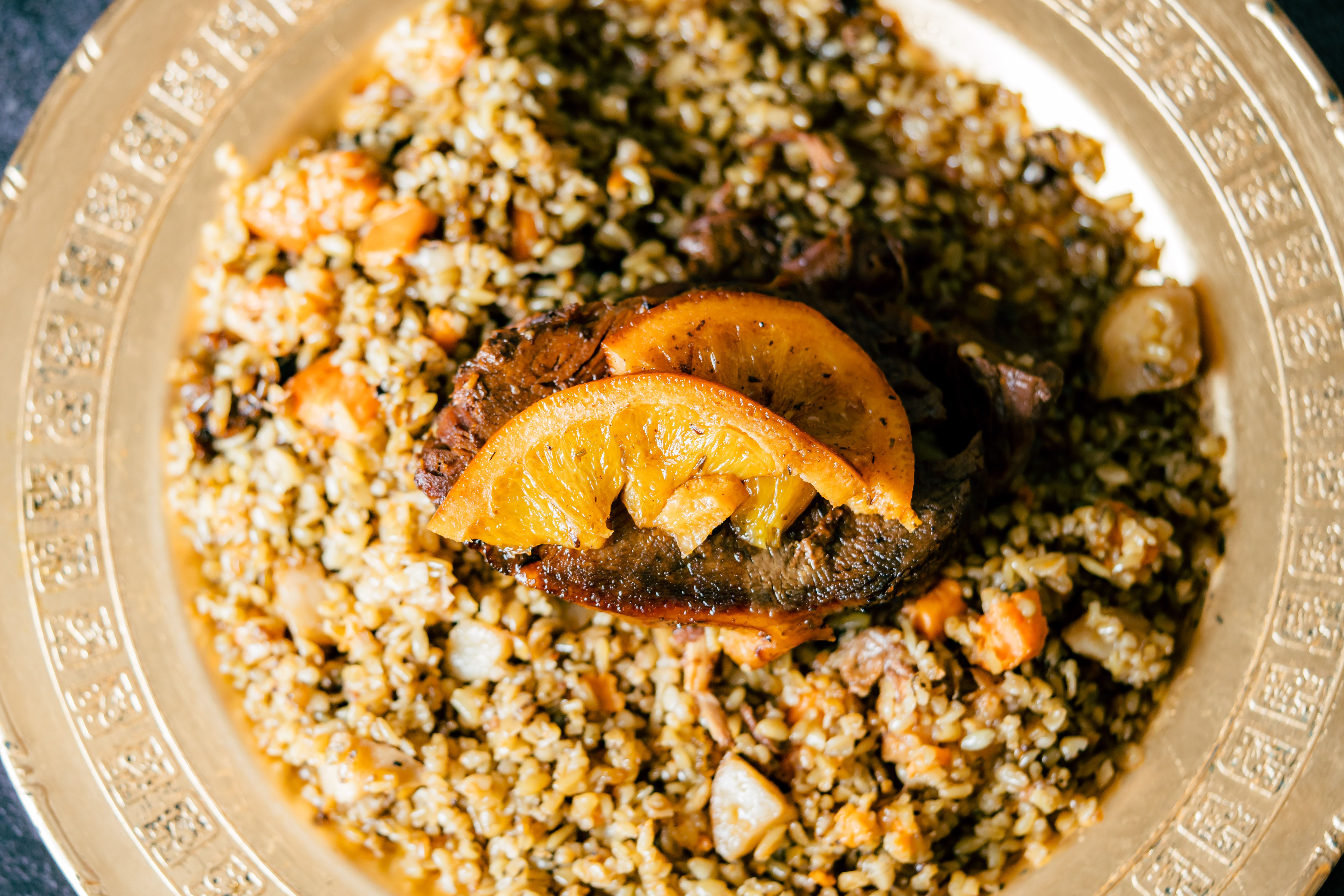
Photo: Anat Landa / Pexels
The diets react (see scores below)
Common Ingredients
- pumpkin
- rice
- dried apricots
- raisins
- prunes
- walnuts
- honey
- cinnamon
Specific recipes may vary.
Incompatible with 7 of 11 diets
Diet Ratings
Ghapama is fundamentally incompatible with ketogenic eating. The dish is essentially a stuffed pumpkin filled with rice (a pure starch), dried apricots, raisins, and prunes (concentrated sugar bombs), and honey — every major ingredient is either a high-net-carb grain or a sugar-dense fruit/sweetener. A single serving would deliver well over 100g of net carbs, far exceeding the entire daily keto allowance of 20-50g. Even the pumpkin itself, while moderate in carbs alone, contributes to an already catastrophically high carb load. Walnuts and cinnamon are keto-friendly, but they are minor components that cannot offset the rest. There is no realistic portion size that makes this dish compatible with ketosis.
Ghapama is a traditional Armenian stuffed pumpkin dish filled with rice, dried fruits, nuts, and spices — all plant-based ingredients. The only point of contention is honey, which the Vegan Society and most mainstream vegan organizations classify as an animal product (produced by bees) and therefore exclude from a vegan diet. Without honey, this dish would be a straightforward whole-food plant-based approve. With honey as listed, it falls into 'caution' territory: most vegans would substitute maple syrup or agave and consider it fully vegan, but as traditionally prepared with honey it does not meet the strict vegan standard. The base dish is otherwise exemplary — whole grains, whole fruits, nuts, and vegetables with no processed ingredients.
A minority of plant-based eaters argue that honey from small-scale or ethical beekeepers causes no meaningful harm to bees and is therefore compatible with plant-based eating; these individuals would approve this dish without modification. Strict ethical vegans, by contrast, reject honey categorically as an animal-derived product regardless of sourcing.
Ghapama is disqualified primarily by rice, a grain that is excluded under standard paleo rules. While most other ingredients are paleo-friendly or at least debatable (pumpkin, walnuts, dried fruits, honey, cinnamon), rice is a non-negotiable grain exclusion across virtually all paleo frameworks. Without the rice, a modified version of this dish could be made paleo-compliant, but as traditionally prepared, it cannot be approved.
Ghapama is a traditional Armenian stuffed pumpkin dish featuring many Mediterranean-friendly ingredients: pumpkin (a nutrient-rich vegetable), walnuts (approved nuts), dried fruits (apricots, raisins, prunes — whole plant foods), and warming spices. These components strongly align with Mediterranean principles. However, two elements temper the rating: white rice is the starchy base (refined grain, though it is a traditional ingredient in many Mediterranean-adjacent cuisines), and honey adds concentrated natural sugar. The dish has no olive oil and is essentially a sweet main course, which is unusual for Mediterranean dietary patterns. Overall it is wholesome and plant-based, but the refined rice and honey-driven sweetness make it a moderate rather than staple choice.
Some Mediterranean diet authorities, particularly those emphasizing traditional Eastern Mediterranean and Middle Eastern culinary heritage, would view this dish more favorably — dried fruits, nuts, and pumpkin are classic regional staples, and honey is considered a natural, minimally processed sweetener preferable to refined sugar. A stricter modern clinical interpretation (e.g., replacing white rice with a whole grain like bulgur or farro) would bring the score higher.
Ghapama is entirely plant-based with zero animal-derived ingredients. It consists of pumpkin (vegetable), rice (grain), dried apricots, raisins, and prunes (fruits), walnuts (nuts), honey (debated but present alongside wholly excluded foods), and cinnamon (plant spice). Every single ingredient violates carnivore diet principles — vegetables, grains, fruits, nuts, and plant-based spices are all explicitly excluded. There is no animal protein, no animal fat, and no animal-derived component of any significance. This dish is fundamentally incompatible with the carnivore diet at every level.
Ghapama contains two clearly excluded ingredients: rice (a grain, explicitly banned on Whole30) and honey (an added sugar, explicitly banned on Whole30). Either of these alone would disqualify the dish. The remaining ingredients — pumpkin, dried apricots, raisins, prunes, walnuts, and cinnamon — are all Whole30-compliant on their own, but the dish as traditionally prepared cannot be made compliant without fundamentally altering the recipe.
Ghapama is a traditional Armenian stuffed pumpkin dish filled with rice and dried fruits, but it contains multiple high-FODMAP ingredients that make it problematic during the elimination phase. Honey is high in excess fructose and is explicitly avoided on a low-FODMAP diet at any meaningful culinary quantity. Prunes are high-FODMAP due to sorbitol (a polyol). Dried apricots are high in sorbitol and become high-FODMAP at very small servings (Monash rates ~1 dried apricot as the safe limit, far less than what would be used in this dish). Raisins are high in fructose and fructans at standard servings (Monash threshold is ~1 tablespoon, which is a very small amount for a stuffed dish). The cumulative FODMAP load from honey, prunes, dried apricots, and raisins together makes this dish essentially unavoidable as an avoid during elimination. Pumpkin (butternut-type) can be low-FODMAP at small portions but moderate-to-high at larger servings. Rice and walnuts are generally low-FODMAP. Cinnamon is low-FODMAP. However, the combination of four high-FODMAP ingredients (honey, prunes, apricots, raisins) creates a high cumulative FODMAP burden regardless of individual portion sizes.
While each dried fruit individually has a Monash-defined low-FODMAP threshold (e.g., ~1 dried apricot, ~1 tablespoon raisins), some FODMAP practitioners argue that the 'stacking' effect of multiple moderate sources together warrants an avoid verdict even if theoretical minimal quantities were used; others might suggest that a heavily modified version with maple syrup instead of honey and very small amounts of one dried fruit could be cautiously trialed, but this would no longer resemble the traditional dish.
Ghapama is a traditional Armenian stuffed pumpkin dish featuring mostly DASH-friendly whole foods: pumpkin is an excellent source of potassium, magnesium, and fiber; dried fruits (apricots, raisins, prunes) contribute potassium and fiber; walnuts provide healthy unsaturated fats and magnesium; and cinnamon is a benign spice. The dish is naturally low in sodium and contains no saturated fat or processed ingredients — all strong DASH positives. However, honey adds significant free/added sugar, and the combination of honey, dried fruits, and white rice creates a notably high glycemic load and sugar density. DASH guidelines limit sweets and added sugars, and while honey is less processed than refined sugar, it is still classified as an added sweetener under DASH. The rice component is likely white rice (traditional), which is less preferred than brown/whole grain rice under DASH. Portion control is important: as a dessert-like main or side dish, a small serving fits within DASH, but a larger portion tips the sugar and caloric balance unfavorably. The absence of sodium, saturated fat, or processed ingredients prevents an 'avoid' rating, but the added sugar and refined carbohydrates keep it from a full 'approve.'
NIH DASH guidelines categorize honey as an added sugar to be limited, aligning with the caution rating here. However, some updated DASH-aligned clinical interpretations note that when added sugars come packaged with micronutrient-dense whole foods (dried fruits, nuts, pumpkin) and total sodium and saturated fat remain negligible, the overall dietary pattern impact may be favorable — particularly when consumed in modest portions as part of an otherwise DASH-compliant diet.
Ghapama is a traditional Armenian stuffed pumpkin dish that, from a Zone Diet perspective, is almost entirely composed of unfavorable or problematic ingredients. The dish has no lean protein source whatsoever, making it impossible to achieve the 40/30/30 macronutrient ratio as a standalone meal. The carbohydrate profile is extremely problematic: rice is a high-glycemic grain (unfavorable in Zone), raisins are explicitly listed by Dr. Sears as an unfavorable high-sugar fruit to avoid, honey is essentially pure sugar with a high glycemic load, and prunes and dried apricots are concentrated sugar sources that count as high-glycemic carbohydrates. Pumpkin itself is moderate on the glycemic index but in this context is overwhelmed by the sugary filling. Walnuts provide some beneficial omega-3 fatty acids and are a Zone-favorable fat source, and cinnamon is polyphenol-rich, but these two ingredients cannot redeem a dish that is essentially a sugar bomb with no protein. The combination of honey, raisins, dried fruits, and white rice creates a massive glycemic spike with no protein or sufficient fat to moderate it. This dish would require such radical reformulation — removing most of the carbohydrate sources and adding a lean protein — that it cannot reasonably function as a Zone meal component.
Ghapama is a traditional Armenian stuffed pumpkin dish with a largely plant-based, whole-food ingredient profile that aligns well with anti-inflammatory principles. Pumpkin is rich in beta-carotene and other carotenoids, which are potent antioxidants associated with reduced inflammatory markers. Walnuts are one of the top plant-based sources of omega-3 fatty acids (ALA) and are explicitly featured in Dr. Weil's Anti-Inflammatory Food Pyramid. Cinnamon is a recognized anti-inflammatory spice. Dried fruits (apricots, raisins, prunes) contribute polyphenols and fiber, though they are concentrated in natural sugars. Honey, while a natural sweetener, is still an added sugar and should be considered in moderation — its anti-inflammatory properties (flavonoids, hydrogen peroxide activity) are modest at culinary doses. Rice is a refined or semi-refined carbohydrate depending on variety; white rice is neutral to mildly inflammatory in anti-inflammatory frameworks, though not harmful in moderate amounts. The dish lacks protein but is not scored down for that. The main limiting factors are the honey and dried fruit sugar load, and the use of white rice, which temper the score from a higher range. Overall, this is a nutrient-dense, largely whole-food, plant-based dish with clear anti-inflammatory highlights.
Some stricter anti-inflammatory and blood-sugar-focused practitioners (e.g., those following a glycemic-load-conscious anti-inflammatory approach) would flag the combination of white rice, honey, and multiple dried fruits as a significant sugar and refined carbohydrate load that could spike blood glucose and transiently promote inflammatory signaling, particularly in individuals with insulin resistance. The dish's score improves meaningfully if brown or wild rice is substituted and honey is used sparingly.
Ghapama is a traditional Armenian stuffed pumpkin dish centered on rice, dried fruits (apricots, raisins, prunes), walnuts, honey, and cinnamon. Its nutritional profile presents a mixed picture for GLP-1 patients. On the positive side, pumpkin is nutrient-dense, high in water content, and easy to digest; the dried fruits and rice provide some fiber; walnuts offer heart-healthy unsaturated fats and omega-3s; and the dish is not fried or heavily processed. However, the dish has no meaningful protein source — a critical deficiency for GLP-1 patients who must prioritize 15–30g protein per meal to prevent muscle loss. The combination of honey, dried fruits, and white rice creates a high sugar and refined carbohydrate load that can spike blood glucose and undermine weight management goals. The caloric density from dried fruits, walnuts, and honey is high relative to protein and fiber payoff per small serving. The dish also lacks the protein density needed to justify its caloric contribution given the severely reduced appetite in GLP-1 patients. It is not a food to avoid entirely — the pumpkin base, spices, and walnuts have genuine nutritional value — but it should only be consumed in small portions as a side or occasional dish, ideally paired with a high-protein main to meet meal protein targets.
Some GLP-1-focused dietitians may rate this more favorably as an occasional dish, noting that pumpkin's high water and fiber content supports satiety and digestive regularity, and that the natural sugars from whole dried fruits behave differently metabolically than added refined sugar. Others would rate it more harshly, arguing that the complete absence of protein and the high glycemic load from rice, honey, and dried fruit make it essentially counterproductive as a main course for GLP-1 patients managing blood sugar.
*See how scores were generated at our methodology page.
Nutritional profile
Six traits that cut across every diet.
Fiber & Plants
How much whole-plant food and fiber it delivers.
Healthy Fats
The quality of its fats (unsaturated, omega-3).
Whole / Unprocessed
How close it is to its natural, unprocessed form.
Gut Gentle
How easy it is on digestion (low FODMAP, few irritants).
Low Glycemic
How little it spikes your blood sugar.
Protein Density
How much protein it packs per calorie.
Controversy Index
Higher controversy = more disagreement between diets.
Diet-Specific Tips
 Mediterranean — 5/10
View tips
- Pumpkin is a nutrient-dense vegetable, strongly approved
- Walnuts are a core Mediterranean nut, approved
- Dried fruits (apricots, raisins, prunes) are whole plant foods, acceptable in moderation
- White rice is a refined grain, preferred whole grain alternatives exist
- Honey adds concentrated natural sugar, limiting everyday use
- No olive oil present, missing the primary fat of Mediterranean diet
- Dish is plant-based with no red meat or processed ingredients
- High natural sugar content from combined dried fruits and honey
 DASH — 6/10
View tips
- Pumpkin is rich in potassium, magnesium, and fiber — core DASH nutrients
- Dried apricots, raisins, and prunes contribute potassium and fiber but are calorie-dense
- Walnuts provide heart-healthy unsaturated fats and magnesium, consistent with DASH
- Honey is an added sugar, which DASH guidelines limit to ≤5 servings/week of sweets
- Traditional preparation likely uses white rice rather than preferred whole-grain brown rice
- Dish is naturally very low in sodium — a strong DASH positive
- No saturated fat, trans fat, or processed/packaged ingredients
- High natural sugar content from multiple sources (honey, dried fruits) warrants portion control
 Anti-Inflammatory — 7/10
View tips
- Pumpkin: high in beta-carotene and carotenoids — strongly anti-inflammatory
- Walnuts: excellent plant-based omega-3 (ALA) source, featured in Dr. Weil's pyramid
- Cinnamon: recognized anti-inflammatory spice with effects on glycemic regulation
- Dried fruits (apricots, raisins, prunes): contribute polyphenols and fiber but are concentrated sugar sources
- Honey: natural added sugar with modest anti-inflammatory properties at culinary doses — use in moderation
- Rice: neutral to mildly pro-inflammatory depending on variety (white vs. brown); a limiting factor
- No processed ingredients, trans fats, seed oils, or artificial additives — clean whole-food base
 GLP-1 Friendly — 4/10
View tips
- No protein source — fails the #1 GLP-1 dietary priority entirely as a standalone main
- High sugar load from honey, raisins, dried apricots, and prunes in combination
- White rice adds refined carbohydrates with limited fiber payoff
- Pumpkin is a GLP-1-friendly base: high water content, nutrient-dense, easy to digest
- Walnuts provide healthy unsaturated and omega-3 fats but add caloric density
- Cinnamon is beneficial and may modestly support blood sugar regulation
- High caloric density relative to protein yield — poor nutritional trade-off for reduced-appetite patients
- Small portions could work as a side dish when paired with a high-protein main
- Not fried, not carbonated, not alcohol — avoids the most problematic GLP-1 triggers