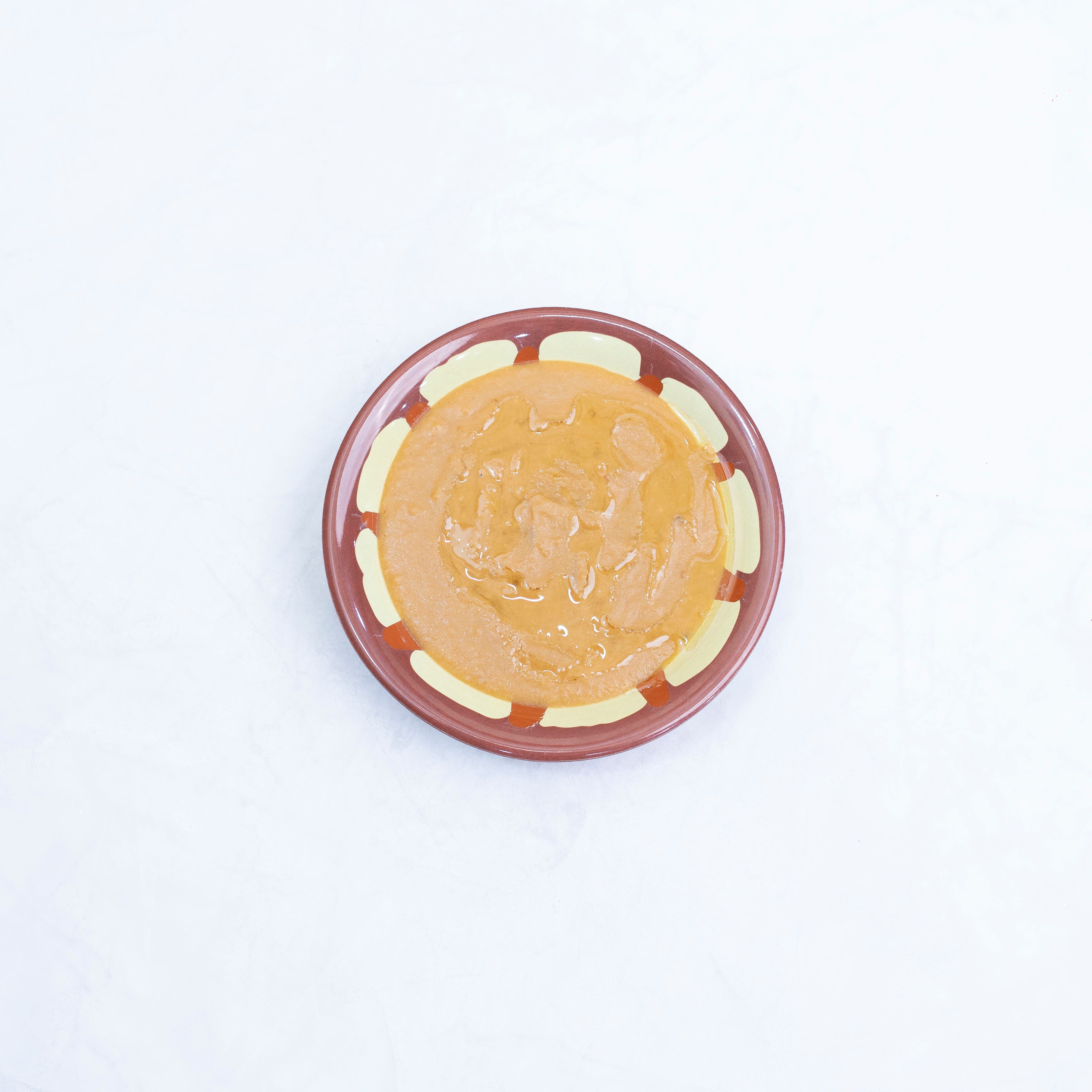
The diets react (see scores below)
Common Ingredients
- chicken
- pearled wheat
- butter
- salt
- cumin
- water
Specific recipes may vary.
Incompatible with 6 of 11 diets
Diet Ratings
Armenian Harissa is a porridge-like dish built around pearled wheat (dzavar), which is a whole grain and the primary bulk ingredient. Pearled wheat is extremely high in net carbs — a single cup cooked contains roughly 40-45g of net carbs — making even a modest serving of this dish completely incompatible with ketosis. Grains are explicitly excluded from the ketogenic diet with no meaningful workaround. While chicken and butter are keto-friendly components, the foundational ingredient (pearled wheat) cannot be removed without fundamentally changing the dish. This is not a portion-control situation; the grain IS the dish.
Armenian Harissa contains multiple animal-derived ingredients that make it entirely incompatible with a vegan diet. The dish is built on chicken as its primary protein and is finished with butter, both of which are animal products. There are no plant-based substitutions implied in this recipe. This is a clear and unambiguous non-vegan dish.
Harissa contains multiple non-paleo ingredients that disqualify it outright. Pearled wheat is a grain — one of the most clearly excluded foods in paleo, and pearling only removes the outer husk while leaving a highly processed, gluten-containing grain. Butter is a dairy product excluded under strict paleo rules. Salt (added) is also discouraged under paleo guidelines. While chicken and cumin are fully paleo-approved, the foundational ingredient of this dish — wheat — makes it incompatible with a paleo diet regardless of preparation method.
Armenian Harissa is a traditional porridge of chicken and pearled wheat, a wholesome dish with simple, minimally processed ingredients. The chicken aligns with the Mediterranean diet's acceptance of poultry in moderation. Pearled wheat, while a whole-grain derivative, has had some of its bran removed, making it less ideal than bulgur or whole-grain wheat but still a reasonable grain choice. The primary concern is butter as the fat source — Mediterranean diet guidelines strongly favor extra virgin olive oil over saturated animal fats. Cumin and salt are fine seasonings. Overall, this is a modest, traditional dish that fits within Mediterranean principles if consumed in moderation, but the butter and refined grain reduce its rating.
Some traditional Middle Eastern and Caucasian dietary patterns — which share overlap with Mediterranean traditions — regularly use butter or clarified butter (ghee) as a cooking fat, and pearled wheat is a staple grain in these cuisines. A traditionalist view might regard Harissa as broadly compatible with the spirit of Mediterranean eating given its whole-food, minimally processed character, simple preparation, and lean protein source.
Harissa (the Armenian porridge dish) is fundamentally incompatible with the carnivore diet. The primary carbohydrate base is pearled wheat, a grain that is strictly excluded from all tiers of carnivore eating. Cumin is a plant-derived spice, also excluded on strict carnivore. While chicken and butter are carnivore-compatible ingredients, they are minor components of this dish relative to the wheat. The dish cannot be adapted to carnivore without removing the wheat, which would fundamentally change its identity. This is a grain-forward dish and must be avoided.
Harissa (the Armenian porridge dish) contains two excluded ingredients: pearled wheat, which is a grain and explicitly excluded from Whole30, and butter, which is dairy and also excluded (only ghee/clarified butter is the allowed dairy exception). Either ingredient alone would disqualify this dish, and together they make it clearly non-compliant.
Armenian Harissa is a porridge-like dish where pearled wheat is the primary structural ingredient, cooked down with chicken until it forms a thick, creamy consistency. Pearled wheat is a wheat product and therefore high in fructans, a key FODMAP that must be avoided during the elimination phase. Unlike sourdough, where long fermentation may reduce fructan content, harissa involves simple boiling which does not degrade fructans. The wheat is not merely a minor ingredient — it constitutes roughly half the dish by volume. The other ingredients (chicken, butter, salt, cumin, water) are all low-FODMAP and unproblematic, but the fundamental role of pearled wheat in this dish makes it impossible to consume in a low-FODMAP-compliant way without fundamentally altering the recipe. There is no practical serving size at which a standard portion of harissa would be low-FODMAP.
Armenian Harissa is a slow-cooked porridge of chicken and pearled wheat (not to be confused with the North African chili paste). Its core ingredients are largely DASH-compatible: lean chicken (excellent lean protein source), pearled wheat (a whole-grain-adjacent refined grain with decent fiber, though not as high as whole wheat), and water. The main DASH concerns are butter (saturated fat — DASH limits saturated fat and emphasizes vegetable oils over butter) and salt (amount unspecified, but traditional recipes can be generously salted). Cumin is fine from a DASH perspective. The dish scores reasonably well due to lean protein and whole grain base, but butter and sodium content pull it into caution territory. If prepared with reduced butter (or replaced with olive oil) and modest salt, it could approach an approvable DASH meal. Pearled wheat is worth noting: it is refined (hull and bran partially removed), so it is less ideal than whole wheat berries, but still provides some fiber and is not categorically excluded from DASH.
NIH DASH guidelines explicitly limit saturated fat and recommend against butter in favor of vegetable oils, placing this dish in caution. However, updated clinical interpretations note that when butter is used in small amounts in an otherwise whole-food, minimally processed dish rich in lean protein and whole grains, the overall dietary pattern effect may be more favorable than a strict ingredient-by-ingredient analysis suggests.
Armenian Harissa is a traditional porridge-like dish made from slow-cooked chicken and pearled wheat (korkot), finished with butter. From a Zone perspective, this dish presents a mixed profile. The chicken provides lean protein, which is a Zone-favorable building block. However, the pearled wheat is a higher-glycemic refined grain — Zone guidelines recommend limiting grains to 0-1 servings per day and classify them as 'unfavorable' carbohydrates. In Harissa, wheat is the dominant carbohydrate source and likely constitutes a significant portion of the dish, creating a carbohydrate-heavy ratio that would skew well above the 40% carb target if served in traditional portions. The butter adds saturated fat rather than the preferred monounsaturated fats (olive oil, avocado, almonds), which early Zone literature discouraged. There are no low-glycemic vegetables present to balance the glycemic load. To make Harissa more Zone-compatible, one would need to significantly reduce the wheat portion, increase the chicken-to-wheat ratio substantially, swap butter for olive oil, and serve alongside non-starchy vegetables. As prepared traditionally, it is carbohydrate-dense and glycemically unfavorable but not entirely un-zoneable with careful portioning.
Some Zone practitioners following Sears' later anti-inflammatory writings (e.g., 'The Mediterranean Zone') might view this dish more charitably: whole wheat provides some fiber that moderates glycemic response, and the dish is minimally processed and free of industrial seed oils. If the chicken-to-wheat ratio skews heavily toward protein and portions are small, the macro balance could be brought closer to Zone ratios. Additionally, cumin contributes polyphenols consistent with Sears' anti-inflammatory emphasis in later works.
Armenian Harissa is a simple porridge-like dish of slowly cooked chicken and pearled wheat, seasoned with cumin and finished with butter. From an anti-inflammatory standpoint, it has both positive and negative elements. Chicken is a lean protein categorized as acceptable in moderation on anti-inflammatory frameworks. Cumin offers mild anti-inflammatory properties through its antioxidant phytochemicals. However, pearled wheat is a refined/processed grain — the pearling process removes the bran and much of the germ, stripping away fiber and nutrients compared to whole wheat or farro, placing it closer to the 'refined carbohydrates' category that anti-inflammatory guidelines recommend limiting. Butter, while not as harmful as trans fats, is a source of saturated fat that anti-inflammatory guidelines flag as a food to limit — extra virgin olive oil would be a preferable finishing fat. The dish lacks the colorful vegetables, legumes, antioxidant-rich herbs (beyond modest cumin), or omega-3 sources that would push it into 'approve' territory. It is not overtly pro-inflammatory — it's free of processed additives, trans fats, refined sugar, and seed oils — but its refined grain base and saturated fat content make it a neutral-to-mildly-unfavorable choice. Substituting whole wheat or spelt berries and replacing butter with olive oil would meaningfully improve its profile.
Some nutritionists would note that traditional whole-food preparations like Harissa — simple, additive-free, minimally processed — are far preferable to modern processed foods even when made with pearled grains and butter. In the context of an otherwise anti-inflammatory diet, an occasional bowl of Harissa poses little concern, and the warming, easily digestible nature of the dish may even support gut health.
Armenian Harissa is a slow-cooked porridge-like dish made from shredded chicken and pearled wheat, traditionally finished with a generous amount of butter. The chicken provides a solid lean protein base, and pearled wheat contributes some fiber and complex carbohydrates, making this more nutritionally substantive than many refined-grain dishes. However, the traditional preparation is butter-heavy — often 2–4 tablespoons stirred in at the end per serving — which significantly raises the saturated fat content and can worsen GLP-1 side effects like nausea, bloating, and reflux. The dish is soft, porridge-textured, and easy to digest, which is a meaningful advantage for GLP-1 patients dealing with slowed gastric emptying. Portion sensitivity is key: a small serving delivers reasonable protein and fiber, but the caloric density rises quickly with butter. A modified version using minimal butter or substituting a small amount of olive oil would rate considerably higher.
Some GLP-1-focused dietitians may view Harissa favorably as a whole-food, minimally processed dish with a soft texture ideal for GI-sensitive patients — and would recommend it with a simple butter reduction. Others caution that the saturated fat from butter, even in modest amounts, may be sufficient to trigger nausea or reflux in patients early in their GLP-1 treatment when GI side effects are most pronounced.
*See how scores were generated at our methodology page.
Nutritional profile
Six traits that cut across every diet.
Fiber & Plants
How much whole-plant food and fiber it delivers.
Healthy Fats
The quality of its fats (unsaturated, omega-3).
Whole / Unprocessed
How close it is to its natural, unprocessed form.
Gut Gentle
How easy it is on digestion (low FODMAP, few irritants).
Low Glycemic
How little it spikes your blood sugar.
Protein Density
How much protein it packs per calorie.
Controversy Index
Higher controversy = more disagreement between diets.
Diet-Specific Tips
 Mediterranean — 5/10
View tips
- Chicken (poultry) is acceptable in moderation per Mediterranean guidelines
- Pearled wheat is a processed grain — less preferred than whole-grain wheat or bulgur
- Butter is the fat source, not extra virgin olive oil — a key deviation from Mediterranean principles
- No added sugars, highly processed ingredients, or red meat
- Simple, minimally processed traditional dish with few ingredients
- Moderate portion as an occasional meal fits within Mediterranean dietary patterns
 DASH — 5/10
View tips
- Chicken is an excellent DASH-approved lean protein source
- Pearled wheat provides carbohydrate and some fiber but is partially refined — less ideal than whole wheat
- Butter adds saturated fat, which DASH explicitly limits; substituting olive oil would improve DASH compatibility
- Salt quantity is unspecified — traditional preparation can be high-sodium, a key DASH concern
- No added sugars, no processed ingredients, no tropical oils beyond butter
- Overall dish is minimally processed and whole-food based, aligning with DASH dietary pattern principles
- Reducing butter and salt would significantly improve DASH score toward approval
 Zone — 5/10
View tips
- Pearled wheat is a higher-glycemic, 'unfavorable' Zone carbohydrate and dominates the dish
- Chicken is a lean, Zone-favorable protein source
- Butter provides saturated fat rather than Zone-preferred monounsaturated fat
- No low-glycemic vegetables present to balance glycemic load
- Traditional serving ratios likely produce carbohydrate excess well above 40% caloric target
- Dish is minimally processed with no added sugar or trans fats — a modest positive
- Zone-compatible only with significant portion adjustment and pairing with non-starchy vegetables
 Anti-Inflammatory — 5/10
View tips
- Pearled wheat is a refined grain with reduced fiber and nutrient content compared to whole wheat — anti-inflammatory guidelines recommend limiting refined carbohydrates
- Butter adds saturated fat, which anti-inflammatory frameworks advise limiting; EVOO would be a preferable substitute
- Chicken is an acceptable lean protein in anti-inflammatory eating
- Cumin provides mild antioxidant and anti-inflammatory phytochemicals
- Dish is free of trans fats, refined sugar, high-fructose corn syrup, and artificial additives — a meaningful positive
- Lacks anti-inflammatory powerhouses: omega-3s, colorful vegetables, legumes, or potent anti-inflammatory herbs and spices beyond cumin
 GLP-1 Friendly — 5/10
View tips
- Chicken provides good lean protein foundation
- Pearled wheat adds complex carbohydrates and moderate fiber
- Traditional butter quantity raises saturated fat significantly — a primary concern for GLP-1 patients
- Soft, porridge-like texture is easy to digest and GLP-1-friendly for GI comfort
- Cumin is a mild spice, unlikely to worsen reflux or nausea
- Highly portion-sensitive: small servings with reduced butter are acceptable; full traditional servings are problematic
- Protein density per calorie is moderate but not high due to wheat and butter dilution
- Fiber content is modest — pearled wheat has less fiber than whole wheat