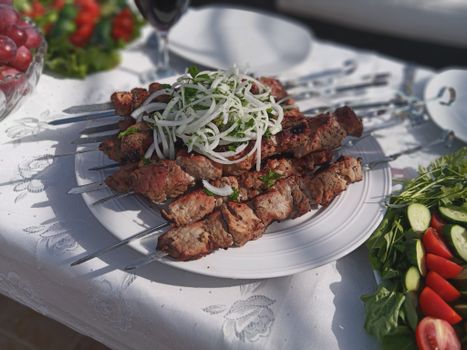
Armenian
Khorovats
The diets react (see scores below)
Common Ingredients
- pork
- onion
- bell peppers
- garlic
- paprika
- black pepper
- salt
- herbs
Specific recipes may vary.
Incompatible with 5 of 11 diets
Diet Ratings
Khorovats is Armenian-style grilled/barbecued meat, in this case pork, which is inherently keto-friendly. The dish is primarily pork (high fat, high protein) seasoned with low-carb aromatics and spices. Bell peppers and onions add minimal net carbs in typical grilling quantities. Garlic, paprika, black pepper, salt, and herbs contribute negligible carbohydrates. There are no grains, added sugars, or starchy ingredients. The grilling method preserves fat content and avoids keto-incompatible cooking additions. A standard serving would contribute well under 10g net carbs, making this a strong keto choice.
Khorovats is Armenian barbecue, and this version is made with pork as the primary protein. Pork is animal flesh and is unambiguously excluded from a vegan diet. The remaining ingredients (onion, bell peppers, garlic, paprika, black pepper, salt, herbs) are all plant-based, but the dish cannot be considered vegan due to its core animal product ingredient.
Khorovats (Armenian grilled/barbecued meat) is fundamentally paleo-compatible in concept — grilled pork with vegetables, garlic, and herbs aligns perfectly with hunter-gatherer eating. However, the inclusion of added salt is a non-negotiable disqualifier under strict paleo rules. Salt is explicitly excluded as an 'added salt' ingredient, and it is a standard, essential component of this dish. Paprika and black pepper are paleo-approved spices, onion, bell peppers, and garlic are whole vegetables, and pork is an unprocessed meat — all of these are approved. But because added salt is listed as an ingredient and is integral to the dish's preparation, the overall verdict must reflect an avoid rating. Without the salt, this would score a 9.
Khorovats is an Armenian grilled meat dish where pork is the primary protein. Pork is a red meat, and the Mediterranean diet strictly limits red meat to a few times per month. While the preparation method (grilling) is healthy and the accompanying vegetables, herbs, garlic, and bell peppers are strongly Mediterranean-compatible, the pork-centric nature of the dish as a main protein source conflicts with core Mediterranean principles. Consumed occasionally as a rare treat, it could fit within the diet's allowance for infrequent red meat, but as a regular main course it does not align.
Some Mediterranean diet interpretations, particularly those rooted in Eastern Mediterranean and Levantine traditions, acknowledge that grilled meats including pork are part of regional culinary heritage and can be consumed in small portions infrequently. The grilling method without added fats and the vegetable-forward accompaniments (onion, bell pepper, garlic, herbs) partially offset concerns, and certain modern Mediterranean diet practitioners argue that lean, minimally processed grilled red meat consumed rarely is compatible with the overall dietary pattern.
Khorovats is an Armenian barbecue dish that, while centered on pork (a carnivore-approved protein), is heavily loaded with plant-based ingredients that are entirely excluded from the carnivore diet. Onion, bell peppers, and garlic are vegetables; paprika, black pepper, and herbs are plant-derived spices. The dish as traditionally prepared is fundamentally incompatible with carnivore principles. Only the pork itself and salt are acceptable. The plant ingredients are not incidental trace additives — they are core structural components of the marinade and dish.
Khorovats is Armenian barbecue — essentially grilled or skewered meat with vegetables and seasonings. All listed ingredients (pork, onion, bell peppers, garlic, paprika, black pepper, salt, and herbs) are fully compliant with Whole30 rules. There are no excluded ingredients: no added sugars, grains, legumes, dairy, or other prohibited additives. This is a whole, minimally processed dish built around meat, vegetables, and natural spices, which aligns perfectly with the Whole30 philosophy.
Khorovats (Armenian BBQ) contains two high-FODMAP ingredients that are deal-breakers during the elimination phase: onion and garlic. Both are among the highest fructan-containing foods in the Monash system and must be avoided entirely during elimination — there is no safe serving size. Onion is high-FODMAP even in small quantities (e.g., 1/4 onion triggers symptoms), and garlic is one of the most concentrated sources of fructans tested by Monash. The remaining ingredients — pork, bell peppers, paprika, black pepper, salt, and most herbs — are low-FODMAP and would otherwise make this dish suitable. However, because onion and garlic are structural flavor components of this marinade/preparation, not incidental additives, they cannot simply be omitted without fundamentally changing the dish as traditionally prepared.
Khorovats is Armenian barbecue, typically made with grilled pork skewers marinated with onion, bell peppers, garlic, and spices. The grilling method is positive from a DASH perspective, as it avoids added fats. Vegetables like onion, bell peppers, and garlic are excellent DASH foods. However, pork is a red meat, which DASH explicitly limits. The cut of pork matters significantly: lean pork tenderloin or loin would be more acceptable under DASH, while fattier cuts like shoulder or ribs would increase saturated fat intake, pushing this toward 'avoid.' The added salt in the marinade is a sodium concern, though home preparation allows for reduction. Overall, the dish is a mixed profile — the cooking method and vegetable components are DASH-friendly, but the red meat and sodium from added salt require moderation and attention to cut selection.
NIH DASH guidelines categorize red meat as a food to limit due to saturated fat and cardiovascular risk. However, updated clinical interpretations note that lean pork cuts (tenderloin) have saturated fat profiles comparable to chicken breast, and some DASH-oriented dietitians allow lean pork in moderation as part of the diet's broader protein flexibility.
Khorovats is an Armenian barbecue dish — essentially grilled skewered meat (pork) with vegetables. The preparation method (grilling) is excellent from a Zone perspective, as no added oils or problematic cooking fats are involved. The vegetable components (bell peppers, onion, garlic) are favorable low-glycemic Zone carbs. The herbs and spices (paprika, black pepper, salt) are nutritionally neutral. The main Zone concern is the protein source: pork's Zone rating depends heavily on the cut. Lean pork tenderloin or loin is considered acceptable in Zone (comparable to chicken in fat profile), but traditional Khorovats often uses fattier cuts like pork shoulder or ribs, which carry higher saturated fat content. Dr. Sears classifies pork as generally 'unfavorable' compared to lean poultry or fish, primarily due to saturated fat. However, when grilled (fat drips away) and using leaner cuts, pork can be incorporated into Zone blocks with careful portioning (~25g protein per meal). The dish lacks a fat component from Zone-preferred monounsaturated sources, and the overall carbohydrate load from onions and peppers is modest and favorable. To Zone-balance this meal, one would add a side of additional low-GI vegetables and a small amount of olive oil or avocado, and ensure the pork portion is lean and appropriately sized.
Some Zone practitioners and Sears' later writings (particularly his anti-inflammatory work) note that the saturated fat concern with pork is contextual — grilled lean pork with abundant vegetables is quite reasonable in a Zone framework. The grilling method significantly reduces fat content regardless of cut, and pork's amino acid profile is Zone-compatible. More permissive Zone coaches might rate this closer to a 7, particularly if lean cuts are used.
Khorovats is Armenian barbecue — essentially grilled pork skewers with onion, bell peppers, garlic, paprika, black pepper, salt, and herbs. The dish has a genuinely mixed anti-inflammatory profile. On the positive side, the preparation method (grilling) avoids inflammatory seed oils, and several ingredients are strongly anti-inflammatory: garlic is well-established for its allicin-driven anti-inflammatory effects, bell peppers are rich in vitamin C and antioxidant carotenoids, paprika contributes capsanthin and other polyphenols, and the herb blend (likely parsley, cilantro, or thyme) adds further antioxidant support. Onion contains quercetin, a notable anti-inflammatory flavonoid. The negative factor is the primary protein: pork. While leaner cuts of pork (loin, tenderloin) are classified as 'moderate' in most anti-inflammatory frameworks — similar to lean poultry — fattier cuts common in khorovats (shoulder, ribs, neck) contain higher levels of saturated fat and arachidonic acid, which can promote inflammatory signaling. Grilling at high heat also produces heterocyclic amines (HCAs) and polycyclic aromatic hydrocarbons (PAHs), which are associated with low-grade inflammation and oxidative stress. The overall dish sits in 'caution' territory: acceptable occasionally, particularly if made with leaner pork cuts, but not a regular anti-inflammatory staple.
Some anti-inflammatory practitioners, including those following Mediterranean-adjacent or ancestral health frameworks, would rate this more favorably, arguing that minimally processed, whole-food grilled meat with abundant vegetables and herbs is far preferable to processed foods and refined carbohydrates — and that moderate pork consumption is not meaningfully inflammatory for most people. Conversely, stricter anti-inflammatory and plant-forward protocols (e.g., Dr. Weil's emphasis on fish over red/fatty meats) would rate the pork more negatively and flag HCA production from charring as an additional concern.
Khorovats is Armenian barbecue — typically pork grilled over open flame with onion, bell peppers, garlic, and herbs. The cooking method (grilling) is a genuine advantage: it renders and drips away fat, produces no added oils, and is far easier to digest than fried or braised preparations. Bell peppers and onion add modest fiber and micronutrients. The seasoning profile (paprika, black pepper, herbs) is generally well-tolerated. The core concern is the protein source: pork is cut-dependent. Khorovats is traditionally made with fattier cuts — pork shoulder (butt) or ribs — which carry significantly more saturated fat than lean options like pork loin or tenderloin. A fattier cut grilled to doneness still retains considerable fat and can worsen GLP-1 side effects including nausea, bloating, and prolonged gastric discomfort. If made with pork loin or tenderloin, the dish moves meaningfully toward an approve. The vegetable accompaniments are a positive. Overall: a conditionally acceptable dish that earns a caution primarily due to cut uncertainty, not the cooking method or seasoning.
Some GLP-1-focused dietitians accept grilled pork in any cut as preferable to processed or fried alternatives, emphasizing that the grilling method sufficiently reduces fat burden and that protein adequacy should take priority over fat-source perfectionism. Others maintain that saturated fat from fatty pork cuts reliably worsens gastroparesis-like GLP-1 side effects and slowed gastric emptying, making cut selection clinically significant rather than a matter of preference.
*See how scores were generated at our methodology page.
Nutritional profile
Six traits that cut across every diet.
Fiber & Plants
How much whole-plant food and fiber it delivers.
Healthy Fats
The quality of its fats (unsaturated, omega-3).
Whole / Unprocessed
How close it is to its natural, unprocessed form.
Gut Gentle
How easy it is on digestion (low FODMAP, few irritants).
Low Glycemic
How little it spikes your blood sugar.
Protein Density
How much protein it packs per calorie.
Controversy Index
Higher controversy = more disagreement between diets.
Diet-Specific Tips
 Keto — 9/10
View tips
- Pork is a high-fat, zero-carb primary protein — ideal for keto
- No grains, sugars, or starchy ingredients present
- Bell peppers and onion are the only carb contributors, minimal in typical serving portions
- Spices and herbs add negligible net carbs
- Grilling method adds no carbs and preserves fat content
- Whole, unprocessed ingredients align with clean keto principles
 Whole30 — 9/10
View tips
- Pork is an approved Whole30 protein
- All vegetables (onion, bell pepper, garlic) are compliant
- Paprika, black pepper, salt, and herbs are all approved seasonings
- No excluded ingredients present
- Traditional preparation is grilled/skewered — no breading or coating
- Simple, whole-food dish consistent with Whole30 spirit
 DASH — 5/10
View tips
- Pork is a red meat, which DASH recommends limiting
- Grilling is a DASH-friendly cooking method that avoids added fats
- Bell peppers, onion, and garlic are core DASH vegetables contributing potassium and fiber
- Added salt in marinade raises sodium concerns — reducing or eliminating added salt improves the score
- Lean pork cuts (tenderloin, loin) are significantly more DASH-compatible than fatty cuts (shoulder, ribs)
- Herbs and spices like paprika and black pepper are DASH-approved sodium-free flavor enhancers
- Portion control is key — DASH limits meat to 6 oz or less per day
 Zone — 6/10
View tips
- Pork is 'unfavorable' protein in Zone due to higher saturated fat vs. chicken or fish
- Grilling method is ideal — reduces fat content and avoids added cooking oils
- Bell peppers and onion are favorable low-glycemic Zone carbohydrates
- Cut of pork matters significantly — tenderloin acceptable, shoulder/ribs problematic
- No added fat source; would need monounsaturated fat addition (olive oil, avocado) to complete Zone balance
- No high-glycemic carbs present — clean carb profile from vegetables only
- Anti-inflammatory herbs and garlic align with Zone's polyphenol emphasis
 Anti-Inflammatory — 5/10
View tips
- Pork is the primary protein — anti-inflammatory framework classifies it as 'limit' for fattier cuts, 'moderate' for lean cuts
- Garlic: strong anti-inflammatory properties via allicin
- Bell peppers: high in vitamin C and antioxidant carotenoids
- Paprika: contributes capsanthin and polyphenols
- Onion: rich in quercetin, an anti-inflammatory flavonoid
- Grilling without seed oils is a positive — avoids refined oil inflammatory load
- High-heat grilling can generate HCAs and PAHs, which are pro-inflammatory compounds
- Saturated fat content depends heavily on pork cut used
- No refined carbohydrates, added sugars, or processed additives — a structural positive
 GLP-1 Friendly — 5/10
View tips
- Grilling is an ideal cooking method — reduces fat, no added oil, easy to digest
- Pork cut is the critical variable — shoulder/ribs are high-fat and problematic; loin/tenderloin are lean and acceptable
- Decent protein source but protein density per calorie is lower with fatty cuts
- Bell peppers and onion contribute fiber and micronutrients
- Seasoning is mild and well-tolerated — no high-spice concern
- No added sugars, refined carbs, or ultra-processed ingredients
- Portion sensitivity matters — small servings of fatty pork are more tolerable than large ones on GLP-1s