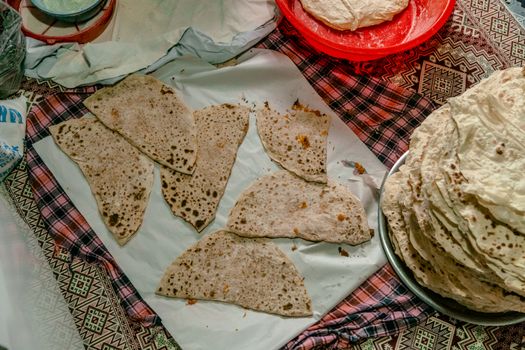
Photo: Kadir Altıntaş / Pexels
The diets react (see scores below)
Common Ingredients
- flour
- water
- salt
- yeast
- sesame seeds
Specific recipes may vary.
Incompatible with 5 of 11 diets
Diet Ratings
Lavash is a traditional Armenian flatbread made primarily from wheat flour, which is a high-carbohydrate grain. A single piece of lavash contains approximately 35-50g of net carbs, which alone can exceed or meet the entire daily carb limit for ketosis. Wheat flour is fundamentally incompatible with the ketogenic diet as it is a grain-based starch. There are no redeeming fat or fiber components that offset the carbohydrate load. The sesame seeds contribute minimal fat but are negligible against the overwhelming carb content of the flour base.
Lavash as described contains only plant-based ingredients: flour, water, salt, yeast, and sesame seeds. All five ingredients are entirely free of animal products or animal-derived components. Traditional Armenian lavash is a simple flatbread, and this ingredient list reflects a clean, minimally processed whole-food preparation. Yeast is a fungus, not an animal product, and is universally accepted in vegan diets. Sesame seeds add nutritional value (healthy fats, calcium, protein). There are no hidden animal-derived additives of concern. This scores a 9 rather than 10 only because lavash is a refined-flour product rather than a whole-grain bread, making it slightly less optimal from a whole-food plant-based standpoint.
Lavash is a traditional Armenian flatbread made primarily from wheat flour, which is a grain and a core exclusion in the Paleo diet. The presence of added salt and yeast (a processed leavening agent) further disqualifies it. Sesame seeds are paleo-approved, and water is neutral, but the foundational ingredient — wheat flour — makes this dish incompatible with Paleo principles. There is no meaningful way to evaluate lavash in a paleo-friendly light; its entire structure depends on a non-paleo grain.
Lavash is a traditional Armenian flatbread made from refined white flour, which is a refined grain rather than the whole grain preferred by Mediterranean diet guidelines. It contains no added sugars or unhealthy fats, and the sesame seeds add a small nutritional benefit (healthy fats, minerals). However, the primary ingredient is white flour, placing it in the 'acceptable in moderation' category rather than a staple. Flatbreads are common in Eastern Mediterranean and Middle Eastern cuisines and are culturally compatible with Mediterranean eating patterns, but whole grain versions would be preferred by modern dietary guidelines.
Traditional Mediterranean and Levantine food cultures regularly include refined flatbreads like lavash, pita, and similar breads as everyday staples, and some authorities argue that the overall dietary pattern matters more than any single ingredient. From a traditional culinary standpoint, lavash as a minimally processed, additive-free bread with sesame seeds could be viewed as a perfectly acceptable accompaniment within a balanced Mediterranean meal.
Lavash is a traditional Armenian flatbread made entirely from plant-derived ingredients: flour (wheat grain), water, salt, yeast (fungal organism), and sesame seeds (plant seed). It contains zero animal products. Grains and seeds are explicitly excluded from the carnivore diet at every tier, from the most permissive 'animal-based' approach to the strictest Lion Diet. Wheat flour is a high-carbohydrate grain product that directly contradicts the foundational principle of eating exclusively animal-derived foods.
Lavash is a flatbread made primarily from wheat flour, which is a grain explicitly excluded on the Whole30. Even if all other ingredients (water, salt, yeast, sesame seeds) were compliant, the wheat flour alone disqualifies it. Furthermore, Whole30 Rule 4 explicitly prohibits recreating bread, wraps, and similar baked goods — lavash is specifically called out as a 'wrap' or flatbread category item, which falls squarely under the banned list of tortillas, wraps, and bread. There is no compliant version of traditional lavash possible within the Whole30 framework.
Lavash is a traditional Armenian flatbread made primarily from wheat flour, which is high in fructans — one of the most significant FODMAPs. Unlike sourdough breads where long fermentation can partially degrade fructans, lavash is a relatively quick-leavened or unleavened flatbread that does not undergo extended fermentation, meaning fructan content remains high. The other ingredients (water, salt, yeast, sesame seeds) are low-FODMAP, but the wheat flour base makes this bread unsuitable during the FODMAP elimination phase at any standard serving size. Monash University consistently rates wheat-based breads without long fermentation as high-FODMAP due to fructan content.
Lavash is a traditional Armenian flatbread made from refined white flour, water, salt, yeast, and sesame seeds. From a DASH perspective, it is a mixed picture. On the positive side, it is low in saturated fat, contains no added sugars, and the sesame seeds contribute small amounts of calcium and magnesium. However, it is made from refined (not whole grain) flour, which means it lacks the fiber, potassium, and micronutrients that DASH emphasizes in the grains group. DASH explicitly recommends whole grains over refined grains. Salt is added during preparation, contributing moderate sodium. Sesame seeds add a modest nutritional benefit but are a minor ingredient by weight. Lavash is acceptable on DASH in controlled portions — it fits within the grains allowance (6-8 servings/day) — but whole grain bread or whole wheat lavash would be a far better choice. The standard version rates as a caution rather than an avoid because it is not high in sodium, saturated fat, or added sugar; it simply lacks the whole-grain quality DASH prioritizes.
NIH DASH guidelines emphasize whole grains and do not distinguish lavash specifically, treating refined grains as permissible but non-preferred within the grains group. Some DASH-oriented dietitians note that traditional lavash is thin and portion-controlled by nature, and when topped with vegetables or legumes it can be a reasonable vehicle for DASH-friendly foods, suggesting it need not be restricted beyond normal grain portion limits.
Lavash is a traditional Armenian flatbread made from refined white flour, which gives it a high glycemic index similar to white bread — a food Dr. Sears explicitly lists as 'unfavorable' in Zone terminology. It provides primarily carbohydrate blocks with minimal protein or fat, and those carbs are fast-digesting, which can spike insulin and disrupt the hormonal balance the Zone targets. However, the Zone is ratio-based rather than exclusion-based. A small portion of lavash (roughly half a piece) can be used as a carb block within a Zone meal if balanced with adequate lean protein and monounsaturated fat. The sesame seeds add a small amount of beneficial fat and some polyphenols, which is a minor positive. The primary concern is the refined flour base, which makes it an 'unfavorable' carbohydrate source — usable in strict moderation but not ideal compared to vegetable-based carb blocks.
Some Zone practitioners note that traditional lavash is thinner and lower in overall carbs per serving than typical bread, and that when used as a wrap or alongside protein and fat, the overall meal ratio can still hit Zone targets. Sears' later writings also place less emphasis on avoiding all grains and more on total glycemic load in context, which could make a small lavash portion more acceptable than its ingredient list alone suggests.
Lavash is a traditional Armenian flatbread made from refined white flour, water, salt, yeast, and sesame seeds. The refined flour base is a refined carbohydrate with a high glycemic index, which can promote inflammatory signaling (elevated blood glucose, insulin spikes) and offers minimal fiber, vitamins, or antioxidants compared to whole grain alternatives. Anti-inflammatory guidelines consistently flag refined grains as foods to limit. However, lavash is not inherently harmful in moderate amounts — it is free from trans fats, added sugars, artificial additives, seed oils, or other explicitly pro-inflammatory ingredients. The inclusion of sesame seeds is a modest positive: sesame contains lignans (sesamin, sesamolin) with antioxidant and mildly anti-inflammatory properties, along with some healthy fats and minerals, though the quantity used in lavash is small. Traditional lavash is also typically very thin and low in fat, making it less calorie-dense than many other bread products. Overall, lavash sits in neutral-to-mildly-unfavorable territory: not actively harmful in small amounts, but not anti-inflammatory, and best replaced with whole grain or sprouted grain flatbreads when possible.
Lavash is a traditional Armenian flatbread made from refined white flour, water, salt, yeast, and sesame seeds. It offers minimal protein, negligible fiber (refined flour strips most), and very low fat — the sesame seeds add a small amount of healthy unsaturated fat and trace minerals but not enough to meaningfully shift the nutritional profile. The primary concern for GLP-1 patients is that lavash is essentially a refined carbohydrate with low nutrient density per calorie — exactly the category of food patients on reduced appetite need to limit. Refined carbs also digest quickly, providing little satiety, which is counterproductive when total food volume is already constrained. On the positive side, lavash is low in fat, easy to digest, and unlikely to worsen GLP-1 GI side effects. It is also portion-friendly in small amounts. It is not actively harmful in the way fried or high-sugar foods are, but it crowds out more nutritionally valuable foods. If used, best treated as a vehicle for high-protein, high-fiber toppings (hummus, grilled chicken, vegetables) rather than consumed alone.
*See how scores were generated at our methodology page.
Nutritional profile
Six traits that cut across every diet.
Fiber & Plants
How much whole-plant food and fiber it delivers.
Healthy Fats
The quality of its fats (unsaturated, omega-3).
Whole / Unprocessed
How close it is to its natural, unprocessed form.
Gut Gentle
How easy it is on digestion (low FODMAP, few irritants).
Low Glycemic
How little it spikes your blood sugar.
Protein Density
How much protein it packs per calorie.
Controversy Index
Higher controversy = more disagreement between diets.
Diet-Specific Tips
 Vegan — 9/10
View tips
- All five ingredients are fully plant-based
- Yeast is a fungus and universally considered vegan
- Sesame seeds contribute healthy fats and minerals
- Refined white flour is the only minor nutritional consideration
- No dairy, eggs, or animal-derived additives present
 Mediterranean — 5/10
View tips
- Made from refined white flour, not a whole grain
- No added sugars or unhealthy fats
- Sesame seeds contribute healthy fats and micronutrients
- Culturally authentic to Eastern Mediterranean/Levantine traditions
- Minimal processing with simple, clean ingredients
- Whole grain lavash or alternatives would score higher under modern guidelines
 DASH — 5/10
View tips
- Refined white flour — lacks fiber and micronutrients emphasized by DASH
- DASH recommends whole grains; refined grains are allowed but not preferred
- Low in saturated fat and free of added sugars — not a negative food
- Sesame seeds provide small amounts of calcium and magnesium
- Moderate sodium from added salt — not excessive but worth monitoring
- Thin flatbread format supports portion control
- Whole wheat lavash would score significantly higher (7-8) on DASH
 Zone — 4/10
View tips
- Refined white flour is a high-glycemic, 'unfavorable' Zone carbohydrate
- No meaningful protein contribution — must be paired carefully with lean protein
- Sesame seeds add modest monounsaturated and polyunsaturated fat, a minor positive
- Can function as a carb block in small portions but requires strict portion control
- Lacks the fiber and micronutrients of Zone-preferred vegetable-based carb sources
- Zone guidelines recommend 0-1 grain servings per day, making lavash an occasional-use item
 Anti-Inflammatory — 5/10
View tips
- Refined white flour is a high-glycemic refined carbohydrate — flagged by anti-inflammatory guidelines as a food to limit
- No added sugars, trans fats, seed oils, or artificial additives — relatively clean ingredient list
- Sesame seeds contribute small amounts of lignans and anti-inflammatory minerals (magnesium, zinc)
- Very thin profile means modest portion sizes are typical, limiting glycemic load in practice
- Whole grain or sprouted grain lavash variants would score significantly higher on the anti-inflammatory spectrum
- No protein source — typically consumed as a wrap or accompaniment, so context of the full meal matters
 GLP-1 Friendly — 4/10
View tips
- Refined carbohydrate — low fiber, low nutrient density per calorie
- No meaningful protein contribution
- Small sesame seed content adds trace unsaturated fat and minerals but insufficient to elevate nutritional value
- Low fat and easy to digest — unlikely to worsen nausea or GI side effects
- Portion-sensitive: a small wrap amount is more acceptable than multiple pieces
- Crowds out higher-priority protein and fiber foods given reduced GLP-1 appetite