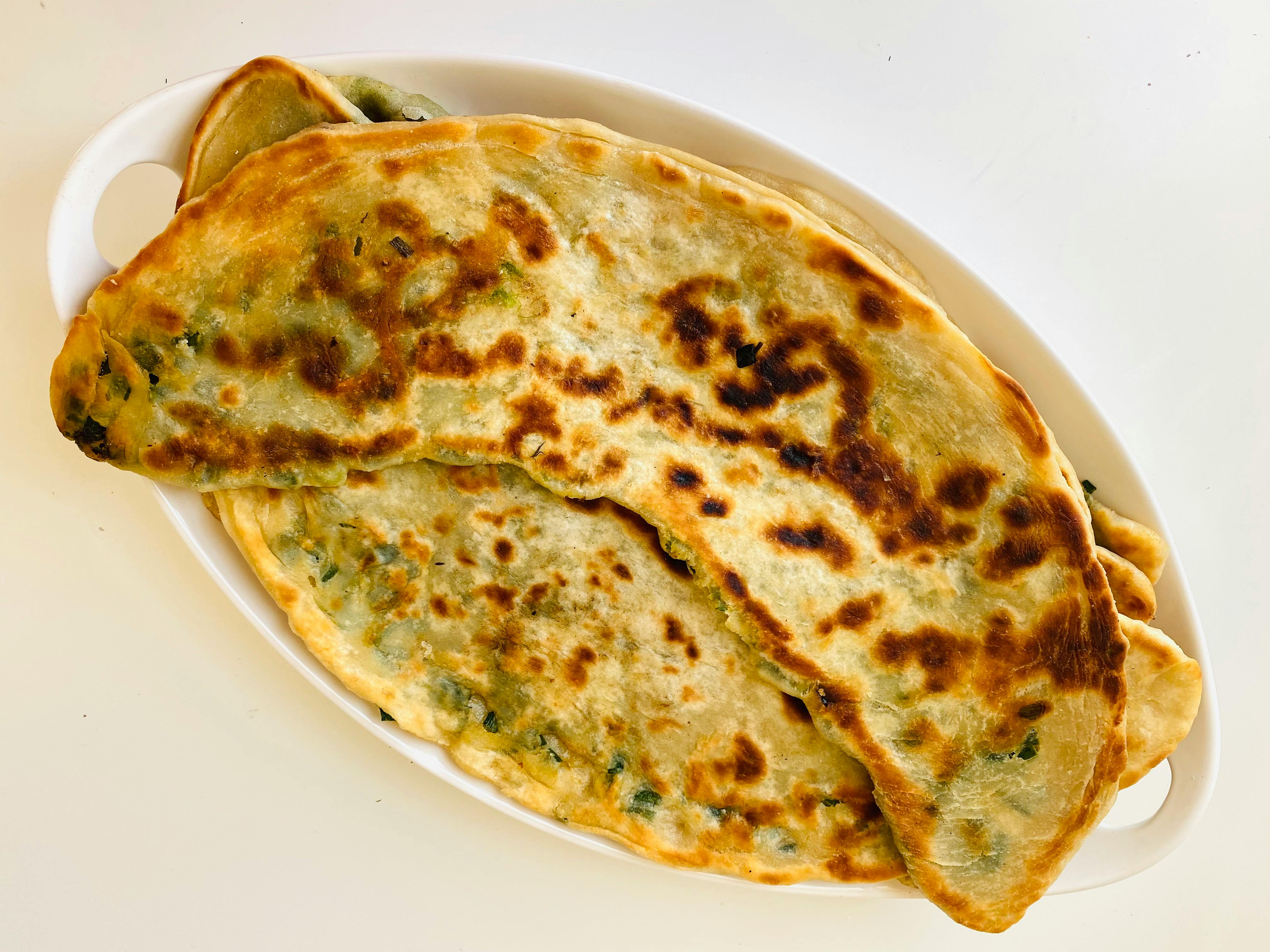
Photo: I Own My Food Art / Pexels
Armenian
Zhingyalov Hats
The diets react (see scores below)
Common Ingredients
- flour
- water
- spinach
- chard
- cilantro
- parsley
- scallions
- olive oil
Specific recipes may vary.
Incompatible with 5 of 11 diets
Diet Ratings
Zhingyalov Hats are Armenian flatbreads stuffed with mixed herbs and greens. The fundamental problem is the flour-based flatbread dough, which is made from wheat flour and water. Wheat flour is a grain with very high net carbs (roughly 70-75g net carbs per 100g), making even a single serving of this bread incompatible with ketosis. While the herb and green filling (spinach, chard, cilantro, parsley, scallions) is relatively keto-friendly with low net carbs and beneficial fiber, the flour shell is the dominant macronutrient offender. A single Zhingyalov Hat flatbread could easily contain 25-40g of net carbs from the dough alone, potentially blowing the entire daily carb budget. The olive oil is a positive fat source, but it cannot offset the grain-based wrapper. There is no reasonable portion size that makes this dish compatible with ketogenic eating in its traditional form.
Zhingyalov Hats is a traditional Armenian flatbread filled with a generous mixture of fresh herbs and greens. All listed ingredients — flour, water, spinach, chard, cilantro, parsley, scallions, and olive oil — are entirely plant-based with no animal products or animal-derived ingredients. This is a whole-food, minimally processed dish that aligns excellently with vegan dietary principles. The dish is naturally vegan in its traditional form, making it an ideal snack choice for plant-based eaters.
Zhingyalov Hats is a traditional Armenian flatbread filled with herbs. While the filling — spinach, chard, cilantro, parsley, scallions, and olive oil — is entirely paleo-compliant, the dish is fundamentally built around flour-based flatbread dough. Wheat flour is a grain product and one of the clearest exclusions in the paleo framework. Grains are excluded because of their anti-nutrient content (lectins, phytates, gluten) and because they were unavailable to Paleolithic hunter-gatherers prior to agricultural development. The herb filling alone would be approved, but the defining structural element of the dish — the flour dough — makes the dish as a whole an avoid.
Zhingyalov Hats is an Armenian flatbread stuffed with a generous mixture of fresh herbs and leafy greens (spinach, chard, cilantro, parsley, scallions) finished with olive oil. The filling is exemplary Mediterranean diet material — multiple servings of plant-based foods, extra virgin olive oil as the fat source, and no processed ingredients, added sugars, or animal products. The main caveat is the flour-based flatbread wrapper: if made with refined white flour (as is traditional), it introduces a refined grain element that modern Mediterranean diet guidelines prefer to limit in favor of whole grains. However, the herb-to-bread ratio is high, the dish is minimally processed, and it aligns well with the plant-forward, olive-oil-centered spirit of the Mediterranean pattern.
Traditional Armenian recipes use white flour flatbread, which modern clinical Mediterranean diet guidelines (e.g., those from the Harvard T.H. Chan School of Public Health) would flag as a refined grain; a stricter interpretation would lower the score, while a more culturally inclusive view of the Mediterranean diet — which accepts regional flatbreads as traditional staples — would maintain a full approval.
Zhingyalov Hats is an Armenian flatbread stuffed entirely with herbs and greens. Every single ingredient — flour, water, spinach, chard, cilantro, parsley, scallions, and olive oil — is plant-derived. There is no animal product whatsoever in this dish. It is the antithesis of the carnivore diet: a grain-based wrapper filled with multiple plant foods, including leafy greens, alliums, and a plant oil. This dish violates every core rule of carnivore eating simultaneously.
Zhingyalov Hats is a traditional Armenian flatbread filled with herbs. The dish contains flour, which is a grain-based ingredient explicitly excluded from the Whole30 program. Beyond the grain violation, this dish is a flatbread/wrap — a category explicitly prohibited under Whole30's 'no recreating baked goods/junk food' rule, which specifically lists tortillas, wraps, and flatbreads as non-compliant even if made with compliant ingredients. Both the ingredient (wheat flour) and the food form (flatbread/wrap) independently disqualify this dish.
Zhingyalov Hats is an Armenian flatbread stuffed with a large quantity of mixed herbs and greens. The primary FODMAP concerns are: (1) The flatbread dough is made from regular wheat flour, which is high in fructans — a major FODMAP trigger. During elimination phase, wheat-based doughs are classified as high-FODMAP. (2) Scallions (green onions) — if the white bulb portions are included, they are high in fructans. The green tops only are low-FODMAP, but traditional recipes often use the whole scallion. (3) The generous quantity of herbs (spinach, chard, cilantro, parsley) are individually low-FODMAP at standard portions, but the cumulative load from a large herb-stuffed flatbread may push borderline items into higher territory. The wheat flour issue alone is sufficient to classify this dish as 'avoid' during the strict elimination phase. A gluten-free flour substitution and green-tops-only scallions would significantly improve compatibility.
Monash University has not specifically tested Zhingyalov Hats, so the verdict relies on component analysis. Some clinical FODMAP practitioners note that spelt or gluten-free flatbreads can be substituted to make the dish elimination-compliant; if made with GF flour and green scallion tops only, the dish could shift to 'caution' or even 'approve,' but the traditional wheat-based version remains problematic.
Zhingyalov Hats is an Armenian flatbread stuffed with a generous mix of fresh herbs and greens — spinach, chard, cilantro, parsley, and scallions — bound with a small amount of olive oil. This dish aligns well with DASH principles: the herb and greens filling is rich in potassium, magnesium, calcium, and fiber (all DASH-emphasized nutrients), olive oil is a preferred unsaturated fat, and the dish is naturally very low in sodium, saturated fat, and added sugar. The flatbread (flour + water) is likely made from white flour rather than whole grain, which is the primary limitation — whole grain versions would score higher. Olive oil use is modest and appropriate. No processed ingredients, red meat, full-fat dairy, or high-sodium components are present. This is a plant-forward snack that fits comfortably within DASH guidelines, with the caveat that portion control applies to the bread component.
NIH DASH guidelines emphasize whole grains over refined grains; traditional Zhingyalov Hats is typically made with white flour, which provides fewer nutrients per serving than whole wheat alternatives. Some DASH clinicians would rate this more conservatively if refined flour is used, while updated interpretations focusing on overall dietary pattern quality may be more permissive given the exceptional nutrient density of the herb filling.
Zhingyalov Hats is a traditional Armenian flatbread stuffed with an abundance of fresh herbs and greens (spinach, chard, cilantro, parsley, scallions) and finished with olive oil. From a Zone perspective, this dish has both strengths and weaknesses. The herb and greens filling is excellent — these are among the most Zone-favorable carbohydrate sources, being very low glycemic, rich in polyphenols, and high in fiber. The olive oil is an ideal monounsaturated fat source, perfectly aligned with Zone fat recommendations. However, the flatbread (flour + water) is the primary structural component, making refined carbohydrates the dominant macronutrient in the dish. This creates a carbohydrate-heavy, protein-deficient profile that cannot easily achieve the 40/30/30 Zone ratio without significant modification. There is no protein source listed, making it impossible to hit the 30% protein target as a standalone snack. The dish would need to be paired with a lean protein source (e.g., a side of chicken, egg whites, or low-fat cheese) to approach Zone balance. A small portion of Zhingyalov Hats can serve as the carbohydrate block in a Zone meal, but as a self-contained snack it falls short of Zone requirements.
Some Zone practitioners would rate this more favorably, noting that the sheer volume of greens relative to dough (traditional recipes use very generous herb-to-bread ratios) means the net glycemic load of the carb portion may be lower than a typical flatbread, and the polyphenol content of the herbs aligns well with Sears' later anti-inflammatory emphasis in 'The Zone Diet' and 'OmegaRx Zone.' If portion of dough is small and herbs are plentiful, this could be treated as a favorable carbohydrate block component.
Zhingyalov Hats is a traditional Armenian flatbread stuffed with a generous mixture of fresh herbs and greens. The filling — spinach, chard, cilantro, parsley, and scallions — is a powerhouse of anti-inflammatory compounds: carotenoids (lutein, beta-carotene), vitamin K, polyphenols, flavonoids, and quercetin. Parsley and cilantro in particular are rich in apigenin and other anti-inflammatory flavonoids. Olive oil adds oleocanthal, a well-documented COX-inhibiting compound with effects analogous to ibuprofen at culinary doses. The main limiting factor is the refined flour flatbread, which offers little fiber and has a moderate glycemic impact, nudging the score slightly below a 9 or 10. However, the herb-to-bread ratio in an authentic Zhingyalov Hat is very high — the bread is thin and the filling is abundant — which substantially offsets this concern. Overall, this dish is an excellent example of plant-forward eating with strong anti-inflammatory credentials.
Zhingyalov Hats is a traditional Armenian flatbread stuffed with a generous mix of fresh herbs and greens (spinach, chard, cilantro, parsley, scallions) cooked with a small amount of olive oil. The filling is a genuine nutritional bright spot: the greens and herbs provide meaningful fiber, micronutrients (iron, folate, vitamins A, C, K), and water content that supports hydration — all well-aligned with GLP-1 dietary goals. The olive oil is an unsaturated fat, which is the preferred fat type. However, this dish has two notable limitations for GLP-1 patients. First, it contains virtually no protein — the primary protein is listed as none, and none of the ingredients contribute meaningful protein. For GLP-1 patients who must prioritize 15–30g protein per meal or snack to prevent muscle loss, this is a significant gap. Second, the flatbread wrapper is made from refined flour and water, contributing refined carbohydrates with low fiber and low nutrient density — exactly the kind of empty calories that are counterproductive when appetite is suppressed and every bite must count nutritionally. The dish is not fried, not spicy, not high in saturated fat, and is easy to digest, so it does not trigger GLP-1 side effects. As a snack alongside a protein source (e.g., Greek yogurt, cottage cheese, a hard-boiled egg), it is acceptable. As a standalone meal or snack, it falls short of GLP-1 priorities.
Some GLP-1-focused dietitians would rate herb-heavy flatbreads more favorably as a low-fat, easy-to-digest option for patients struggling with nausea who need gentle, palatable foods — the greens filling provides real micronutrient and fiber value. Others would downgrade it further, emphasizing that low-protein, refined-carb snacks should be avoided entirely when appetite is reduced and protein targets are already difficult to meet.
*See how scores were generated at our methodology page.
Nutritional profile
Six traits that cut across every diet.
Fiber & Plants
How much whole-plant food and fiber it delivers.
Healthy Fats
The quality of its fats (unsaturated, omega-3).
Whole / Unprocessed
How close it is to its natural, unprocessed form.
Gut Gentle
How easy it is on digestion (low FODMAP, few irritants).
Low Glycemic
How little it spikes your blood sugar.
Protein Density
How much protein it packs per calorie.
Controversy Index
Higher controversy = more disagreement between diets.
Diet-Specific Tips
 Vegan — 9/10
View tips
- All ingredients are fully plant-based
- Whole-food flatbread with herb and greens filling
- No dairy, eggs, or animal-derived additives
- Minimal processing — simple dough with fresh vegetables
- Traditional preparation uses olive oil, not butter or lard
- Nutritionally strong due to variety of leafy greens and herbs
 Mediterranean — 8/10
View tips
- Abundant fresh leafy greens and herbs as the primary filling — strongly Mediterranean
- Extra virgin olive oil used as the fat source
- No animal products, added sugars, or processed ingredients
- Flatbread made with refined white flour is a mild concern under modern whole-grain guidelines
- High herb-to-bread ratio mitigates the refined grain impact
- Minimally processed, whole-food dish aligned with Mediterranean principles
 DASH — 8/10
View tips
- Rich herb and greens filling (spinach, chard, cilantro, parsley, scallions) provides potassium, magnesium, calcium, and fiber — core DASH nutrients
- Olive oil is a DASH-preferred unsaturated fat
- Naturally very low in sodium — strong DASH advantage
- No saturated fat, added sugar, processed ingredients, or red meat
- Flatbread likely made from refined white flour rather than whole grain — a moderate DASH limitation
- Plant-forward composition aligns with DASH emphasis on vegetables and minimally processed foods
 Zone — 5/10
View tips
- Refined flour flatbread raises glycemic load and is an 'unfavorable' Zone carbohydrate
- No protein source — fails the 30% protein requirement as a standalone snack
- Spinach, chard, cilantro, parsley, and scallions are excellent low-glycemic, high-polyphenol Zone-favorable carbs
- Olive oil is an ideal monounsaturated fat — strong Zone alignment
- Dish is carbohydrate-dominant, requiring pairing with lean protein to achieve 40/30/30 balance
- Traditional herb-heavy preparation may moderate net glycemic load compared to plain flatbread
 Anti-Inflammatory — 8/10
View tips
- Dense herb and leafy green filling (spinach, chard, parsley, cilantro, scallions) rich in carotenoids, flavonoids, and polyphenols
- Olive oil provides oleocanthal and monounsaturated fats with well-documented anti-inflammatory effects
- Parsley and cilantro are particularly high in apigenin, quercetin, and other anti-inflammatory flavonoids
- Refined flour flatbread is the only meaningful pro-inflammatory element, but its proportion relative to filling is low in authentic preparation
- No animal protein, saturated fat, added sugar, or processed additives
- No omega-6-heavy seed oils or refined ingredients beyond the flour
 GLP-1 Friendly — 5/10
View tips
- No meaningful protein — fails the #1 GLP-1 dietary priority
- Refined flour wrapper adds low-nutrient refined carbohydrates
- Herb and greens filling provides fiber, micronutrients, and hydration support
- Olive oil is a preferred unsaturated fat — used in small amounts
- Not fried, not spicy, not high in saturated fat — low GI side-effect risk
- Easy to digest — suitable for patients with nausea or slowed gastric emptying
- Best used as a side or paired with a protein source, not as a standalone snack