Photo: Anthony Rahayel / Pexels
Austrian
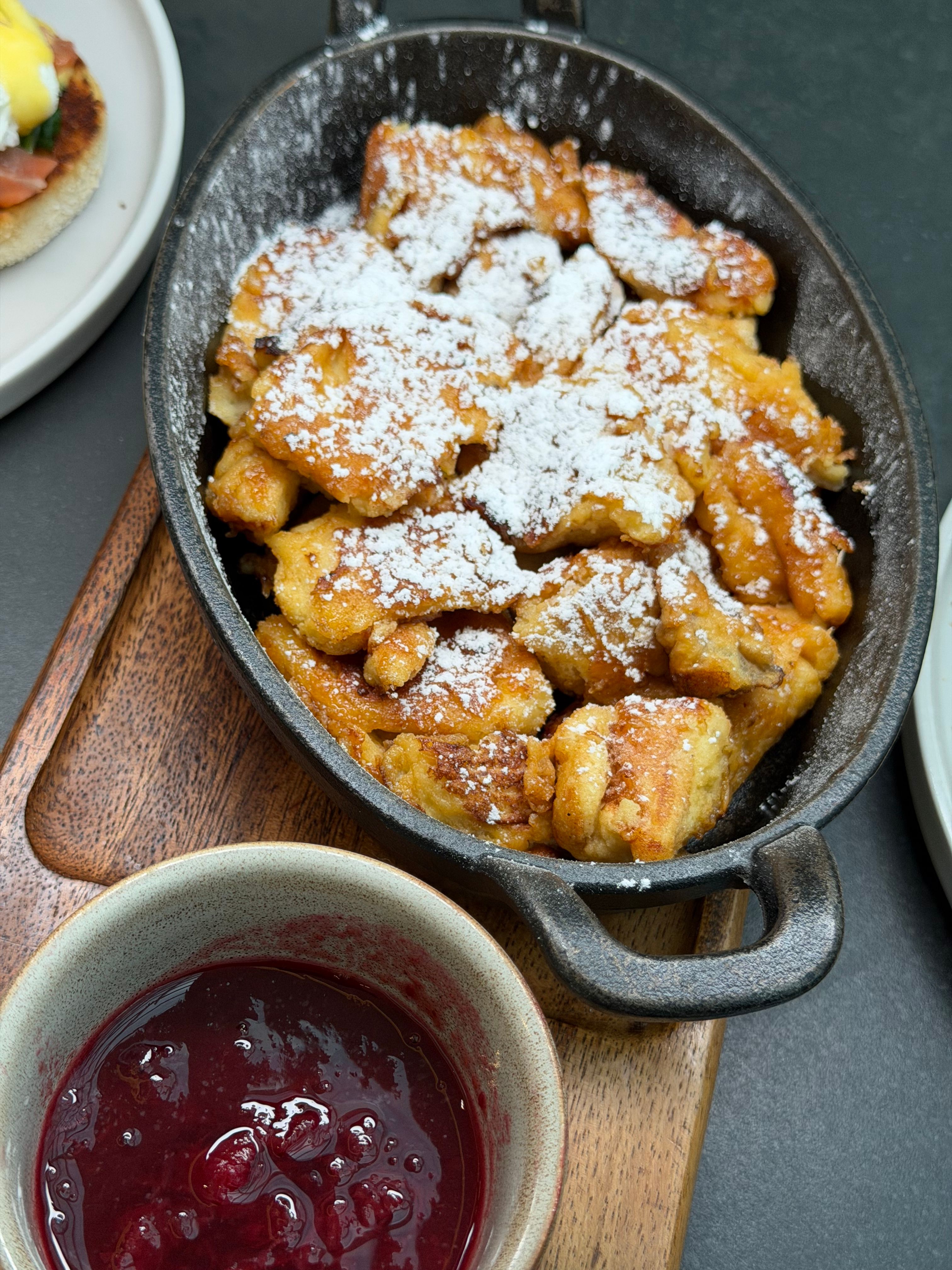
Kaiserschmarrn
The diets react (see scores below)
Common Ingredients
- flour
- eggs
- milk
- sugar
- butter
- raisins
- powdered sugar
- vanilla
Specific recipes may vary.
Incompatible with 11 of 11 diets
Diet Ratings
Kaiserschmarrn is a classic Austrian shredded pancake dessert that is fundamentally incompatible with ketogenic eating. It is built on a base of wheat flour (high-carb grain), milk, and sugar, then topped with powdered sugar and includes raisins — all significant sources of net carbs. A standard serving easily delivers 60–90g of net carbs, far exceeding the entire daily keto allowance of 20–50g in a single dish. There is no meaningful way to consume a traditional Kaiserschmarrn and remain in ketosis.
Kaiserschmarrn is an Austrian shredded pancake dessert that contains multiple animal-derived ingredients: eggs (listed as the primary protein), milk, and butter. All three are direct animal products explicitly excluded under vegan dietary rules. There is no ambiguity here — this dish is fundamentally incompatible with a vegan diet in its traditional form. A vegan version could theoretically be made by substituting plant-based milk, vegan butter, and an egg replacer, but the standard dish as described is not vegan.
Kaiserschmarrn is fundamentally incompatible with the paleo diet. The dish is built on flour (wheat grain), milk (dairy), sugar (refined), butter (dairy), and powdered sugar (refined sugar) — all of which are explicitly excluded from paleo. While eggs, raisins, and vanilla are paleo-approved, they are minor supporting ingredients that cannot redeem a dish whose entire structural and flavor foundation is non-paleo. This is a classic grain-and-dairy-based dessert with no meaningful paleo adaptation possible without reconstructing it from scratch.
Kaiserschmarrn is an Austrian dessert/snack made primarily from refined white flour, added sugars (both granulated and powdered), butter as the primary fat, and milk — a combination that directly contradicts Mediterranean diet principles. It is high in refined carbohydrates, added sugar, and saturated fat from butter, with no olive oil, no whole grains, no legumes, and no vegetables. While eggs and dairy (milk) are acceptable in moderation on a Mediterranean diet, they are not the problematic core here — the refined flour, multiple sugar sources, and butter-as-primary-fat make this dish fundamentally incompatible. It is also a processed, dessert-style dish rather than a whole food. Raisins are the only marginally Mediterranean-friendly ingredient.
Kaiserschmarrn is an Austrian dessert pancake that is fundamentally incompatible with the carnivore diet. The dish is built almost entirely on plant-derived and processed ingredients: flour (grain), sugar, powdered sugar, raisins (fruit), and vanilla (plant spice). While it does contain eggs, milk, and butter — which are animal-derived — these are minor components in a dish whose foundational structure is plant-based carbohydrates and sugar. The presence of refined flour, two forms of sugar, and raisins makes this a high-carbohydrate, plant-heavy dish that violates every tier of carnivore eating. Even the most permissive 'animal-based' practitioners following Saladino's approach would not include grain-based flour or refined sugar.
Kaiserschmarrn is an Austrian shredded pancake dessert that violates Whole30 on multiple levels. It contains flour (a grain, excluded), sugar (added sugar, excluded), butter (dairy, excluded), milk (dairy, excluded), and powdered sugar (added sugar, excluded). Furthermore, even if those ingredients were substituted with compliant alternatives, Kaiserschmarrn is essentially a pancake/crepe-style dish, which falls directly into the 'no recreating baked goods or junk food' rule — pancakes and crepes are explicitly named as off-limits under the SWYPO (Sex With Your Pants On) rule. This dish is excluded on both ingredient and spirit-of-the-program grounds.
Kaiserschmarrn contains multiple high-FODMAP ingredients that make it unsuitable during the elimination phase. Regular wheat flour is the primary structural ingredient and is high in fructans — a major FODMAP trigger — at any standard serving size. Milk contributes significant lactose, another key FODMAP. Raisins are high in fructose and fructans and are explicitly high-FODMAP even at small quantities (Monash flags raisins as high-FODMAP at just 13g/1 tablespoon). Vanilla extract in small amounts is generally considered low-FODMAP, and eggs, butter, and sugar are safe. However, the combination of wheat flour, milk, and raisins creates a dish that is high-FODMAP across three separate FODMAP categories simultaneously, making it clearly unsuitable during the elimination phase regardless of portion size.
Kaiserschmarrn is an Austrian shredded pancake dessert that conflicts with multiple core DASH diet principles. It is high in added sugars (granulated sugar plus powdered sugar topping), made with refined white flour rather than whole grains, and uses butter as a primary fat, contributing saturated fat. While eggs and milk provide some protein and calcium, the overall nutritional profile is dominated by refined carbohydrates and added sugars. DASH explicitly limits sweets and added sugars to 5 or fewer servings per week, and a portion of Kaiserschmarrn would likely exceed a single weekly allowance in one sitting. The butter content adds saturated fat, which DASH limits. There is no significant source of potassium, magnesium, or fiber. Raisins provide minimal fiber and some natural sugar, which does not redeem the dish nutritionally in this context.
Kaiserschmarrn is an Austrian shredded pancake dessert that is fundamentally incompatible with Zone Diet principles. The dish is built almost entirely from high-glycemic, unfavorable Zone carbohydrates: refined white flour, sugar, raisins (explicitly listed as an unfavorable Zone carb due to high glycemic load and sugar density), and powdered sugar as a finishing topping. The fat source is butter (saturated), not monounsaturated. While eggs do provide some protein, the macronutrient ratio is wildly skewed — this dish is overwhelmingly carbohydrate-dominant with essentially no lean protein offset and the wrong kind of fat. The combination of flour, sugar, raisins, and powdered sugar creates a very high glycemic load that would cause exactly the insulin spike Dr. Sears designed the Zone to prevent. There is no realistic portioning strategy that would bring this dish into Zone balance as a snack — the ratio distortion is too severe. Even a tiny portion would provide negligible protein and mostly fast-digesting carbohydrates. This is categorically the type of treat Sears identifies as driving unfavorable eicosanoid production and inflammation.
Kaiserschmarrn is an Austrian dessert pancake with a strongly pro-inflammatory nutritional profile. The dish is built on refined white flour (refined carbohydrate, minimal fiber), added sugars in two forms (granulated sugar and powdered sugar dusted on top), and butter (saturated fat). Eggs and milk provide modest nutritional value but do not offset the inflammatory load. Raisins offer trace antioxidants but also contribute concentrated sugars. Vanilla is a neutral to mildly beneficial spice. Overall, this dish is high in refined carbohydrates and added sugars, both of which are consistently associated with elevated inflammatory markers (CRP, IL-6) in clinical research. Butter, while not as concerning as trans fats, is a saturated fat that anti-inflammatory guidelines recommend limiting. There are no meaningful sources of omega-3 fatty acids, polyphenols, or antioxidants present. This dish falls squarely in the 'limit or avoid' category under virtually all anti-inflammatory frameworks.
Kaiserschmarrn is an Austrian dessert-style shredded pancake that is fundamentally misaligned with GLP-1 dietary priorities. Its ingredient list — refined flour, butter, whole milk, sugar, raisins, and powdered sugar — delivers a high-sugar, moderate-fat, low-fiber, nutrient-poor calorie load. While eggs provide some protein, the dish as a whole is protein-dilute: the dominant macronutrients are refined carbohydrates and added sugars, with meaningful saturated fat from butter. Fiber content is negligible. The refined carbohydrate and sugar load will cause rapid blood glucose swings, which is especially counterproductive for GLP-1 patients who are often managing insulin resistance or type 2 diabetes. The butter and milk fat content may worsen nausea, bloating, or reflux — common GLP-1 side effects — due to slowed gastric emptying combined with high fat. As a snack category entry, it offers almost nothing of nutritional value per calorie, violating the nutrient density principle that is critical when total intake is sharply reduced. Powdered sugar as a finishing ingredient further signals empty calorie density. Even in a small portion, the sugar-to-protein ratio is unfavorable and the glycemic impact is high.
*See how scores were generated at our methodology page.
Nutritional profile
Six traits that cut across every diet.
Fiber & Plants
How much whole-plant food and fiber it delivers.
Healthy Fats
The quality of its fats (unsaturated, omega-3).
Whole / Unprocessed
How close it is to its natural, unprocessed form.
Gut Gentle
How easy it is on digestion (low FODMAP, few irritants).
Low Glycemic
How little it spikes your blood sugar.
Protein Density
How much protein it packs per calorie.
Controversy Index
Higher controversy = more disagreement between diets.