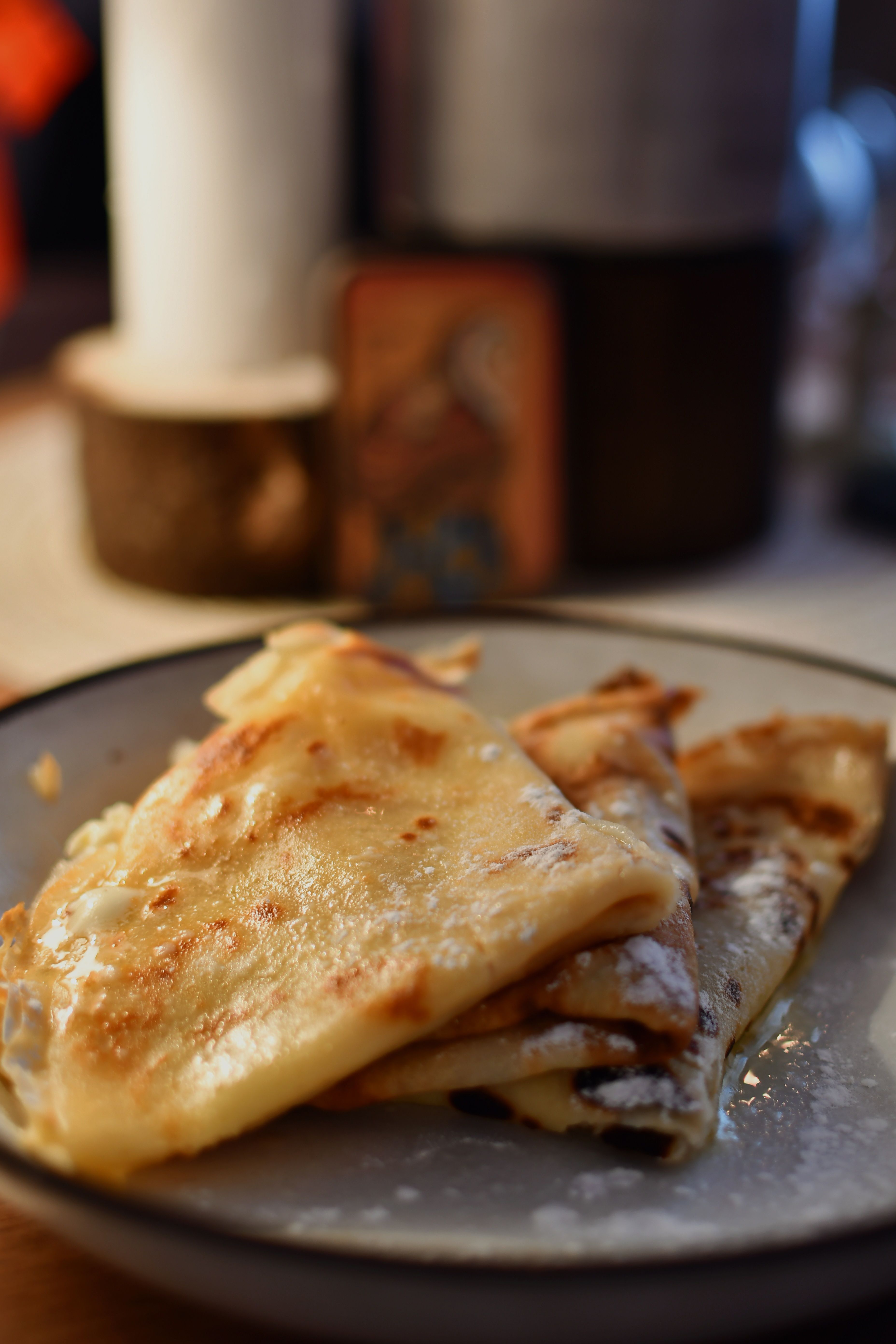
Photo: Darya Grey_Owl / Pexels
Austrian
Palatschinken
The diets react (see scores below)
Common Ingredients
- flour
- eggs
- milk
- sugar
- butter
- apricot jam
- vanilla
Specific recipes may vary.
Incompatible with 8 of 11 diets
Diet Ratings
Palatschinken are Austrian crepes/thin pancakes made with wheat flour, milk, sugar, and filled with apricot jam — a combination of multiple high-carb, keto-incompatible ingredients. Flour alone delivers substantial net carbs per serving, sugar and apricot jam add significant additional sugar load, and milk contributes lactose. This dish is fundamentally built on grains and sugar, placing it firmly outside ketogenic diet compatibility. There is no realistic portion size that makes this food keto-friendly.
Palatschinken are Austrian-style crêpes that contain multiple animal-derived ingredients: eggs, milk, and butter. All three are explicitly excluded under vegan dietary rules as animal products. There is no ambiguity here — this dish is fundamentally built on animal ingredients and cannot be considered vegan in its traditional form. A vegan version could be made using plant-based milk, flax or chia eggs, and vegan butter, but the standard recipe as described is not vegan-compliant.
Palatschinken are Austrian crepes containing multiple non-paleo ingredients. Flour (wheat grain) is a direct violation of paleo principles as all grains are excluded. Milk is dairy, also excluded. Butter is dairy (though ghee is debated, plain butter retains casein and lactose). Sugar is a refined sweetener, excluded. Apricot jam typically contains added refined sugar. With four to five core paleo violations — wheat flour, milk, butter, refined sugar, and processed jam — this dish is firmly in the avoid category with high confidence. The only paleo-compliant ingredients are eggs and vanilla.
Palatschinken are Austrian-style crêpes that combine several ingredients problematic for the Mediterranean diet. The base uses refined white flour (not a whole grain), butter as the primary fat (displacing olive oil), milk and eggs in combination, added sugar in the batter, and a filling of apricot jam which is high in added/concentrated sugar. While eggs and dairy are acceptable in moderation, this dish stacks multiple non-core or discouraged elements together: refined grains, saturated fat from butter, and significant added sugar. It is a Central European dessert/snack with no meaningful plant-forward nutrition and is far outside the Mediterranean dietary pattern.
Some Mediterranean diet interpreters take a flexible 80/20 approach, noting that eggs and dairy are permitted in moderation, and a small portion of a sweet crêpe eaten occasionally is not categorically banned. Traditional southern French cuisine (bordering the Mediterranean) includes similar thin crêpes, suggesting some regional overlap.
Palatschinken are Austrian sweet crepes that are fundamentally incompatible with the carnivore diet. The dish is built on flour (a grain), sugar (processed plant-derived sweetener), and apricot jam (fruit-based sugar), with vanilla (a plant spice). While eggs, milk, and butter are animal-derived ingredients, they are minor supporting components in what is overwhelmingly a plant-based, carbohydrate-heavy dish. The primary structure comes from wheat flour, and the filling is pure fruit jam — both categorically excluded on any tier of carnivore eating. There is universal consensus across all carnivore authorities on this verdict.
Palatschinken are Austrian-style crepes/thin pancakes, which are excluded on Whole30 on multiple grounds. First, the dish contains flour (a grain), which is explicitly excluded. Second, it contains dairy milk and butter (both excluded dairy products). Third, it contains added sugar. Fourth, apricot jam typically contains added sugar. Finally, and independently of ingredients, Palatschinken are crepes/thin pancakes — a form explicitly listed under the 'no recreating baked goods/junk food' rule, which specifically calls out crepes, pancakes, and wraps as prohibited even if made with compliant ingredients. This dish fails on every possible criterion.
Palatschinken (Austrian crêpes) contain multiple high-FODMAP ingredients that make this dish problematic during the elimination phase. Regular wheat flour is the primary structural ingredient and contains significant fructans — a major FODMAP trigger. Milk contains lactose, another key FODMAP. Apricot jam is typically made from apricots (a stone fruit high in polyols, specifically sorbitol) and often contains high-fructose corn syrup or concentrated fruit sugars, adding excess fructose concerns. Vanilla extract in small amounts is generally fine, eggs are low-FODMAP, and butter is low-FODMAP (fat-based, negligible lactose). However, the combination of wheat flour, milk, and apricot jam creates a triple FODMAP burden that makes a standard serving of Palatschinken clearly high-FODMAP during elimination. Even a single crêpe would involve a substantial amount of wheat flour and milk. A low-FODMAP version could theoretically be made with gluten-free flour, lactose-free milk, and a low-FODMAP jam (e.g., strawberry in small quantities), but the traditional recipe as described should be avoided.
Palatschinken are Austrian crepes filled with apricot jam, made from refined white flour, eggs, milk, butter, and sugar. From a DASH perspective, several concerns arise: refined white flour lacks the fiber of whole grains, butter contributes saturated fat (DASH limits saturated fat), sugar is added (DASH limits sweets), and apricot jam adds more concentrated sugar. On the positive side, the dish is low in sodium, eggs and milk provide some protein and calcium, and the dish is not heavily processed. The overall profile — refined carbs, added sugars, saturated fat from butter — places it in 'caution' territory: acceptable occasionally in modest portions but not a DASH-emphasized food. Swapping white flour for whole wheat, reducing butter, using low-fat milk, and choosing a low-sugar or pure-fruit jam would improve the DASH compatibility meaningfully.
NIH DASH guidelines explicitly limit added sugars and sweets, and emphasize whole grains over refined flour, making Palatschinken a suboptimal choice. However, some updated clinical interpretations note that when portion-controlled and made with low-fat milk and minimal butter, occasional indulgence in lightly sweetened crepe-style dishes may fit within a flexible DASH framework, particularly for non-hypertensive individuals focused on overall dietary pattern rather than individual foods.
Palatschinken are Austrian-style crêpes — thin pancakes filled with apricot jam. The macronutrient profile is fundamentally incompatible with Zone ratios. The batter is built on refined white flour (high-glycemic, essentially Zone 'unfavorable' carb), sugar is added to both batter and filling, and the apricot jam filling is a concentrated sugar source with negligible fiber. Butter adds saturated fat rather than the preferred monounsaturated fat. The protein contribution from eggs is modest relative to the carbohydrate load. A typical serving delivers a heavily carb-skewed ratio — perhaps 70-75% calories from carbs, 10-15% from protein, 15-20% from fat — the inverse of Zone targets. While eggs provide some lean protein, the quantity is insufficient to balance the high-glycemic carbohydrate flood from flour, sugar, and jam. This dish is not salvageable as a Zone snack without so drastically altering the recipe (eliminating flour, sugar, jam) that it would no longer be Palatschinken. As a snack category item, it provides no meaningful fiber, no low-glycemic carbohydrates, no omega-3s, and would spike insulin sharply — precisely what the Zone seeks to prevent.
Palatschinken are thin Austrian crêpe-style pancakes filled with apricot jam. The ingredient profile is largely neutral to mildly pro-inflammatory from an anti-inflammatory perspective. Refined white flour provides minimal fiber and has a high glycemic index, spiking blood sugar and potentially elevating inflammatory markers. Added sugar appears both in the batter and the apricot jam filling, contributing to glycemic load — a recognized driver of low-grade inflammation. Butter is a saturated fat, which anti-inflammatory guidelines recommend limiting. Eggs are moderate (mixed profile: some pro-inflammatory arachidonic acid offset by choline and selenium). Milk is a moderate food in the anti-inflammatory framework. On the positive side, vanilla has minor antioxidant properties, apricots contain beta-carotene and polyphenols, and eggs provide some beneficial micronutrients. Overall, Palatschinken is a refined-carbohydrate, sugar-containing dessert/snack with butter and jam — squarely in the 'acceptable occasionally but not aligned with anti-inflammatory principles' category. It lacks the omega-3s, fiber, antioxidants, and polyphenols that characterize anti-inflammatory eating.
Palatschinken are thin Austrian crepes filled with apricot jam and vanilla, made from flour, eggs, milk, sugar, and butter. While eggs provide some protein, the overall dish is carbohydrate- and sugar-dominant with modest protein per serving (roughly 6-9g depending on size), limited fiber, and added sugar from both the batter and the jam filling. Butter contributes saturated fat. The refined flour offers little nutritional density per calorie. On the positive side, the dish is easy to digest, relatively low in total fat compared to fried foods, and portion-friendly as a snack. However, the high sugar content from jam and added sugar, combined with low protein density and near-zero fiber, makes this a poor GLP-1 companion food. It delivers empty-ish calories at a time when every bite needs to count nutritionally, and the sugar load can undermine blood sugar stability. A savory version with a cottage cheese or quark filling would score significantly higher.
*See how scores were generated at our methodology page.
Nutritional profile
Six traits that cut across every diet.
Fiber & Plants
How much whole-plant food and fiber it delivers.
Healthy Fats
The quality of its fats (unsaturated, omega-3).
Whole / Unprocessed
How close it is to its natural, unprocessed form.
Gut Gentle
How easy it is on digestion (low FODMAP, few irritants).
Low Glycemic
How little it spikes your blood sugar.
Protein Density
How much protein it packs per calorie.
Controversy Index
Higher controversy = more disagreement between diets.
Diet-Specific Tips
 DASH — 4/10
View tips
- Refined white flour instead of whole grain reduces fiber and DASH alignment
- Butter adds saturated fat, which DASH explicitly limits
- Added sugar in both the batter and apricot jam conflicts with DASH guidance on sweets
- Low sodium profile is a positive attribute
- Milk and eggs provide calcium and protein consistent with DASH
- No significant potassium, magnesium, or fiber contribution
- Occasional consumption in small portions is acceptable within a DASH pattern
 Anti-Inflammatory — 4/10
View tips
- Refined white flour — high glycemic index, low fiber, pro-inflammatory potential
- Added sugar in batter and apricot jam — elevates glycemic load and inflammatory markers
- Butter — saturated fat, should be limited in anti-inflammatory diets
- Eggs — moderate/mixed inflammatory profile
- Apricot jam — some polyphenols and beta-carotene from apricots, offset by added sugar
- No significant anti-inflammatory ingredients (omega-3s, antioxidants, whole grains, legumes, colorful vegetables)
- Occasional indulgence is consistent with the anti-inflammatory framework's flexible approach
 GLP-1 Friendly — 4/10
View tips
- Low protein density — roughly 6-9g per serving, well below the 15-30g per meal target
- High sugar content from added sugar in batter plus apricot jam filling undermines blood sugar stability
- Refined flour provides minimal fiber, contributing near-zero toward the 25-30g daily fiber target
- Butter adds saturated fat, though total fat per serving is moderate
- Easy to digest and soft texture is appropriate for GLP-1 GI sensitivity
- Small portion can be eaten as a snack but nutritional return per calorie is poor
- Savory or high-protein filling (quark, cottage cheese) would substantially improve the rating