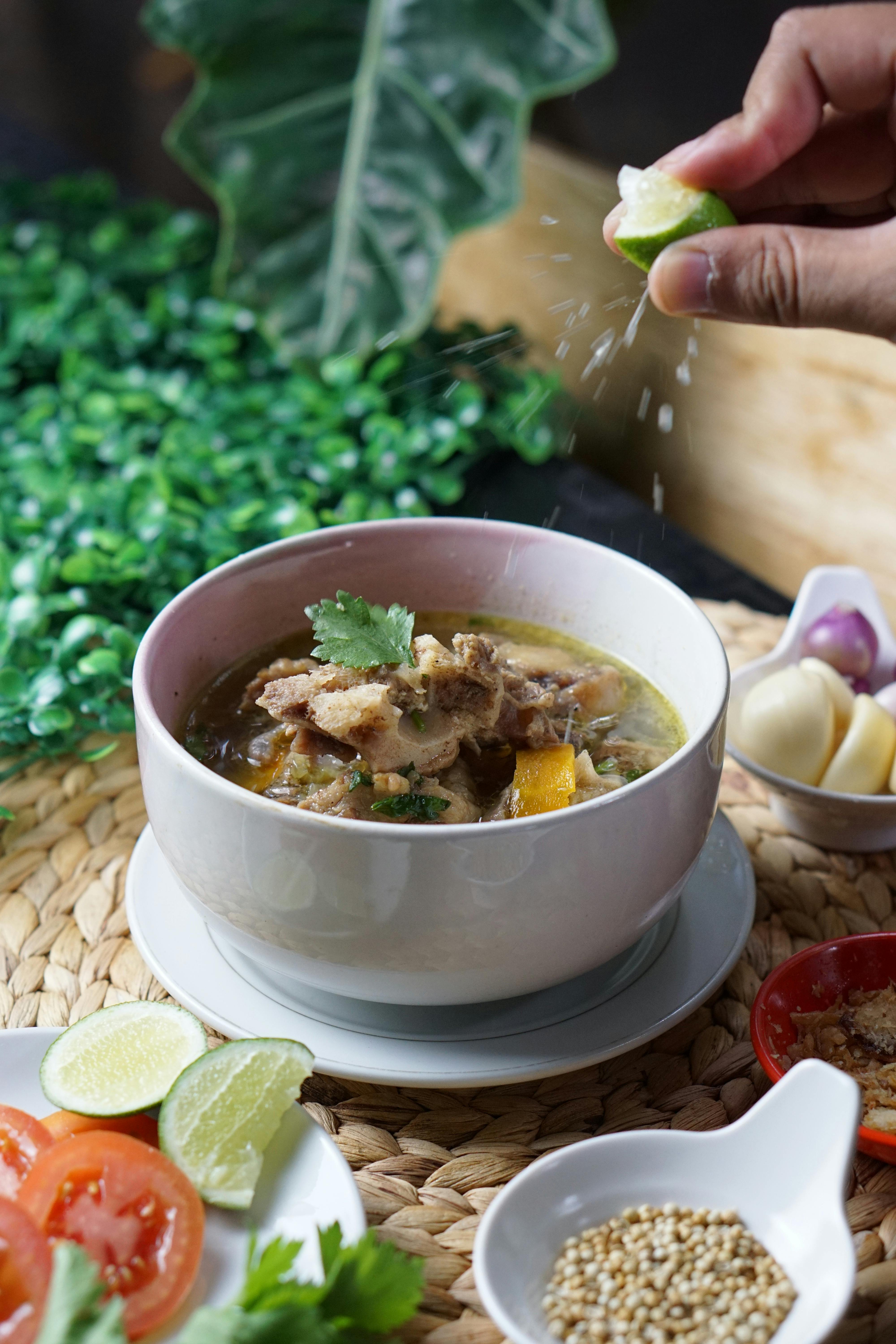
Photo: Arief Setiawan / Pexels
The diets react (see scores below)
Common Ingredients
- lamb
- chickpeas
- potato
- onion
- saffron
- dried plums
- turmeric
- mint
Specific recipes may vary.
Incompatible with 6 of 11 diets
Diet Ratings
Bozbash is fundamentally incompatible with ketogenic diet requirements. The dish contains multiple high-carb ingredients: chickpeas (roughly 20-25g net carbs per 100g cooked), potato (roughly 15-17g net carbs per 100g), and dried plums (prunes, roughly 50g+ net carbs per 100g). Even a single serving of this soup would almost certainly exceed the entire daily net carb budget of 20-50g for a keto dieter. The lamb base is keto-friendly, as are the spices (saffron, turmeric, mint) and onion in small amounts, but the carbohydrate load from chickpeas, potato, and dried plums is disqualifying. There is no reasonable portion size that would make this dish compatible with ketosis without fundamentally reconstructing the recipe.
Bozbash is a traditional Azerbaijani lamb soup. Lamb is a direct animal product (red meat), making this dish entirely incompatible with a vegan diet. There is no ambiguity here — the primary protein is the defining ingredient of the dish, and it cannot be substituted while still calling the dish Bozbash. The remaining ingredients (chickpeas, potato, onion, saffron, dried plums, turmeric, mint) are all plant-based, but the presence of lamb is an absolute disqualifier.
Bozbash contains two clear paleo violations: chickpeas (a legume) and potato (a debated-to-excluded tuber). Chickpeas are explicitly excluded from the paleo diet by all major authorities, as legumes contain lectins, phytates, and antinutrients that Paleolithic humans would not have consumed in significant quantities. Potato is at minimum debated, with strict Cordain-school paleo excluding it entirely. The remaining ingredients — lamb, onion, saffron, dried plums, turmeric, and mint — are all paleo-compliant, but the chickpeas alone are a definitive disqualifier. This dish cannot be made paleo-compatible without fundamentally altering its character by removing the chickpeas.
Bozbash is a traditional Azerbaijani lamb soup with a mixed Mediterranean diet profile. The positive elements are substantial: chickpeas provide excellent plant-based protein and fiber, potato adds complex carbohydrates, onion is a Mediterranean staple, and the spice blend (saffron, turmeric, mint) aligns well with anti-inflammatory Mediterranean principles. Dried plums add polyphenols and fiber. However, the primary protein is lamb, a red meat that the Mediterranean diet limits to a few times per month. The dish is a whole-food, minimally processed preparation with no refined grains or added sugars, which works in its favor. Overall, this is a borderline dish: the plant-forward supporting ingredients are excellent, but lamb as the dominant protein pushes it into the caution zone. Enjoyed occasionally (a few times per month) it fits within Mediterranean guidelines, but should not be a weekly staple.
Some Mediterranean diet researchers, particularly those studying Middle Eastern and Caucasian dietary traditions, note that lamb consumed in moderate portions within a soup rich in legumes and vegetables represents a traditional whole-food eating pattern with significant nutritional merit. The relatively small ratio of meat to plant ingredients in a soup preparation may reduce the overall red meat impact compared to a standalone lamb dish.
Bozbash is a traditional Azerbaijani lamb soup that contains multiple plant-based ingredients incompatible with the carnivore diet. While lamb is an excellent ruminant meat and fully approved, the dish is overwhelmingly plant-heavy: chickpeas (legume), potato (starchy tuber), onion (vegetable), dried plums (fruit), saffron (plant spice), turmeric (plant spice), and mint (plant herb). The majority of the dish's ingredients — and much of its caloric and flavor profile — come from plant sources. No adaptation of this dish would remain recognizable as Bozbash; it would need to be stripped down to plain lamb broth and meat to be carnivore-compliant.
Bozbash contains chickpeas, which are legumes and explicitly excluded from the Whole30 program. All other ingredients — lamb, potato, onion, saffron, dried plums, turmeric, and mint — are fully compliant. However, the presence of chickpeas alone disqualifies this dish. Dried plums should be verified to contain no added sugar, but plain dried plums (prunes) are generally compliant. The dish could theoretically be made Whole30-compliant by omitting the chickpeas, but as traditionally prepared it must be avoided.
Bozbash contains multiple high-FODMAP ingredients that make it unsuitable during the elimination phase. Chickpeas are high in GOS (galacto-oligosaccharides) and are high-FODMAP at typical serving sizes used in soups (Monash rates canned chickpeas as low-FODMAP only at 1/4 cup/42g, but a full serving of this soup would contain significantly more). Onion is one of the highest-FODMAP foods tested by Monash University, being very high in fructans even in small amounts and should be strictly avoided during elimination. Dried plums (prunes) are high in sorbitol (a polyol) and are rated high-FODMAP by Monash. The combination of these three problematic ingredients — chickpeas (GOS), onion (fructans), and dried plums (polyols) — makes this dish a multi-FODMAP trigger. The remaining ingredients (lamb, potato, saffron, turmeric, mint) are generally low-FODMAP and not problematic on their own.
Bozbash is an Azerbaijani lamb soup with several DASH-friendly ingredients — chickpeas provide fiber, potassium, and plant protein; potato adds potassium; onion, saffron, turmeric, and mint are anti-inflammatory and sodium-free spices. However, lamb is a red meat with moderate-to-high saturated fat content, which DASH guidelines recommend limiting. The overall dish can be prepared with relatively low sodium if no added salt or high-sodium broths are used, but traditionally the lamb itself contributes saturated fat that places this outside the core DASH emphasis on lean proteins. Portion size and fat trimming are critical factors. If prepared with trimmed lean lamb cuts and no added salt, this soup edges toward acceptable, but the red meat foundation keeps it in the caution zone rather than a full approval.
NIH DASH guidelines explicitly limit red meat consumption and recommend lean poultry and fish as preferred proteins; lamb's saturated fat content is a concern under standard DASH protocol. However, updated clinical interpretations note that lean, trimmed lamb in moderate portions within an otherwise vegetable- and legume-rich dish may be compatible with DASH goals, particularly given the high nutrient density of the other ingredients (chickpeas, potatoes, spices).
Bozbash is an Azerbaijani lamb soup with a macro profile that presents several Zone challenges but remains workable with careful portioning. The primary protein — lamb — is moderately fatty red meat rather than a lean Zone-preferred protein (skinless chicken, fish, lean beef). Lamb contains meaningful saturated fat, which Dr. Sears traditionally discouraged, though it can be used in Zone meals if trimmed and portion-controlled to roughly 25g protein per meal. The carbohydrate load is the bigger concern: potato is a high-glycemic, 'unfavorable' Zone carbohydrate that Sears explicitly categorizes poorly due to its rapid glucose impact, and dried plums (prunes) carry concentrated sugars. Chickpeas, by contrast, are a Zone-favorable legume — low glycemic index, high fiber (reducing net carbs), and providing some protein. Onion is a favorable low-GI vegetable. The spices (saffron, turmeric, mint) are Zone-positive for their anti-inflammatory polyphenol content, particularly turmeric, which aligns with Sears' later OmegaRx Zone emphasis on anti-inflammatory eating. As traditionally prepared, the dish likely skews carbohydrate-heavy (potato + chickpeas + dried plums) and protein-moderate with excess saturated fat, disrupting the 40/30/30 ratio. However, a modified version — reducing potato, omitting or minimizing dried plums, trimming fat from lamb, and increasing the chickpea and onion proportion — could approach Zone balance. The dish is categorically 'caution' rather than 'avoid' because its foundational ingredients are real whole foods, and the soup format makes portioning straightforward.
Some Zone practitioners applying Sears' later anti-inflammatory framework (The OmegaRx Zone, Anti-Inflammation Zone) might rate lamb more favorably if grass-fed, as it contains higher omega-3 ratios and conjugated linoleic acid. Additionally, the turmeric and saffron represent meaningful polyphenol sources that Sears increasingly emphasized. A strict early-Zone reading (Enter the Zone) would penalize potato and dried plums more heavily and might push the score lower (4), while a later-Sears anti-inflammatory reading focusing on polyphenol richness and whole-food sourcing might be more lenient (6).
Bozbash is a traditional Azerbaijani lamb soup with a genuinely mixed anti-inflammatory profile. On the positive side, the dish contains several powerful anti-inflammatory ingredients: turmeric provides curcumin, one of the most researched anti-inflammatory compounds; saffron contains crocin and safranal with demonstrated antioxidant and anti-inflammatory properties; chickpeas offer plant-based protein, fiber, and polyphenols that support gut health and reduce inflammatory markers; dried plums (prunes) are rich in antioxidants and fiber; mint contributes rosmarinic acid and flavonoids; and onion provides quercetin. The primary liability is lamb, a red meat high in saturated fat and arachidonic acid, both of which are associated with pro-inflammatory pathways. While lamb is less processed than cured meats and contains some beneficial nutrients (zinc, B12), the anti-inflammatory framework consistently places red meat in the 'limit' category. Potato is nutritionally neutral to mildly beneficial (resistant starch, vitamin C) but contributes to glycemic load. The overall dish is a wholesome, whole-food preparation with no refined sugars, trans fats, or processed additives — which meaningfully elevates it above typical red meat dishes. The spice profile is genuinely impressive from an anti-inflammatory standpoint. The lamb content prevents an 'approve' rating but the dish is far from pro-inflammatory.
Some anti-inflammatory practitioners following stricter protocols (such as AIP or those emphasizing near-elimination of red meat) would rate this lower due to lamb's saturated fat and arachidonic acid content. Conversely, proponents of whole-food, traditional dietary patterns note that lamb consumed in moderate portions within a spice-rich, legume-heavy soup context has minimal inflammatory impact and may be acceptable in the context of an overall anti-inflammatory diet — particularly given the extraordinary spice profile here.
Bozbash is a traditional Azerbaijani lamb soup with chickpeas, potato, onion, saffron, dried plums, turmeric, and mint. Its profile is mixed for GLP-1 patients. On the positive side, lamb provides meaningful protein, chickpeas add both protein and fiber (supporting the top two priorities), the broth base is easy to digest and hydrating, and anti-inflammatory spices like turmeric and saffron are benign or beneficial. The soup format is inherently small-portion-friendly and gentle on a slowed GI tract. However, lamb is a fatty red meat — even lean cuts carry moderate saturated fat, and traditional bozbash often uses bone-in shoulder or rib cuts that are higher in fat. The dried plums add concentrated sugar, and potato contributes starchy carbohydrates with relatively low nutrient density per calorie. The fat content from lamb is the primary concern: it can worsen nausea, bloating, and reflux, which are common GLP-1 side effects. A modified version using a leaner lamb cut (leg), skimming fat from the broth, and reducing potato in favor of more chickpeas would score considerably higher.
Some GLP-1-focused dietitians accept moderate amounts of lamb in a broth-based soup because the fat is partially rendered into the liquid and can be skimmed, making actual fat intake per serving lower than a dry lamb dish; they also value the iron and zinc density of red meat for patients eating significantly fewer total calories. Others maintain that any high-saturated-fat red meat should be avoided given the heightened sensitivity to fat-induced GI symptoms on GLP-1 medications, regardless of preparation method.
*See how scores were generated at our methodology page.
Nutritional profile
Six traits that cut across every diet.
Fiber & Plants
How much whole-plant food and fiber it delivers.
Healthy Fats
The quality of its fats (unsaturated, omega-3).
Whole / Unprocessed
How close it is to its natural, unprocessed form.
Gut Gentle
How easy it is on digestion (low FODMAP, few irritants).
Low Glycemic
How little it spikes your blood sugar.
Protein Density
How much protein it packs per calorie.
Controversy Index
Higher controversy = more disagreement between diets.
Diet-Specific Tips
 Mediterranean — 4/10
View tips
- Lamb is a red meat, limited to a few times per month on the Mediterranean diet
- Chickpeas are an excellent Mediterranean-approved legume, providing plant protein and fiber
- Potato, onion, and dried plums contribute plant-based nutrients and polyphenols
- Saffron, turmeric, and mint offer anti-inflammatory phytonutrients consistent with Mediterranean principles
- No refined grains, added sugars, or processed ingredients — whole-food preparation
- Soup format dilutes red meat content relative to plant ingredients, moderating the red meat concern
 DASH — 5/10
View tips
- Lamb is a red meat — DASH limits red meat due to saturated fat content
- Chickpeas are an excellent DASH food: high in fiber, potassium, and plant protein
- Potato adds potassium, a key DASH mineral
- No inherently high-sodium ingredients — sodium level depends heavily on preparation and added salt
- Turmeric, saffron, and mint are sodium-free and anti-inflammatory
- Dried plums add some sugar but also fiber and potassium
- Fat trimming of lamb significantly impacts saturated fat load
- Portion control of lamb is essential for DASH compatibility
 Zone — 5/10
View tips
- Lamb is a moderate-fat red meat — usable in Zone but less ideal than lean proteins; requires trimming and portion control
- Potato is an explicitly 'unfavorable' high-glycemic Zone carbohydrate that disrupts the carb block balance
- Dried plums add concentrated sugar load, further elevating glycemic impact of the carbohydrate portion
- Chickpeas are Zone-favorable: low GI, high fiber (low net carbs), provide complementary protein
- Turmeric and saffron are anti-inflammatory polyphenol sources aligned with Sears' later Zone dietary philosophy
- As traditionally prepared, the dish likely has an imbalanced macro ratio (carb-heavy, excess saturated fat)
- Soup format is portion-control friendly — modification by reducing potato and dried plums can improve Zone compatibility
 Anti-Inflammatory — 5/10
View tips
- Lamb is red meat — limited on anti-inflammatory diets due to saturated fat and arachidonic acid
- Turmeric (curcumin) is a top anti-inflammatory spice with strong research support
- Saffron contains crocin and safranal — antioxidant and anti-inflammatory properties
- Chickpeas provide fiber, plant protein, and polyphenols — strongly anti-inflammatory
- Dried plums are antioxidant-rich with fiber supporting gut microbiome health
- Mint contributes rosmarinic acid and flavonoids
- Onion provides quercetin, a potent anti-inflammatory flavonoid
- No processed ingredients, refined sugars, seed oils, or artificial additives
- Whole-food soup preparation preserves nutrient integrity
 GLP-1 Friendly — 5/10
View tips
- Lamb is a fatty red meat — moderate-to-high saturated fat depending on cut, increasing risk of nausea and reflux
- Chickpeas provide meaningful protein and fiber, supporting both top GLP-1 dietary priorities
- Broth-based soup format is hydrating, easy to digest, and small-portion-friendly
- Dried plums add concentrated natural sugar — a minor concern for blood sugar stability
- Potato is a starchy, low-fiber-density ingredient that displaces more nutrient-dense options
- Turmeric and saffron are anti-inflammatory and do not worsen GLP-1 side effects
- Fat can be partially mitigated by using leaner lamb cuts and skimming the broth
- Overall protein per serving is moderate but depends heavily on portion of lamb included