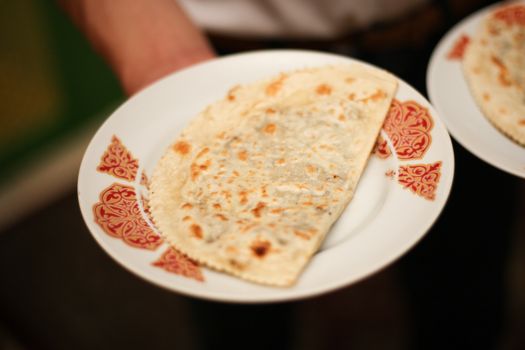
Photo: Артем Смолдарев / Pexels
The diets react (see scores below)
Common Ingredients
- flour
- lamb
- onion
- spinach
- sumac
- cilantro
- butter
- salt
Specific recipes may vary.
Incompatible with 7 of 11 diets
Diet Ratings
Kutab is a thin flatbread stuffed with lamb, greens, and herbs. The defining and disqualifying ingredient is wheat flour, which forms the flatbread shell. Wheat flour is a high-carb grain product that directly violates core ketogenic principles. A single kutab contains a substantial portion of dough, contributing roughly 20-35g of net carbs per piece depending on size — potentially exceeding or consuming the entire daily keto carb budget in one snack. While the filling ingredients (lamb, spinach, onion in small amounts, sumac, cilantro, butter) are largely keto-friendly, the flour wrapper is non-negotiable and makes the dish incompatible with ketosis.
Kutab contains lamb and butter, both of which are animal products and therefore incompatible with a vegan diet. Lamb is a direct animal flesh product, and butter is a dairy derivative. There is no ambiguity here — this dish is clearly non-vegan as prepared.
Kutab is an Azerbaijani flatbread dish where thin dough made from wheat flour is the defining, non-negotiable element of the recipe. Flour (wheat) is a grain and is categorically excluded from the paleo diet. While the filling ingredients — lamb, onion, spinach, sumac, and cilantro — are all paleo-approved, the dish cannot exist without its grain-based wrapper. Butter and salt are also non-paleo (dairy and added salt), adding further violations. The core structure of this dish is fundamentally incompatible with paleo principles.
Kutab is a thin flatbread filled with lamb, onion, and greens. While the spinach, onion, sumac, and cilantro are Mediterranean-friendly ingredients, the dish has two significant issues: lamb is a red meat that the Mediterranean diet restricts to a few times per month, and the flatbread is made from refined white flour rather than whole grain. Butter is used instead of olive oil, further diverging from Mediterranean fat priorities. The combination of refined grain, red meat, and saturated fat from butter places this dish solidly in the 'avoid' category for regular consumption, though the plant-based filling ingredients (spinach, onion, herbs, sumac) add some nutritional merit.
Some Mediterranean diet interpreters, particularly those drawing on Middle Eastern and Eastern Mediterranean traditions, view herb-and-greens-filled flatbreads as broadly compatible with the diet's spirit, especially when portions are small and the filling is predominantly vegetables. In this view, the spinach-dominant variant of kutab could be considered an occasional acceptable snack, with lamb used in small quantities as a flavoring rather than a primary protein.
Kutab is an Azerbaijani flatbread stuffed with lamb, herbs, and vegetables. Despite containing lamb and butter — both carnivore-approved ingredients — the dish is fundamentally incompatible with the carnivore diet. It is built around a wheat flour flatbread shell, which is a grain and therefore strictly excluded. Additionally, the filling contains multiple plant-based ingredients: onion, spinach, sumac (a plant-based spice), and cilantro. The only carnivore-compatible components are the lamb, butter, and salt. The dominant structure of the dish — a grain-based wrap — makes this an avoid regardless of the meat filling.
Kutab is an Azerbaijani flatbread — a thin dough stuffed with fillings such as lamb, spinach, and herbs. The dish contains flour (a grain) as its primary structural component, which is excluded on Whole30. Beyond the grain exclusion, kutab also falls directly into the 'no recreating baked goods or junk food' rule, as it is explicitly a flatbread/wrap — a category the program specifically names as off-limits (tortillas, wraps, crackers). Even if a grain-free flour substitute were used, the flatbread/wrap format itself violates the spirit and letter of Whole30 Rule 4. The filling ingredients (lamb, onion, spinach, sumac, cilantro, salt) are individually compliant, but butter (regular dairy butter) is also excluded — only ghee/clarified butter is permitted. The dish cannot be made Whole30-compatible without fundamentally ceasing to be kutab.
Kutab contains two high-FODMAP ingredients that make it unsuitable during the elimination phase: wheat flour (high in fructans) forms the dough/pastry shell, and onion (one of the highest-fructan foods tested by Monash University) is used as a filling ingredient. These are not trace amounts — flour is the structural base of the dish and onion is a primary filling component. Even if the lamb, spinach, sumac, cilantro, butter, and salt are all low-FODMAP, the wheat dough and onion filling alone disqualify this dish during elimination. There is no realistic way to consume a standard serving of kutab without significant fructan intake from both sources.
Kutab is a thin Azerbaijani flatbread filled with lamb, spinach, onion, and herbs. Several ingredients align well with DASH principles: spinach is a DASH superfood rich in potassium and magnesium, onion and cilantro are DASH-approved vegetables, and sumac adds flavor without sodium. However, lamb is a red meat, which DASH limits due to its saturated fat content, and butter adds saturated fat. The refined flour flatbread lacks the fiber benefit of whole grains. Salt is listed as an ingredient, contributing to sodium load. The overall dish is moderately problematic — it is not heavily processed and contains beneficial vegetables, but the combination of red meat, butter, refined flour, and added salt places it in the 'caution' category. It could be improved by substituting whole wheat flour, using less butter, and minimizing added salt.
NIH DASH guidelines categorically limit red meat and refined grains, placing lamb-based dishes with butter in the caution zone. However, some updated DASH-oriented clinicians note that lamb in small portions within a vegetable-rich preparation (like this spinach-heavy flatbread) can fit within weekly red meat allowances, and the herb-forward profile reduces need for added salt in practice.
Kutab is an Azerbaijani flatbread (thin crepe-like pancake) stuffed with lamb and/or greens. From a Zone perspective, this dish presents several challenges. The flour-based flatbread wrapper is a refined, higher-glycemic carbohydrate — an 'unfavorable' Zone carb that can spike insulin. Lamb, while a complete protein, is a fattier red meat compared to ideal Zone proteins like skinless chicken or fish, and contains more saturated fat than Sears recommends. Butter adds additional saturated fat. On the positive side, spinach, onion, cilantro, and sumac (a polyphenol-rich spice) are all Zone-favorable ingredients that contribute low-glycemic carbs and anti-inflammatory compounds. The macronutrient ratio will likely skew toward fat (from lamb and butter) and refined carbs (from flour), making it difficult to hit the 40/30/30 Zone target without significant modification. Portioning is key — a small piece accompanied by a large vegetable side could be worked into a Zone meal, but as a standalone snack this dish is unbalanced. The protein portion from lamb filling may be adequate per block depending on quantity, but the fat load and refined carb base remain problematic.
Some Zone practitioners following Sears' later anti-inflammatory framework (e.g., 'The Zone Diet' revised editions and OmegaRx writings) would note that lamb's saturated fat is less concerning than once thought, particularly if omega-3 balance is otherwise maintained. Additionally, if the flatbread is thin and the filling is generous (especially with the spinach-heavy version of kutab), the carb load from flour can be moderate and the vegetable content increases favorability. A spinach-dominant kutab with minimal butter could score closer to a 5-6 with careful portioning.
Kutab is a thin Azerbaijani flatbread filled with lamb, onion, spinach, and spices. The ingredient profile is mixed from an anti-inflammatory standpoint. On the positive side, spinach is a nutrient-dense, antioxidant-rich leafy green; onion contains quercetin and other anti-inflammatory flavonoids; sumac is high in polyphenols and has demonstrated anti-inflammatory activity; and cilantro provides additional phytonutrients. These are all genuinely beneficial components. However, lamb is red meat, which anti-inflammatory frameworks place in the 'limit' category due to saturated fat content and pro-inflammatory arachidonic acid — though grass-fed lamb has a more favorable omega-6 to omega-3 ratio than many other red meats. Butter is a saturated fat that anti-inflammatory guidelines recommend limiting. Flour (refined white flour, as is typical in kutab) contributes refined carbohydrates with minimal fiber, which is neutral to mildly pro-inflammatory. The dish is not deeply processed and contains no additives, trans fats, or high-fructose corn syrup, which keeps it from the 'avoid' category. Overall, this is an occasional food that can fit within an anti-inflammatory dietary pattern if consumed in moderation, but the red meat and butter content prevent a full approval.
Some anti-inflammatory practitioners, particularly those following Dr. Weil's more flexible Mediterranean-influenced approach, would view lamb consumed occasionally — especially grass-fed — as acceptable within a varied diet, particularly given the strongly anti-inflammatory accompaniments like sumac and spinach. Others following stricter anti-inflammatory or AIP-style protocols would flag both red meat and refined flour as consistently problematic and recommend avoiding this dish regularly.
Kutab is a thin, unleavened flatbread filled with lamb and vegetables (spinach, onion, herbs), finished with butter. The dish has meaningful positives: spinach and onion add fiber and micronutrients, sumac and cilantro are GLP-1 neutral, and the thin flatbread crust is lighter than many pastry-based snacks. However, several factors pull it into caution territory. Lamb is a fatty red meat — even lean cuts carry more saturated fat than chicken breast, fish, or legumes, and ground lamb used in kutab typically includes fattier trim. Butter is added as a finishing element, adding saturated fat and calories without meaningful protein or fiber benefit. The flour-based wrapper is a refined carbohydrate with low fiber and protein density. While kutab is a small, portion-friendly snack (a positive), the calories it does provide skew toward fat and refined carbs rather than protein and fiber — not ideal for GLP-1 patients who need every calorie to be nutritionally dense. The fat load may also worsen nausea or reflux, common GLP-1 side effects. One or two pieces occasionally is unlikely to be harmful, but it is not a reliable protein or fiber source and should not be a dietary staple on GLP-1 therapy.
Some GLP-1-focused dietitians may view kutab more favorably in small portions — the lamb does provide complete protein, and the greens add meaningful nutrition in a compact form. The disagreement centers on whether the saturated fat from lamb and butter is clinically significant at typical snack-sized servings, or whether the protein contribution justifies inclusion in a varied diet.
*See how scores were generated at our methodology page.
Nutritional profile
Six traits that cut across every diet.
Fiber & Plants
How much whole-plant food and fiber it delivers.
Healthy Fats
The quality of its fats (unsaturated, omega-3).
Whole / Unprocessed
How close it is to its natural, unprocessed form.
Gut Gentle
How easy it is on digestion (low FODMAP, few irritants).
Low Glycemic
How little it spikes your blood sugar.
Protein Density
How much protein it packs per calorie.
Controversy Index
Higher controversy = more disagreement between diets.
Diet-Specific Tips
 DASH — 5/10
View tips
- Lamb is a red meat limited by DASH guidelines due to saturated fat content
- Spinach is a DASH-approved food rich in potassium and magnesium
- Butter adds saturated fat, which DASH limits
- Refined flour lacks the fiber benefit of whole grains recommended by DASH
- Added salt increases sodium load; preparation sodium is a concern
- Onion, cilantro, and sumac are DASH-compatible flavor enhancers
- Small portion size as a snack mitigates some concerns about red meat and fat
 Zone — 4/10
View tips
- Refined wheat flour wrapper is a high-glycemic, 'unfavorable' Zone carbohydrate
- Lamb is a fatty red meat — higher in saturated fat than ideal Zone proteins
- Butter adds saturated fat, inconsistent with Zone's monounsaturated fat preference
- Spinach, onion, cilantro, and sumac are Zone-favorable, anti-inflammatory ingredients
- Macronutrient ratio likely skews toward fat and refined carbs, away from 40/30/30 target
- Small portions can be incorporated into a Zone meal with significant vegetable sides
- Sumac is polyphenol-rich, aligning with Sears' anti-inflammatory focus
 Anti-Inflammatory — 4/10
View tips
- Lamb (red meat) is in the 'limit' category — saturated fat and arachidonic acid are pro-inflammatory
- Butter adds saturated fat, which anti-inflammatory guidelines advise limiting
- Refined flour contributes refined carbohydrates with low fiber
- Spinach provides antioxidants, folate, and anti-inflammatory phytonutrients
- Sumac is rich in polyphenols with documented anti-inflammatory properties
- Onion contains quercetin, a potent anti-inflammatory flavonoid
- Cilantro adds additional anti-inflammatory phytonutrients
- No trans fats, artificial additives, or highly processed ingredients — a mitigating factor
- Grass-fed lamb has a better omega-6 to omega-3 ratio than conventionally raised red meat
 GLP-1 Friendly — 4/10
View tips
- Lamb is a fatty red meat with higher saturated fat than preferred GLP-1 protein sources
- Butter adds saturated fat without protein or fiber benefit
- Refined flour wrapper is low in fiber and protein
- Spinach and onion contribute fiber and micronutrients — a positive
- Small portion size is GLP-1-friendly structurally
- Overall macronutrient profile skews fat-and-carb rather than protein-and-fiber
- Fat content may worsen nausea, bloating, or reflux on GLP-1 medications