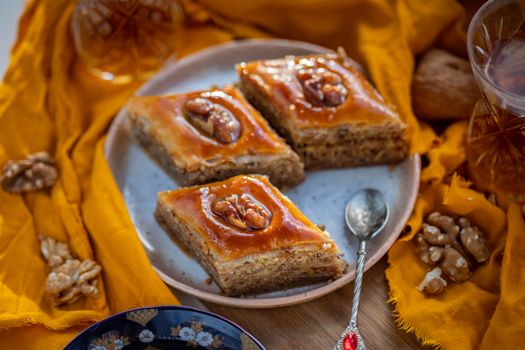
Photo: Valeria Boltneva / Pexels
Azerbaijani
Pakhlava
The diets react (see scores below)
Common Ingredients
- flour
- walnuts
- almonds
- sugar
- butter
- saffron
- cardamom
- egg yolk
Specific recipes may vary.
Incompatible with 11 of 11 diets
Diet Ratings
Pakhlava is a traditional Azerbaijani layered pastry that is fundamentally incompatible with a ketogenic diet. Its two primary ingredients — flour (a refined grain) and sugar — are the exact foods that ketogenic eating categorically excludes. The flour-based pastry layers contribute massive amounts of net carbs, and sugar is used both in the filling and typically as a syrup glaze. Even though walnuts, almonds, butter, egg yolk, saffron, and cardamom are keto-friendly ingredients, they are completely overshadowed by the high-carb base. A single piece of pakhlava can easily contain 30-50g of net carbs, which alone could exceed an entire day's carb allowance on keto. There is no portion size small enough to make this dish compatible with maintaining ketosis.
Azerbaijani Pakhlava contains multiple animal-derived ingredients that disqualify it from a vegan diet. Butter is a dairy product, and egg yolk is an animal product — both are clearly excluded under vegan rules. The remaining ingredients (flour, walnuts, almonds, sugar, saffron, cardamom) are all plant-based, but the presence of butter and egg yolk make this dish non-vegan as traditionally prepared. A vegan version could be made by substituting plant-based butter and an egg replacer, but the default/traditional recipe is not vegan-compliant.
Pakhlava is a traditional Azerbaijani pastry that is fundamentally incompatible with the paleo diet. The dish is built on wheat flour (a grain, strictly excluded from paleo) and refined sugar (excluded as a processed sweetener). Butter is a dairy product, which is also excluded — though ghee is debated, regular butter retains casein and lactose and is not considered paleo. While walnuts, almonds, saffron, cardamom, and egg yolk are all paleo-approved ingredients, the core structural components — flour and sugar — make this dish a clear 'avoid.' There is no meaningful way to consume pakhlava in its traditional form while following paleo principles.
Pakhlava is a rich pastry that fundamentally conflicts with Mediterranean diet principles. It is made with refined white flour (a refined grain), substantial added sugar, and butter (saturated fat) as its primary fat — directly opposing the diet's emphasis on whole grains and extra virgin olive oil as the primary fat. While walnuts and almonds are genuinely Mediterranean-approved nuts, they are embedded in a high-sugar, high-saturated-fat pastry matrix that negates their benefits. The dish is a concentrated source of added sugars and refined carbohydrates, which the Mediterranean diet explicitly minimizes. As an occasional treat it is not poisonous, but it contradicts core dietary principles and should not be a regular part of a Mediterranean eating pattern.
Pakhlava is a traditional Azerbaijani pastry that is almost entirely plant-based and heavily processed. The ingredient list includes flour (grain), walnuts (nuts), almonds (nuts), sugar (processed sweetener), saffron (plant spice), and cardamom (plant spice). The only animal-derived ingredients are butter and egg yolk, which appear in minor supporting roles within an overwhelmingly plant-based confection. This dish violates virtually every core carnivore diet principle: it contains grains, nuts, sugar, and plant spices, with no meaningful animal protein. Even the most liberal 'animal-based' carnivore practitioners would exclude this due to the flour, sugar, and nut content. There is no version of the carnivore diet that accommodates this dish.
Pakhlava contains multiple excluded ingredients that disqualify it from the Whole30 program. Flour is a grain product (wheat), which is explicitly excluded. Sugar is an added sweetener, also explicitly excluded. Butter (regular, not ghee or clarified butter) is a dairy product and excluded. Even if those three ingredients were somehow substituted, pakhlava is a classic pastry/baked sweet that falls squarely into the 'no recreating baked goods and junk food' rule — it is structurally and functionally a dessert pastry. There is no compliant version of this dish.
Pakhlava is a layered pastry made with wheat flour as its base, which is the primary FODMAP concern. Wheat flour is high in fructans and is explicitly avoided during the elimination phase of the low-FODMAP diet. Additionally, walnuts and almonds are both problematic at standard serving sizes — almonds are low-FODMAP only at 10 nuts or fewer per Monash, and walnuts are low-FODMAP at about 10 halves; in pakhlava, nuts are used generously as filling. The combination of a wheat-based pastry (fructans) with large amounts of mixed nuts (GOS and excess polyols at typical serving quantities) makes this dish high-FODMAP. Sugar, butter, saffron, cardamom, and egg yolk are all low-FODMAP and pose no concern. However, the wheat flour alone is sufficient to classify this as avoid during elimination phase, and the nut load compounds the issue.
Monash University has not specifically tested pakhlava, so exact FODMAP loads per serving piece are unknown. Some FODMAP practitioners might argue that a single small piece could fall within tolerable thresholds if nut portions are modest, but the wheat flour base remains a clear fructan source that most elimination-phase protocols would prohibit regardless of portion size.
Pakhlava is a traditional Azerbaijani pastry that is fundamentally incompatible with DASH diet principles. It is built around large quantities of sugar and butter, making it high in added sugar and saturated fat — two categories DASH explicitly limits. The refined white flour provides minimal fiber and little nutritional value. While walnuts and almonds are genuinely DASH-friendly foods rich in healthy fats, magnesium, and potassium, they are embedded in a matrix of sugar syrup and butter that overwhelms any benefit they provide. Egg yolks contribute additional saturated fat and cholesterol. The caloric density and high added-sugar content place this firmly in the 'sweets' category that DASH recommends minimizing to 5 or fewer servings per week, and even then, in small portions. A typical serving of pakhlava would likely exhaust most or all of a DASH dieter's weekly sweets allowance in a single sitting. The spices (saffron, cardamom) are neutral and even beneficial, but do not meaningfully alter the overall nutritional profile.
Pakhlava is an Azerbaijani pastry that is fundamentally incompatible with Zone Diet principles. Its core structure is built on refined white flour (high-glycemic carbohydrate), large quantities of sugar (pure high-glycemic carb), and butter (saturated fat). The macronutrient ratio is heavily skewed toward carbohydrates and saturated fat, with virtually no lean protein. While walnuts and almonds do provide some beneficial monounsaturated and omega-3 fats, they are present alongside sugar and butter in proportions that cannot be corrected by portioning alone. Even a small serving would deliver a glycemic spike from the flour-sugar combination that is antithetical to Zone's core goal of blood sugar stabilization. There is no lean protein component whatsoever, making it impossible to construct a Zone-balanced block from this food. This is a dessert/confection that sits in the same category as baklava — essentially a delivery mechanism for sugar and refined carbs with accompanying saturated fat.
Pakhlava is a rich Azerbaijani pastry that presents a strongly pro-inflammatory nutritional profile. While it contains some beneficial ingredients — walnuts (omega-3 ALA), almonds (vitamin E, monounsaturated fats), saffron (crocin, antioxidants), and cardamom (anti-inflammatory phytochemicals) — these are substantially outweighed by the dominant inflammatory drivers. The dish is built on refined white flour (high glycemic index, devoid of fiber, drives rapid blood sugar spikes and promotes inflammatory cytokines), large quantities of added sugar (directly elevates CRP and IL-6 in research), and butter as a primary fat source (high in saturated fat, limited to the 'avoid' or 'limit' category in anti-inflammatory frameworks). The combined sugar-plus-refined-carbohydrate load is the most significant concern — this combination is one of the most reliably pro-inflammatory dietary patterns documented in nutrition research. The beneficial nuts and spices, while present, appear in quantities too small relative to the sugar and butter to meaningfully offset the inflammatory impact of this dessert. As an occasional treat it is not catastrophic, but as a snack category food it cannot be recommended under anti-inflammatory principles.
Azerbaijani pakhlava is a dense, layered pastry made primarily from refined flour, butter, sugar, and nuts. It is high in refined carbohydrates, saturated fat, and added sugar, with negligible protein and minimal fiber relative to its caloric load. A typical serving delivers a significant sugar and fat hit with very little nutritional return — the opposite of what GLP-1 patients need. The slow gastric emptying caused by GLP-1 medications means high-fat, high-sugar foods like this sit heavily in the stomach and are more likely to trigger nausea, bloating, and reflux. While walnuts and almonds do contribute some unsaturated fats and trace nutrients, they are present within a matrix of butter and sugar that negates most of their benefit. There is no meaningful protein contribution. This is a calorie-dense, nutrient-poor food that conflicts with nearly every GLP-1 dietary priority: it fails on protein density, fat content, sugar load, digestibility, and nutrient density per calorie.
*See how scores were generated at our methodology page.
Nutritional profile
Six traits that cut across every diet.
Fiber & Plants
How much whole-plant food and fiber it delivers.
Healthy Fats
The quality of its fats (unsaturated, omega-3).
Whole / Unprocessed
How close it is to its natural, unprocessed form.
Gut Gentle
How easy it is on digestion (low FODMAP, few irritants).
Low Glycemic
How little it spikes your blood sugar.
Protein Density
How much protein it packs per calorie.
Controversy Index
Higher controversy = more disagreement between diets.