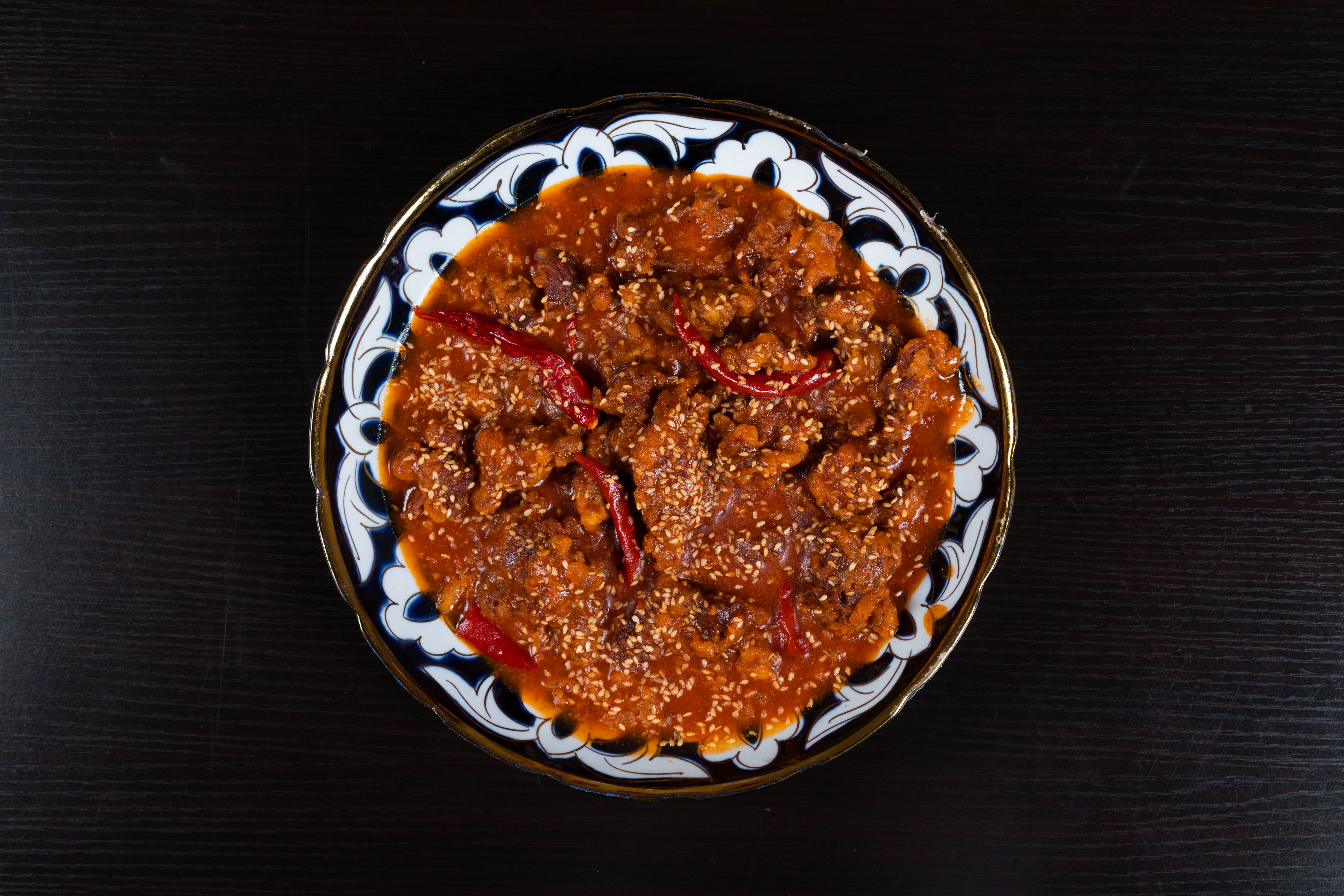
Photo: Collab Media / Pexels
The diets react (see scores below)
Common Ingredients
- lamb
- onion
- saffron
- turmeric
- salt
- black pepper
- butter
Specific recipes may vary.
Incompatible with 8 of 11 diets
Diet Ratings
Qovurma is an Azerbaijani slow-cooked lamb dish that aligns excellently with ketogenic principles. Lamb is a fatty, high-quality protein source with zero carbs. Butter adds healthy saturated fat. Onion contributes minimal net carbs in typical cooking quantities (a standard serving would include only a small portion of onion). Saffron, turmeric, salt, and black pepper are negligible in carb content. The dish is whole, unprocessed, and naturally high in fat and protein with very low net carbs per serving, making it a strong keto fit.
Qovurma is an Azerbaijani braised lamb dish containing two clear animal-derived ingredients: lamb (meat) and butter (dairy). Both are definitively excluded under vegan dietary rules. There is no ambiguity here — this dish is fundamentally built around animal products and is entirely incompatible with a vegan diet.
Qovurma is a traditional Azerbaijani slow-cooked lamb dish that is largely paleo-friendly in concept, but contains two problematic ingredients: salt and butter. Added salt is explicitly excluded from strict paleo guidelines. Butter is a dairy product — while ghee (clarified butter) is debated but widely accepted by many paleo practitioners, whole butter retains milk solids (casein) and lactose, making it more problematic than ghee. The core ingredients — lamb, onion, saffron, turmeric, and black pepper — are all paleo-approved whole foods. However, the combination of added salt and butter pushes this dish into avoid territory under strict paleo rules. With simple substitutions (replacing butter with ghee or animal fat, and omitting added salt), this dish would score significantly higher.
Many modern paleo practitioners, including followers of Mark Sisson's Primal Blueprint, tolerate small amounts of high-quality butter and consider modest seasoning with salt acceptable in whole-food contexts. Under this more flexible interpretation, Qovurma made with grass-fed butter and minimal salt could be considered a caution-level dish rather than an avoid.
Qovurma is a slow-cooked Azerbaijani lamb dish that conflicts with core Mediterranean diet principles in two significant ways: lamb is red meat (limited to a few times per month in Mediterranean guidelines), and butter is the cooking fat rather than the preferred extra virgin olive oil. The dish does include beneficial components — onion, saffron, and turmeric are all anti-inflammatory spices and aromatics — but the protein and fat choices place it firmly outside regular Mediterranean eating patterns. As an occasional indulgence (once a month), it would be less problematic, but as a staple main course it is incompatible.
Some Mediterranean diet scholars note that Middle Eastern and Levantine culinary traditions, which share cultural roots with Azerbaijani cuisine, do incorporate lamb and clarified butter in celebratory dishes with a long traditional history. A flexible, culturally inclusive interpretation of the Mediterranean diet might tolerate this dish on rare occasions, especially given the anti-inflammatory spice profile.
Qovurma is built on lamb, which is an excellent ruminant protein and would otherwise be highly approved on the carnivore diet. However, the dish contains multiple non-carnivore ingredients that disqualify it: onion (a plant/vegetable), saffron (a plant-derived spice), turmeric (a plant-derived spice/root), and black pepper (a plant-derived spice). While salt and butter are acceptable, and lamb itself is ideal, the plant-based ingredients make this dish incompatible with carnivore principles. The dish cannot simply be 'modified mentally' — as prepared, it contains plant foods. A carnivore practitioner would need to strip it down to just the lamb cooked in butter with salt.
Qovurma contains butter, which is dairy and explicitly excluded on the Whole30 program. Regular butter is not permitted — only ghee or clarified butter is the dairy exception allowed. All other ingredients (lamb, onion, saffron, turmeric, salt, black pepper) are fully Whole30-compliant. The dish could easily be made compliant by substituting ghee for butter.
Qovurma contains onion as a primary ingredient, which is high in fructans and one of the most significant FODMAP triggers. Onion is consistently rated as high-FODMAP by Monash University at virtually any culinary quantity — even small amounts cooked into a dish can leach fructans into the food. The remaining ingredients are largely low-FODMAP: lamb is a safe protein, saffron and turmeric are used in trace spice quantities and are low-FODMAP, salt and black pepper are fine, and butter is low-FODMAP (fat, not lactose-rich). However, the presence of onion as a structural ingredient in this braised dish makes it unsuitable during the elimination phase. Onion cannot simply be reduced to a 'safe' portion in this context, as the dish is built around it and fructans dissolve into the cooking liquid, permeating the entire dish.
Qovurma is an Azerbaijani braised/fried lamb dish that conflicts with DASH diet principles on multiple fronts. Lamb is a red meat high in saturated fat, which DASH explicitly limits. The use of butter adds additional saturated fat, compounding the concern. DASH guidelines specifically recommend limiting red meat and full-fat dairy (including butter), favoring lean poultry, fish, and plant-based proteins instead. The salt content raises sodium concerns as well, and the cooking method (qovurma typically involves pan-frying or slow-frying in fat) does not reduce the fat load. While onion, saffron, and turmeric are DASH-friendly spices and aromatics, they cannot offset the core dietary issues. This dish as traditionally prepared is not compatible with DASH eating patterns.
Qovurma is a traditional Azerbaijani slow-cooked lamb dish that presents a mixed Zone Diet profile. The primary protein source — lamb — is higher in saturated fat than Zone-preferred lean proteins like skinless chicken or fish, though it does provide complete protein and can be portioned into Zone blocks (approximately 1 oz cooked lamb ≈ 1 protein block at ~7g protein). Onion is a favorable low-glycemic carbohydrate and a Zone-friendly vegetable. Saffron and turmeric are excellent Zone additions due to their strong anti-inflammatory and polyphenol properties, aligning with Sears' later emphasis on anti-inflammatory eating. The significant problem is butter as the cooking fat — it's a saturated fat source, not the monounsaturated fat (olive oil, avocado, almonds) that Zone recommends. Additionally, the dish as traditionally prepared is predominantly protein and fat with minimal carbohydrate, making it difficult to achieve the 40/30/30 macro ratio without adding substantial low-glycemic vegetables or fruit on the side. The fat-heavy, carb-light nature of qovurma means it must be carefully paired with large portions of Zone-favorable vegetables (e.g., steamed broccoli, leafy greens) to approach Zone balance. With portion control and appropriate pairing, it can fit into a Zone meal plan, but it is not a naturally Zone-balanced dish.
Dr. Sears' later writings, particularly in 'The OmegaRx Zone' and 'Toxic Fat,' place increasing emphasis on anti-inflammatory foods and polyphenols over strict macronutrient ratios alone. From this updated perspective, the turmeric and saffron in qovurma are highly favorable anti-inflammatory ingredients that Sears would likely endorse. Some Zone practitioners also note that lamb, while fattier than chicken, contains a reasonable omega-3 to omega-6 ratio compared to grain-fed beef, making it more compatible with the anti-inflammatory goals of the later Zone framework. These practitioners might rate this dish somewhat more favorably if prepared with grass-fed lamb and portioned with a large vegetable side.
Qovurma is a traditional Azerbaijani braised or fried lamb dish. Its anti-inflammatory profile is genuinely mixed. On the positive side, turmeric and saffron are notable anti-inflammatory spices — turmeric's curcumin is one of the most researched anti-inflammatory compounds in food, and saffron contains crocin and safranal with antioxidant properties. Black pepper enhances curcumin bioavailability, and onions contribute quercetin, a potent anti-inflammatory flavonoid. However, the dish is built around lamb, a red meat that is limited on anti-inflammatory frameworks due to saturated fat content and arachidonic acid, which can promote pro-inflammatory eicosanoids. The use of butter as the cooking fat compounds the saturated fat burden and is explicitly in the 'limit' category. Lamb is not as inflammatory as processed red meat, and grass-fed lamb does contain some omega-3s, but the combination of red meat and butter as primary components outweighs the benefits of the spices in terms of overall dietary pattern. Occasional consumption within an otherwise anti-inflammatory diet is reasonable, but this dish cannot be considered a staple.
Some anti-inflammatory practitioners, particularly those following Mediterranean or traditional dietary frameworks, argue that unprocessed red meats like lamb — especially grass-fed — are acceptable in moderation due to their CLA, zinc, and iron content, and that the pro-inflammatory signal from saturated fat is overstated in whole-food contexts. Others, including strict followers of Dr. Weil's pyramid, would more firmly flag lamb-plus-butter as a combination to limit due to compounded saturated fat load.
Qovurma is a traditional Azerbaijani slow-cooked lamb dish prepared with butter, making it a high-fat meal on two fronts: lamb is a fatty red meat (particularly cuts used in traditional qovurma, which are not lean), and butter adds saturated fat. While the dish does provide meaningful protein from lamb, the fat load per serving is problematic for GLP-1 patients — high dietary fat slows gastric emptying further beyond what the medication already causes, significantly worsening nausea, bloating, and reflux. Butter as the cooking fat adds saturated fat with no fiber or micronutrient benefit. The spices (saffron, turmeric, black pepper) are generally well-tolerated and even anti-inflammatory, but they cannot offset the core issue. Onion contributes minimal fiber. The dish is low in fiber overall and calorie-dense relative to its nutrient profile for GLP-1 patients eating small portions. A patient eating a small serving would get some protein but a disproportionate fat load, making this a poor fit for the GLP-1 dietary framework.
Some GLP-1-focused dietitians note that lamb, while higher in saturated fat than chicken or fish, is a complete protein with good iron and B12 density — nutrients GLP-1 patients eating fewer calories are at risk of deficiencies in. A minority view holds that a small portion of lean lamb (e.g., leg cuts, trimmed of visible fat) prepared with minimal butter could be acceptable occasionally, but the traditional qovurma preparation with butter makes this concession difficult to apply here.
*See how scores were generated at our methodology page.
Nutritional profile
Six traits that cut across every diet.
Fiber & Plants
How much whole-plant food and fiber it delivers.
Healthy Fats
The quality of its fats (unsaturated, omega-3).
Whole / Unprocessed
How close it is to its natural, unprocessed form.
Gut Gentle
How easy it is on digestion (low FODMAP, few irritants).
Low Glycemic
How little it spikes your blood sugar.
Protein Density
How much protein it packs per calorie.
Controversy Index
Higher controversy = more disagreement between diets.
Diet-Specific Tips
 Keto — 9/10
View tips
- Lamb provides high-quality protein and natural fat with zero net carbs
- Butter increases healthy fat content, supporting keto macros
- Onion is the only meaningful carb source but is minimal per serving in a slow-cooked dish
- Spices (saffron, turmeric, black pepper) add negligible carbs
- No grains, sugars, or starchy vegetables present
- Whole, unprocessed ingredients align with clean keto principles
 Zone — 5/10
View tips
- Lamb is a higher-fat protein, not ideal for Zone's lean protein preference, but usable in controlled portions (~1 oz per block)
- Butter as cooking fat contributes saturated fat, conflicting with Zone's monounsaturated fat recommendation
- Onion is a Zone-favorable low-glycemic carbohydrate
- Saffron and turmeric are potent polyphenols and anti-inflammatory agents strongly aligned with Sears' anti-inflammatory Zone principles
- Dish is naturally carb-deficient for Zone ratios — requires significant vegetable pairing to achieve 40% carbohydrate target
- Fat-to-protein ratio may be disproportionately high depending on cut of lamb (shoulder vs. leg) and butter quantity
- No high-glycemic ingredients, processed foods, or trans fats present
 Anti-Inflammatory — 4/10
View tips
- Lamb (red meat) is in the 'limit' category due to saturated fat and arachidonic acid content
- Butter is a saturated fat explicitly limited in anti-inflammatory frameworks
- Turmeric provides curcumin, a well-researched anti-inflammatory compound
- Black pepper (piperine) enhances curcumin absorption
- Saffron contains crocin and safranal with antioxidant and anti-inflammatory properties
- Onions are a good source of quercetin, an anti-inflammatory flavonoid
- No omega-3 rich ingredients; no vegetables beyond onion; no whole grains or legumes