Photo: Farhad Ibrahimzade / Pexels
The diets react (see scores below)
Common Ingredients
- flour
- water
- spinach
- scallions
- cilantro
- sumac
- butter
- salt
Specific recipes may vary.
Incompatible with 6 of 11 diets
Diet Ratings
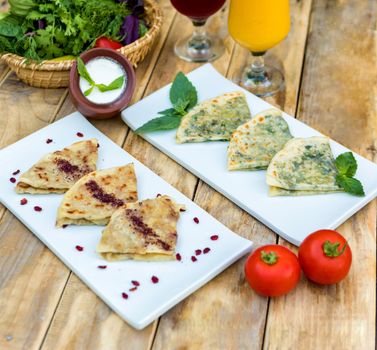
Qutab is a thin flatbread (similar to a crepe or pancake) made with wheat flour as its primary ingredient. Wheat flour is a refined grain with very high net carbs — a single qutab contains roughly 25-35g of net carbs from the dough alone, which can single-handedly exhaust or exceed the entire daily keto carb budget. While the filling ingredients (spinach, scallions, cilantro, sumac, butter) are individually keto-friendly or low-carb, they cannot offset the fundamental incompatibility of the flour-based wrapper. The dish is structurally defined by its grain-based shell, making it incompatible with ketosis regardless of portion size.
Qutab is an Azerbaijani flatbread/pancake typically filled with greens. The listed ingredients are largely plant-based — flour, water, spinach, scallions, cilantro, sumac, and salt are all vegan. However, butter is an animal-derived dairy product, which makes this dish non-vegan as traditionally prepared. The butter is used both in the dough and/or to brush the finished qutab, so it is a core ingredient, not incidental. A vegan version could easily be made by substituting plant-based butter or oil, but the dish as described contains an animal product.
Qutab is a thin flatbread filled with herbs and greens. The foundation of the dish is flour — a refined grain product that is explicitly excluded from the paleo diet. Wheat flour is among the clearest violations of paleo principles, as grains were not consumed by Paleolithic humans and contain anti-nutrients like gluten and phytates. Salt is also added, which is discouraged in strict paleo. Butter is a dairy product, excluded under paleo rules (unlike ghee, which has casein and lactose removed). The filling ingredients — spinach, scallions, cilantro, and sumac — are all paleo-friendly, but they cannot redeem a dish whose structure fundamentally depends on a grain-based wrapper. The dish cannot be meaningfully adapted without eliminating its core identity.
Qutab is a thin flatbread filled with greens (spinach, scallions, cilantro) and flavored with sumac — a dish with a genuinely healthy filling profile. The greens are Mediterranean diet staples, and sumac is a traditional Eastern Mediterranean spice fully in line with the diet's flavor palette. However, two factors temper the assessment: the flour used is almost certainly refined white flour (traditional qutab uses refined flour, not whole grain), which falls into the 'refined grains' category the Mediterranean diet discourages; and butter, not olive oil, is used as the fat — a dairy fat that is not the canonical Mediterranean fat source. The filling is excellent, the wrapper and cooking fat are the limiting factors. This is a 'caution' rather than 'avoid' because the overall dish is minimally processed, vegetable-forward, and not high in sugar or saturated fat at typical serving sizes.
Some Mediterranean diet interpreters, particularly those drawing on Eastern Mediterranean and Levantine traditions, would note that thin flatbreads with herb-and-green fillings are common in Turkish, Greek (like gözleme), and regional cuisines and could be viewed as acceptable occasionally. Additionally, butter appears in some traditional Mediterranean regional cooking (e.g., North African and Eastern Mediterranean cuisines), and its use here is modest.
Qutab is an Azerbaijani flatbread stuffed with plant-based ingredients. Every single component except butter and salt is explicitly prohibited on the carnivore diet. Flour and water form the flatbread wrapper — grains are entirely excluded. The filling consists of spinach, scallions, and cilantro — all vegetables/plant foods. Sumac is a plant-derived spice. Butter is the only animal-derived ingredient present, and even that is a minor component of an overwhelmingly plant-based dish. There is no animal protein whatsoever. This dish is fundamentally incompatible with carnivore principles at every structural level.
Qutab is an Azerbaijani stuffed flatbread/crepe made with wheat flour as the primary structural ingredient. Wheat flour is a grain and is explicitly excluded on the Whole30 program. Beyond the flour issue, regular butter is also an excluded dairy product (only ghee/clarified butter is permitted). Additionally, even if compliant ingredient substitutes were attempted, qutab is fundamentally a flatbread/wrap — a category explicitly prohibited under Whole30's 'no recreating baked goods/junk food' rule, which specifically lists tortillas, wraps, crepes, and pancakes as disallowed even when made with otherwise compliant ingredients.
Qutab is an Azerbaijani flatbread/pancake made with plain wheat flour as the primary structural ingredient, which is high in fructans and must be avoided during the FODMAP elimination phase. Beyond the wheat dough, the filling contains scallion greens (which are low-FODMAP, but the white bulb portions are high-FODMAP and are often used together), and spinach, which is low-FODMAP in small servings (~75g). Cilantro, sumac, butter, and salt are all low-FODMAP. The primary disqualifier is the wheat flour wrapper, which at any standard serving size of qutab (typically one or more flatbreads, each requiring a significant amount of flour) would deliver a meaningful fructan load. Scallion bulbs, if present in the filling, add further fructan risk. The combination of wheat dough plus potential scallion bulb use makes this dish unsuitable during the strict elimination phase.
Monash University distinguishes wheat's FODMAP load by quantity — some wheat-containing foods in very small portions may fall below threshold — but clinical FODMAP practitioners consistently advise eliminating all regular wheat-based wraps and flatbreads during elimination due to the inherently high fructan content per standard serving. Additionally, scallion green tops are Monash-approved, but if the cook uses the white bulb portions, the fructan risk increases significantly, and this is difficult to control in restaurant or traditional home preparation.
Qutab is an Azerbaijani flatbread stuffed with spinach, scallions, cilantro, and sumac, cooked with butter. Several elements align well with DASH principles: spinach is a DASH superfood rich in potassium, magnesium, and fiber; scallions and cilantro add micronutrients with negligible sodium; sumac is a low-sodium spice. However, the dish has notable DASH concerns. The flour is likely refined white flour rather than whole grain, missing the fiber and nutrient density DASH emphasizes in grains. Butter contributes saturated fat, which DASH limits — a small amount per serving may be acceptable, but traditional preparation can be generous with butter for both cooking and finishing. Salt is added, and the total sodium depends heavily on preparation; home-cooked versions can be moderate, but restaurant preparations may push sodium higher. Overall, this is a moderately DASH-compatible snack: the vegetable filling is excellent, but the refined flour base and butter use require portion awareness and preparation mindfulness.
NIH DASH guidelines specify whole grains and limit saturated fat from butter, making traditional qutab a cautionary food. However, updated clinical interpretations note that when butter is used sparingly and the dish is packed with potassium-rich greens like spinach, the overall nutrient profile can still support DASH goals — some practitioners would approve a small portion as a vegetable-forward snack.
Qutab is an Azerbaijani flatbread (thin crepe-like pancake) filled with herbs and greens. The filling ingredients — spinach, scallions, cilantro, and sumac — are excellent Zone-friendly choices: low-glycemic, polyphenol-rich vegetables and spices that align well with Sears' anti-inflammatory principles. However, the structural base is refined white flour, which is a high-glycemic carbohydrate that Zone methodology classifies as 'unfavorable.' Butter adds saturated fat rather than preferred monounsaturated fat. Critically, this dish contains no meaningful protein source, making it essentially impossible to hit the 30% protein target without significant additions. As a snack or standalone item, it represents a carb-and-fat combination with virtually no protein block — the antithesis of Zone balance. A small portion could theoretically be paired with lean protein on the side to create a Zone-compatible meal, but the dish itself is structurally imbalanced. The refined flour shell is the primary Zone concern, placing this firmly in 'caution' territory.
Qutab is a thin Azerbaijani flatbread filled with herbs and greens. The filling is strongly anti-inflammatory: spinach delivers magnesium, folate, and antioxidants (lutein, zeaxanthin, quercetin); scallions and cilantro provide flavonoids and polyphenols; sumac is an exceptionally potent anti-inflammatory spice rich in gallic acid, anthocyanins, and tannins with documented CRP-lowering effects. These ingredients collectively represent a high-quality anti-inflammatory profile. The limiting factors are the refined white flour shell (no fiber, high glycemic) and the butter used in cooking. Butter is a saturated fat that anti-inflammatory frameworks recommend limiting. The flatbread is thin so the flour quantity is moderate, but it is still a refined carbohydrate base. If made with whole wheat flour and cooked in extra virgin olive oil instead of butter, this dish would score considerably higher. As presented, it lands in 'caution' — a nutrient-dense filling partially offset by a refined carb wrapper and saturated fat.
Some anti-inflammatory practitioners (including those following a more lenient Mediterranean-adjacent approach like Dr. Weil's pyramid, which does not prohibit whole grain flatbreads or occasional butter) might rate this dish more favorably given the exceptional anti-inflammatory filling, modest portion size, and the fact that the butter quantity in a thin flatbread is small. A strict interpretation, however — especially one aligned with AIP or low-glycemic anti-inflammatory protocols — would flag the refined flour more strongly.
Qutab is a thin Azerbaijani flatbread stuffed with spinach, scallions, and cilantro, finished with butter and sumac. The filling is genuinely positive — spinach and scallions provide fiber, micronutrients, and reasonable digestibility, and sumac adds flavor without significant GLP-1 side effect risk. However, the dish falls short on two key GLP-1 priorities: protein and overall nutrient density per calorie. The wrapper is refined wheat flour with no meaningful protein contribution, and butter adds saturated fat. The portion is small by design, which is a partial advantage, but a typical serving of 2–3 qutabs delivers modest fiber, minimal protein (likely 3–5g), and moderate refined carbohydrate calories. This makes it a low-protein, moderate-fat snack — acceptable as an occasional small accompaniment but not a reliable GLP-1-friendly choice on its own. It does not rise to 'avoid' because it is not fried, not high-sugar, not carbonated, and the filling is vegetable-forward and easy to digest. The butter is a mild concern but not disqualifying in a single serving.
Some GLP-1-focused RDs would view this more favorably as a small-portion, vegetable-forward snack that is easy to digest and unlikely to worsen GI side effects — particularly if butter is used sparingly. Others would flag the refined flour wrapper and lack of protein more firmly, arguing that every snack opportunity should contribute meaningfully toward the daily 100–120g protein target, which qutab does not.
*See how scores were generated at our methodology page.
Nutritional profile
Six traits that cut across every diet.
Fiber & Plants
How much whole-plant food and fiber it delivers.
Healthy Fats
The quality of its fats (unsaturated, omega-3).
Whole / Unprocessed
How close it is to its natural, unprocessed form.
Gut Gentle
How easy it is on digestion (low FODMAP, few irritants).
Low Glycemic
How little it spikes your blood sugar.
Protein Density
How much protein it packs per calorie.
Controversy Index
Higher controversy = more disagreement between diets.
Diet-Specific Tips
 Mediterranean — 5/10
View tips
- Filling is strongly plant-forward: spinach, scallions, cilantro — all Mediterranean diet staples
- Sumac is a traditional Eastern Mediterranean spice, fully compatible
- Refined white flour wrapper is a refined grain, discouraged by Mediterranean diet guidelines
- Butter is the cooking fat rather than extra virgin olive oil, which is the preferred Mediterranean fat
- No added sugars, no processed ingredients, no red meat — overall a clean, whole-food preparation
- Portion context matters: a small snack serving limits negative impact of refined flour and butter
 DASH — 5/10
View tips
- Spinach filling is rich in potassium and magnesium, core DASH nutrients
- Refined white flour base lacks the fiber of DASH-preferred whole grains
- Butter adds saturated fat that DASH recommends limiting
- Salt quantity is preparation-dependent; home cooking allows sodium control
- No high-sodium processed ingredients or added sugars
- Sumac, scallions, and cilantro contribute micronutrients without sodium concerns
- Small portion size typical of snack serving mitigates some concerns
 Zone — 4/10
View tips
- Refined white flour base is a high-glycemic 'unfavorable' carbohydrate in Zone terminology
- No protein source — fails to contribute to the required 30% protein ratio
- Butter provides saturated fat rather than Zone-preferred monounsaturated fat
- Spinach, scallions, cilantro, and sumac are excellent low-glycemic, polyphenol-rich Zone-friendly ingredients
- As a standalone snack, macronutrient ratio is severely skewed toward carbs and fat with negligible protein
- Could only be incorporated into a Zone meal as a small component alongside a lean protein source
 Anti-Inflammatory — 5/10
View tips
- Sumac is a top-tier anti-inflammatory spice rich in anthocyanins and gallic acid
- Spinach provides lutein, zeaxanthin, quercetin, and magnesium
- Scallions and cilantro add polyphenols and flavonoids
- Refined white flour base is pro-inflammatory (high glycemic, low fiber)
- Butter is a saturated fat flagged for limitation in anti-inflammatory frameworks
- Thin flatbread limits total flour and butter quantity per serving
- No omega-3 sources, no legumes, no olive oil in this preparation
 GLP-1 Friendly — 4/10
View tips
- Very low protein — refined flour wrapper and vegetable filling provide minimal protein, failing the #1 GLP-1 dietary priority
- Vegetable filling (spinach, scallions, cilantro) contributes fiber and micronutrients, supporting the #2 priority partially
- Butter adds saturated fat per serving, a mild concern on GLP-1 medications
- Refined wheat flour offers low nutrient density per calorie
- Not fried, not high-sugar, not heavily spiced — does not actively worsen GLP-1 side effects
- Small portion size is appropriate for GLP-1 reduced appetite, but volume alone does not compensate for low protein density
- Best treated as a small side or accompaniment rather than a standalone snack