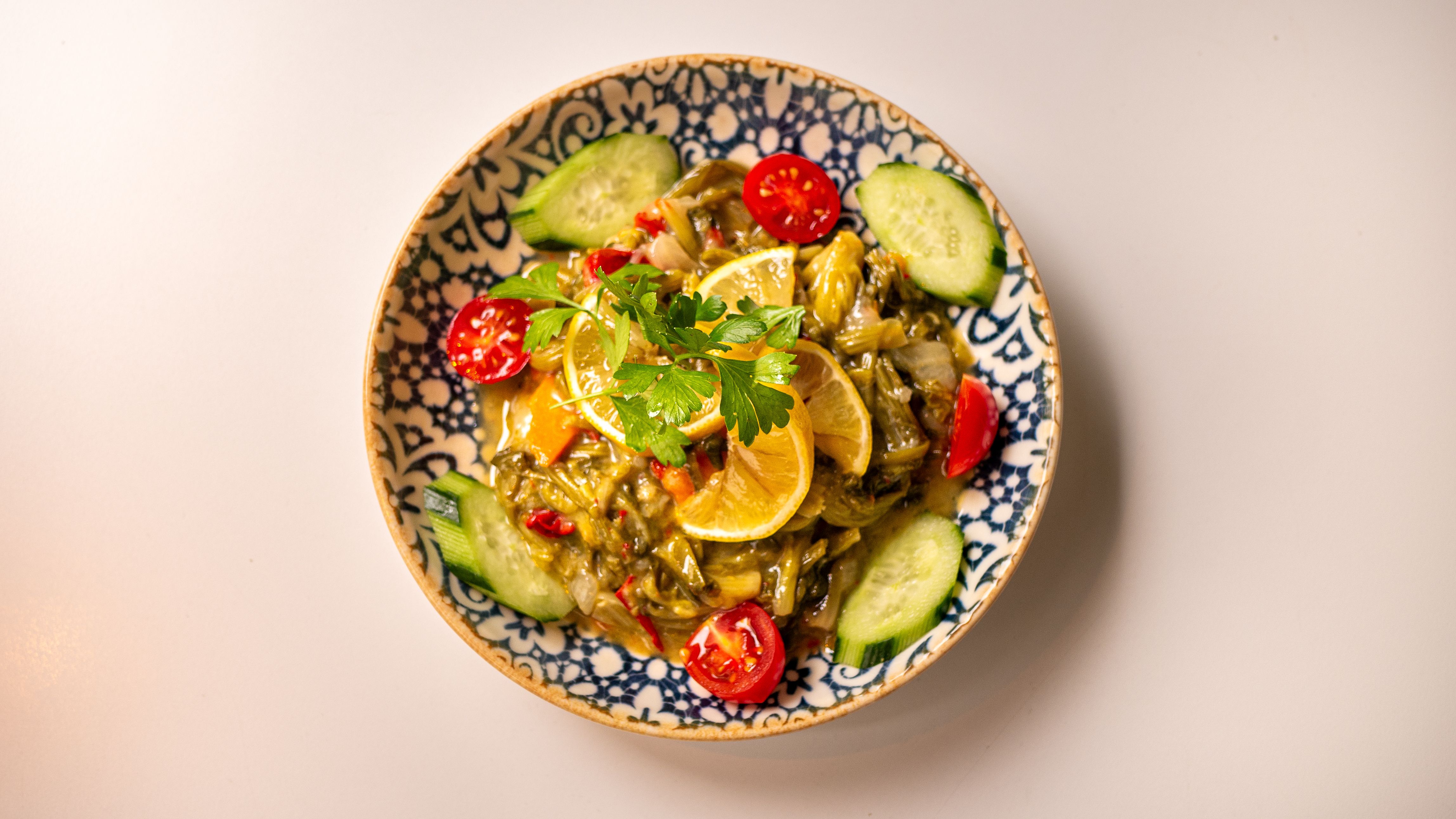
Photo: Nurefşan Çalışkan / Pexels
Azerbaijani
Sabzi Qovurma
The diets react (see scores below)
Common Ingredients
- lamb
- cilantro
- parsley
- dill
- scallions
- onion
- dried lime
- saffron
Specific recipes may vary.
Incompatible with 4 of 11 diets
Diet Ratings
Sabzi Qovurma is a herb-heavy lamb stew that aligns well with ketogenic principles. Lamb is an excellent high-fat, moderate-protein meat with zero carbs. The dominant ingredients are fresh herbs (cilantro, parsley, dill, scallions) which are very low in net carbs even in generous quantities. Onion adds a small amount of carbs but is typically used in modest amounts as an aromatic. Dried lime (limu omani) contributes negligible net carbs at typical usage. Saffron is used in trace amounts and is essentially carb-free. The dish is naturally grain-free, sugar-free, and starchy-vegetable-free. The main concern is the cumulative herb volume — traditional Sabzi Qovurma uses very large quantities of fresh herbs (sometimes several cups), which could push scallion and onion carbs moderately higher. Even so, total net carbs for a standard serving should remain comfortably under 8-10g, well within daily keto limits.
Some strict or therapeutic keto practitioners flag dishes with large volumes of scallions and onions, noting that alliums can accumulate carbs quickly when used at traditional Azerbaijani quantities; they may recommend halving the onion content or tracking carefully rather than freely consuming.
Sabzi Qovurma is an Azerbaijani herb-based stew whose primary protein is lamb, a direct animal product. Lamb is unambiguously non-vegan, making this dish entirely incompatible with a vegan diet regardless of the otherwise plant-based supporting ingredients (cilantro, parsley, dill, scallions, onion, dried lime, saffron).
Sabzi Qovurma is an excellent paleo dish. Lamb is a nutrient-dense, unprocessed meat that is a cornerstone of the paleo diet. All the herbs and aromatics — cilantro, parsley, dill, scallions, and onion — are whole, unprocessed plant foods fully compatible with paleo principles. Dried lime is simply a dehydrated citrus fruit with no additives, and saffron is a natural spice. There are no grains, legumes, dairy, refined sugars, seed oils, or processed ingredients in this dish. The traditional preparation involves slow-cooking the lamb with herbs and aromatics, which is a cooking method entirely consistent with ancestral eating patterns.
Sabzi Qovurma is a lamb-based herb stew where lamb is the primary and dominant protein. In Mediterranean diet guidelines, red meat (including lamb) is limited to a few times per month or at most once weekly, making it a food to minimize rather than embrace. The dish does have genuine redeeming qualities: it is rich in fresh herbs (cilantro, parsley, dill, scallions, onion) which are plant-forward additions, and saffron and dried lime add antioxidant and phytochemical value. However, the lamb-centric nature of the dish as a main course means it fundamentally conflicts with Mediterranean principles around red meat frequency. The cooking method (qovurma implies frying or sautéing in fat, often using the lamb's own fat rather than olive oil) further distances it from Mediterranean ideals. It scores a 3 rather than 1-2 because the herb volume is unusually high and nutritionally beneficial.
Some Mediterranean diet practitioners argue that occasional lamb dishes loaded with vegetables and herbs — particularly in Middle Eastern and Eastern Mediterranean culinary traditions — can fit within a flexible Mediterranean pattern if consumed infrequently and prepared with olive oil substituted for animal fat. The Oldways Mediterranean Diet Pyramid acknowledges regional variation that can include lamb in moderate portions.
Sabzi Qovurma is fundamentally a herb-based lamb dish where the defining characteristic is a massive quantity of fresh herbs (cilantro, parsley, dill, scallions) that form the bulk of the dish — not merely seasoning. The dish also includes onion, dried lime, and saffron, all plant-derived. While the lamb itself is carnivore-approved, the dish as prepared is overwhelmingly plant-based in composition. Carnivore diet excludes all plant foods without exception, meaning the herbs, aromatics, and spices that define this dish are entirely non-compliant. The lamb alone could be salvaged, but Sabzi Qovurma as a dish cannot be considered carnivore-compatible.
Sabzi Qovurma is a traditional Azerbaijani herb and lamb stew whose listed ingredients are entirely Whole30-compliant. Lamb is an approved protein, cilantro, parsley, dill, scallions, and onion are all compliant vegetables/herbs, dried lime (limu omani) is a natural dried citrus fruit used as a souring agent, and saffron is an approved spice. There are no grains, legumes, dairy, added sugars, alcohol, or any other excluded ingredients present. This is a clean, whole-food dish that aligns well with the spirit of the Whole30 program.
Sabzi Qovurma contains two major high-FODMAP ingredients that make it unsuitable during the elimination phase: onion and scallion bulbs (white parts). Onion is one of the highest-fructan foods tested by Monash University and is a primary trigger for IBS symptoms — it must be completely avoided during elimination, even in small amounts used in cooking. Scallions (green onions) are low-FODMAP in the green tops only, but the white bulb portions are high in fructans. Traditional recipes use significant quantities of both. Dried lime (loomi/black lime) has limited Monash testing, adding uncertainty. The remaining ingredients are low-FODMAP: lamb is safe as a plain protein, fresh cilantro/parsley/dill are low-FODMAP herbs, the green tops of scallions are safe, and saffron is used in such trace amounts it poses no FODMAP concern. However, the presence of onion alone — a staple of this dish — makes it a clear avoid during elimination.
Sabzi Qovurma is an Azerbaijani herb-braised lamb dish featuring abundant fresh herbs (cilantro, parsley, dill, scallions, onion) alongside lamb as the primary protein. The herbs are strongly DASH-positive, providing potassium, magnesium, fiber, and micronutrients. However, lamb is classified as red meat under DASH guidelines, which explicitly limits red meat consumption. Lamb is also higher in saturated fat than poultry or fish, which DASH discourages. The remaining ingredients — dried lime, saffron, and onion — are DASH-neutral or mildly beneficial. Sodium content depends heavily on preparation (added salt, broth), but the base recipe has no inherently high-sodium ingredients beyond what may be added during cooking. The dish scores in the caution range: the herb-to-meat ratio is favorable and the absence of processed or high-sodium components is a plus, but lamb as the primary protein conflicts with core DASH recommendations to limit red meat. Smaller portions (3 oz or less) over lean cuts would improve DASH compatibility.
NIH DASH guidelines categorize red meat as a food to limit due to saturated fat and recommend lean poultry and fish instead. However, updated clinical interpretations note that lean cuts of lamb (leg, loin) consumed in modest portions (≤3 oz) within an overall DASH-compliant dietary pattern may be acceptable, particularly given the dish's exceptionally high herb content delivering significant potassium and fiber — some DASH-oriented dietitians do not categorically exclude all red meat if overall saturated fat targets are met.
Sabzi Qovurma is a lamb and fresh herb stew — conceptually aligned with Zone principles in several ways, but lamb as the primary protein introduces the main concern. Lamb is a moderately fatty red meat with a meaningful saturated fat content, which Zone places in the 'use with caution' category compared to preferred lean proteins like skinless chicken, fish, or egg whites. However, lamb is not categorically excluded — it can fit Zone blocks if portions are controlled and lean cuts (leg of lamb, trimmed shoulder) are selected. The herb base (cilantro, parsley, dill, scallions, onion) is excellent from a Zone perspective: these are all low-glycemic, polyphenol-rich vegetables that contribute virtually no glycemic load. Dried lime and saffron add flavor without meaningful macronutrient impact. The dish's primary challenge is the fat profile of lamb and the likelihood that it is cooked in added fat (butter or oil), which could tip total fat upward and skew the fat profile toward saturated. To Zone-optimize this dish, one would: (1) use a lean cut of lamb trimmed of visible fat, (2) cook in olive oil rather than butter, (3) serve with a large side of low-glycemic vegetables or a small portion of legumes to hit the carbohydrate block requirement, and (4) keep the lamb portion to roughly 3 oz (~85g) cooked. The herb abundance is a genuine Zone asset — polyphenol-rich and anti-inflammatory. This is a workable Zone meal with intentional portioning, not an ideal one.
Some Zone practitioners, particularly those following Sears' later anti-inflammatory framework (The Anti-Inflammation Zone), may rate this more favorably, noting that pasture-raised lamb has a better omega-6 to omega-3 ratio than grain-fed beef and contains conjugated linoleic acid (CLA). From that perspective, lean lamb in moderate portions is an acceptable Zone protein, and the polyphenol-dense herb base (especially parsley, cilantro) actively supports Zone anti-inflammatory goals. Those practitioners might score this a 6-7. Conversely, strict early-Zone followers (Enter the Zone, 1995) who rigidly prioritize saturated fat minimization would place lamb lower, perhaps a 4.
Sabzi Qovurma is a herb-forward Azerbaijani lamb dish with a genuinely mixed anti-inflammatory profile. On the positive side, the dish is dominated by large quantities of fresh herbs — cilantro, parsley, dill, and scallions — which are rich in polyphenols, flavonoids, vitamin C, and chlorophyll-based antioxidants with documented anti-inflammatory properties. Onion contributes quercetin, a potent anti-inflammatory flavonoid. Dried lime (limu omani) provides vitamin C, citric acid, and bioactive compounds associated with reduced oxidative stress. Saffron is particularly notable — its active compound crocin has shown meaningful anti-inflammatory effects in research, including reductions in CRP and IL-6. These herb and spice components collectively represent a strong anti-inflammatory foundation. The problematic element is lamb as the primary protein. Lamb is red meat with significant saturated fat content, which anti-inflammatory frameworks consistently place in the 'limit' category. Saturated fat can promote inflammatory signaling pathways (NF-κB), and regular red meat consumption is associated with elevated inflammatory markers. That said, lamb also provides zinc and iron, and the saturated fat context matters — a dish where lamb is cooked with a very high ratio of anti-inflammatory herbs (as is traditional in this preparation, where herbs are nearly equal in volume to the meat) partially offsets concern. The dish is not a pro-inflammatory disaster, but the lamb base prevents an 'approve' verdict.
Some anti-inflammatory practitioners, particularly those following Mediterranean-adjacent or ancestral diet frameworks, argue that unprocessed red meat from grass-fed animals contains conjugated linoleic acid (CLA) and a more favorable omega-6 to omega-3 ratio than grain-fed meat, making moderate consumption acceptable. Dr. Weil's pyramid does not categorically exclude red meat but emphasizes limiting it to a few times per month — this dish, eaten occasionally, may fit within that guidance. Conversely, strict anti-inflammatory protocols informed by newer epidemiological research on red meat and systemic inflammation would rate this lower.
Sabzi Qovurma is a traditional Azerbaijani herb-heavy lamb braise. The dish has genuine nutritional strengths: lamb is a complete protein source and the large volume of fresh herbs (cilantro, parsley, dill, scallions) contributes meaningful fiber, micronutrients, and antioxidants. Dried lime adds flavor without caloric cost. However, the primary protein is lamb, which is a fatty red meat — a significant concern for GLP-1 patients. Lamb cuts used in qovurma (typically shoulder or leg, often bone-in) carry substantial saturated fat, which worsens nausea, bloating, and reflux — the most common GLP-1 side effects. The 'qovurma' preparation involves sautéing or frying the meat in fat before braising, increasing total fat load compared to simply braised or steamed proteins. While the herb base is genuinely beneficial and the dish avoids sugar, refined grains, and processed ingredients, the fat content and cooking method place it firmly in caution territory. Portion size matters significantly here — a small serving focusing on lean trimmed pieces with the herb mixture is more tolerable than a full traditional portion.
Some GLP-1-focused dietitians accept lamb in moderation given its high protein density and zinc/iron content, particularly for patients with micronutrient depletion concerns during rapid weight loss. Others flag all fatty red meat categorically due to the outsized impact of dietary fat on gastric emptying delay and nausea in GLP-1 patients, recommending substitution with chicken or white fish even in cultural dishes.
*See how scores were generated at our methodology page.
Nutritional profile
Six traits that cut across every diet.
Fiber & Plants
How much whole-plant food and fiber it delivers.
Healthy Fats
The quality of its fats (unsaturated, omega-3).
Whole / Unprocessed
How close it is to its natural, unprocessed form.
Gut Gentle
How easy it is on digestion (low FODMAP, few irritants).
Low Glycemic
How little it spikes your blood sugar.
Protein Density
How much protein it packs per calorie.
Controversy Index
Higher controversy = more disagreement between diets.
Diet-Specific Tips
 Keto — 8/10
View tips
- Lamb is zero-carb, high-fat, ideal keto protein source
- Herbs (cilantro, parsley, dill) are very low net carb even in large volumes
- Onion and scallions contribute modest carbs — portion awareness advised
- Dried lime and saffron are negligible in carb contribution
- No grains, added sugars, or starchy vegetables in the dish
- Traditional large herb quantities may require carb tracking for strict keto adherents
 Paleo — 9/10
View tips
- Lamb is a paleo-approved unprocessed meat
- All herbs (cilantro, parsley, dill) are whole, natural plant foods
- Scallions and onion are paleo-approved vegetables
- Dried lime is simply dehydrated citrus — no non-paleo additives
- Saffron is a natural, ancestral spice
- No grains, legumes, dairy, seed oils, or refined sugar present
- Simple, whole-food preparation method aligns with paleo philosophy
 Whole30 — 9/10
View tips
- Lamb is an explicitly approved protein on Whole30
- All herbs (cilantro, parsley, dill, scallions) are compliant
- Onion is a compliant vegetable
- Dried lime (limu omani) is a natural dried citrus fruit — no excluded ingredients
- Saffron is a compliant spice
- No grains, legumes, dairy, or added sugars present
- Dish is a whole-food stew, fully in the spirit of Whole30
 DASH — 5/10
View tips
- Lamb is red meat — DASH explicitly limits red meat due to saturated fat content
- High abundance of fresh herbs (cilantro, parsley, dill, scallions) provides potassium, magnesium, and fiber — strongly DASH-positive
- No inherently high-sodium processed ingredients in base recipe
- Saturated fat content of lamb depends on cut; fattier cuts (shoulder, ribs) would lower the score further
- Dried lime and saffron are DASH-neutral spices/flavorings with no sodium concerns
- Portion size is critical — smaller servings of lamb reduce saturated fat load significantly
- Sodium added during cooking (salt, salted broth) would need to be controlled for DASH compliance
 Zone — 5/10
View tips
- Lamb is a moderately fatty red meat — acceptable in Zone but not a preferred lean protein; saturated fat content requires portion control
- Herb base (cilantro, parsley, dill, scallions, onion) is Zone-favorable: low-glycemic, polyphenol-rich, anti-inflammatory
- Dish lacks a carbohydrate block — must be paired with vegetables or legumes to achieve 40/30/30 ratio
- Dried lime and saffron are Zone-neutral: negligible macronutrient contribution, positive polyphenol value
- Cooking fat matters: olive oil would align with Zone monounsaturated fat preference; butter or animal fat would worsen the verdict
- Lean cut selection (leg, trimmed loin) and ~3 oz cooked portion are necessary for Zone compliance
- Pasture-raised lamb may have a more favorable omega-3 profile, partially mitigating saturated fat concern
 Anti-Inflammatory — 5/10
View tips
- Lamb is red meat — high in saturated fat, consistently placed in the 'limit' category by anti-inflammatory frameworks
- Very high herb load (cilantro, parsley, dill, scallions) provides exceptional polyphenol, flavonoid, and antioxidant content
- Saffron contains crocin and safranal, which have demonstrated reductions in CRP and IL-6 in clinical studies
- Onion is a rich source of quercetin, a well-researched anti-inflammatory flavonoid
- Dried lime contributes vitamin C and bioactive citrus compounds with antioxidant properties
- No seed oils, refined carbohydrates, added sugars, or processed additives — clean whole-food ingredient list
- Frequency and portion size of lamb are key — occasional consumption is less inflammatory than regular
 GLP-1 Friendly — 4/10
View tips
- Lamb is a high-saturated-fat red meat — worsens GLP-1 GI side effects
- Qovurma cooking method involves frying/sautéing in fat before braising — elevated total fat load
- High herb volume (cilantro, parsley, dill, scallions) provides meaningful fiber and micronutrients
- No added sugar, refined grains, or ultra-processed ingredients — clean base
- Dried lime and saffron are GLP-1 neutral — no concern
- Protein content is adequate but fat-to-protein ratio is unfavorable compared to lean proteins
- Portion-sensitive: small servings of trimmed lean lamb are significantly more tolerable
- Substituting lamb with chicken thigh (skinless) or white fish would move this dish toward approve