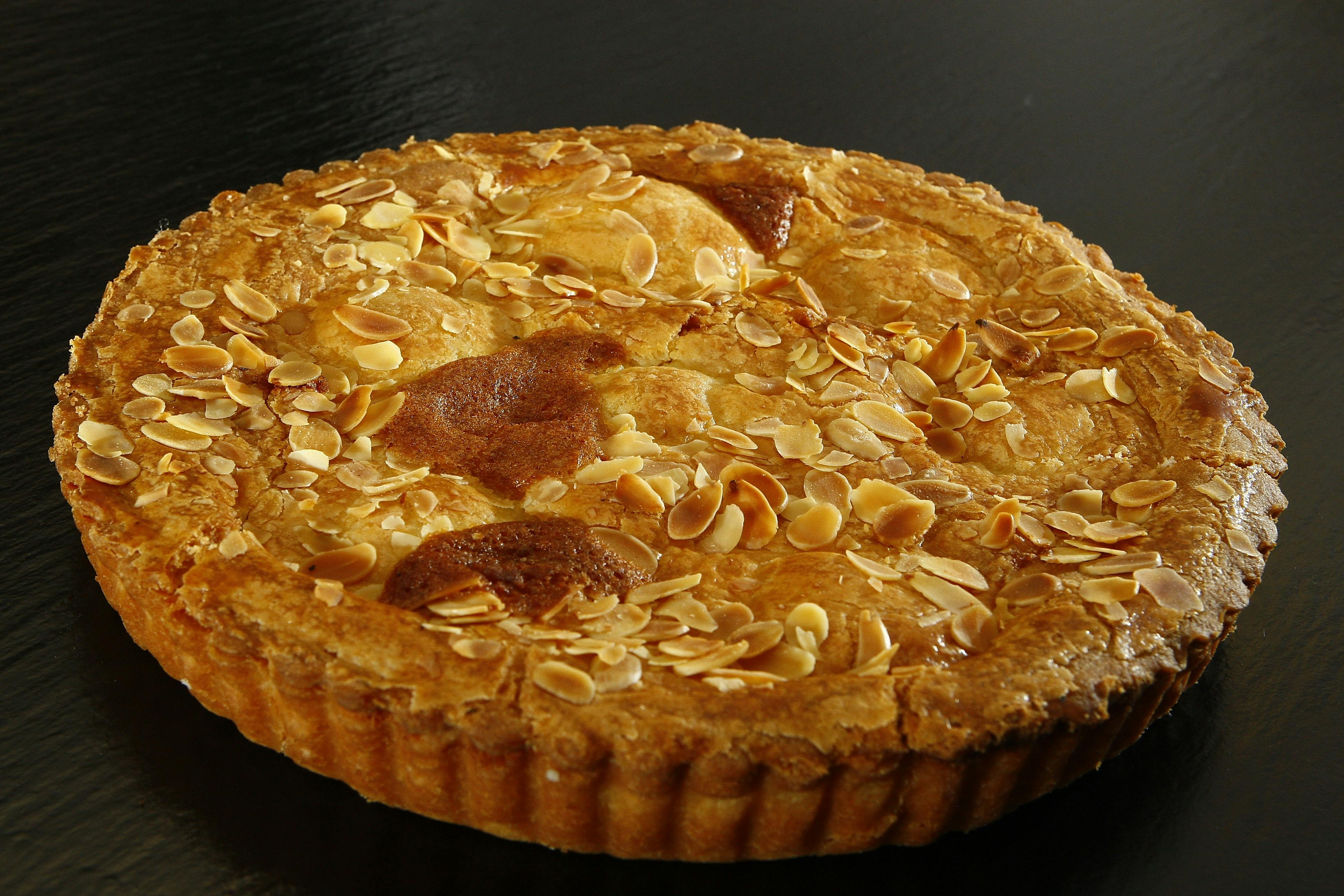
British
Bakewell Tart
The diets react (see scores below)
Common Ingredients
- shortcrust pastry
- raspberry jam
- butter
- sugar
- eggs
- ground almonds
- flour
- baking powder
- icing sugar
- water
Specific recipes may vary.
Incompatible with 11 of 11 diets
Diet Ratings
Bakewell Tart is fundamentally incompatible with a ketogenic diet. It contains multiple high-carb ingredients including shortcrust pastry (wheat flour), sugar, raspberry jam (high-sugar fruit preserve), icing sugar, and additional flour — all of which are strictly prohibited on keto. A single standard slice would contain well over 50g of net carbs, easily blowing the entire daily keto carb allowance. While ground almonds are keto-friendly and butter and eggs are approved, they are completely overshadowed by the carbohydrate load from the pastry, jam, and sugar components. There is no meaningful portion size that would make this dish compatible with ketosis.
Bakewell Tart contains multiple animal-derived ingredients that make it incompatible with a vegan diet. Butter (dairy) is used in both the shortcrust pastry and the frangipane filling, and eggs are a core structural component of the almond filling. These are unambiguous animal products. While vegan versions of Bakewell Tart can be made by substituting plant-based butter and flax/chia eggs, the traditional recipe as listed here is clearly not vegan.
Bakewell Tart is fundamentally incompatible with the Paleo diet. The dish is built almost entirely on non-Paleo ingredients: shortcrust pastry contains wheat flour, which is a grain and strictly excluded; additional flour and baking powder compound the grain violations; refined sugar and icing sugar are processed sweeteners that are explicitly forbidden; and butter is a dairy product. Raspberry jam typically contains refined sugar as well. While eggs and ground almonds are Paleo-approved, they are minor components in a dish that is otherwise a concentrated collection of Paleo exclusions. This is a highly processed, grain-and-sugar-based dessert with no meaningful adaptation possible without completely reconstructing the recipe.
Bakewell Tart is a British dessert that contradicts Mediterranean diet principles on multiple fronts. It is built on refined shortcrust pastry (refined grain), loaded with added sugars (granulated sugar, icing sugar, raspberry jam), and uses butter as its primary fat rather than olive oil. The overall composition is high in saturated fat, refined carbohydrates, and added sugars — exactly the categories the Mediterranean diet minimises. Ground almonds are the one redeeming ingredient, but their nutritional benefit is far outweighed by the surrounding components. This is a highly processed, sugar-forward confection with no meaningful place in a Mediterranean dietary pattern.
Bakewell Tart is almost entirely plant-derived and heavily processed, making it completely incompatible with the carnivore diet. The dish consists of shortcrust pastry (flour, plant fat), raspberry jam (fruit and sugar), ground almonds (nuts), sugar, flour, baking powder, icing sugar, and water — all of which are explicitly excluded from carnivore. The only animal-derived ingredients are butter and eggs, which appear in minor roles within an otherwise entirely plant-based and sugar-laden dessert. There is no meaningful animal protein, the carbohydrate load is extreme, and the food is classified as a processed baked good with multiple anti-carnivore ingredients.
Bakewell Tart contains multiple excluded ingredients that make it wholly incompatible with Whole30. Shortcrust pastry and flour are grain-based (wheat), which is explicitly excluded. Sugar and icing sugar are added sugars, also explicitly excluded. Butter (not ghee or clarified butter) is a dairy product and excluded. Raspberry jam typically contains added sugar. Beyond individual ingredients, this dish is a classic baked good/dessert pastry — exactly the category Whole30 Rule 4 prohibits even when compliant ingredients might theoretically be substituted. There is no compliant version of a Bakewell Tart possible within the program.
Bakewell Tart contains multiple high-FODMAP ingredients that make it unsuitable during the elimination phase. The shortcrust pastry is made with wheat flour, which is high in fructans — a key FODMAP to avoid. The recipe also lists additional flour, compounding the fructan load. Raspberry jam, while raspberries themselves are low-FODMAP at small servings (30g), commercial jams are often made with high-fructose corn syrup or large quantities of fruit, and the concentrated serving in a tart could push fructose levels into high-FODMAP territory. Ground almonds are low-FODMAP at around 24g (2 tablespoons), but almond meal/ground almonds in the frangipane filling of a Bakewell Tart is typically used in much larger quantities (often 100g+ for a whole tart), which would be high-FODMAP per serve due to GOS and excess fructose at higher amounts. Butter, sugar, eggs, baking powder, icing sugar, and water are all low-FODMAP and do not contribute concern. The wheat flour components alone make this a clear avoid during elimination phase.
Bakewell Tart is a classic British dessert that conflicts with DASH diet principles on multiple fronts. The shortcrust pastry is made with refined flour and high saturated fat content (typically butter or lard). The filling combines butter, sugar, and ground almonds in a frangipane that is calorie-dense and high in saturated fat. Raspberry jam adds significant added sugar. The icing sugar glaze further loads the dish with refined sugar. There are no meaningful sources of potassium, calcium, magnesium, or fiber. The dish is high in saturated fat from butter used in both pastry and filling, high in added sugars from jam, sugar, and icing, made from refined (not whole grain) flour, and provides negligible DASH-beneficial nutrients. As a snack category item, portion control is difficult and the nutritional profile is antithetical to the DASH eating plan, which explicitly limits sweets, added sugars, and saturated fats.
Bakewell Tart is a classic British dessert that is fundamentally incompatible with Zone Diet principles. The macronutrient profile is dominated by high-glycemic carbohydrates (shortcrust pastry, sugar, raspberry jam, icing sugar, flour) and saturated fat (butter), with no meaningful lean protein source. The carbohydrate load is almost entirely high-glycemic — refined flour in the pastry, added sugars in the jam and icing sugar — which would spike insulin dramatically, precisely the hormonal response the Zone Diet is designed to prevent. The fat profile is primarily saturated (butter) rather than the monounsaturated fats (olive oil, avocado, almonds) that Zone favors. While ground almonds do provide some monounsaturated fat and modest protein, their contribution is overwhelmed by the sugar, butter, and refined flour. There is no lean protein block to anchor a Zone-balanced meal, and the carbohydrate-to-protein ratio is wildly out of the 40/30/30 target. Even a very small portion would deliver almost no useful Zone macros — the calories are essentially sugar and saturated fat. This is one of the rare foods that genuinely belongs in the 'avoid' category because its core composition (pure refined sugar + saturated fat + high-GI refined carbs) cannot be balanced into a Zone meal without reducing the portion to a nutritionally meaningless size.
Bakewell Tart is a classic British pastry dessert with a strongly pro-inflammatory nutritional profile. The shortcrust pastry is made from refined white flour and butter (saturated fat), providing a base high in refined carbohydrates with minimal fiber or micronutrient value. The filling relies heavily on butter (saturated fat), sugar, and icing sugar — multiple sources of added sugar that drive insulin response and promote inflammatory markers like CRP. Raspberry jam adds further concentrated sugar. Ground almonds are the one redeeming ingredient, offering vitamin E, healthy monounsaturated fats, and modest anti-inflammatory potential, but they are present in a context overwhelmed by pro-inflammatory components. The overall composition — refined flour, substantial butter, multiple layers of added sugar, and negligible fiber, polyphenols, or omega-3s — is squarely in the 'avoid' category under anti-inflammatory dietary principles. This is an occasional treat at best, not a food compatible with anti-inflammatory eating patterns.
Bakewell Tart is a poor fit for GLP-1 patients across nearly every scoring dimension. It is built on shortcrust pastry (high saturated fat, refined flour), butter (high saturated fat), sugar and icing sugar (high-glycaemic, empty calories), and raspberry jam (concentrated sugar). Ground almonds contribute modest healthy fat and a small amount of protein, but nowhere near enough to redeem the overall profile. The dish provides negligible dietary protein, minimal fiber, and a high calorie load dominated by refined carbohydrates and saturated fat. High fat content directly worsens the GLP-1 side effect profile — nausea, bloating, and reflux — because fat slows gastric emptying further on top of the medication's existing effect. The sugar load delivers empty calories at a stage where every calorie needs to carry nutritional value. There is no meaningful hydration support and the small-portion friendliness of a sweet pastry is undermined by the fact that even a small serving delivers the wrong macronutrients. This is a standard-category avoid with high confidence.
*See how scores were generated at our methodology page.
Nutritional profile
Six traits that cut across every diet.
Fiber & Plants
How much whole-plant food and fiber it delivers.
Healthy Fats
The quality of its fats (unsaturated, omega-3).
Whole / Unprocessed
How close it is to its natural, unprocessed form.
Gut Gentle
How easy it is on digestion (low FODMAP, few irritants).
Low Glycemic
How little it spikes your blood sugar.
Protein Density
How much protein it packs per calorie.
Controversy Index
Higher controversy = more disagreement between diets.