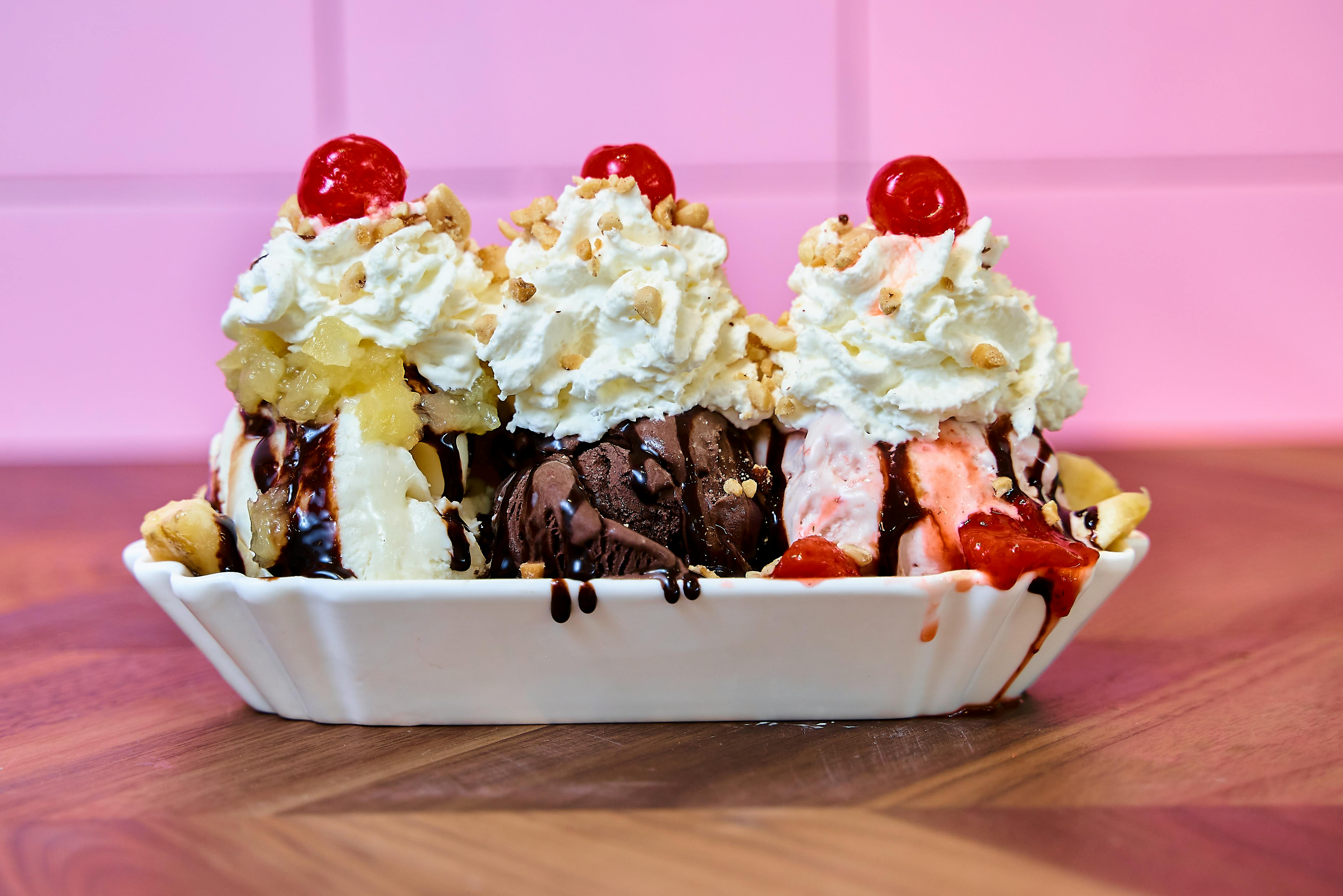
Photo: David Disponett / Pexels
American
Banana Split
The diets react (see scores below)
Common Ingredients
- banana
- vanilla ice cream
- chocolate ice cream
- strawberry ice cream
- chocolate sauce
- strawberry sauce
- pineapple sauce
- whipped cream
- maraschino cherry
- nuts
Specific recipes may vary.
Incompatible with 11 of 11 diets
Diet Ratings
A banana split is one of the most keto-incompatible desserts imaginable. A single banana alone contains approximately 24-27g of net carbs, instantly pushing most people near or over their daily limit. Combined with three scoops of sugar-laden ice cream (vanilla, chocolate, strawberry), three sugar-based sauces (chocolate, strawberry, pineapple), maraschino cherries (heavily sweetened), and whipped cream, the total net carb load easily exceeds 100-150g per serving — three to seven times the entire daily keto allowance. Every single major component (banana, ice creams, sauces, cherry) contains significant added sugars or high-glycemic carbohydrates. The only marginally keto-friendly ingredient is the nuts, which are a negligible positive in this context. This dish would immediately and completely break ketosis.
A classic Banana Split contains multiple dairy-based ingredients that are definitively non-vegan. The vanilla, chocolate, and strawberry ice creams are all made from dairy milk and cream. Whipped cream is also a dairy product. Maraschino cherries are plant-based, the banana is plant-based, and nuts are plant-based, but the core components of this dessert — three scoops of dairy ice cream and whipped cream — are animal-derived. While fully vegan versions of this dish can be constructed using plant-based ice cream and coconut whipped cream, the default/standard Banana Split as listed contains animal products and is not vegan-compatible.
A banana split is almost entirely composed of non-paleo ingredients. The three ice cream flavors are dairy-based and contain refined sugar — both strictly excluded from the paleo diet. The chocolate, strawberry, and pineapple sauces are heavily processed and loaded with refined sugar, corn syrup, and artificial additives. Whipped cream is dairy. Maraschino cherries are heavily processed, artificially dyed, and soaked in sugar syrup — far removed from their natural form. While the banana itself and the nuts are paleo-approved, they are minor components surrounded by a dessert built almost entirely on dairy, refined sugar, and processed ingredients. This dish is incompatible with paleo principles in any meaningful sense.
A Banana Split is fundamentally incompatible with Mediterranean diet principles. While the banana itself is a whole fruit aligned with the diet, the dish is dominated by multiple scoops of ice cream (high in saturated fat and added sugars), multiple sugar-laden sauces (chocolate, strawberry, pineapple), whipped cream, and a maraschino cherry (heavily processed with added sugars and dyes). This is a high-sugar, high-saturated-fat dessert with minimal nutritional value beyond the fruit. Mediterranean diet guidelines explicitly minimize added sugars, refined dairy products in large quantities, and highly processed foods — all of which are central to this dish. The only redeeming element is the banana and possibly the nuts, but these are overwhelmed by the surrounding ingredients.
A Banana Split is almost entirely plant-based and heavily processed, making it one of the most incompatible foods imaginable with the carnivore diet. The dish is built around a banana (fruit), three flavors of ice cream laden with sugar, plant-derived syrups (chocolate, strawberry, pineapple), whipped cream (which may contain additives and sugar), a maraschino cherry (heavily processed fruit soaked in sugar syrup), and nuts (plant seeds). Even the whipped cream, the only nominally animal-derived ingredient, is sweetened and processed. There is no meaningful animal protein or fat present in carnivore-acceptable form. Every primary component — fruit, sugar, plant oils, syrups, processed toppings — is explicitly excluded under all tiers of the carnivore diet, including the most lenient 'animal-based' interpretations.
A banana split is entirely incompatible with Whole30. It contains multiple excluded ingredients: ice cream (dairy), whipped cream (dairy), chocolate sauce (added sugar), strawberry sauce (added sugar), pineapple sauce (added sugar), and maraschino cherries (added sugar, artificial coloring). The only compliant ingredient is the banana itself. This dish is essentially a collection of excluded foods and represents the exact type of indulgent treat the Whole30 program is designed to eliminate.
A banana split contains multiple high-FODMAP ingredients that make it unsuitable during the elimination phase. A whole banana (typically one medium banana) is high-FODMAP due to excess fructose and fructooligosaccharides — Monash rates unripe bananas as low-FODMAP only at one small (100g) firm banana, but a ripe banana used in a banana split is high-FODMAP. The three ice creams (vanilla, chocolate, strawberry) are all dairy-based and contain significant lactose, which is a major FODMAP. Chocolate sauce frequently contains high-fructose corn syrup or excess fructose. Strawberry sauce and pineapple sauce are often concentrated with excess fructose and may contain high-FODMAP fruits in large quantities — pineapple in particular is borderline, and concentrated sauces push it over the threshold. Maraschino cherries are high-FODMAP due to polyols (sorbitol) naturally present in cherries plus added sugars. Whipped cream adds more lactose. Even setting aside individual ingredients, the cumulative FODMAP load of this dish is extremely high. There is virtually no scenario in which a standard banana split is appropriate during the elimination phase.
A banana split is fundamentally incompatible with DASH diet principles despite containing one DASH-friendly ingredient (banana). The dish is dominated by full-fat dairy ice cream (three scoops), which is high in saturated fat and added sugar — both explicitly limited by NIH/NHLBI DASH guidelines. The chocolate sauce, strawberry sauce, pineapple sauce, and whipped cream add substantial amounts of added sugar and saturated fat. Maraschino cherries are heavily processed with added sugar. The overall dish represents a high-calorie, high-saturated-fat, high-added-sugar dessert that directly conflicts with DASH's emphasis on limiting sweets and full-fat dairy. While the banana provides potassium and fiber, its DASH benefits are entirely overwhelmed by the other components. DASH guidelines explicitly limit sweets to 5 or fewer servings per week, and this single dish would consume that entire weekly allotment and more.
A banana split is one of the most Zone-incompatible foods imaginable. It is dominated by high-glycemic, high-sugar ingredients with virtually no lean protein, no favorable fat, and no low-glycemic carbohydrates. The banana itself is classified as an 'unfavorable' carb in Zone terminology due to its high glycemic index and sugar content. Three scoops of ice cream add enormous amounts of sugar and saturated fat. The chocolate, strawberry, and pineapple sauces are essentially pure sugar. Whipped cream adds more saturated fat. The maraschino cherry is sugar-preserved. The only remotely Zone-friendly element is the small amount of nuts, which provide monounsaturated fat — but they are a trivial component in an otherwise nutritionally catastrophic dish. There is no meaningful protein component to balance the macros. The 40/30/30 ratio is completely unachievable here: this dish is approximately 70-80% carbohydrates (mostly high-glycemic sugar), 15-20% fat (mostly saturated), and 3-5% protein. No reasonable portioning adjustment can redeem a banana split as a Zone snack — it would need to be deconstructed beyond recognition. This is a genuine 'avoid' under Zone methodology.
A banana split is dominated by pro-inflammatory ingredients across nearly every component. The three ice creams contribute high amounts of added sugar, saturated fat (from full-fat dairy), and often artificial flavors and stabilizers. The chocolate sauce, strawberry sauce, and pineapple sauce are typically high-fructose corn syrup or heavily sugared preparations. Whipped cream adds more saturated fat. Maraschino cherries are processed with sugar and artificial dyes, bearing little resemblance to the anti-inflammatory polyphenols found in fresh cherries. The only redemptive element is the banana, which provides potassium, vitamin B6, and some fiber, and depending on the nut type (walnuts would add omega-3s), there may be a small beneficial component. However, these positives are entirely overwhelmed by the sugar load, saturated fat, processed additives, and near-total absence of anti-inflammatory compounds in meaningful quantities. The overall glycemic impact is extreme, and high sugar intake is directly linked to elevated CRP and IL-6. This dish is essentially a concentrated delivery mechanism for ingredients the anti-inflammatory framework most strongly warns against.
A banana split is essentially everything a GLP-1 patient should avoid in a single dish. It is dominated by high-fat, high-sugar ice cream across three flavors, layered with multiple sugar-dense sauces (chocolate, strawberry, pineapple), whipped cream, and a maraschino cherry — all of which are empty calories with negligible protein or fiber. The only nutritionally meaningful ingredient is the banana, which contributes some fiber and potassium but is overwhelmed by the surrounding sugar load. A standard banana split delivers roughly 800-1,200 calories, 40-60g of fat, 120-180g of sugar, and fewer than 10g of protein. The high fat content will worsen GLP-1 side effects including nausea, bloating, and reflux due to slowed gastric emptying. The sugar spike followed by a crash directly undermines blood sugar stability. The nuts add a small amount of unsaturated fat and protein but are entirely insufficient to offset the overall nutritional profile. This dish fails on every GLP-1 dietary priority: low protein density, low fiber, very high fat, very high sugar, and extremely low nutrient density per calorie.
*See how scores were generated at our methodology page.
Nutritional profile
Six traits that cut across every diet.
Fiber & Plants
How much whole-plant food and fiber it delivers.
Healthy Fats
The quality of its fats (unsaturated, omega-3).
Whole / Unprocessed
How close it is to its natural, unprocessed form.
Gut Gentle
How easy it is on digestion (low FODMAP, few irritants).
Low Glycemic
How little it spikes your blood sugar.
Protein Density
How much protein it packs per calorie.
Controversy Index
Higher controversy = more disagreement between diets.