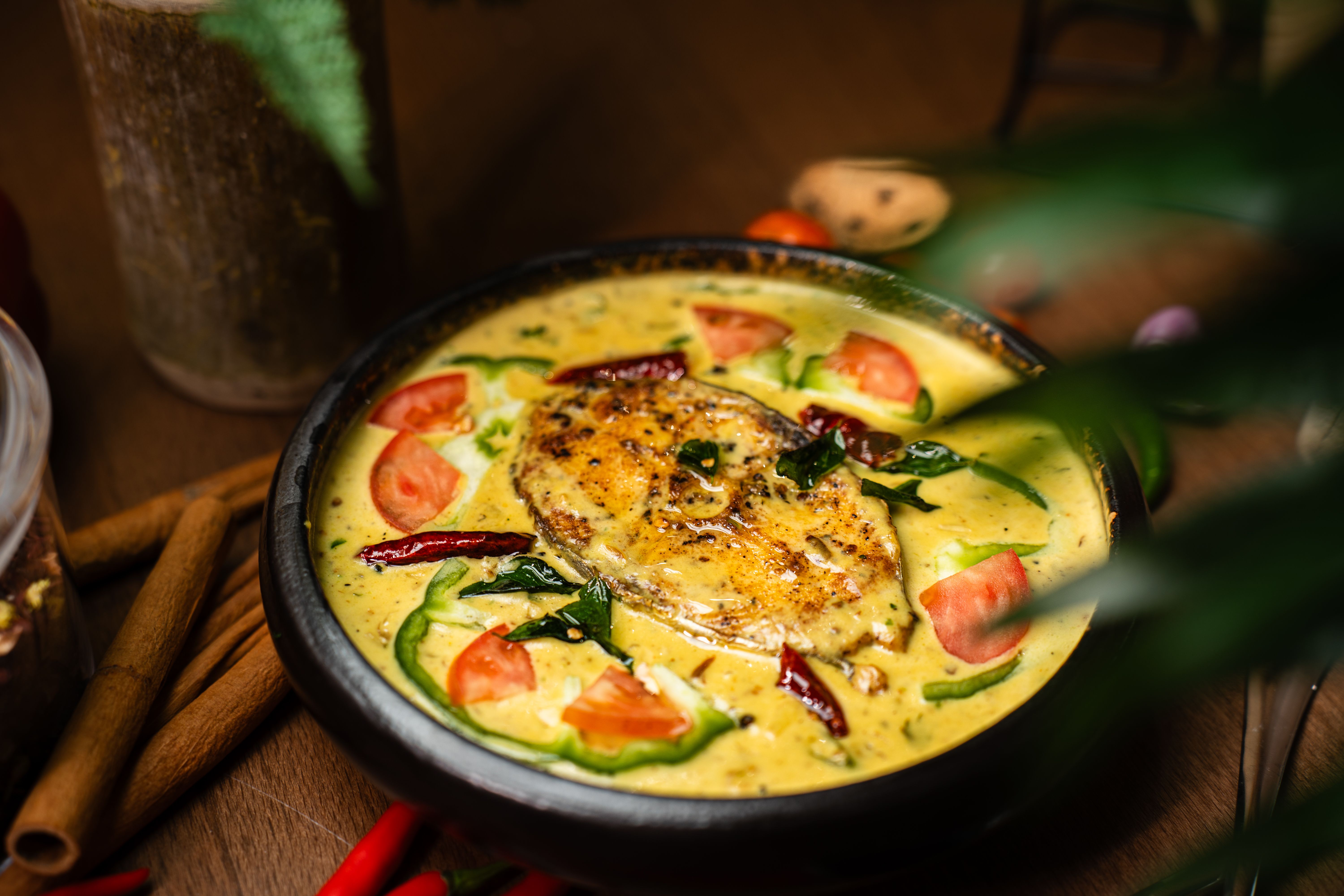
Photo: athul santhosh / Pexels
Bangladeshi
Ilish Bhapa
The diets react (see scores below)
Common Ingredients
- hilsa fish
- mustard seeds
- green chiles
- mustard oil
- turmeric
- yogurt
- salt
Specific recipes may vary.
Incompatible with 4 of 11 diets
Diet Ratings
Ilish Bhapa is a steamed hilsa fish dish that aligns well with ketogenic principles. Hilsa (ilish) is a fatty fish naturally rich in omega-3s, making it an excellent keto protein and fat source. Mustard oil is a healthy fat used in the dish. The core spices — mustard seeds, turmeric, green chiles — are negligible in carbs at culinary quantities. The main concern is yogurt, which contains lactose (milk sugar), but a typical serving of a few tablespoons contributes only 2-4g net carbs and is used as a marinade/sauce base rather than consumed in large volume. Overall net carbs per serving remain well within keto limits, and the fat-to-protein ratio is favorable given hilsa's natural oil content.
Strict or carnivore-adjacent keto practitioners may flag the yogurt due to its lactose content and potential insulin response, arguing that any dairy-derived sugars should be minimized; they might recommend substituting with heavy cream or simply omitting it. Additionally, some strict keto protocols caution against mustard seeds in larger quantities due to marginally higher carb content compared to pure oils or leafy greens.
Ilish Bhapa contains multiple animal-derived ingredients that make it entirely incompatible with a vegan diet. Hilsa fish is an animal product, and yogurt is a dairy product derived from animal milk. Both are explicitly excluded under vegan dietary rules. There is no ambiguity here — this dish is firmly in the 'avoid' category with no meaningful debate within the vegan community.
Ilish Bhapa contains three non-paleo ingredients: yogurt (dairy), mustard oil (a seed oil excluded under paleo guidelines), and salt (added salt is excluded). While the base of hilsa fish, mustard seeds, green chiles, and turmeric are fully paleo-approved, the combination of these three problematic ingredients pushes the dish firmly into avoid territory. Mustard oil is particularly notable as a seed/plant oil not on the approved oils list. Yogurt is dairy and excluded by most paleo frameworks. Added salt, while minor and debated in strictness, is technically excluded.
Some modern paleo practitioners, particularly those following a more flexible or ancestral health approach, tolerate small amounts of added salt as a mineral-rich condiment and may accept ghee or clarified fats in place of mustard oil. A strict swap of mustard oil for coconut oil and omission of yogurt and salt would make this dish paleo-compliant, and some practitioners might view these as minor infractions worth overlooking given the otherwise clean profile.
Ilish Bhapa is a steamed hilsa fish dish with mostly whole, minimally processed ingredients. Hilsa is a fatty fish rich in omega-3s, aligning well with the Mediterranean diet's emphasis on fish 2-3 times weekly. Mustard seeds, green chiles, turmeric, and yogurt are all whole, health-supportive ingredients. The main point of divergence from Mediterranean principles is the use of mustard oil rather than extra virgin olive oil as the primary fat. Mustard oil is not part of the Mediterranean tradition, though it is a monounsaturated-rich plant oil with its own health credentials. The small amount of yogurt is acceptable in moderation. Overall, this dish is nutrient-dense, fish-forward, and minimally processed.
Some Mediterranean diet purists would flag mustard oil as a non-canonical fat, arguing that only extra virgin olive oil qualifies as the primary cooking fat under strict Mediterranean guidelines. However, many modern integrative Mediterranean diet interpretations accept other plant-based oils with favorable fatty acid profiles, and mustard oil's high monounsaturated and omega-3 content makes it a reasonable functional substitute in cross-cultural contexts.
Ilish Bhapa is fundamentally incompatible with the carnivore diet despite containing carnivore-approved hilsa fish as its base. The dish contains multiple plant-derived ingredients that are strictly excluded: mustard seeds and mustard oil (plant oils/seeds), green chiles (plant food), and turmeric (plant spice). Yogurt is a dairy ingredient that is debated but generally tolerated by many carnivore practitioners, and salt is acceptable. However, the volume and centrality of plant-based components — particularly mustard seeds, mustard oil, green chiles, and turmeric — make this dish a clear 'avoid.' The hilsa fish itself would be a carnivore-approved food, but in this preparation it cannot be separated from its plant-based marinade and cooking medium. A carnivore-compatible version would require stripping the recipe down to just the fish, salt, and perhaps animal fat for cooking.
Ilish Bhapa contains yogurt, which is a dairy product and explicitly excluded on the Whole30 program. All other ingredients — hilsa fish, mustard seeds, green chiles, mustard oil, turmeric, and salt — are fully compliant. However, the yogurt alone disqualifies the dish as written. A modified version replacing yogurt with a compliant alternative (such as coconut milk or coconut cream) could make this dish Whole30-compatible.
Ilish Bhapa (steamed hilsa fish with mustard and yogurt) is mostly low-FODMAP, but the inclusion of yogurt introduces lactose as a significant concern during the elimination phase. Hilsa fish is a plain protein and fully low-FODMAP. Mustard seeds, mustard oil, turmeric, green chiles, and salt are all low-FODMAP at typical culinary quantities. The problem is yogurt: per Monash University, regular cow's milk yogurt is high-FODMAP due to lactose, even at modest servings (a standard serve of ~200g is high-FODMAP). The amount of yogurt used in Bhapa preparations varies — sometimes it's a marinade component (small quantity per serving), which may bring it closer to the low-FODMAP threshold (~42g or ~2 tablespoons per Monash), but traditional recipes often use enough yogurt that the per-serving lactose load becomes meaningful. This creates practical ambiguity around portion size. If lactose-free yogurt is substituted, the dish would likely score 8-9 and be approvable.
Monash University lists plain yogurt as high-FODMAP at a standard 200g serve but notes that small amounts (~42g) may be tolerated — if yogurt is used sparingly as a marinade and divided across multiple servings, some FODMAP practitioners might consider this dish borderline acceptable. However, strict elimination phase protocols typically advise avoiding all regular yogurt entirely to eliminate lactose as a variable, regardless of quantity.
Ilish Bhapa (steamed hilsa fish with mustard and yogurt) has several DASH-compatible elements: hilsa is a fatty fish rich in omega-3s, potassium, and protein, which aligns well with DASH's encouragement of fish consumption. Mustard seeds, turmeric, green chiles, and yogurt are generally acceptable or beneficial ingredients. However, two factors introduce caution: (1) Mustard oil is not explicitly endorsed by NIH DASH guidelines — it is high in erucic acid and while low in saturated fat, it is not among the DASH-recommended vegetable oils (canola, olive, safflower); its use is culturally standard in this dish but adds a layer of uncertainty. (2) Salt is added without specified quantity — traditional preparations can be moderately high in sodium, which requires portion awareness under DASH sodium limits. The yogurt used is typically full-fat in Bangladeshi cooking, which DASH guidelines specify should be low-fat. On balance, this is a reasonable fish dish that can fit into a DASH pattern with modifications (low-fat yogurt, measured salt, substituting canola oil), but as traditionally prepared it warrants moderation.
NIH DASH guidelines specify low-fat dairy and approved vegetable oils (not mustard oil), making the traditional preparation imperfect. However, updated clinical interpretations note that mustard oil's very low saturated fat content and favorable MUFA/PUFA profile may be functionally compatible with DASH principles, and emerging research is softening the strict low-fat dairy requirement as full-fat dairy has not consistently worsened cardiovascular outcomes.
Ilish Bhapa (steamed hilsa fish in mustard-yogurt sauce) has genuinely positive Zone attributes but requires careful portioning and pairing. Hilsa (ilish) is a fatty fish rich in omega-3 fatty acids, which aligns directly with Dr. Sears' anti-inflammatory emphasis on DHA/EPA. The yogurt provides a modest lean protein contribution and acts as a favorable dairy component. Turmeric and green chiles are polyphenol-rich, strongly anti-inflammatory, and essentially free in Zone block terms. However, mustard oil is the primary concern: it is high in erucic acid and omega-6 fatty acids compared to preferred monounsaturated sources like olive oil, and Dr. Sears' later anti-inflammatory writings specifically caution against omega-6-heavy oils. Additionally, hilsa is a significantly fattier fish than, say, cod or tilapia — while the fat is largely beneficial omega-3, the total fat content means the fat blocks add up quickly, potentially skewing the 30/30/40 ratio if portions aren't carefully controlled. The dish itself contains no carbohydrate component, so it must be paired with low-glycemic vegetables (e.g., sautéed spinach, cauliflower, or a green salad) to complete a Zone-balanced meal. As a protein-fat anchor for a Zone meal, it works well when portioned to ~3 oz of fish, but the mustard oil and high fat content of hilsa prevent a full 'approve' rating.
Some Zone practitioners and Sears' later work (e.g., 'The Mediterranean Zone') are more permissive about fatty fish even when oil types are suboptimal, arguing that the omega-3 content of hilsa effectively offsets concerns about mustard oil's fatty acid profile. In this view, the dish could score higher (7) as a protein-fat block anchor. Conversely, stricter Zone adherents following the original 'Enter the Zone' block system might rate the dish lower because mustard oil is not among Sears' explicitly recommended fat sources and the high fat density of hilsa requires very small portions to stay within fat block limits.
Ilish Bhapa is a steamed Bengali/Bangladeshi dish featuring hilsa (ilish) fish, which is one of the richest sources of omega-3 fatty acids among freshwater/estuarine fish — comparable in fatty acid profile to salmon. The omega-3 content alone makes this dish a strong anti-inflammatory candidate. Turmeric contributes curcumin, one of the most well-researched natural anti-inflammatory compounds. Green chiles provide capsaicin and vitamin C, both with anti-inflammatory properties. Mustard seeds contain selenium and omega-3 alpha-linolenic acid (ALA). Yogurt in small amounts (as used here as a binding/marinating agent) is acceptable under the moderate dairy category. The primary concern is mustard oil, which sits in a debated category — it is high in erucic acid and has a distinct fatty acid profile (high in monounsaturates and ALA, relatively low omega-6), and is traditionally used in South Asian cooking. While it is not extra virgin olive oil, it is not a seed oil high in omega-6, and its ALA content is notably anti-inflammatory. The overall dish is minimally processed, steamed rather than fried, and relies on whole ingredients with well-established anti-inflammatory properties.
Mustard oil is the main point of debate: it is banned for edible use in the US, Canada, and EU due to erucic acid content, and some anti-inflammatory practitioners would flag it as a concern. However, traditional use and emerging research suggest its high ALA and monounsaturated fat content may be net beneficial, and authorities like Dr. Weil generally permit traditional culinary oils used in moderation within culturally specific diets.
Ilish Bhapa (steamed hilsa fish in mustard-yogurt sauce) has genuine nutritional strengths for GLP-1 patients but requires meaningful caveats. Hilsa (Tenualosa ilisha) is a richly flavored fatty fish — an excellent source of omega-3 fatty acids and quality protein (~20-22g per 100g serving), which strongly supports the #1 priority. The steaming method (bhapa) is ideal for GLP-1 patients: no frying, no heavy oil bath, easy on a slowed digestive system. Yogurt adds a small protein boost and supports gut health. Turmeric has anti-inflammatory properties. However, hilsa is one of the fattiest freshwater fish available — total fat can reach 12-19g per 100g depending on season and specimen, significantly higher than lean proteins like chicken breast or cod. Mustard oil, while high in monounsaturated and omega-3 fats (erucic acid profile), is used in non-trivial quantities in authentic recipes and adds to the fat load. Green chiles may trigger nausea or reflux in GLP-1 patients who are sensitive to spice, particularly those in early weeks of treatment or dose escalation. The dish is low in fiber and carbohydrates, so pairing with a fiber source (lentils, vegetables) is necessary to meet daily targets. Portion sensitivity is important: a small serving (80-100g fish) keeps fat at a manageable level, but a full traditional portion could push fat high enough to worsen GLP-1 GI side effects.
Some GLP-1-focused dietitians would rate this higher, arguing that the fat in hilsa is predominantly omega-3 and omega-6 unsaturated fats — clinically distinct from saturated fat in red meat — and that the cardiovascular and anti-inflammatory benefits justify inclusion even at moderate portions. Others in the GLP-1 clinical community would rate it lower, noting that total fat content (regardless of type) is the primary driver of delayed gastric emptying complications and nausea, and that leaner fish (tilapia, cod, shrimp) are preferable until a patient is well-established on their dose and tolerating fats well.
*See how scores were generated at our methodology page.
Nutritional profile
Six traits that cut across every diet.
Fiber & Plants
How much whole-plant food and fiber it delivers.
Healthy Fats
The quality of its fats (unsaturated, omega-3).
Whole / Unprocessed
How close it is to its natural, unprocessed form.
Gut Gentle
How easy it is on digestion (low FODMAP, few irritants).
Low Glycemic
How little it spikes your blood sugar.
Protein Density
How much protein it packs per calorie.
Controversy Index
Higher controversy = more disagreement between diets.
Diet-Specific Tips
 Keto — 8/10
View tips
- Hilsa fish is naturally high in healthy omega-3 fats, ideal for keto macros
- Mustard oil adds additional healthy fat with negligible carbs
- Yogurt introduces a small amount of lactose (~2-4g net carbs per serving), manageable within keto limits
- Spices (turmeric, mustard seeds, green chiles) contribute minimal net carbs at cooking quantities
- No grains, added sugars, or starchy ingredients present
- Whole, minimally processed ingredients align with clean keto principles
 Mediterranean — 8/10
View tips
- Hilsa is a fatty fish rich in omega-3s, strongly aligned with Mediterranean fish emphasis
- Steaming is a healthy, minimal-processing cooking method
- Mustard oil replaces olive oil — not traditional Mediterranean, but a plant-based fat with healthy profile
- Mustard seeds, turmeric, green chiles are whole spices with no nutritional concerns
- Yogurt used in small amounts fits within moderate dairy allowance
- No refined grains, added sugars, or processed ingredients
 Low-FODMAP — 5/10
View tips
- Hilsa fish is a plain protein — fully low-FODMAP
- Yogurt contains lactose and is high-FODMAP at standard servings (>42g per Monash)
- Quantity of yogurt per serving determines FODMAP load — marinade use may be lower than a full serve
- Mustard seeds, mustard oil, turmeric, green chiles, and salt are all low-FODMAP
- Substituting lactose-free yogurt would make the dish elimination-phase safe
- Green chiles are low-FODMAP; note they are different from onion/garlic which are absent here
 DASH — 6/10
View tips
- Hilsa fish is rich in omega-3 fatty acids, protein, and potassium — core DASH-friendly nutrients
- Mustard oil is not among DASH-recommended oils (canola, olive, safflower) though it is low in saturated fat
- Full-fat yogurt deviates from DASH's low-fat or fat-free dairy specification
- Added salt quantity unspecified — traditional recipes can approach moderate-to-high sodium levels
- Mustard seeds, turmeric, and green chiles are low-sodium, anti-inflammatory spices consistent with DASH
- Steaming method (bhapa) is a heart-healthy cooking technique that avoids added fats from frying
- Dish can be made more DASH-compliant by using low-fat yogurt, reducing salt, and substituting canola oil
 Zone — 6/10
View tips
- Hilsa is rich in omega-3 fatty acids (DHA/EPA), strongly aligned with Zone anti-inflammatory principles
- Mustard oil is omega-6-heavy and not among Zone-preferred monounsaturated fats (olive oil, avocado, almonds)
- Hilsa is a high-fat fish — portion control is critical to avoid exceeding Zone fat block allotment
- Yogurt adds modest favorable lean protein and is a Zone-acceptable dairy ingredient
- Turmeric and green chiles are high-polyphenol ingredients, actively anti-inflammatory per Sears' framework
- Dish contains zero carbohydrate — must be paired with low-glycemic vegetables to complete a Zone meal
- No high-glycemic ingredients, processed components, or trans fats present
 Anti-Inflammatory — 8/10
View tips
- Hilsa fish is exceptionally rich in omega-3 fatty acids (EPA and DHA), strongly anti-inflammatory
- Turmeric provides curcumin, a well-documented anti-inflammatory and antioxidant compound
- Green chiles contribute capsaicin and vitamin C with anti-inflammatory properties
- Mustard seeds provide ALA (omega-3) and selenium
- Mustard oil is debated — high in erucic acid but also rich in ALA and monounsaturates; not a high-omega-6 seed oil
- Yogurt is used in small amounts as a marinade, acceptable in moderation
- Steaming method preserves nutrients and avoids adding inflammatory fats
- No processed ingredients, refined carbohydrates, added sugars, or trans fats
 GLP-1 Friendly — 5/10
View tips
- High omega-3 fatty fish — quality fat profile but high total fat content (12-19g per 100g), which may worsen GLP-1 GI side effects
- Steamed preparation (bhapa) is GLP-1-friendly — no frying, gentle on digestion
- Good protein source (~20-22g per 100g) supporting the #1 GLP-1 dietary priority
- Mustard oil adds additional fat load — unsaturated profile is favorable but quantity matters
- Green chiles may trigger nausea or reflux, particularly in early treatment or dose-escalation phases
- Low fiber — must be paired with vegetables, lentils, or whole grains to meet daily fiber targets
- Portion-sensitive: small servings (80-100g) are manageable; large traditional portions may be problematic
- Yogurt base is a positive addition — mild probiotic benefit and small protein contribution