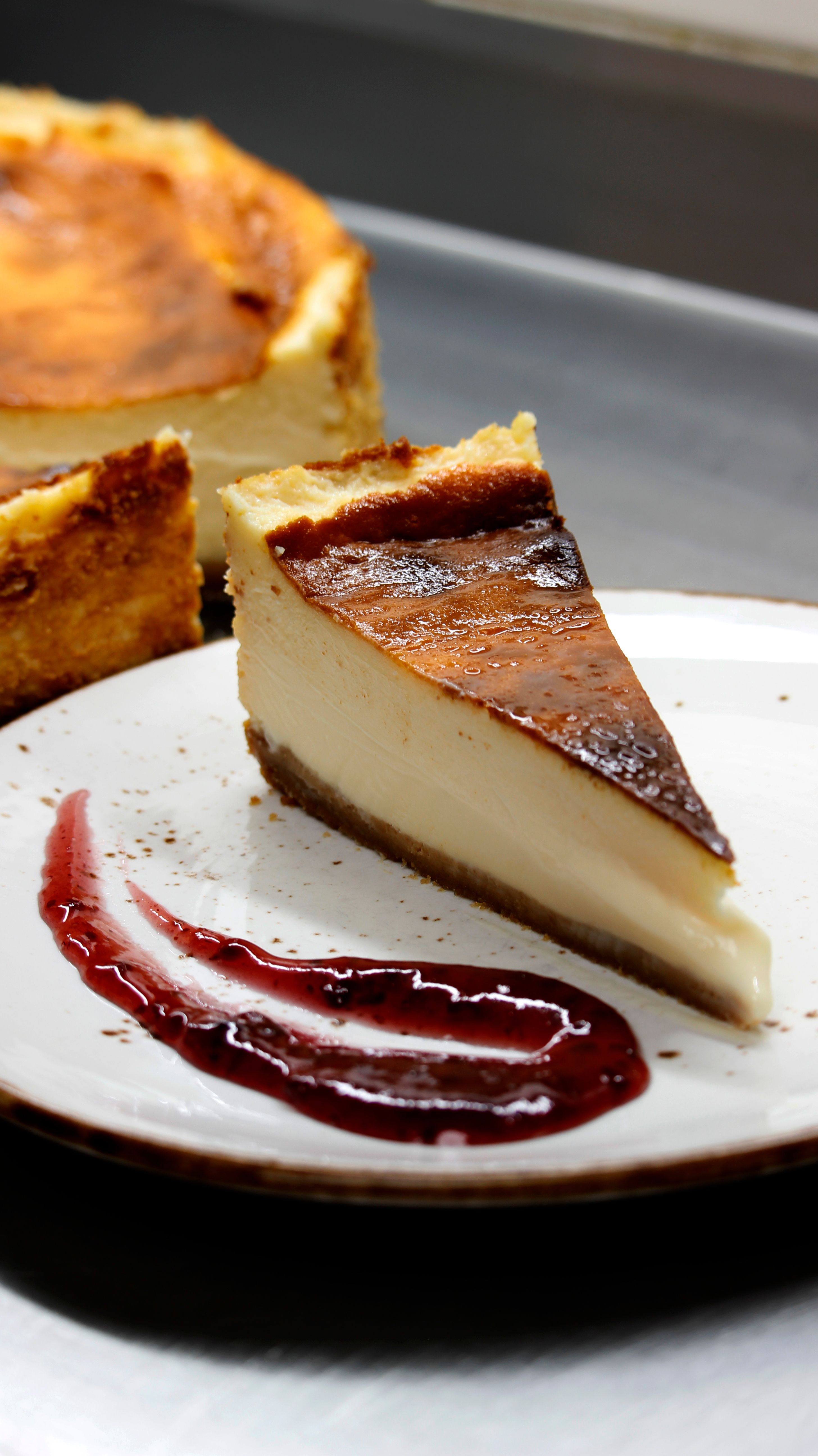
Photo: Pablo Rodríguez / Pexels
Spanish
Basque Cheesecake
The diets react (see scores below)
Common Ingredients
- cream cheese
- eggs
- sugar
- butter
- parchment paper
Specific recipes may vary.
Incompatible with 11 of 11 diets
Diet Ratings
Basque cheesecake contains significant added sugar as a core ingredient, making it fundamentally incompatible with ketogenic eating. A standard slice can easily contain 20-35g of net carbs from sugar alone, which can consume or exceed the entire daily carb allowance in a single serving. While cream cheese, eggs, and butter are individually keto-friendly ingredients, the sugar content disqualifies this dessert in its traditional form. Parchment paper is non-nutritive. There is no meaningful portion size that would make a standard Basque cheesecake keto-compatible.
Basque Cheesecake contains multiple animal-derived ingredients that are entirely incompatible with a vegan diet. Cream cheese is a dairy product, eggs are an animal product, and butter is dairy-derived. All three are core structural components of this dish — not trace ingredients or additives — making it impossible to classify this as vegan in any meaningful sense. There is no ambiguity here within vegan discourse.
Basque Cheesecake is fundamentally incompatible with the Paleo diet. The primary protein and base ingredient is cream cheese, a dairy product explicitly excluded from Paleo. Refined sugar is a core ingredient and is strictly prohibited. Butter, while sometimes debated, is still a dairy derivative that most paleo authorities discourage. There are no gray-area ingredients here that could redeem the dish — the entire recipe is built around non-Paleo foods. Parchment paper is a cooking tool, not an ingredient, and eggs are the only Paleo-compliant component present.
Basque Cheesecake is a rich dessert built around cream cheese, butter, eggs, and sugar — a combination that directly contradicts Mediterranean diet principles. The dish is high in saturated fat from cream cheese and butter, contains significant added sugar, and has no meaningful plant-based components. Butter is not a Mediterranean fat (olive oil is), and cream cheese is a heavily processed dairy product far removed from the traditional fermented dairy (yogurt, aged cheeses in small amounts) that appears occasionally in Mediterranean eating. The high sugar content places this firmly in the 'avoid' category for added sugars. While eggs and dairy are not categorically excluded from the Mediterranean diet, this dessert combines them in quantities and with ingredients (butter, added sugar, processed cream cheese) that contradict the diet's core principles.
Basque Cheesecake is fundamentally incompatible with the carnivore diet. While it contains some animal-derived ingredients (cream cheese, eggs, butter), it is defined by sugar as a core ingredient — a processed, plant-derived sweetener that is explicitly excluded under all carnivore frameworks. Sugar alone disqualifies this dish regardless of its other components. Additionally, parchment paper is not a food ingredient, and the dessert format itself is oriented around sweetness rather than animal nutrition. Even the most permissive carnivore practitioners (Saladino's animal-based approach) would not sanction refined sugar in this quantity. This is a processed dessert, not an animal food.
Basque Cheesecake contains multiple excluded ingredients that make it entirely incompatible with Whole30. Cream cheese is dairy (excluded), sugar is added sugar (excluded), and butter is dairy (excluded — only ghee/clarified butter is the dairy exception). Beyond the individual ingredients, this dish is a cheesecake — a classic baked dessert — which directly violates the Whole30 rule against recreating baked goods and sweets, even if compliant ingredients were hypothetically substituted.
Basque cheesecake's primary FODMAP concern is cream cheese. Monash University rates cream cheese as low-FODMAP at 2 tablespoons (40g) but high-FODMAP at larger servings due to lactose content. A standard slice of Basque cheesecake will contain significantly more cream cheese than this threshold — a typical recipe uses 500-900g of cream cheese divided into 8-12 slices, meaning each slice could contain 60-110g of cream cheese, well above the 40g low-FODMAP limit. Eggs, sugar, and butter are all low-FODMAP with no meaningful FODMAP content. The dish notably lacks wheat flour (a key distinction from New York-style cheesecake), so fructans are not a concern. The FODMAP risk here is entirely lactose-driven from the cream cheese at realistic serving sizes.
Monash University technically approves cream cheese at the 40g threshold, which might suggest small portions of this cheesecake could be tolerated; however, clinical FODMAP practitioners would likely advise avoiding a standard slice during strict elimination phase because the cream cheese load per serving almost certainly exceeds the safe threshold, and lactose sensitivity is common among the IBS population this diet targets.
Basque Cheesecake is fundamentally incompatible with DASH diet principles. Its primary ingredients — full-fat cream cheese, butter, and sugar — directly conflict with multiple DASH guidelines simultaneously. Full-fat cream cheese and butter are high in saturated fat, which DASH explicitly limits. The dish is high in added sugar, another category DASH restricts. Full-fat dairy is specifically excluded under DASH in favor of fat-free or low-fat alternatives. Together, these ingredients create a dessert that is calorie-dense, high in saturated fat, and high in added sugar with negligible amounts of the nutrients DASH emphasizes: potassium, magnesium, fiber, and calcium in bioavailable, low-fat form. While eggs have become more accepted in updated DASH-aligned guidance, they are the least problematic ingredient here. This dish offers no meaningful contribution to DASH dietary goals and represents exactly the type of food the plan discourages.
Basque cheesecake is fundamentally incompatible with Zone Diet principles. The macronutrient profile is severely imbalanced: it is dominated by saturated fat (cream cheese, butter) and high-glycemic simple sugar, with minimal protein relative to the fat and carbohydrate load. There are no low-glycemic vegetables or fruits, no lean protein sources, and no monounsaturated fats. The primary carbohydrate source is refined sugar, which is one of the few foods Dr. Sears explicitly categorizes as unfavorable to the point of near-exclusion. The saturated fat from both cream cheese and butter is exactly what the Zone aims to minimize. Even in very small portions, this dessert cannot be easily integrated into a Zone block structure without dramatically distorting the 40/30/30 ratio — the fat blocks would far outpace protein blocks, and the carbohydrate blocks would come entirely from high-glycemic sugar. As a snack, it provides essentially no Zone-favorable nutritional value and would disrupt hormonal balance (insulin and eicosanoid signaling) in ways directly contrary to the Zone's anti-inflammatory goals.
Basque cheesecake is composed almost entirely of ingredients that anti-inflammatory guidelines recommend limiting or avoiding. Cream cheese is a high-fat, full-fat dairy product high in saturated fat, which is consistently flagged as pro-inflammatory across anti-inflammatory frameworks. Butter adds additional saturated fat. Added sugar (a primary ingredient) is one of the clearest drivers of inflammatory markers like CRP and IL-6 in the research literature. Eggs are a moderate ingredient with mixed signals, but they are not enough to redeem this dish. The dish contains no fiber, no omega-3s, no antioxidants, no polyphenols, and no phytonutrients of note. There is nothing here from the anti-inflammatory 'emphasize' category. Occasional consumption as a true indulgence would not be catastrophic for an otherwise strong anti-inflammatory diet, but as a regular snack this dish is clearly misaligned with anti-inflammatory principles on multiple fronts simultaneously.
Basque cheesecake is a poor fit for GLP-1 patients. It is a dessert composed almost entirely of cream cheese, butter, eggs, and sugar — delivering very high saturated fat, high sugar, and modest protein relative to its calorie load. A typical slice (100-120g) contains roughly 350-400 calories, 25-30g fat (largely saturated), 20-25g sugar, and only 6-8g protein with negligible fiber. This violates nearly every GLP-1 dietary priority: fat content worsens nausea and reflux by further slowing gastric emptying on top of the medication's effect, the high sugar load spikes blood glucose and delivers empty calories, fiber is essentially zero, and nutrient density per calorie is extremely low. The combination of high fat and high sugar in a single serving is particularly problematic. While eggs provide some nutritional value, they are overwhelmed by the cream cheese and butter content. This food offers no meaningful hydration, no fiber benefit, and poor protein density for its calorie cost — exactly the profile that GLP-1 patients should avoid.
*See how scores were generated at our methodology page.
Nutritional profile
Six traits that cut across every diet.
Fiber & Plants
How much whole-plant food and fiber it delivers.
Healthy Fats
The quality of its fats (unsaturated, omega-3).
Whole / Unprocessed
How close it is to its natural, unprocessed form.
Gut Gentle
How easy it is on digestion (low FODMAP, few irritants).
Low Glycemic
How little it spikes your blood sugar.
Protein Density
How much protein it packs per calorie.
Controversy Index
Higher controversy = more disagreement between diets.