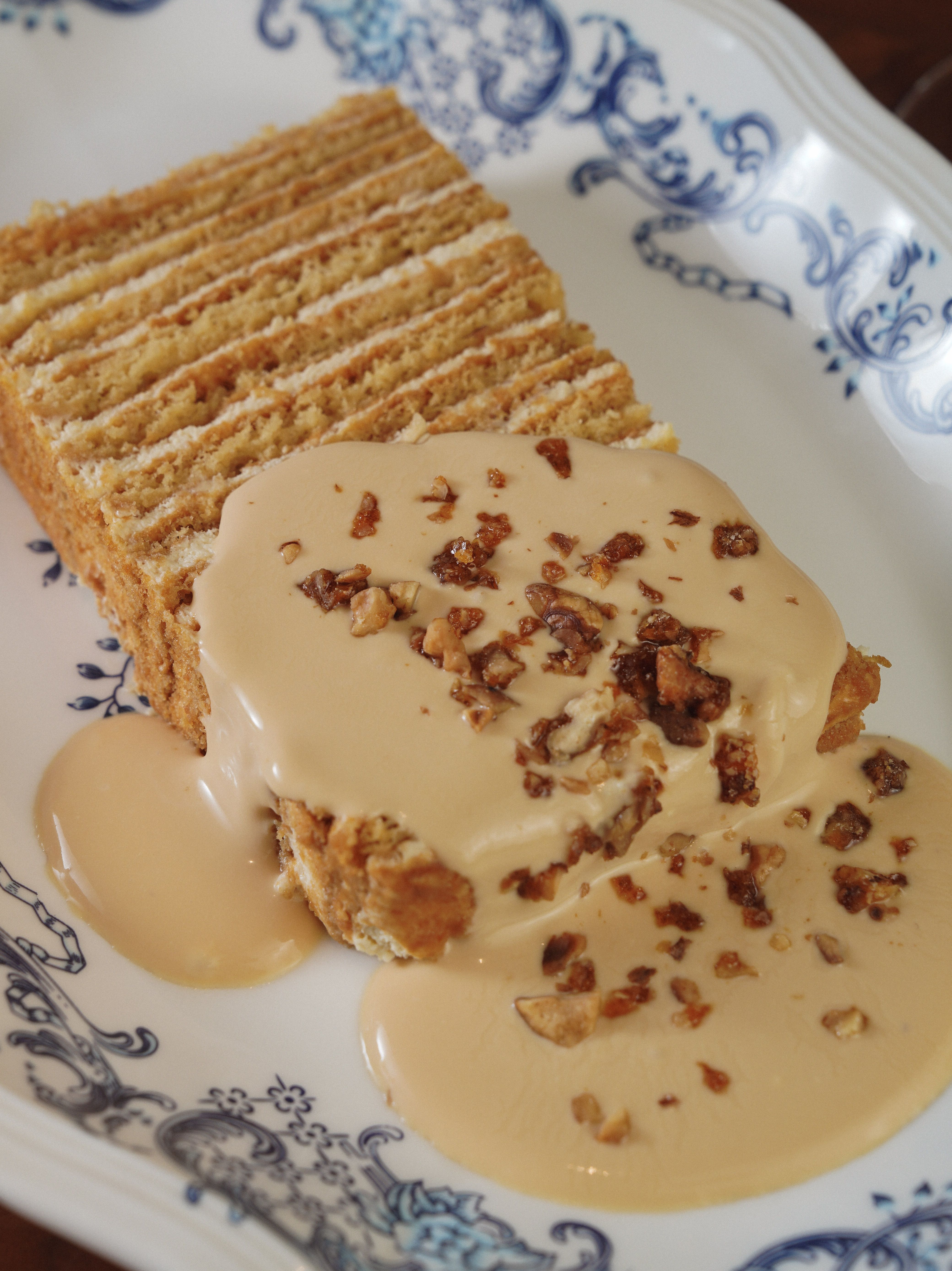
The diets react (see scores below)
Common Ingredients
- flour
- butter
- sugar
- eggs
- milk
- baking powder
- vanilla
- chocolate
- almonds
Specific recipes may vary.
Incompatible with 11 of 11 diets
Diet Ratings
Baumkuchen is a traditional German layered cake built on a foundation of wheat flour and sugar — two ingredients that are fundamentally incompatible with ketogenic eating. A standard serving delivers a very high net carb load from both refined flour and added sugar, easily exceeding the entire daily keto carb budget in a single slice. While butter and eggs are keto-friendly components, and almonds offer some fat and fiber, they do not offset the dominant carbohydrate content from flour, sugar, and milk. Chocolate coatings typically add further sugar. There is no realistic portion size that makes this dish compatible with maintaining ketosis.
Baumkuchen contains multiple animal-derived ingredients that disqualify it from a vegan diet. Butter and milk are dairy products, and eggs are explicitly excluded under all vegan frameworks. These are not trace contaminants or cross-contamination risks — they are core, structural ingredients without which the dish cannot be made in its traditional form. The remaining ingredients (flour, sugar, baking powder, vanilla, chocolate, almonds) could individually be vegan-compliant, but the butter, milk, and eggs make this dish clearly non-vegan.
Baumkuchen is a traditional German layered cake that is fundamentally incompatible with the Paleo diet. The recipe is built almost entirely on non-Paleo ingredients: wheat flour (a grain), refined sugar, dairy milk, and butter — all of which are explicitly excluded. Baking powder typically contains cornstarch and other additives. Chocolate in a conventional baked good context likely contains added sugar and dairy. While eggs and almonds are Paleo-approved, they are minor supporting ingredients in an otherwise completely non-compliant dish. There is no meaningful way to adapt the core identity of Baumkuchen within strict Paleo guidelines.
Baumkuchen is a traditional German layered cake that directly contradicts Mediterranean diet principles across multiple dimensions. It is built primarily on refined white flour and substantial amounts of added sugar, both of which the Mediterranean diet discourages strongly. Butter is the primary fat rather than extra virgin olive oil, and it is used in large quantities, contributing significant saturated fat. While eggs, milk, and almonds have some place in the Mediterranean framework, they are ancillary to a base that is essentially a refined-grain, high-sugar confection. Chocolate adds further sugar. This is a classic processed dessert/snack with minimal nutritional alignment to the Mediterranean pattern.
Baumkuchen is a traditional German layered cake that is almost entirely plant-derived and processed. Its ingredient list — flour, sugar, baking powder, vanilla, chocolate, and almonds — represents multiple categories of foods explicitly excluded from the carnivore diet. While it does contain some animal-derived ingredients (butter, eggs, milk), these are minor components in a dish that is fundamentally a grain-based, sugar-laden confection. There is no meaningful protein from animal sources, and the carbohydrate load from flour and sugar alone makes this entirely incompatible with carnivore principles. No carnivore authority or protocol would endorse this food.
Baumkuchen contains multiple excluded ingredients: flour (a grain), butter (dairy — only ghee/clarified butter is allowed), sugar (added sugar), and milk (dairy). Even if all ingredients were somehow compliant, Baumkuchen is a layered cake — a classic baked good that falls squarely into the 'no recreating baked goods' rule. This dish is disqualified on multiple fronts with no ambiguity.
Baumkuchen is a traditional German layered cake made primarily with wheat flour, which is high in fructans — one of the most problematic FODMAPs during the elimination phase. A standard serving of Baumkuchen would contain a significant amount of wheat flour, making it clearly high-FODMAP. Additionally, milk contributes lactose (a disaccharide FODMAP), and while butter and eggs are low-FODMAP, they do not offset the major FODMAP sources. Almonds become high-FODMAP at servings above approximately 10 whole almonds, and given their presence in Baumkuchen (often as a coating or incorporated into the batter), they add further FODMAP risk. Chocolate, depending on type and quantity, can also contribute polyols or excess fructose. The combination of wheat flour and milk alone makes this dish firmly in the 'avoid' category during the elimination phase at any standard serving size.
Baumkuchen is a rich German layered cake made primarily from butter, sugar, flour, eggs, milk, and chocolate — a combination that places it firmly outside DASH diet recommendations. It is high in saturated fat (butter, chocolate), high in added sugars, and made with refined white flour offering minimal fiber. While it contains almonds (a DASH-friendly nut), they appear in insufficient quantity to meaningfully offset the nutritional negatives. The dish provides little to no potassium, magnesium, calcium, or fiber relative to its caloric density. DASH guidelines explicitly limit sweets, added sugars, and foods high in saturated fat, all of which are central to this confection.
Baumkuchen is a traditional German layered cake whose macronutrient profile is fundamentally incompatible with Zone Diet principles. The dominant ingredients — flour, butter, sugar, and chocolate — combine to create a high-glycemic, high-saturated-fat, protein-deficient food. The carbohydrate load comes almost entirely from refined flour and sugar, both of which are among the most 'unfavorable' sources in Zone terminology due to their high glycemic index and lack of fiber. Butter and chocolate contribute significant saturated fat rather than the monounsaturated fat the Zone prioritizes. While eggs and almonds offer small amounts of protein and favorable fat respectively, they are minor players in this formulation and cannot rescue the overall macro balance. A typical serving would be heavily skewed toward carbohydrates and saturated fats with negligible lean protein, making it essentially impossible to incorporate as a Zone block without consuming such a tiny portion that it provides no satiety or nutritional value. This is a dessert/snack that functions like a confection — close to the 'pure sugar and refined carb' category the Zone treats as genuinely avoidable rather than merely requiring portioning.
Baumkuchen is a traditional German layered cake whose ingredient profile is predominantly pro-inflammatory by anti-inflammatory diet standards. Refined white flour provides little fiber and has a high glycemic index, driving blood sugar spikes and associated inflammatory cascades. Butter contributes significant saturated fat, which at high intake is linked to elevated inflammatory markers. Sugar is a primary ingredient and is one of the most well-established drivers of inflammation, promoting elevated CRP and IL-6. The milk adds additional saturated fat and is of limited anti-inflammatory value. While eggs offer some choline and selenium, and almonds provide vitamin E, healthy monounsaturated fats, and modest anti-inflammatory benefit, and dark chocolate may contribute polyphenols — these positive elements are minor fractions of the overall dish and are swamped by the high refined carbohydrate and saturated fat load. Baking powder is neutral. Vanilla has minor antioxidant properties but is not a meaningful anti-inflammatory contributor at culinary quantities. As a snack item, this dish delivers little satiety from fiber or protein, making it easy to overconsume the inflammatory components. Occasional consumption would not be catastrophic, but this food offers no meaningful anti-inflammatory benefit and is dominated by ingredients that anti-inflammatory frameworks consistently flag.
Baumkuchen is a traditional German layered cake built on flour, butter, sugar, eggs, and milk — a composition that is nearly the inverse of what GLP-1 patients need. It is calorie-dense with empty carbohydrates from refined flour and sugar, high in saturated fat from butter, and provides negligible protein or fiber per serving. The chocolate coating adds further sugar and saturated fat, and while almonds offer a small amount of protein and healthy fat, their quantity in a standard slice is nutritionally insignificant. GLP-1 patients have sharply reduced appetite and caloric intake, meaning every bite must deliver meaningful nutrition — protein, fiber, and micronutrients. Baumkuchen delivers almost none of these. It is also high in fat, which worsens GLP-1 side effects including nausea, bloating, and delayed gastric emptying. As a snack category item, it competes directly against high-protein, high-fiber options that would far better support muscle preservation, satiety, and GI tolerance.
*See how scores were generated at our methodology page.
Nutritional profile
Six traits that cut across every diet.
Fiber & Plants
How much whole-plant food and fiber it delivers.
Healthy Fats
The quality of its fats (unsaturated, omega-3).
Whole / Unprocessed
How close it is to its natural, unprocessed form.
Gut Gentle
How easy it is on digestion (low FODMAP, few irritants).
Low Glycemic
How little it spikes your blood sugar.
Protein Density
How much protein it packs per calorie.
Controversy Index
Higher controversy = more disagreement between diets.