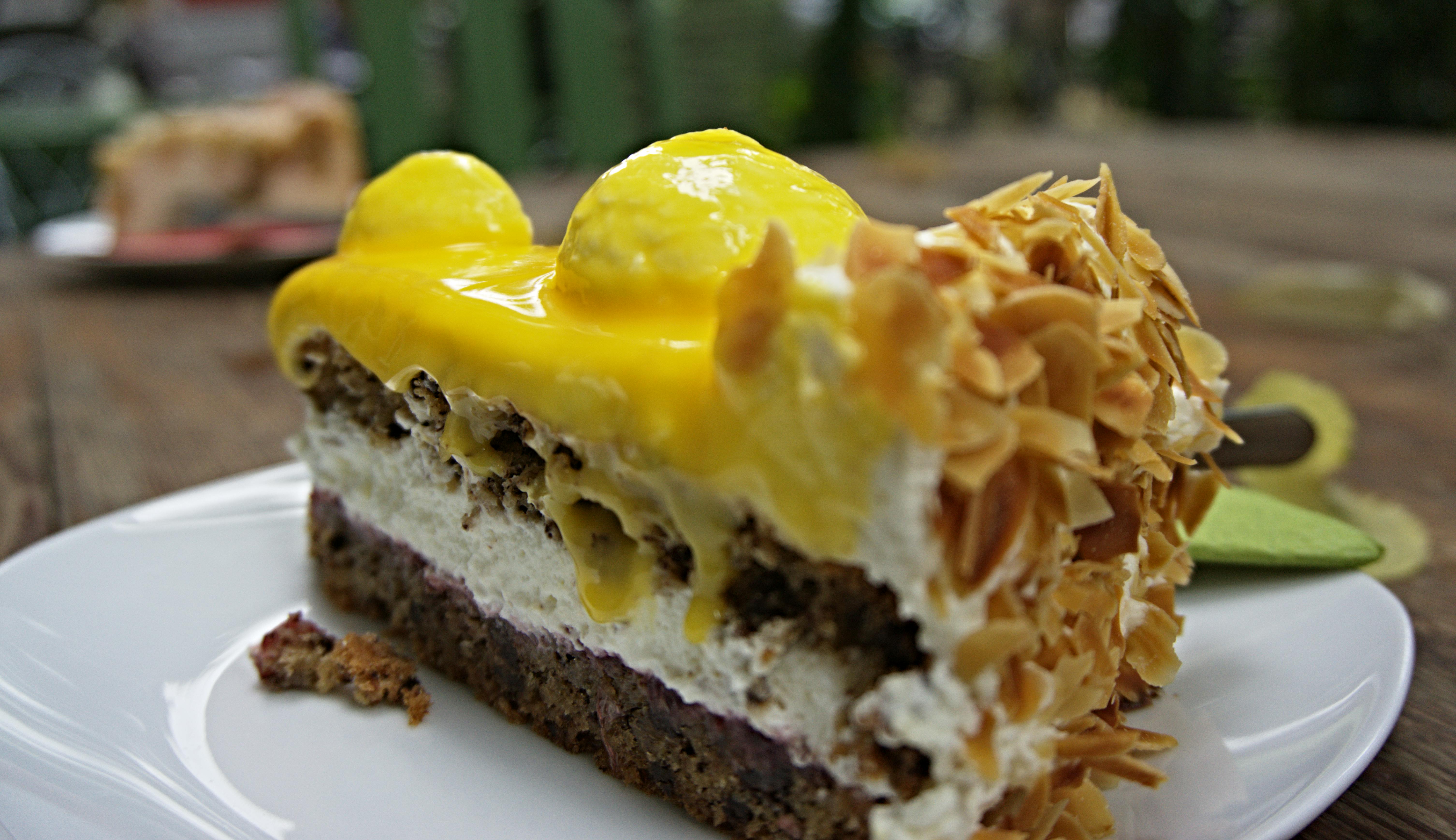
Photo: Ingo Joseph / Pexels
German
Bee Sting Cake
The diets react (see scores below)
Common Ingredients
- yeast
- flour
- butter
- sugar
- eggs
- milk
- almonds
- honey
- vanilla
- custard powder
Specific recipes may vary.
Incompatible with 11 of 11 diets
Diet Ratings
Bee Sting Cake (Bienenstich) is a traditional German yeast-leavened cake that is fundamentally incompatible with a ketogenic diet. It is built on a wheat flour dough base — a high-glycemic grain that alone would exceed daily keto carb limits in a single serving. Beyond the flour, it contains multiple additional high-carb, high-sugar ingredients: granulated sugar in both the dough and the almond topping, honey in the caramelized almond crust, milk and custard powder in the cream filling, and yeast-driven fermentation that still leaves substantial residual carbohydrates. A typical slice would deliver 50–70g of net carbs, far exceeding the entire daily keto allowance. There are no meaningful keto-friendly redeeming qualities — even the almonds and eggs, which would otherwise be fine, are buried under layers of sugar and flour. This dish represents virtually every category of food that keto explicitly prohibits: grains, added sugars, honey, and high-carb dairy preparations.
Bee Sting Cake (Bienenstich) contains multiple clear animal-derived ingredients that make it entirely incompatible with a vegan diet. Butter and milk are dairy products, eggs are an animal product, and honey is excluded by the overwhelming consensus of vegan organizations including the Vegan Society and PETA. Custard powder, while often plant-based in its dry form, is used here to make a custard filling that requires milk and eggs. Every one of these ingredients is a hard exclusion under vegan rules, making this one of the least vegan-compatible desserts imaginable. A vegan version could theoretically be constructed using plant-based butter, non-dairy milk, egg replacers, agave or maple syrup instead of honey, and a plant-based custard, but the traditional recipe as presented here fails on at least five separate animal-product criteria.
Bee Sting Cake (Bienenstich) is fundamentally incompatible with the Paleo diet. The recipe is built around multiple core non-Paleo ingredients: yeast-leavened wheat flour forms the cake base (grains are strictly excluded), milk is a dairy product (excluded), sugar is refined (excluded), butter is dairy (excluded), and custard powder is a processed, starch-based additive (excluded). While eggs, almonds, honey, and vanilla are Paleo-compatible, these supportive ingredients cannot redeem a dish whose structural foundation violates nearly every key Paleo exclusion category. This is a classic European pastry with no meaningful path to Paleo compliance without a complete recipe overhaul.
Bee Sting Cake is a traditional German dessert that fundamentally conflicts with Mediterranean diet principles. It is built on refined white flour (not a whole grain), substantial amounts of butter (not olive oil) as the primary fat, added sugar both in the dough and the almond topping, and a custard cream filling made with custard powder and milk. While it contains some redeeming ingredients — eggs, milk, almonds, and honey are all acceptable in moderation within the Mediterranean framework — the overall profile is that of a highly processed, high-sugar, high-saturated-fat confection. The refined grain base, butter-heavy composition, and significant added sugar content place this firmly in the 'avoid' category. It is not a traditional Mediterranean food, offers no meaningful plant-forward nutrition, and would not be a regular part of any Mediterranean diet pattern.
Bee Sting Cake is a traditional German pastry that is almost entirely plant-based and processed, making it completely incompatible with the carnivore diet. The primary ingredients are yeast, flour, sugar, almonds, vanilla, and custard powder — all plant-derived or highly processed carbohydrates. While eggs, butter, milk, and honey are animal-adjacent ingredients, they are minor components in a dish built on a grain-based dough loaded with sugar. Even the most liberal 'animal-based' carnivore frameworks would reject this as a staple food due to its grain and sugar foundation. There is no meaningful animal protein, and the carbohydrate load is extreme.
Bee Sting Cake (Bienenstich) is a German yeast-raised cake and is non-compliant on multiple levels. It contains flour (a grain, excluded), sugar (added sugar, excluded), milk (dairy, excluded), butter (dairy, excluded), and custard powder (typically contains cornstarch and sugar, both excluded). Beyond the individual excluded ingredients, this is literally a cake — exactly the type of baked good/junk food recreation that Rule 4 explicitly prohibits on Whole30, regardless of ingredient substitutions. There is no compliant version of this dish.
Bee Sting Cake (Bienenstich) contains multiple high-FODMAP ingredients that make it clearly unsuitable during the elimination phase. Regular wheat flour is high in fructans — the primary FODMAP offender here — and forms the bulk of the yeast-leavened dough. Milk used in both the dough and the custard filling is high in lactose, and standard custard powder preparations with full milk compound this significantly. Honey is high in excess fructose and is explicitly listed as a high-FODMAP ingredient by Monash University at any meaningful quantity; it is used both in the dough and as the signature caramelized almond topping. Taken together, this cake has at least three independently high-FODMAP ingredients (wheat flour, lactose from milk, honey) that would be problematic even in small servings. There is no realistic portion size at which a slice of Bee Sting Cake could be considered low-FODMAP during the elimination phase.
Bee Sting Cake (Bienenstich) is a traditional German sweet cake made with a yeasted dough enriched with butter and sugar, topped with a caramelized honey-almond glaze, and filled with vanilla custard cream. This dessert is fundamentally incompatible with DASH diet principles. It is high in added sugars (sugar, honey, custard), high in saturated fat (butter, whole milk, egg yolks in custard), and made with refined white flour rather than whole grains. DASH guidelines explicitly limit sweets and added sugars to 5 or fewer servings per week in small portions, and this cake would likely consume or exceed that entire weekly allowance in a single serving. The butter content contributes significant saturated fat, which DASH limits to reduce cardiovascular risk. While almonds are a DASH-friendly ingredient, their benefit is completely overshadowed by the overall nutritional profile of this dessert. This is a classic treat food that belongs firmly in the 'occasional indulgence' category, not as a regular dietary component for anyone following DASH principles.
Bee Sting Cake (Bienenstich) is a German yeast-based cake with a caramelized almond-honey topping and custard cream filling. From a Zone Diet perspective, this is essentially a triple threat of unfavorable macros: (1) High-glycemic carbohydrates dominate — refined wheat flour forms the yeast dough base, sugar and honey are added throughout, and custard powder typically contains cornstarch and sugar. The entire carbohydrate profile is high-glycemic with no meaningful fiber or low-GI vegetables to offset it. (2) Fat is primarily saturated — butter is used generously in both the dough and the almond topping, which is the opposite of the monounsaturated fat profile Zone prioritizes. (3) There is no lean protein component — eggs contribute some protein but are embedded in a high-fat, high-carb matrix with no ability to balance the block ratio. The macro ratio is almost certainly heavily skewed toward carbohydrates and saturated fat, with negligible lean protein, making it essentially impossible to fit into a Zone-balanced snack without consuming a trivially small portion that provides little satiety or nutritional value. Even the almonds, which are favorable in Zone as a monounsaturated fat source, are coated in honey and sugar here, negating their benefit. This food category — sweet yeast-based pastry with custard filling and caramelized sugar topping — is precisely what Zone methodology identifies as a problematic combination of high-glycemic carbs and saturated fat that drives unfavorable eicosanoid production.
Bee Sting Cake (Bienenstich) is a traditional German sweet cake with a strongly pro-inflammatory profile. The ingredient list is dominated by refined wheat flour, butter, sugar, and milk — a combination of refined carbohydrates, saturated fat, and added sugars that are well-established drivers of inflammatory markers like CRP and IL-6. The custard powder filling typically adds more refined starch and sugar. While almonds and honey offer minor redeeming qualities — almonds provide vitamin E and some anti-inflammatory unsaturated fats, and raw honey contains trace polyphenols — these benefits are negligible in the context of an indulgent baked cake where almonds are used primarily as a sweet topping caramelized with butter and sugar. Eggs contribute some choline, but the overall composition is a classic example of a refined, high-sugar, high-saturated-fat confection that anti-inflammatory frameworks consistently flag. This is essentially a dessert cake, not a snack in any nutritional sense, and it offers very little that would moderate its inflammatory burden.
Bee Sting Cake (Bienenstich) is a classic German dessert consisting of a enriched yeast dough base made with butter, flour, sugar, and milk, topped with a caramelized honey-almond crust and filled with a thick vanilla custard cream. It is essentially a high-sugar, high-fat, refined-carbohydrate dessert with negligible protein and minimal fiber. Every major component conflicts with GLP-1 dietary priorities: the enriched dough is a refined grain with high glycemic impact, the butter contributes significant saturated fat, the honey-almond topping adds concentrated sugars and additional fat, and the custard filling is sugar- and fat-dense with little nutritional payoff per calorie. The slow gastric emptying caused by GLP-1 medications means this heavy, rich food will sit in the stomach far longer than usual, significantly increasing the risk of nausea, bloating, and reflux. As a snack category item it offers no practical protein contribution toward the 100-120g daily target, no meaningful fiber, and represents a textbook example of empty-calorie, nutrient-poor eating that is especially counterproductive when total caloric intake is already severely reduced by medication.
*See how scores were generated at our methodology page.
Nutritional profile
Six traits that cut across every diet.
Fiber & Plants
How much whole-plant food and fiber it delivers.
Healthy Fats
The quality of its fats (unsaturated, omega-3).
Whole / Unprocessed
How close it is to its natural, unprocessed form.
Gut Gentle
How easy it is on digestion (low FODMAP, few irritants).
Low Glycemic
How little it spikes your blood sugar.
Protein Density
How much protein it packs per calorie.
Controversy Index
Higher controversy = more disagreement between diets.