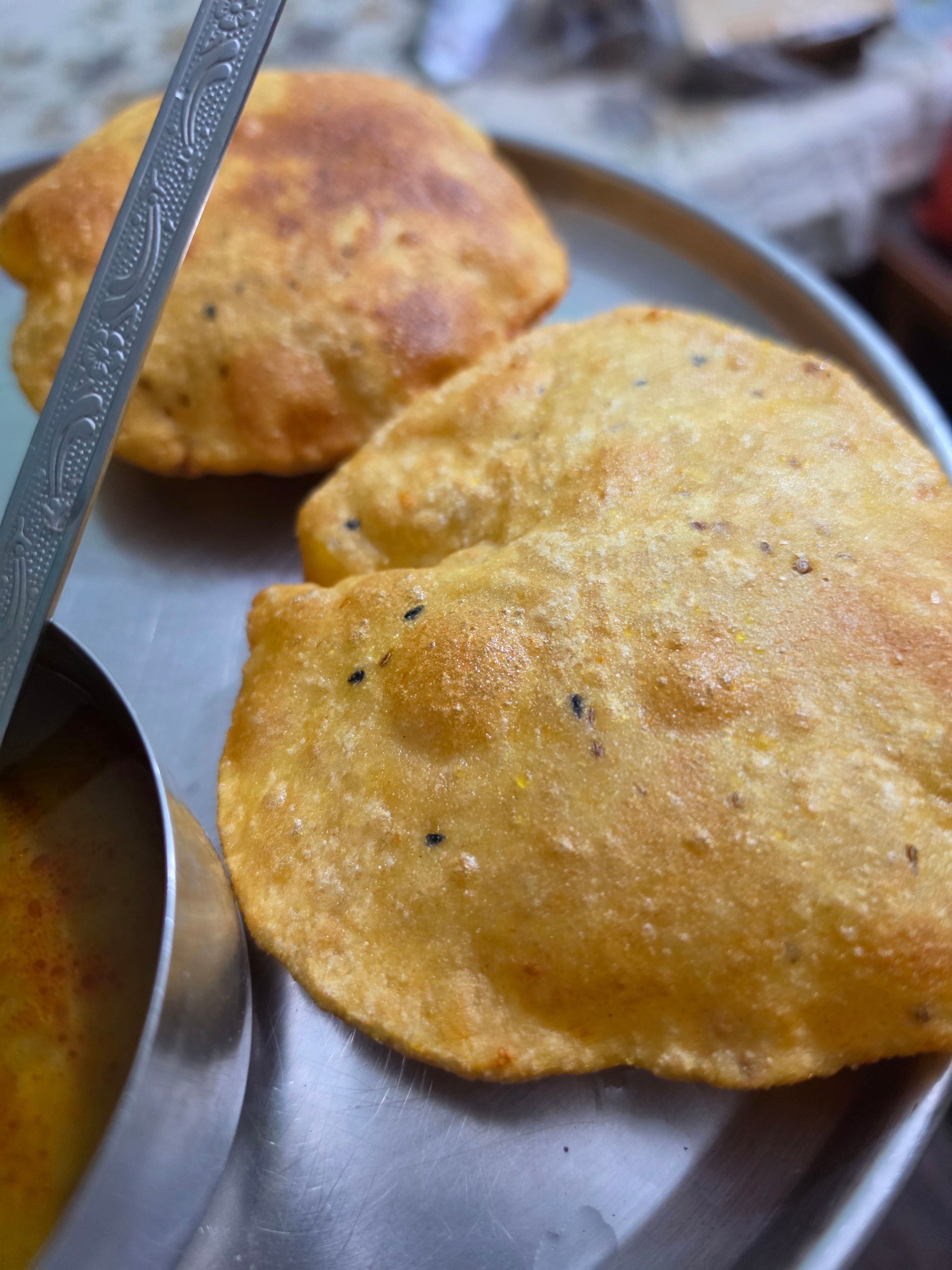
Photo: Cheese Please / Pexels
The diets react (see scores below)
Common Ingredients
- flour
- ghee
- water
- salt
- vegetable oil
Specific recipes may vary.
Incompatible with 11 of 11 diets
Diet Ratings
Luchi is a deep-fried Indian flatbread made from refined wheat flour (maida), which is an extremely high-carb ingredient. A single luchi contains roughly 15-20g of net carbs, and they are typically eaten in multiples. Refined wheat flour is a pure grain product with virtually no fiber to offset the carbs, making it fundamentally incompatible with ketogenic dietary requirements. Even though ghee and vegetable oil are used in frying (which are keto-friendly fats), the primary ingredient — refined flour — disqualifies this dish entirely. There is no meaningful portion size that would allow luchi to fit within a 20-50g daily net carb budget.
Luchi is a deep-fried flatbread from Bengali cuisine. As listed, it contains ghee — clarified butter derived from cow's milk — which is a direct animal product and disqualifying under vegan rules. Ghee is not a contested ingredient; it is unambiguously dairy-derived. The remaining ingredients (flour, water, salt, vegetable oil) are all plant-based and vegan-friendly. A vegan version of luchi is achievable simply by omitting ghee and using only vegetable oil for frying, but the dish as described here is not vegan.
Luchi is a deep-fried Indian flatbread made primarily from refined wheat flour (maida), which is a grain and a clear paleo exclusion. Beyond the flour, the dish compounds its non-paleo status with two additional violations: added salt and vegetable oil (a seed oil). Ghee is the only ingredient with any paleo standing, but it cannot redeem a dish built on a grain foundation. This dish fails on multiple core paleo criteria simultaneously.
Luchi is a deep-fried flatbread made from refined white flour (maida), which directly contradicts core Mediterranean diet principles on multiple fronts. First, it uses refined/processed grain rather than whole grains. Second, it is deep-fried, adding significant quantities of fat from vegetable oil. Third, ghee (clarified butter) is a saturated animal fat, not olive oil, which is the canonical fat in the Mediterranean diet. The combination of refined flour, deep frying, and saturated animal fat places this dish firmly in the 'avoid' category. It offers minimal fiber, no legumes, no vegetables, and no whole grains — none of the plant-forward nutritional qualities the Mediterranean diet emphasizes.
Luchi is a deep-fried Indian flatbread made from refined wheat flour, which is a plant-derived grain product — entirely incompatible with the carnivore diet. The primary ingredient is flour, a processed grain, which is explicitly excluded from all tiers of carnivore eating. Vegetable oil used for frying is a plant-based oil, also strictly excluded. While ghee and salt are carnivore-compatible ingredients, they are minor components here and cannot redeem a dish whose foundation is a grain-based carbohydrate. There is no animal protein present, and the dish provides no nutritional value within a carnivore framework.
Luchi is a deep-fried Indian flatbread made from wheat flour (maida). Wheat/flour is a grain and is explicitly excluded on the Whole30. Additionally, even if the flour issue were somehow resolved, luchi is a fried flatbread — a category explicitly prohibited under the Whole30's 'no recreating baked goods/junk food' rule, which specifically lists flatbreads, wraps, and similar items. Ghee and salt are compliant ingredients, but the foundational ingredient (wheat flour) makes this dish clearly off-limits.
Luchi is a deep-fried Indian flatbread made primarily from refined wheat flour (maida). Wheat flour is high in fructans, a key FODMAP that must be avoided during the elimination phase. A standard serving of luchi (2-3 pieces) would contain a significant amount of wheat flour, making it clearly high-FODMAP. The other ingredients — ghee, water, salt, and vegetable oil — are all low-FODMAP and pose no concern. However, the wheat flour is the dominant ingredient and disqualifies this dish entirely during the elimination phase. Unlike sourdough, luchi undergoes no fermentation process that might reduce fructan content.
Luchi is a deep-fried Indian flatbread made from refined white flour (maida), ghee, and vegetable oil. It fails DASH diet criteria on multiple fronts: (1) It uses refined white flour rather than whole grains — DASH explicitly emphasizes whole grains for fiber, potassium, and magnesium content. (2) It is deep-fried in vegetable oil, dramatically increasing total fat content and caloric density, which is discouraged in DASH. (3) Ghee is a clarified butter high in saturated fat — DASH limits saturated fat and discourages full-fat animal fats. (4) The combination of deep-frying plus ghee makes this a high saturated fat, high calorie food with negligible fiber, potassium, calcium, or magnesium — essentially the opposite of a DASH-aligned food. It provides none of the nutrients DASH prioritizes and combines multiple dietary patterns DASH discourages.
Luchi is a deep-fried Indian flatbread made from refined white flour (maida), cooked in ghee and/or vegetable oil. From a Zone Diet perspective, this food has multiple serious strikes against it. First, refined white flour is a high-glycemic carbohydrate that Sears explicitly classifies as 'unfavorable' — it causes rapid insulin spikes, directly opposing the Zone's core goal of insulin control. Second, deep-frying in vegetable oil (typically omega-6-heavy seed oil) is directly contrary to Sears' anti-inflammatory emphasis — he actively discourages omega-6-dominant seed oils. Third, ghee is a saturated fat rather than the monounsaturated fats (olive oil, avocado, almonds) the Zone prioritizes. Fourth, the dish contains no protein whatsoever, making it impossible to constitute a Zone-balanced meal or snack on its own. Fifth, it provides no fiber (refined flour) and no polyphenols, offering nothing on the anti-inflammatory or micronutrient front. While the Zone is ratio-based and not exclusionary, luchi combines refined high-GI carbs + omega-6 fats + saturated fat + zero protein in a way that is essentially the opposite of Zone construction principles. It could theoretically be a tiny carb block alongside lean protein and vegetables, but the frying medium and flour quality make even that a poor choice compared to any whole-grain or vegetable alternative.
Luchi is a deep-fried flatbread made from refined white flour (maida), cooked in vegetable oil (typically high-omega-6 seed oil) with ghee. This combination is strongly pro-inflammatory from an anti-inflammatory diet perspective. Refined white flour is a high-glycemic refined carbohydrate that spikes blood sugar and promotes inflammatory pathways. Deep-frying in vegetable oil (likely sunflower, cottonseed, or similar high-omega-6 seed oil) at high heat promotes lipid oxidation and the formation of pro-inflammatory oxidized lipids. Ghee, while a traditional fat, is high in saturated fat and is categorized as a food to limit. The dish offers no meaningful fiber, antioxidants, polyphenols, or omega-3 fatty acids. It has no vegetables, legumes, whole grains, or anti-inflammatory spices. As a deep-fried refined-flour breakfast staple consumed regularly, luchi represents a poor fit for an anti-inflammatory dietary pattern.
Luchi is a deep-fried unleavened bread made from refined white flour (maida) and cooked in vegetable oil, often with ghee added to the dough. It scores extremely poorly against virtually every GLP-1 dietary priority. It is deep-fried, making it high in fat and difficult to digest at a time when gastric emptying is already slowed — a combination that strongly worsens nausea, bloating, and reflux. It is made from refined flour, offering negligible fiber and minimal micronutrient value. It contains no meaningful protein. It is calorie-dense with near-zero nutritional return per calorie, making it a poor use of the reduced appetite window GLP-1 patients operate within. The ghee and frying oil contribute saturated and high total fat load per serving. As a breakfast food, it sets a poor nutritional foundation for the day when protein and fiber intake targets are already difficult to meet on a reduced-calorie intake.
*See how scores were generated at our methodology page.
Nutritional profile
Six traits that cut across every diet.
Fiber & Plants
How much whole-plant food and fiber it delivers.
Healthy Fats
The quality of its fats (unsaturated, omega-3).
Whole / Unprocessed
How close it is to its natural, unprocessed form.
Gut Gentle
How easy it is on digestion (low FODMAP, few irritants).
Low Glycemic
How little it spikes your blood sugar.
Protein Density
How much protein it packs per calorie.
Controversy Index
Higher controversy = more disagreement between diets.