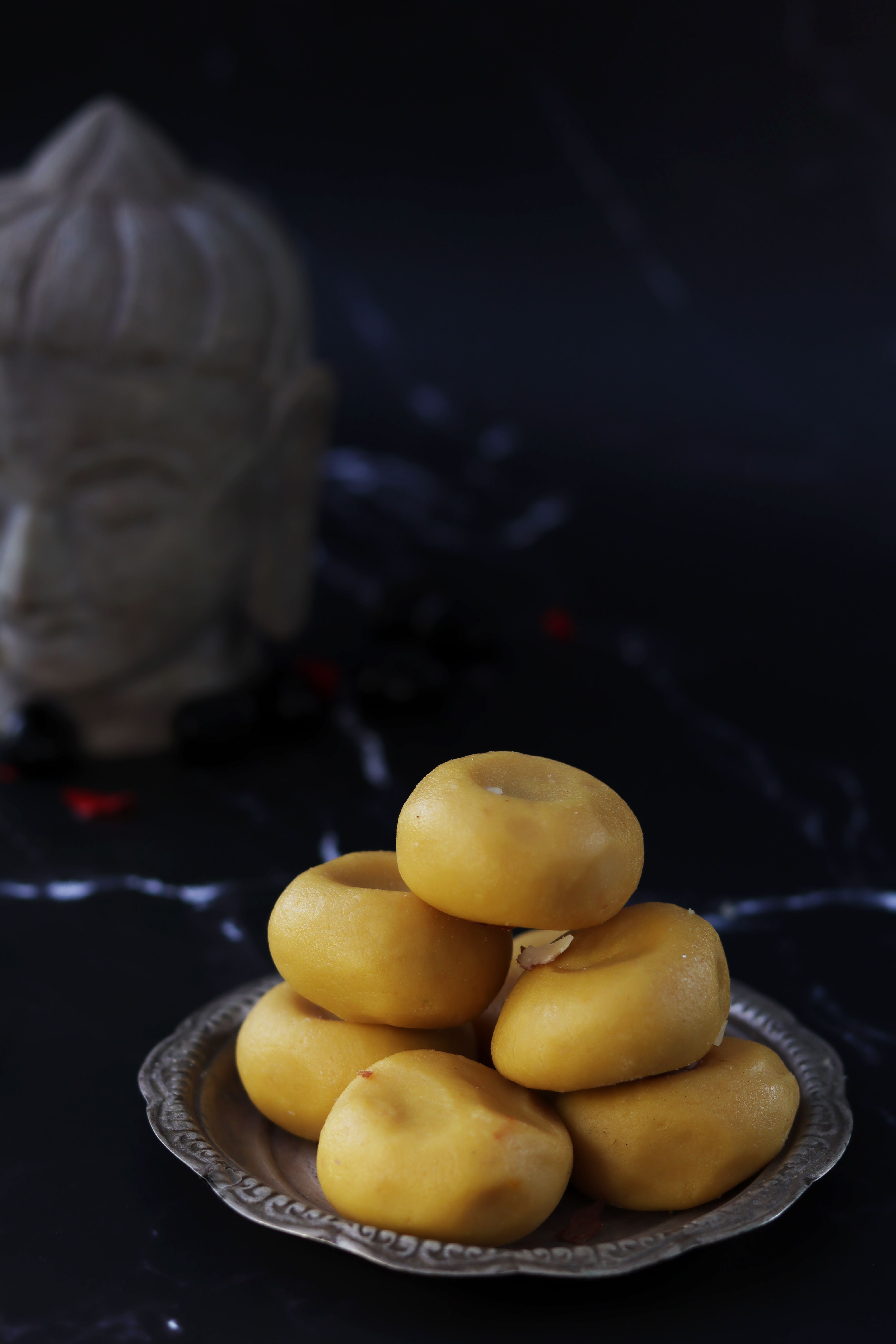
Photo: Sohani Kamat / Pexels
The diets react (see scores below)
Common Ingredients
- chhena
- sugar
- cardamom
- pistachios
- saffron
Specific recipes may vary.
Incompatible with 7 of 11 diets
Diet Ratings
Sandesh is a traditional Bengali sweet made primarily from chhena (fresh cheese curds) and sugar. While chhena itself is relatively keto-friendly due to its high fat and protein content, sugar is the second main ingredient and is central to the recipe — it cannot be omitted without fundamentally changing the dish. A typical serving of Sandesh contains 20-30g of net carbs, almost entirely from added sugar, which alone can exceed or consume the entire daily keto carb budget. Pistachios also add modest carbs. This dish is fundamentally a sugar-based confection and is incompatible with ketosis in its traditional form.
Sandesh is a traditional Bengali sweet made primarily from chhena, which is fresh paneer/cottage cheese produced by curdling cow's or buffalo's milk. As a dairy-derived product, chhena is an animal product and therefore incompatible with a vegan diet. The remaining ingredients — sugar, cardamom, pistachios, and saffron — are all plant-based, but the foundational ingredient disqualifies the dish entirely. There is no meaningful debate within the vegan community about dairy cheese being non-vegan.
Sandesh is a Bengali sweet made primarily from chhena (fresh cheese curds derived from cow's milk), which is a dairy product explicitly excluded from the paleo diet. Sugar is a refined sweetener, also excluded. While cardamom, saffron, and pistachios are paleo-compliant, the two foundational ingredients — chhena and sugar — are clear paleo violations. There is no meaningful way to classify this dish as paleo-compatible given its core composition.
Sandesh is a Bengali sweet made primarily from chhena (fresh cheese curds), sugar, and flavorings like cardamom, saffron, and pistachios. From a Mediterranean diet perspective, this dish presents a mixed profile. The chhena is essentially a fresh dairy cheese, which falls into the moderate/occasional category similar to ricotta or cottage cheese. Pistachios are genuinely Mediterranean-approved nuts. Cardamom and saffron are beneficial spices. However, the significant sugar content is the main concern — added sugar directly contradicts Mediterranean diet principles regardless of the food vehicle. The dish functions as a dessert/sweet snack with notable refined sugar, which pushes it toward the 'avoid' spectrum. The dairy base alone would warrant caution, but combined with added sugar, the score lowers further. It is not a highly processed food with artificial ingredients, which prevents a full 'avoid' verdict.
Some Mediterranean diet practitioners take a lenient view on small portions of homemade sweets made from whole-food ingredients like fresh cheese and nuts, arguing that traditional Mediterranean cuisines also include desserts with honey or sugar in moderation. From this perspective, an occasional small piece of Sandesh — given its whole-food dairy base and nut content — could be treated similarly to a small serving of Greek pastry or ricotta-based dessert.
Sandesh is a Bengali sweet made primarily from chhena (fresh cheese curds from cow's milk) but combined with multiple carnivore-incompatible ingredients. Sugar is a processed carbohydrate with no place on the carnivore diet. Cardamom and saffron are plant-derived spices excluded under carnivore rules. Pistachios are nuts — a plant food explicitly excluded. While chhena itself is a dairy product debated within the carnivore community, the overwhelming presence of sugar, plant spices, and nuts makes this dish firmly in the 'avoid' category. Even the most permissive 'animal-based' practitioners (e.g., Saladino) who allow honey and fruit would not endorse a sugar-and-nut-laden processed confection like this.
Sandesh contains two excluded ingredients: chhena (fresh cheese made from cow's milk, which is dairy and explicitly excluded from Whole30) and sugar (added sugar, also explicitly excluded). While cardamom, pistachios, and saffron are all compliant spices/nuts, the core ingredients of this dish are fundamentally incompatible with the Whole30 program. There is no compliant substitution that would still produce Sandesh — it is defined by its dairy cheese base and sugar content.
Sandesh is a Bengali sweet made primarily from chhena (fresh cottage cheese/paneer made by curdling milk). The main FODMAP concern is lactose. Chhena is a fresh, unaged cheese that retains significant lactose content — unlike aged hard cheeses (cheddar, parmesan) where lactose is minimal, fresh cheeses like chhena/paneer are high in lactose and are high-FODMAP during the elimination phase. A typical serving of Sandesh (2-3 pieces, ~80-100g) would contain a substantial lactose load from chhena. Sugar is low-FODMAP (sucrose). Cardamom in small culinary amounts is low-FODMAP. Pistachios become high-FODMAP above ~10 nuts (1 serving per Monash), and Sandesh recipes often include a meaningful quantity. Saffron in trace amounts is low-FODMAP. The primary driver of avoidance is the chhena base, which makes this dish high-FODMAP at any realistic serving size.
Monash University has not specifically tested chhena/sandesh, and some FODMAP practitioners note that the curdling and whey-draining process used to make chhena may reduce lactose content somewhat compared to fluid milk — though not to the levels seen in aged hard cheeses. Additionally, a very small portion (1 small piece) might reduce the lactose load, but this is an unrealistic serving for this dessert in practice.
Sandesh is a Bengali sweet made primarily from chhena (fresh paneer/cottage cheese derived from whole milk) and sugar. The chhena provides protein and calcium but is made from full-fat milk, placing it in the full-fat dairy category that standard DASH guidelines recommend limiting. The added sugar is a significant concern — DASH explicitly limits sweets and added sugars. However, Sandesh is not high in sodium, contains no trans fats or tropical oils, and the pistachios add magnesium and healthy fats aligned with DASH principles. The cardamom and saffron are nutritionally neutral. The primary issues are the full-fat dairy base and added sugar content, making this acceptable only as an occasional, portion-controlled treat rather than a DASH staple. A version made with low-fat chhena and reduced sugar would score higher.
NIH DASH guidelines specify low-fat or fat-free dairy and limit sweets, which would place Sandesh firmly in the 'caution' or 'avoid' range due to full-fat chhena and added sugar. However, updated clinical interpretations note that emerging research (including studies cited in the 2020-2025 Dietary Guidelines context) suggests full-fat dairy may not adversely affect cardiovascular outcomes, and chhena is minimally processed with no sodium — some DASH-oriented dietitians may permit small portions of traditional sweets like Sandesh within overall daily sugar and calorie limits.
Sandesh is a Bengali sweet made primarily from chhena (fresh cheese similar to ricotta/paneer) and sugar. From a Zone perspective, it has a mixed profile. The chhena provides decent protein and some fat, which is useful for Zone block building. However, sugar is the second main ingredient and the primary carbohydrate source — a high-glycemic, nutritionally empty carb that Zone methodology rates as 'unfavorable.' The pistachios contribute healthy monounsaturated and polyunsaturated fats along with some protein, which is Zone-friendly. Cardamom and saffron are negligible macronutrient contributors but provide polyphenols, which Sears' later work endorses. The core problem is that Sandesh is a dessert sweet where the carbohydrate load comes almost entirely from refined sugar rather than low-glycemic vegetables or fruits. A small portion (1 piece) might be workable as a Zone snack if the chhena's protein and fat roughly balance the sugar carbs in a 1-block snack, but this requires very strict portion control and is not an 'ideal' Zone food choice. The ratio can be approximated in very small servings, but the glycemic quality of carbs here is poor by Zone standards.
Some Zone practitioners applying Sears' later anti-inflammatory framework would note that chhena is a whole-food dairy protein and the pistachios provide favorable fats, making a small single-piece Sandesh more defensible as an occasional Zone snack than stricter Zone adherents would allow. The polyphenols from saffron also align with Sears' later emphasis on anti-inflammatory eating, slightly softening the verdict for those following his more recent Omega Rx Zone approach.
Sandesh is a Bengali sweet made primarily from chhena (fresh cheese from cow's milk), sugar, and aromatic spices. The profile is mixed from an anti-inflammatory standpoint. On the positive side, cardamom has documented anti-inflammatory and antioxidant properties; saffron contains crocin and crocetin, which are potent antioxidants with anti-inflammatory activity in research; and pistachios are a beneficial nut offering healthy fats, polyphenols, and fiber. Chhena is essentially a fresh, low-processed dairy product similar to ricotta or paneer — it falls into the 'moderate' dairy category (lower in saturated fat than aged cheeses, no additives). However, the primary concern is the added sugar content, which is a core ingredient and driver of the sweet's character. Added sugar directly promotes inflammatory pathways, raising CRP and IL-6 markers. The saturated fat from chhena is moderate but not negligible. In small, occasional portions, the beneficial spices and pistachios offer some anti-inflammatory offset, and chhena's relative freshness and minimal processing is a mild positive. But the sugar load places this firmly in the 'caution' zone — it is not a dish to consume regularly or in large amounts on an anti-inflammatory diet.
Some anti-inflammatory practitioners would rate this more harshly (closer to 'avoid') given that any significant added sugar load is considered a primary driver of systemic inflammation regardless of accompanying beneficial spices — the spice quantities in a small sweet are unlikely to meaningfully offset the sugar burden. On the other hand, traditional food advocates note that chhena-based sweets consumed in culturally appropriate small portions represent a far less inflammatory profile than ultra-processed Western desserts, and the bioactive compounds in saffron and cardamom provide genuine anti-inflammatory benefit.
Sandesh is a Bengali sweet made primarily from chhena (fresh cheese curds) and sugar. While chhena does provide some protein, the dish is fundamentally a dessert/sweet snack with a high sugar load and moderate-to-high fat content from the fresh cheese. A typical serving (2-3 pieces, ~60-80g) delivers a significant sugar hit with limited protein payoff relative to calories. The sugar content conflicts directly with GLP-1 dietary priorities — high-sugar foods are in the avoid category, they spike blood glucose, provide empty calories, and can worsen nausea. The fat content of chhena, while not extreme, adds to GI stress on a slowed gastric system. Pistachios add some healthy fat and micronutrients but are present in small garnish quantities insufficient to meaningfully improve the nutritional profile. Cardamom and saffron are fine. The fundamental problem is that the primary caloric drivers are sugar and cheese fat — not protein or fiber — making this a poor use of limited appetite capacity on GLP-1 medications.
Some GLP-1-aware dietitians note that chhena-based sweets contain more protein than most Indian mithai and may argue a single small piece is acceptable as an occasional treat within a high-protein day. However, the consensus among obesity medicine RDs is that high-sugar snacks with low fiber and no meaningful protein advantage should be avoided, particularly given that GLP-1 patients have limited caloric bandwidth and are prone to blood sugar fluctuations.
*See how scores were generated at our methodology page.
Nutritional profile
Six traits that cut across every diet.
Fiber & Plants
How much whole-plant food and fiber it delivers.
Healthy Fats
The quality of its fats (unsaturated, omega-3).
Whole / Unprocessed
How close it is to its natural, unprocessed form.
Gut Gentle
How easy it is on digestion (low FODMAP, few irritants).
Low Glycemic
How little it spikes your blood sugar.
Protein Density
How much protein it packs per calorie.
Controversy Index
Higher controversy = more disagreement between diets.
Diet-Specific Tips
 Mediterranean — 4/10
View tips
- Chhena (fresh cheese) is a dairy product acceptable only in moderation in the Mediterranean diet
- Significant added sugar directly contradicts Mediterranean diet principles
- Pistachios are a genuinely approved Mediterranean nut
- No processed ingredients, artificial additives, or refined grains
- Functions as a dessert/sweet snack rather than a nutritionally substantive food
- Not part of any Mediterranean culinary tradition
 DASH — 4/10
View tips
- Chhena is full-fat dairy — standard DASH recommends low-fat or fat-free dairy
- Added sugar (from sugar ingredient) conflicts with DASH limits on sweets
- Very low sodium — a positive DASH attribute
- Pistachios contribute magnesium, healthy unsaturated fats, and fiber — DASH-positive
- No tropical oils, trans fats, or high saturated fat beyond the dairy base
- Small portion sizes typical of traditional Sandesh servings mitigate some concerns
- Low-fat chhena substitution and reduced sugar would improve DASH compatibility
 Zone — 4/10
View tips
- Sugar is primary carbohydrate — high-glycemic and 'unfavorable' in Zone terminology
- Chhena provides usable protein blocks (similar to fresh cheese/ricotta)
- Pistachios contribute Zone-favorable monounsaturated and polyunsaturated fats
- No low-glycemic vegetables or fruits present — carb quality is poor
- Very small portion could approximate a 1-block Zone snack but is not recommended
- Saffron and cardamom provide polyphenols aligned with Sears' anti-inflammatory principles
 Anti-Inflammatory — 5/10
View tips
- Added sugar (primary ingredient) — pro-inflammatory, raises CRP and IL-6
- Chhena (fresh cheese) — moderate saturated fat, but minimally processed dairy; falls in 'moderate' category
- Saffron — contains crocin and crocetin with documented antioxidant and anti-inflammatory activity
- Cardamom — anti-inflammatory and antioxidant polyphenols
- Pistachios — healthy fats, polyphenols, fiber with anti-inflammatory properties
- No processed additives, trans fats, or artificial ingredients
- Portion size is critical — traditionally a small-portion sweet, which mitigates but does not eliminate the sugar concern