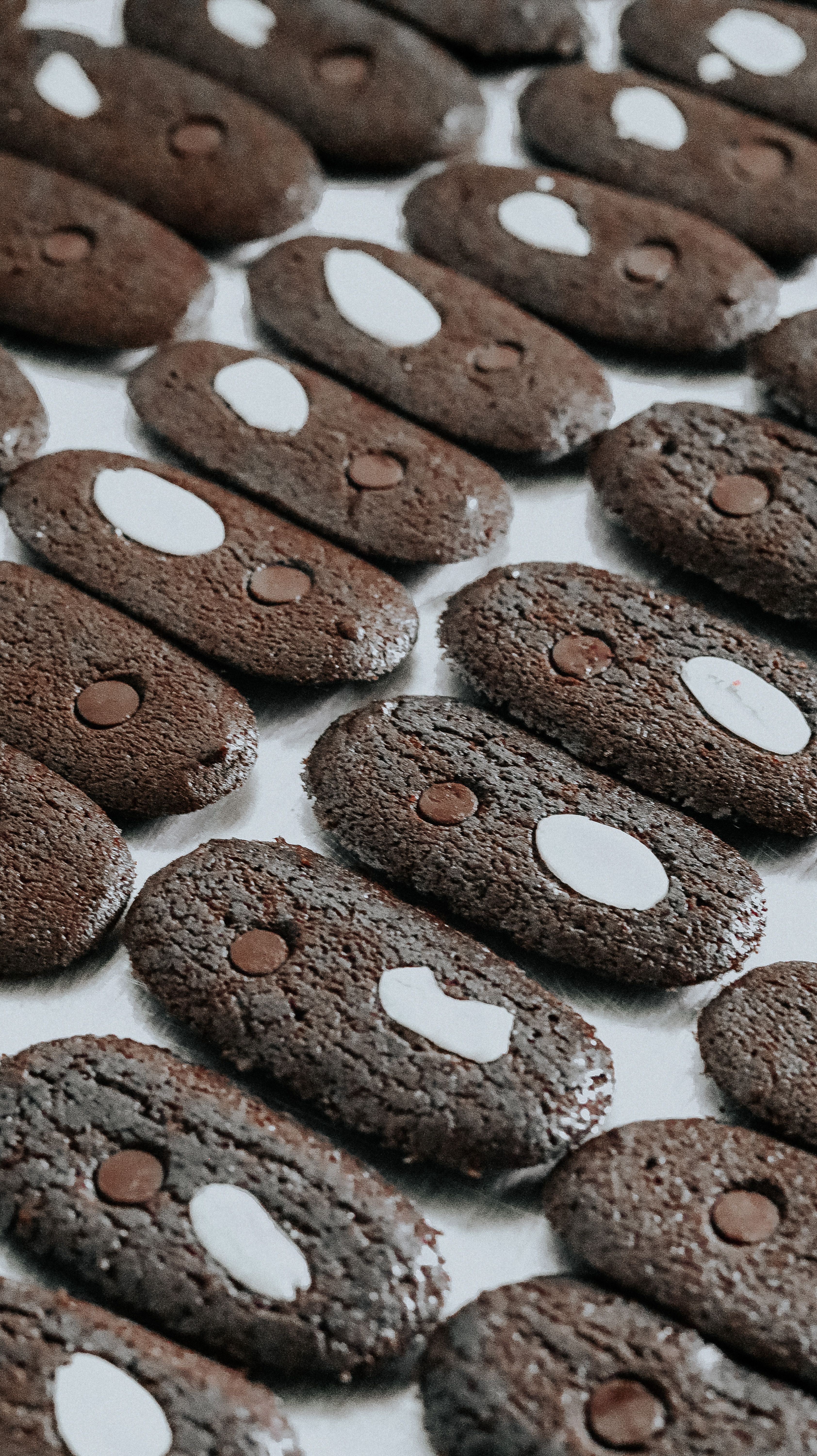
Photo: Meggy Kadam Aryanto / Pexels
American
Black and White Cookie
The diets react (see scores below)
Common Ingredients
- flour
- butter
- sugar
- eggs
- baking powder
- vanilla extract
- salt
- milk
- chocolate
- powdered sugar
Specific recipes may vary.
Incompatible with 11 of 11 diets
Diet Ratings
The Black and White Cookie is fundamentally incompatible with a ketogenic diet. It is built on wheat flour (high net carbs), sugar, powdered sugar, and milk — ingredients that together deliver an enormous carbohydrate load, likely 50–70g of net carbs per cookie. There is no meaningful fat-to-carb ratio that redeems it, and the primary caloric contributors are refined carbohydrates and sugar. Every core ingredient except butter and eggs directly violates ketogenic principles.
The Black and White Cookie contains multiple animal-derived ingredients that make it clearly non-vegan. Butter is a dairy product, eggs are an animal product, and milk is a dairy product — all three are explicit violations of vegan diet rules. These are core structural ingredients in this recipe, not trace contaminants, meaning there is no version of this specific recipe that is vegan. A vegan adaptation would require substituting plant-based butter, a flax or chia egg replacer, and non-dairy milk, making it a fundamentally different formulation.
The Black and White Cookie is fundamentally incompatible with the Paleo diet. It contains multiple strictly excluded ingredients: flour (a grain), sugar and powdered sugar (refined sugars), butter and milk (dairy), salt (added), and baking powder (a processed leavening agent). There is virtually nothing in this cookie that qualifies as Paleo-approved. This is a classic processed baked good that represents exactly what the Paleo diet excludes.
The Black and White Cookie is a quintessential American baked good that conflicts with nearly every core Mediterranean diet principle. It is made primarily from refined white flour, substantial amounts of butter (not olive oil), and large quantities of added sugar — both in the cookie base and the powdered sugar frosting. Chocolate frosting adds further refined sugar and saturated fat. There are no plant-forward, fiber-rich, or nutrient-dense ingredients. It is a highly processed confection with no significant nutritional redeeming qualities within the Mediterranean diet framework. Occasional treats are not forbidden, but this item is essentially a vehicle for refined grains, saturated fat, and added sugar — three things the Mediterranean diet explicitly minimizes.
The Black and White Cookie is almost entirely plant-derived and processed, making it completely incompatible with the carnivore diet. The primary ingredients are flour (grain), sugar, and powdered sugar (plant-derived sweeteners), with vanilla extract (plant-based flavoring) and baking powder (plant-derived leavening agent). While eggs, butter, and milk are animal-derived, they are minor components in what is fundamentally a baked good built on grains and sugar — the two most excluded food categories in carnivore eating. There is no meaningful protein source, and the macronutrient profile is dominated by carbohydrates. This food offers no place on any tier of the carnivore diet, from the strictest Lion Diet to the most lenient animal-based approach.
The Black and White Cookie contains multiple Whole30-excluded ingredients: flour (a grain), butter (dairy), sugar (added sugar), milk (dairy), and powdered sugar (added sugar). Additionally, even if all ingredients were somehow compliant, this is a classic baked good (cookie) that falls squarely into the 'no recreating baked goods/junk food' rule. The program explicitly prohibits cookies regardless of ingredient compliance. This dish fails on nearly every Whole30 criterion simultaneously.
Black and White Cookies are a classic New York bakery item made with wheat flour as the primary structural ingredient. Wheat flour is high in fructans, a key FODMAP group that must be strictly avoided during the elimination phase. A standard Black and White Cookie is a large, cake-like cookie (typically 100–150g), meaning fructan intake from wheat flour would be substantial. Additionally, milk is used in the batter, contributing lactose, another FODMAP. Powdered sugar is generally low-FODMAP, as is butter, eggs, vanilla, baking powder, and dark chocolate in small amounts. However, the wheat flour and milk together make this cookie clearly high-FODMAP at any realistic serving size. There is no gluten-free or lactose-free substitution indicated here, so this must be rated as avoid.
The Black and White Cookie is a classic American bakery treat that is fundamentally incompatible with DASH diet principles. It is made primarily from refined white flour (not a whole grain), butter (high in saturated fat), and large amounts of sugar and powdered sugar (high added sugar). The chocolate and powdered sugar fondant icing layers add further refined sugar and saturated fat. The cookie provides virtually no potassium, magnesium, calcium, or fiber — the key nutrients DASH emphasizes. It is high in saturated fat from butter, high in added sugar, made from refined grains, and offers no meaningful nutritional benefit aligned with DASH goals. The NIH/NHLBI DASH guidelines explicitly limit sweets, added sugars, and saturated fats, and recommend limiting refined grains in favor of whole grains. This food falls squarely in the 'sweets' category that DASH limits to 5 or fewer servings per week of small portions, and even then, lower-fat, lower-sugar options are preferred.
The Black and White Cookie is a quintessential high-glycemic, nutritionally empty snack that is nearly impossible to fit into Zone Diet principles. Its primary ingredients are refined white flour and sugar (both high-glycemic, unfavorable carbs in Zone terminology), butter (saturated fat, not monounsaturated), and powdered sugar frosting (pure sugar). There is no meaningful lean protein, no low-glycemic carbohydrate, and no monounsaturated fat. The macronutrient ratio is heavily skewed toward simple carbs and saturated fat — essentially the inverse of Zone's 40/30/30 target. Even eating a tiny portion to 'fit it in' would contribute almost nothing to a balanced Zone meal and would spike insulin rapidly. Dr. Sears specifically identifies refined flour and sugar as the foods most disruptive to eicosanoid balance and insulin regulation. This cookie has no redeeming Zone-favorable qualities and cannot be meaningfully incorporated into any Zone block structure.
The Black and White Cookie is a classic American bakery item built on a pro-inflammatory foundation. Its core ingredients — refined white flour, butter, sugar, and powdered sugar — represent exactly what anti-inflammatory nutrition consistently advises against. Refined flour lacks fiber and raises blood glucose rapidly, triggering inflammatory cascades. The large amounts of added sugar (both granulated and powdered) are strongly linked to elevated CRP and IL-6 markers. Butter contributes saturated fat, which is limited under anti-inflammatory frameworks. The chocolate component (likely a thin fondant-style coating rather than high-cacao dark chocolate) provides negligible polyphenol benefit. There are no redeeming anti-inflammatory ingredients — no omega-3s, no meaningful antioxidants, no whole grains, no beneficial herbs or spices. This is essentially a vehicle for refined carbohydrates and added sugar, the two most consistently pro-inflammatory dietary elements across all anti-inflammatory frameworks.
A Black and White Cookie is a classic American bakery item made primarily from refined flour, butter, sugar, and powdered sugar frosting — essentially a soft sugar cookie with thick icing. It offers negligible protein, minimal fiber, high refined sugar, and moderate-to-high saturated fat from butter. For GLP-1 patients eating significantly fewer calories overall, this item delivers almost exclusively empty calories with no meaningful nutritional return. The high sugar load is problematic for blood sugar stability, and the refined flour provides no fiber benefit. The butter content, while not fried, contributes saturated fat that can worsen GLP-1 GI side effects. There is no redeeming nutritional feature that would justify including this in a GLP-1 patient's limited caloric budget.
*See how scores were generated at our methodology page.
Nutritional profile
Six traits that cut across every diet.
Fiber & Plants
How much whole-plant food and fiber it delivers.
Healthy Fats
The quality of its fats (unsaturated, omega-3).
Whole / Unprocessed
How close it is to its natural, unprocessed form.
Gut Gentle
How easy it is on digestion (low FODMAP, few irritants).
Low Glycemic
How little it spikes your blood sugar.
Protein Density
How much protein it packs per calorie.
Controversy Index
Higher controversy = more disagreement between diets.