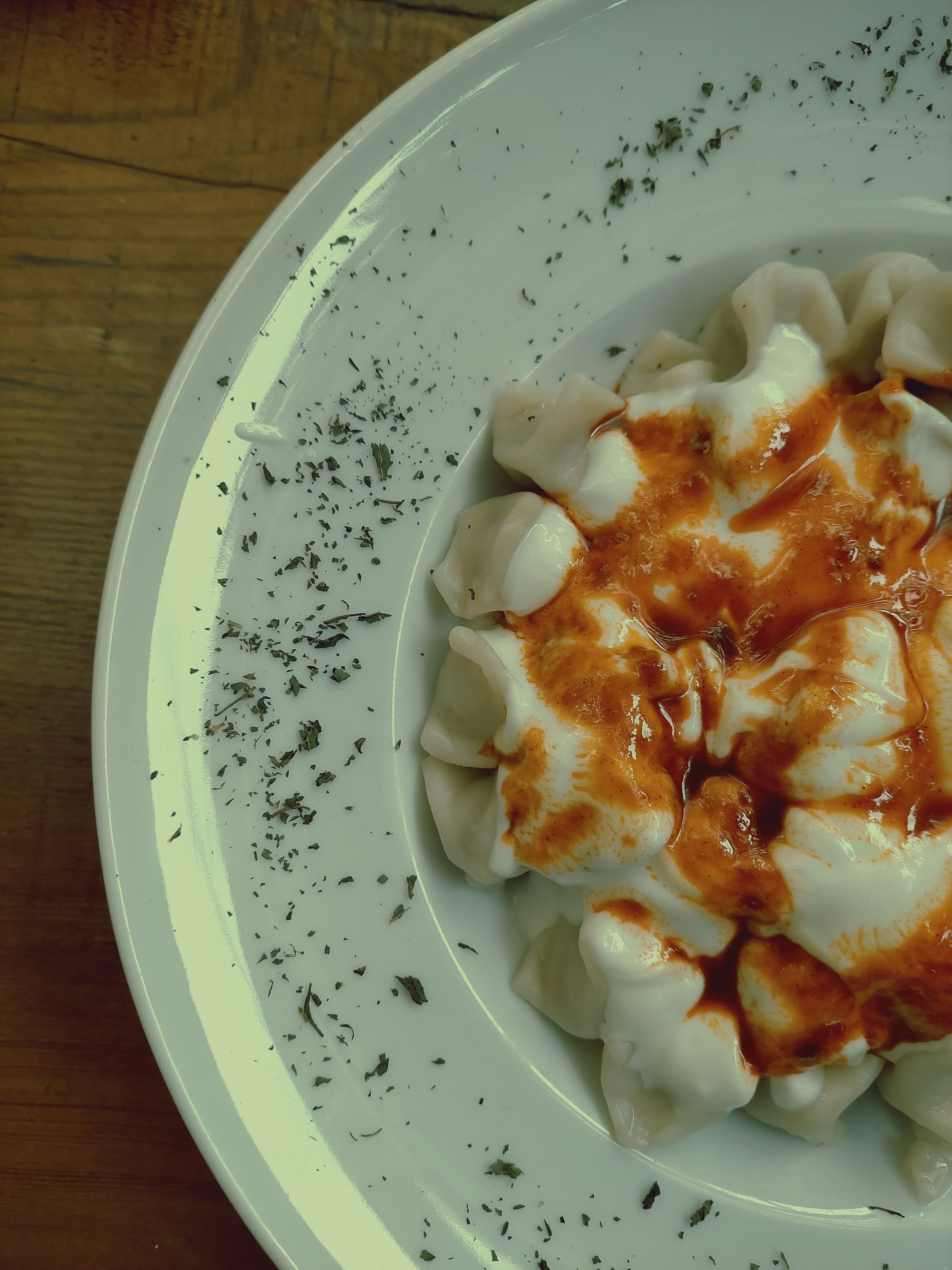
Photo: Selin Karaman / Pexels
The diets react (see scores below)
Common Ingredients
- flour
- ground beef
- onion
- garlic
- yogurt
- butter
- paprika
- salt
Specific recipes may vary.
Incompatible with 7 of 11 diets
Diet Ratings
Klepe are Bosnian dumplings made with wheat flour dough wrapped around a ground beef and onion filling, served with yogurt and butter sauce. The wheat flour wrapper is the fundamental, non-negotiable component of this dish — it is structurally central, not a minor ingredient. Flour-based dumpling dough contributes a very high net carb load (a typical serving of 6-8 dumplings could easily contain 40-60g+ of net carbs from the dough alone), which immediately and decisively breaks ketosis. While the beef filling, butter, and yogurt components are keto-compatible, the dish as traditionally prepared cannot be made keto without completely replacing the core element that makes it klepe. The onion adds minor additional carbs. There is no version of this dish in its traditional form that is compatible with a ketogenic diet.
Klepe (Bosnian dumplings) contain multiple animal-derived ingredients that are strictly excluded from a vegan diet. Ground beef is animal flesh, yogurt is a dairy product, and butter is an animal-derived fat. The dish is fundamentally built around these non-vegan components — the beef forms the filling while yogurt and butter constitute the sauce. There is no ambiguity here: this dish is incompatible with a vegan diet in its traditional form.
Klepe (Bosnian meat-filled dumplings) contains multiple paleo-incompatible ingredients. Flour (wheat) is a grain and strictly excluded from paleo. Yogurt and butter are dairy products, both excluded under paleo rules. Salt is also on the avoid list. The only paleo-compliant ingredients in this dish are ground beef, onion, garlic, and paprika. With three core structural and sauce components being non-paleo (flour dough, yogurt sauce, butter), this dish is fundamentally incompatible with the paleo diet — it cannot be meaningfully adapted without ceasing to be Klepe.
Klepe are Bosnian dumplings filled with ground beef, served with butter and yogurt — a dish that conflicts with Mediterranean diet principles on multiple fronts. Ground beef is red meat, which should be limited to a few times per month. Butter replaces olive oil as the primary fat, which is contrary to the Mediterranean diet's emphasis on extra virgin olive oil. The dough wrapper is made from refined white flour, a refined grain discouraged in favor of whole grains. While onion, garlic, and yogurt have some Mediterranean-compatible elements, the combination of red meat, butter, and refined flour makes this dish a poor fit overall.
Klepe are Bosnian meat-filled dumplings that are fundamentally incompatible with the carnivore diet. The dish is built around flour-based dough (a grain product), which is the primary structural component and a major carnivore violation. Additional plant-based ingredients include onion, garlic, and paprika — all excluded on carnivore. While the dish does contain animal-derived components (ground beef, yogurt, butter), these are secondary to the dominant plant-based elements. The flour alone disqualifies this dish entirely, regardless of the meat filling. This is a classic mixed dish where carnivore-compatible ingredients are embedded within an incompatible plant-based framework.
Klepe (Bosnian meat-filled dumplings) contains multiple excluded ingredients. Flour (a grain) is used to make the dumpling dough, yogurt is a dairy product, and butter is regular dairy butter — all explicitly excluded on Whole30. This dish is also structurally a pasta/dumpling, which falls under the 'no recreating baked goods/junk food' rule (pasta or noodles are explicitly prohibited). There is no compliant version of this dish possible without fundamentally changing its nature.
Klepe (Bosnian stuffed dumplings) contains multiple high-FODMAP ingredients that make it unsuitable during the elimination phase. Wheat flour (used for the dumpling dough) is high in fructans at any standard serving size. Onion is one of the highest-FODMAP foods known, rich in fructans, and is a core ingredient in the filling. Garlic is another top fructan offender and is also a key flavoring. Yogurt contains lactose and is typically used in significant quantities as a sauce in this dish. Butter is low-FODMAP and safe. Ground beef is low-FODMAP. Paprika and salt are low-FODMAP. However, the combination of wheat dough, onion, garlic, and yogurt means this dish has at least four high-FODMAP components stacked together, making it clearly unsuitable during elimination phase regardless of portion size.
Klepe are Bosnian meat-filled dumplings (similar to manti) made with refined white flour dough, ground beef filling, and topped with yogurt and butter sauce. Several components raise DASH concerns: (1) Ground beef is red meat, which DASH limits due to saturated fat content — standard ground beef (80/20) is high in saturated fat, though leaner varieties (93/7) are more acceptable; (2) Butter is a saturated fat source that DASH discourages; (3) Salt is added to both dough and filling, creating moderate-to-high sodium content depending on preparation; (4) Refined white flour rather than whole grain is used for the dough. On the positive side, the dish includes onion, garlic, and yogurt (a DASH-friendly dairy if low-fat), and the protein content supports DASH goals. The dish is not categorically DASH-incompatible but requires significant modification — leaner beef, less butter, low-sodium preparation, and portion control — to fit within DASH guidelines.
NIH DASH guidelines explicitly limit red meat and saturated fats (butter), making traditional Klepe a poor fit. However, updated clinical interpretations note that if lean ground beef (≥93% lean) is used and butter is minimized or replaced with olive oil, and yogurt is low-fat, the dish's protein and dairy components could align reasonably well with DASH principles in moderate portions.
Klepe are Bosnian meat-filled dumplings — essentially pasta pockets filled with seasoned ground beef and onion, served with a yogurt and butter sauce. From a Zone perspective, this dish has several structural challenges. The dumpling dough (flour) is a high-glycemic refined carbohydrate, which Zone categorizes as an 'unfavorable' carb — it spikes blood sugar and is difficult to portion into precise carb blocks. The ground beef filling, while a protein source, is typically not lean enough for ideal Zone compliance (Zone prefers very lean proteins at ~7g protein per block with minimal fat). The butter-yogurt sauce adds saturated fat rather than the preferred monounsaturated fats (olive oil, avocado, almonds). On the positive side, the dish does contain protein (ground beef), some favorable elements (garlic, onion, yogurt provides some protein), and could theoretically be portioned to approximate Zone ratios — but it would require very small servings of dough and careful attention to fat sources. The overall macro profile skews toward carbs and saturated fat, making Zone balance difficult without significant modification. It is not a 'avoid' because the protein filling and yogurt provide some structural Zone elements, but it is far from a favorable Zone meal.
Some Zone practitioners applying a more flexible interpretation of later Sears anti-inflammatory writings might argue that small portions of klepe (2-3 dumplings) alongside a large salad could approximate Zone ratios, and that traditional whole-food fermented dairy (yogurt) adds beneficial probiotics. However, Dr. Sears' published materials clearly classify refined flour pasta/dumplings as unfavorable carbs, and butter as a saturated fat to limit, making this dish structurally misaligned with core Zone principles regardless of portion control.
Klepe are Bosnian stuffed dumplings (similar to tortellini) with a profile that mixes several anti-inflammatory positives with notable negatives. On the positive side: garlic is a well-established anti-inflammatory ingredient with allicin and organosulfur compounds; onion contributes quercetin and polyphenols; paprika provides carotenoids including capsaicin and beta-carotene. However, the dish is built around a foundation of refined white flour (pro-inflammatory refined carbohydrate), ground beef (red meat — recommended to limit), butter (saturated fat — recommended to limit), and yogurt (full-fat dairy is in the 'limit' category, though yogurt's probiotic potential adds some nuance). The combination of red meat + butter + refined flour represents three simultaneously 'limit' or 'avoid' category items, pushing this firmly into caution territory. The dish is not aggressively pro-inflammatory (no trans fats, no HFCS, no processed additives), but it lacks the omega-3s, colorful vegetables, whole grains, or legumes that would distinguish it as anti-inflammatory. As an occasional traditional dish it is acceptable, but it should not be a dietary staple for those following anti-inflammatory principles.
Klepe are Bosnian stuffed dumplings — wheat flour dough filled with seasoned ground beef and onion, typically served with a yogurt-garlic sauce and butter drizzled on top. The dish has some redeeming nutritional qualities but carries several concerns for GLP-1 patients. On the positive side, the ground beef filling provides meaningful protein, and the yogurt topping adds additional protein along with probiotics. However, the refined flour dough is low in fiber and nutrient density, the butter topping adds saturated fat, and the overall fat load from beef plus butter can worsen GLP-1 side effects like nausea, bloating, and reflux. Ground beef (depending on fat percentage) can be a significant saturated fat source. The portion is also volume-heavy relative to its protein-per-calorie ratio — patients on GLP-1s may struggle to eat enough dumplings to hit protein targets without also consuming a large carbohydrate and fat load. The dish is not fried and is relatively easy to digest compared to heavier preparations, which prevents a lower score. With modifications — leaner ground beef (90%+ lean), reduced butter, extra yogurt — it becomes more acceptable.
Some GLP-1-focused dietitians would view the yogurt-and-beef combination more favorably as a protein-adequate traditional meal worth preserving with modifications, while others would categorically flag the refined dough and butter as too high in empty carbohydrates and saturated fat for patients with significantly reduced caloric budgets. Tolerance of the fat load is also highly individual among GLP-1 patients.
*See how scores were generated at our methodology page.
Nutritional profile
Six traits that cut across every diet.
Fiber & Plants
How much whole-plant food and fiber it delivers.
Healthy Fats
The quality of its fats (unsaturated, omega-3).
Whole / Unprocessed
How close it is to its natural, unprocessed form.
Gut Gentle
How easy it is on digestion (low FODMAP, few irritants).
Low Glycemic
How little it spikes your blood sugar.
Protein Density
How much protein it packs per calorie.
Controversy Index
Higher controversy = more disagreement between diets.
Diet-Specific Tips
 DASH — 4/10
View tips
- Red meat (ground beef) — DASH limits red meat due to saturated fat
- Butter in sauce — saturated fat source discouraged by DASH
- Added salt in dough and filling — moderate-to-high sodium risk
- Refined white flour dough — not a whole grain
- Yogurt topping — DASH-friendly if low-fat
- Onion and garlic — beneficial DASH ingredients
- Leaner beef substitution would significantly improve DASH compatibility
- Portion size critical — calorie-dense dish
 Zone — 4/10
View tips
- Refined wheat flour dough is a high-glycemic 'unfavorable' carbohydrate in Zone terminology
- Ground beef is not a lean Zone-preferred protein — contains significant saturated fat
- Butter sauce adds saturated fat rather than preferred monounsaturated fat (olive oil/avocado)
- Dish is carbohydrate and saturated fat heavy, making 40/30/30 ratio difficult to achieve
- Yogurt provides some protein value and is a relatively Zone-friendly dairy component
- Garlic and onion are favorable low-glycemic Zone vegetables but present in small amounts
- Would require very small portions and significant accompaniment modifications to fit Zone blocks
 Anti-Inflammatory — 4/10
View tips
- Refined white flour is a pro-inflammatory refined carbohydrate
- Ground beef (red meat) is in the 'limit' category for anti-inflammatory eating
- Butter adds saturated fat, flagged as pro-inflammatory at regular consumption
- Garlic and onion contribute meaningful anti-inflammatory polyphenols and organosulfur compounds
- Paprika provides carotenoids and mild anti-inflammatory benefit
- Yogurt has some probiotic benefit but full-fat dairy is in the 'limit' category
- No omega-3 sources, whole grains, or legumes to offset the inflammatory ingredients
- No processed additives, trans fats, or HFCS — not aggressively harmful
 GLP-1 Friendly — 4/10
View tips
- Refined flour dough is low in fiber and nutrient density — not ideal for limited caloric intake
- Ground beef provides protein but carries saturated fat risk depending on fat percentage
- Butter topping adds saturated fat and may worsen nausea or reflux
- Yogurt-garlic sauce is a positive element — adds protein and probiotics
- Not fried and soft-textured — relatively easy to digest
- Volume-heavy relative to protein yield per calorie
- Modifiable: leaner beef and reduced butter would improve the rating meaningfully