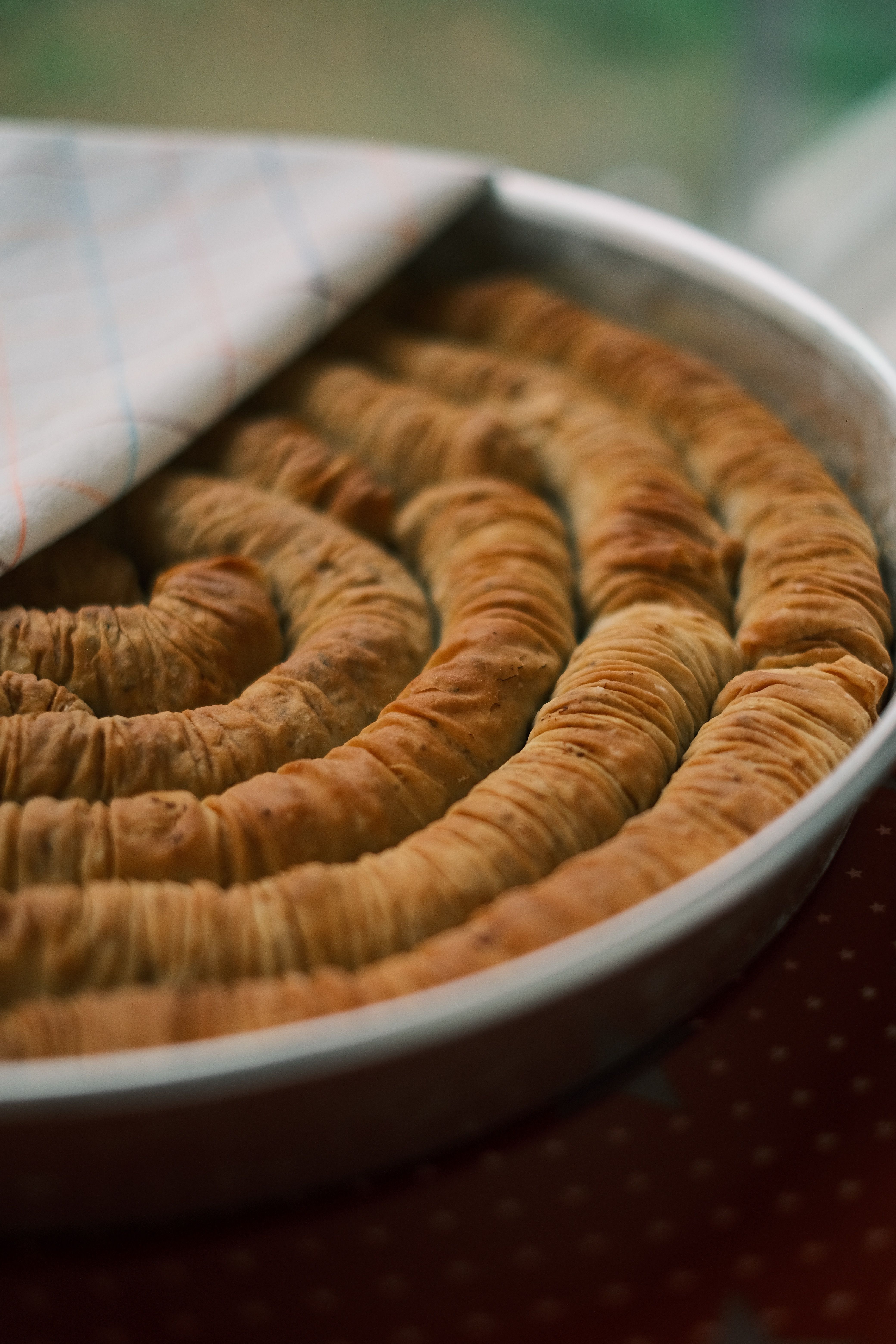
Photo: Emre Gencer / Pexels
The diets react (see scores below)
Common Ingredients
- phyllo dough
- spinach
- cottage cheese
- eggs
- oil
- salt
- black pepper
Specific recipes may vary.
Incompatible with 6 of 11 diets
Diet Ratings
Zeljanica is a traditional Bosnian phyllo pastry pie filled with spinach, cottage cheese, and eggs. While the filling ingredients (spinach, cottage cheese, eggs) are largely keto-friendly, the dish is fundamentally built around phyllo dough, which is a refined grain product with extremely high net carbs. A standard serving of zeljanica contains multiple layers of phyllo, each sheet contributing roughly 4-5g net carbs, meaning a single serving can easily deliver 30-50g net carbs from the dough alone — well beyond the daily keto threshold. The phyllo dough makes this dish incompatible with ketosis regardless of the otherwise acceptable filling. There is no meaningful way to portion-control around the dough without fundamentally changing the dish.
Zeljanica is a traditional Bosnian spinach and cheese pie that contains multiple clear animal-derived ingredients. Cottage cheese is a dairy product (made from cow's milk), and eggs are an animal product — both are explicitly excluded from a vegan diet. While the phyllo dough, spinach, and oil are plant-based, the presence of cottage cheese and eggs makes this dish fundamentally non-vegan. A vegan version could theoretically be made by substituting tofu-based filling for the cottage cheese and using a flax or chickpea egg replacement, but the traditional dish as listed is not vegan-compatible.
Zeljanica is a traditional Bosnian spinach and cheese pie that is fundamentally incompatible with the paleo diet. The dish contains multiple strictly excluded ingredients: phyllo dough is made from refined wheat flour (a grain), cottage cheese is dairy, and salt is added. While spinach, eggs, and black pepper are fully paleo-approved, they are minor components overshadowed by the non-paleo foundation of the dish. The unspecified 'oil' is also a concern, as it is likely a seed oil (sunflower or vegetable oil, common in Bosnian cooking). There is no meaningful way to adapt this dish within its traditional form — the phyllo dough and cottage cheese are structural to the recipe, not incidental additions.
Zeljanica is a Bosnian spinach and cheese pie made with phyllo dough. Its ingredients present a mixed Mediterranean profile. Spinach is an excellent plant-based vegetable strongly encouraged in the Mediterranean diet. Eggs and cottage cheese are acceptable in moderation (poultry/dairy category). However, phyllo dough is a refined grain product, which modern Mediterranean diet guidelines discourage in favor of whole grains. The use of oil (likely vegetable or neutral oil rather than extra virgin olive oil) is also a consideration — if substituted with EVOO, the dish improves. Overall, the dish has redeeming qualities (spinach, eggs, moderate dairy) but is anchored by refined phyllo pastry, placing it in the moderation category.
Traditional Eastern Mediterranean and Middle Eastern cuisines (Greek, Turkish, Levantine) regularly include phyllo-based pies like spanakopita as part of their dietary patterns, and some Mediterranean diet authorities consider these culturally embedded dishes acceptable in the broader dietary framework. The high vegetable and egg content could justify a more favorable reading in a traditional context.
Zeljanica is a Bosnian spinach and cheese pie that is fundamentally incompatible with the carnivore diet. The dish is built around phyllo dough (wheat-based grain product), spinach (plant food), and oil (likely plant-based). While it contains eggs and cottage cheese — both of which are accepted by many carnivore practitioners — these animal-derived ingredients are minor components overwhelmed by multiple excluded plant foods and processed grain products. No amount of eggs or dairy rescues a dish whose foundation is phyllo dough and spinach. This is a classic plant-heavy pastry dish with essentially no redeeming carnivore qualities.
Zeljanica contains two major Whole30-excluded ingredients: phyllo dough (made from wheat flour, a grain) and cottage cheese (a dairy product). Both are explicitly prohibited on the Whole30 program. There is no compliant version of this dish that preserves its essential character, as phyllo dough is the structural foundation of the pastry. Even if the cheese were substituted, the grain-based dough alone disqualifies it entirely.
Zeljanica contains two significant FODMAP concerns that make it problematic during the elimination phase. First, phyllo dough is made from wheat flour, which is high in fructans — a primary FODMAP to eliminate. A standard serving of zeljanica would involve multiple layers of phyllo, delivering a substantial fructan load. Second, cottage cheese contains lactose at meaningful levels; Monash University rates regular cottage cheese as high-FODMAP at a standard serving (around 4 tablespoons/75g). The spinach is low-FODMAP, eggs are low-FODMAP, oil is low-FODMAP, and salt/black pepper are low-FODMAP, but the combination of wheat-based phyllo and lactose-containing cottage cheese creates a double FODMAP hit that makes this dish unsuitable during elimination.
Monash University does rate some sourdough-style or spelt wheat products as lower-FODMAP when long fermentation reduces fructan content, but standard commercial phyllo dough uses conventional wheat with no fermentation, so there is no practitioner consensus that phyllo is safe. Some FODMAP practitioners might suggest substituting lactose-free cottage cheese and gluten-free pastry to create a compliant version, but the traditional dish as described should be avoided.
Zeljanica contains a mix of DASH-friendly and DASH-cautionary components. On the positive side, spinach is an excellent DASH food — high in potassium, magnesium, and fiber — and cottage cheese provides calcium and protein with relatively moderate saturated fat. Eggs are acceptable in moderation under modern DASH interpretations. However, phyllo dough is a refined white flour product with notable sodium content (typically 200-300mg per few sheets), and the dish as traditionally prepared uses a generous amount of oil and salt, pushing total sodium meaningfully higher. The overall sodium load across a typical serving portion can approach 400-600mg or more, and the refined grain base lacks the fiber benefits of whole grains emphasized by DASH. The dish is not heavily processed or high in saturated fat, but the refined phyllo and added salt require portion control for DASH adherence. Using low-sodium cottage cheese and minimizing added salt would improve the DASH compatibility significantly.
NIH DASH guidelines emphasize whole grains and low-sodium dairy, which would flag phyllo dough and standard cottage cheese as suboptimal. However, updated clinical interpretations note that spinach-rich dishes with moderate-fat dairy and eggs can fit within DASH when portions are controlled and sodium is managed — some DASH-oriented dietitians would conditionally approve a smaller portion prepared with reduced salt.
Zeljanica is a Bosnian spinach and cheese pie made with phyllo dough, spinach, cottage cheese, eggs, and oil. From a Zone perspective, this dish has some genuinely favorable components but requires careful portioning. The positives are significant: spinach is an ideal Zone carbohydrate (low-glycemic, high in polyphenols and fiber), cottage cheese provides lean protein that fits Zone protein blocks well, and eggs contribute quality protein with some beneficial fat. The challenge is the phyllo dough — a refined flour product with a moderately high glycemic index, classified as an 'unfavorable' carbohydrate in Zone terminology. However, phyllo is used in thin layers, so the total refined carb load per serving may be manageable if portions are controlled. The oil used (likely olive oil or vegetable oil depending on the recipe) is a variable — olive oil would be Zone-ideal, seed oils less so. The overall macronutrient balance skews toward carbohydrates from the phyllo with moderate protein from eggs and cottage cheese, and fat from oil and eggs. A typical serving would likely be carbohydrate-heavy relative to the 40/30/30 target. With a small portion paired with additional lean protein, this dish can fit into Zone eating, but it's not a natural Zone-balanced meal on its own. The spinach-to-phyllo ratio matters considerably.
Some Zone practitioners would rate this more favorably, noting that Sears' later writings (Toxic Fat, The Mediterranean Zone) embrace Mediterranean and Eastern European vegetable-rich dishes as aligned with the Zone's anti-inflammatory goals. The spinach and cottage cheese combination is nearly ideal, and if the phyllo is thin and the portion modest (1-2 pieces), the unfavorable carb load may be acceptable within a balanced Zone meal. Others would rate it lower, arguing that for a breakfast dish, the refined phyllo carbohydrates could spike insulin early in the day, undermining Zone hormonal balance.
Zeljanica is a traditional Bosnian spinach and cheese pie with a mixed anti-inflammatory profile. On the positive side, spinach is a highly anti-inflammatory leafy green rich in antioxidants, carotenoids (lutein, zeaxanthin), vitamin K, and folate — all associated with reduced inflammatory markers. Eggs contribute choline and selenium, which have anti-inflammatory properties, along with some arachidonic acid on the other side. Cottage cheese is a relatively low-fat dairy option, placing it in the 'moderate' category rather than the 'limit' category of full-fat dairy. The 'oil' used is a key variable — if extra virgin olive oil, this significantly improves the profile with oleocanthal and polyphenols; if a refined seed oil (sunflower, corn), it adds omega-6 burden. Black pepper modestly enhances bioavailability of anti-inflammatory compounds. The main concern is phyllo dough, which is a refined carbohydrate with little fiber or nutritional value, representing a moderate pro-inflammatory element. The dish is not heavily processed, contains no added sugar or trans fats, and is vegetable-forward. Overall, this is a reasonable moderate-frequency food — not a strong anti-inflammatory dish due to refined pastry, but far from pro-inflammatory given the spinach base and modest dairy.
Some anti-inflammatory practitioners (e.g., those following AIP or strict Wahls Protocol) would flag eggs for arachidonic acid content and refined phyllo for its glycemic impact, pushing this toward 'avoid.' Conversely, Mediterranean-aligned anti-inflammatory frameworks like Dr. Weil's would view this favorably as a vegetable-rich, minimally processed traditional dish — particularly if olive oil is used — and might score it higher.
Zeljanica is a Bosnian spinach and cheese pie made with phyllo dough, spinach, cottage cheese, and eggs. It has genuine nutritional strengths for a GLP-1 patient: cottage cheese and eggs together provide meaningful protein (roughly 12-18g per moderate serving depending on ratios), spinach contributes fiber and micronutrients, and the dish is relatively easy to digest compared to heavier pastries. However, phyllo dough is a refined grain with limited fiber and minimal nutritional value per calorie, and the oil used in layering phyllo adds significant fat per serving — traditional preparation often involves generous oiling between layers, which raises the fat content and may worsen GLP-1 side effects like nausea, bloating, and reflux. The dish is also portion-sensitive: a small slice works reasonably well, but a larger serving tips the fat and refined carb load into problematic territory. Cottage cheese is an excellent GLP-1-friendly protein source, which partially redeems the dish. Rated caution rather than avoid because the protein and vegetable content are real, but the phyllo and oil are meaningful drawbacks.
Some GLP-1-focused dietitians may rate this more favorably if prepared with minimal oil and a small portion, citing the cottage cheese and egg protein content as a practical win for patients who struggle to meet protein targets at breakfast. Others would flag the refined phyllo crust and variable fat content from oiling as reasons to steer patients toward crustless egg-and-spinach alternatives that deliver the same protein and fiber with better fat and carb profiles.
*See how scores were generated at our methodology page.
Nutritional profile
Six traits that cut across every diet.
Fiber & Plants
How much whole-plant food and fiber it delivers.
Healthy Fats
The quality of its fats (unsaturated, omega-3).
Whole / Unprocessed
How close it is to its natural, unprocessed form.
Gut Gentle
How easy it is on digestion (low FODMAP, few irritants).
Low Glycemic
How little it spikes your blood sugar.
Protein Density
How much protein it packs per calorie.
Controversy Index
Higher controversy = more disagreement between diets.
Diet-Specific Tips
 Mediterranean — 5/10
View tips
- Spinach is a Mediterranean-approved vegetable, adding nutritional value
- Phyllo dough is a refined grain, not aligned with whole grain emphasis of Mediterranean diet
- Eggs and cottage cheese are acceptable in moderation but not core staples
- Oil type matters — EVOO would be preferred over generic refined oils
- No red meat or highly processed ingredients, which is a positive
- Portion size and frequency of consumption are important moderating factors
 DASH — 5/10
View tips
- Spinach is a core DASH vegetable — excellent source of potassium and magnesium
- Phyllo dough is made from refined white flour, not a DASH-preferred whole grain
- Cottage cheese provides calcium and protein but adds sodium; low-sodium versions preferred
- Added salt during preparation raises overall sodium concern
- Eggs are acceptable in DASH in moderation under current dietary guidance
- Oil type and quantity matters — moderate vegetable oil is acceptable, but excess adds calories
- Portion size is critical; a small serving is more compatible than a large one
 Zone — 5/10
View tips
- Phyllo dough is a refined, higher-glycemic 'unfavorable' carbohydrate in Zone terminology
- Spinach is an ideal Zone low-glycemic, high-polyphenol carbohydrate source
- Cottage cheese provides lean protein that fits Zone protein blocks well
- Eggs contribute quality protein and some beneficial fat
- Overall macro ratio likely skews too carbohydrate-heavy for Zone balance without portion control
- Type of oil used significantly affects Zone compatibility (olive oil favorable vs. seed oils unfavorable)
- Small portions with additional lean protein could bring this into Zone range
 Anti-Inflammatory — 5/10
View tips
- Spinach is strongly anti-inflammatory — rich in carotenoids, antioxidants, and vitamin K
- Phyllo dough is refined carbohydrate with minimal fiber — modest pro-inflammatory element
- Cottage cheese is low-fat dairy — acceptable in moderation per anti-inflammatory guidelines
- Eggs have mixed profile: beneficial selenium and choline, but some arachidonic acid
- Oil type is critical: EVOO would significantly improve the score vs. refined seed oils
- No added sugar, trans fats, or artificial additives — favorable for a pastry-based dish
- Traditional whole-food preparation with no processed ingredients beyond phyllo
 GLP-1 Friendly — 5/10
View tips
- Cottage cheese and eggs provide moderate protein (~12-18g per serving), a genuine positive for GLP-1 patients
- Spinach contributes fiber, micronutrients, and hydration support
- Phyllo dough is a refined grain — low fiber, low nutrient density per calorie
- Oil used between phyllo layers adds significant fat, risking nausea, bloating, and reflux
- Portion-sensitive: a small slice is more acceptable than a standard serving
- No high-fiber whole grain component; fiber contribution comes only from spinach
- Preparation method matters significantly — less oil between layers meaningfully improves the profile
- Better GLP-1-friendly alternatives exist (crustless spinach-egg bake, cottage cheese egg muffins)