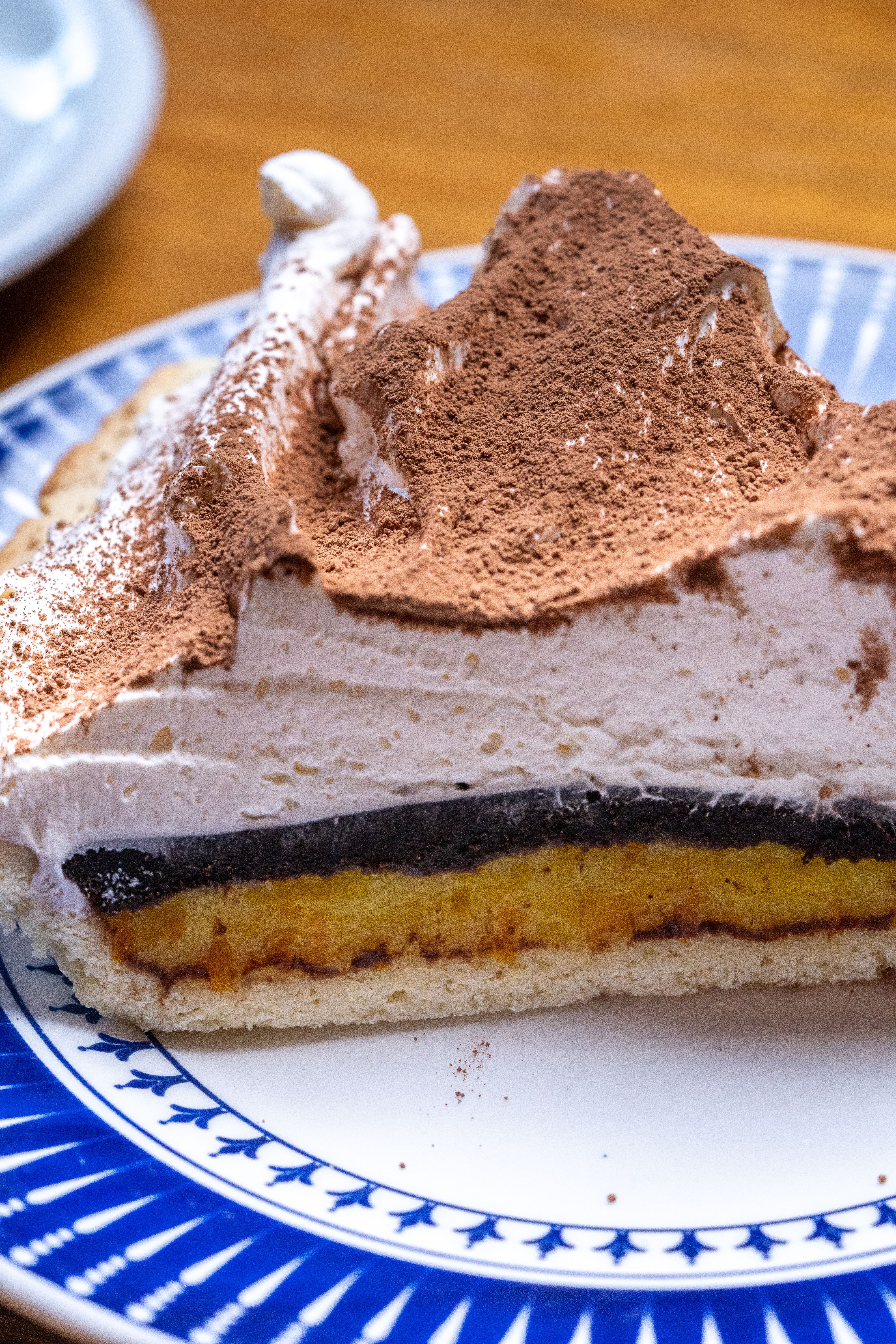
Photo: Nano Erdozain / Pexels
American
Boston Cream Pie
The diets react (see scores below)
Common Ingredients
- cake flour
- eggs
- sugar
- butter
- milk
- vanilla extract
- cornstarch
- chocolate
- heavy cream
Specific recipes may vary.
Incompatible with 11 of 11 diets
Diet Ratings
Boston Cream Pie is fundamentally incompatible with a ketogenic diet. It contains cake flour (a refined grain high in carbohydrates), sugar (added directly and via chocolate), milk, and cornstarch — all of which are high-carb ingredients that will easily push daily net carbs far beyond the 20-50g keto threshold in a single serving. A standard slice can contain 50-70g of net carbs on its own, instantly breaking ketosis. There are no significant offsetting keto-friendly qualities; while butter, eggs, and heavy cream are keto-approved, they are minor components overwhelmed by the grain and sugar base.
Boston Cream Pie contains multiple animal-derived ingredients that make it entirely incompatible with a vegan diet. Eggs and butter are direct animal products, milk and heavy cream are dairy products, and the chocolate ganache topping typically contains heavy cream. Every major component of this dish — the sponge cake, pastry cream filling, and chocolate glaze — relies on animal ingredients. There is no ambiguity here; this dish is thoroughly non-vegan in its traditional form. Vegan versions can be made by substituting plant-based milk, vegan butter, aquafaba or flax eggs, and dairy-free chocolate and cream, but the dish as described contains none of these substitutions.
Boston Cream Pie is fundamentally incompatible with the Paleo diet. The dish is built on multiple strictly excluded ingredients: cake flour (a refined wheat grain product), sugar (refined sugar), milk and heavy cream (dairy), and butter (dairy). Cornstarch, derived from corn (a grain), is also excluded. These are not peripheral or trace ingredients — they are the structural foundation of this dessert. There is no version of this dish that can be considered Paleo without a complete reconstruction using different ingredients.
Boston Cream Pie is a heavily processed American dessert that contradicts nearly every core Mediterranean diet principle. It is built on refined cake flour (not whole grain), loaded with added sugars, saturated fats from butter and heavy cream, and chocolate ganache. There is no olive oil, no plant-based whole foods, no legumes, and no nutritional redeeming qualities aligned with Mediterranean eating. The combination of refined carbohydrates, high sugar content, and saturated fat makes this a textbook example of what the Mediterranean diet advises minimizing or eliminating entirely.
Boston Cream Pie is fundamentally incompatible with the carnivore diet. The dish is built around cake flour (a grain-based plant food), sugar (a processed plant-derived sweetener), vanilla extract (plant-derived flavoring), and cornstarch (a plant-based thickener). While it does contain some animal-derived ingredients — eggs, butter, milk, heavy cream, and chocolate — these are minor supporting components in a dish dominated by plant-based and processed ingredients. No amount of animal-derived content can redeem a food whose primary structure is grain flour and sugar. This is a classic dessert cake with no meaningful place in a carnivore eating framework.
Boston Cream Pie contains multiple excluded ingredients and violates core Whole30 rules. Cake flour is a grain product (wheat), which is explicitly excluded. Sugar is an added sweetener, also excluded. Butter (not ghee or clarified butter) is a dairy product and excluded. Milk is excluded dairy. Cornstarch is explicitly listed as an excluded ingredient. Even setting aside the individual ingredients, Boston Cream Pie is exactly the type of baked good/dessert that Whole30 Rule 4 prohibits — it is a cake with pastry cream and chocolate ganache, a quintessential junk food recreation. This dish fails on nearly every level of the Whole30 program.
Boston Cream Pie contains multiple high-FODMAP ingredients that make it unsuitable during the elimination phase. Cake flour is wheat-based and high in fructans — a primary FODMAP concern. Milk used in the pastry cream filling contains lactose, which is a disaccharide FODMAP. Heavy cream is low-lactose in small amounts, but the combined lactose load from milk plus any residual dairy across the recipe is problematic at a standard serving. Chocolate (especially milk chocolate or dark chocolate in larger quantities) can also contribute excess polyols and fructose. The cumulative FODMAP load from wheat flour (fructans) and milk (lactose) alone is sufficient to trigger symptoms in IBS patients during elimination, regardless of portion size adjustments. There is no realistic way to consume a standard slice of Boston Cream Pie within FODMAP-safe limits given these structural ingredients.
Boston Cream Pie is fundamentally incompatible with DASH diet principles. It contains multiple ingredients that DASH explicitly limits or discourages: butter and heavy cream are high in saturated fat, refined cake flour lacks the fiber of whole grains, and significant added sugar is central to the dessert. The chocolate ganache topping adds further saturated fat and sugar. This dish provides negligible amounts of the nutrients DASH emphasizes — potassium, magnesium, calcium from low-fat sources, and dietary fiber — while delivering a concentrated load of saturated fat, added sugars, and refined carbohydrates. As a snack, it offers poor nutritional value relative to DASH-recommended options like fruits, vegetables, or low-fat dairy. NIH/NHLBI DASH guidelines explicitly limit sweets, added sugars, full-fat dairy, and saturated fats, all of which are core components of this dish.
Boston Cream Pie is a quintessential high-glycemic, high-sugar dessert that is fundamentally incompatible with Zone Diet principles. The dish is built almost entirely from unfavorable Zone ingredients: cake flour (refined, high-glycemic carbohydrate), sugar (pure glucose/fructose spike), butter and heavy cream (saturated fat, no monounsaturated benefit), and a chocolate glaze that adds more sugar and saturated fat. There is no lean protein source, no low-glycemic carbohydrate, and no monounsaturated fat. The macronutrient ratio would be severely skewed — dominated by high-glycemic carbohydrates and saturated fats, with negligible protein. Even the eggs, the only partial Zone-friendly ingredient, are overwhelmed by the surrounding ingredients. A typical slice would deliver 40-50g of high-glycemic carbs, 20-25g of fat (mostly saturated), and under 5g of protein — the opposite of a 40/30/30 Zone balance. This cannot be meaningfully 'portioned into the Zone' in any practical sense; even a single bite-sized portion would still deliver a glycemic and saturated fat load with no compensating lean protein or monounsaturated fat. This is as close to a categorically avoid food as the Zone framework identifies.
Boston Cream Pie is a highly pro-inflammatory dessert by anti-inflammatory standards. The ingredient profile is dominated by refined carbohydrates (cake flour, sugar), saturated fats (butter, heavy cream), and high glycemic sweeteners — all of which are well-established drivers of inflammatory markers like CRP and IL-6. Cake flour is a refined, low-fiber grain stripped of the fiber and nutrients found in whole grains. Large amounts of added sugar spike blood glucose and insulin, promoting inflammatory cascades. Butter and heavy cream are full-fat dairy products high in saturated fat, which anti-inflammatory frameworks recommend limiting. The chocolate component offers minor redemption only if it is high-cacao dark chocolate (>70%), which contains anti-inflammatory flavanols; however, in a traditional Boston Cream Pie the chocolate glaze is typically made with sweetened chocolate and heavy cream (ganache), significantly diluting any benefit. Cornstarch adds further refined carbohydrate with no nutritional upside. There are virtually no anti-inflammatory positives — no omega-3s, no meaningful polyphenols beyond possibly the chocolate, no fiber, no colorful vegetables or fruits, no beneficial spices. This is a classic example of a refined, high-sugar, high-saturated-fat dessert that anti-inflammatory diet authorities uniformly advise against consuming regularly.
Boston Cream Pie is a poor fit for GLP-1 patients on virtually every dietary criterion. It is built around refined cake flour (low fiber, low protein, high glycemic), substantial butter and heavy cream (high saturated fat), and significant added sugar in both the custard filling and chocolate glaze. The macronutrient profile is dominated by simple carbohydrates and saturated fat with negligible protein contribution. High fat content will worsen GLP-1 side effects including nausea, bloating, and delayed gastric emptying discomfort. The sugar load causes rapid blood sugar spikes counterproductive to metabolic goals. Nutrient density per calorie is extremely low — it provides almost no protein, minimal fiber, and no meaningful micronutrient value relative to its caloric cost. As a snack category item, it fails to deliver the 15-30g protein target or meaningful fiber that small-portion snacks should prioritize on GLP-1 therapy. There is no meaningful redeeming nutritional feature for this patient population.
*See how scores were generated at our methodology page.
Nutritional profile
Six traits that cut across every diet.
Fiber & Plants
How much whole-plant food and fiber it delivers.
Healthy Fats
The quality of its fats (unsaturated, omega-3).
Whole / Unprocessed
How close it is to its natural, unprocessed form.
Gut Gentle
How easy it is on digestion (low FODMAP, few irritants).
Low Glycemic
How little it spikes your blood sugar.
Protein Density
How much protein it packs per calorie.
Controversy Index
Higher controversy = more disagreement between diets.