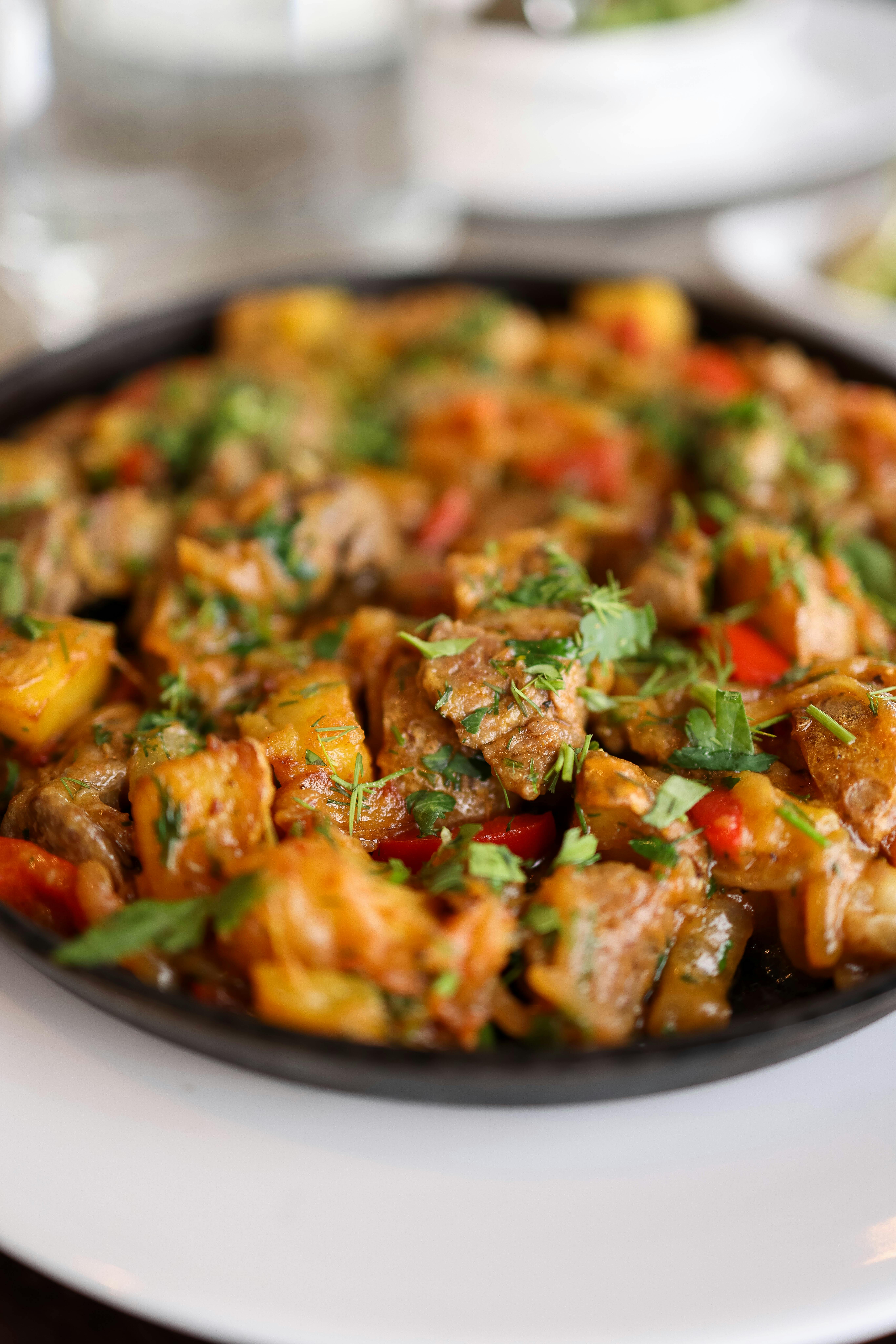
Photo: Valeria Boltneva / Pexels
The diets react (see scores below)
Common Ingredients
- pork
- potatoes
- bell peppers
- tomatoes
- eggplant
- onion
- okra
- paprika
Specific recipes may vary.
Incompatible with 4 of 11 diets
Diet Ratings
Gyuvech is a Bulgarian slow-cooked stew that is fundamentally incompatible with ketogenic eating due to the inclusion of potatoes as a primary ingredient. Potatoes are a high-starch vegetable with approximately 15-17g net carbs per 100g, and a standard serving of this dish would easily push well beyond the 20-50g daily net carb limit on its own. While several other ingredients (pork, bell peppers, eggplant, tomatoes, onion) are individually manageable in keto portions, the potatoes are a core structural component of the dish and cannot simply be removed without fundamentally changing the recipe. Okra and bell peppers add modest additional carbs. The combination makes this dish a clear keto violation in its traditional form.
Gyuvech contains pork as its primary protein, which is an animal product and explicitly excluded from a vegan diet. While the dish also includes many excellent plant-based ingredients (potatoes, bell peppers, tomatoes, eggplant, onion, okra, paprika), the presence of pork makes this entirely incompatible with vegan eating. A vegan version of this Bulgarian stew could be made by simply omitting the pork and relying on the vegetables alone.
Gyuvech is a Bulgarian slow-cooked stew with mostly paleo-compliant ingredients: pork (approved), bell peppers, tomatoes, eggplant, onion, okra, and paprika are all unprocessed vegetables and spices fully aligned with paleo principles. The problematic ingredient is white potatoes, which occupy a gray zone in the paleo community. Loren Cordain's original framework excludes white potatoes due to their glycemic load and saponin content, while more modern paleo voices have since relaxed this stance. Assuming the pork is unprocessed and no salt, seed oils, or additives are used in preparation, the dish is otherwise clean. The white potato inclusion alone drops this from a clear approve to caution territory.
Mark Sisson (Primal Blueprint) and Whole30 both permit white potatoes, and many modern paleo practitioners now include them freely as a whole-food starch. Under this interpretation, Gyuvech would be fully approvable, scoring 8-9, given that all other ingredients are unambiguously paleo-compliant.
Gyuvech is a Bulgarian baked stew featuring a rich array of Mediterranean-friendly vegetables — bell peppers, tomatoes, eggplant, onion, okra, and potatoes — that strongly align with plant-forward Mediterranean principles. The primary protein, however, is pork, which is red meat and falls in the 'limited to a few times per month' category under strict Mediterranean diet guidelines. The vegetable-to-meat ratio is favorable, and the dish is a whole-food, minimally processed preparation with no added sugars or refined grains. Paprika is a traditional spice with no dietary concerns. The dish lands in caution territory: the vegetable base is excellent, but pork as the primary protein keeps it from full approval.
Some Mediterranean diet researchers, particularly those focusing on traditional Balkan and Eastern Mediterranean regional practices, note that pork has historically been consumed in moderate amounts in parts of Greece, the Balkans, and Southern Europe. In a dish where pork is used sparingly relative to the large volume of vegetables — as is common in gyuvech — some practitioners would consider occasional consumption compatible with a Mediterranean-style pattern, especially compared to heavily processed or high-fat red meat dishes.
Gyuvech is a Bulgarian vegetable and meat stew that is overwhelmingly plant-based. While it contains pork as the primary protein, the dish is loaded with carnivore-excluded plant foods: potatoes (starchy vegetable/carbohydrate), bell peppers, tomatoes, eggplant, onion, okra, and paprika (a plant-derived spice). The pork component alone would be carnivore-compatible, but in this dish it is a minor element surrounded by a large variety of vegetables and plant ingredients. The carnivore diet strictly excludes all plant foods, making this dish fundamentally incompatible regardless of the pork content. There is unanimous consensus in the carnivore community that a vegetable-dominant stew like this is entirely off-limits.
Gyuvech is a traditional Bulgarian slow-cooked stew made entirely of Whole30-compliant ingredients. Pork is an approved protein, and all the vegetables listed — potatoes, bell peppers, tomatoes, eggplant, onion, and okra — are explicitly allowed on Whole30. Paprika is a compliant spice. There are no grains, legumes, dairy, added sugars, or other excluded ingredients in this dish as described. It is a whole-food, minimally processed meal that aligns well with the spirit of the Whole30 program.
Gyuvech contains multiple high-FODMAP ingredients that make it unsuitable during the elimination phase. Onion is one of the highest-FODMAP foods tested by Monash University, containing significant fructans at any cooking amount — and as a stew-style dish, onion is typically a foundational ingredient used in substantial quantities. Eggplant is moderate-to-high FODMAP at standard serving sizes (Monash rates it as high-FODMAP above 75g, and stew portions easily exceed this). Okra contains moderate FODMAPs (GOS and fructans) and becomes high-FODMAP at servings above 6 pods, which is easily exceeded in a casserole dish. The combination of onion, eggplant, and okra creates a high cumulative FODMAP load that cannot be mitigated by portion control when the dish is prepared traditionally. Pork, potatoes, bell peppers, tomatoes, and paprika are individually low-FODMAP and would otherwise be safe, but the problematic ingredients dominate the FODMAP profile of this dish.
Gyuvech is a Bulgarian slow-cooked casserole combining pork with an abundance of DASH-favorable vegetables (bell peppers, tomatoes, eggplant, onion, okra, potatoes) and paprika. The vegetable base is strongly aligned with DASH principles, providing potassium, magnesium, fiber, and antioxidants. The primary concern is the pork component: DASH limits red meat due to saturated fat and cholesterol content, though pork loin or leaner cuts used in moderation are more acceptable than fatty cuts. The dish typically uses minimal added sodium beyond the natural ingredients, which is a positive. Preparation method matters significantly — if fatty pork (shoulder, belly) is used with added salt or lard, the dish trends toward avoid territory; if lean pork tenderloin or loin is used with minimal added salt, it scores closer to 7. The overall dish is rated as caution because pork is a red meat that DASH recommends limiting, but the exceptional vegetable density partially offsets this concern.
NIH DASH guidelines categorize all red meat (including pork) as a food to limit, recommending no more than lean meat 6oz/day with preference for poultry and fish. However, updated clinical interpretations note that lean pork cuts (tenderloin, loin) have a fat profile comparable to chicken breast, and some DASH-oriented dietitians consider lean pork acceptable in moderate portions — particularly when paired with a high volume of vegetables as in this dish.
Gyuvech is a Bulgarian slow-cooked stew that has both Zone-friendly and Zone-challenging elements. On the positive side, the dish is rich in low-glycemic, polyphenol-dense vegetables — bell peppers, tomatoes, eggplant, onion, and okra are all favorable Zone carbohydrate sources that Dr. Sears would consider excellent choices. The paprika adds additional polyphenol value. However, two significant Zone concerns arise: (1) Potatoes are a high-glycemic carbohydrate that Sears explicitly classifies as 'unfavorable' and recommends avoiding — they can spike insulin and disrupt the Zone's hormonal balance goal. (2) Pork, depending on the cut, can carry significant saturated fat, making it a less ideal protein choice compared to skinless chicken or fish. The dish's macro ratio likely skews toward excessive carbohydrates (with potatoes dominant) and insufficient lean protein relative to Zone targets of 40/30/30. With portion control — reducing potato volume, using lean pork loin, and ensuring adequate protein relative to the carb load — this dish can be adapted into a Zone-compatible meal, but as traditionally prepared it requires modification.
Some Zone practitioners in the later Sears anti-inflammatory framework might view the vegetable diversity and polyphenol density of Gyuvech as highly favorable, arguing that the fiber content in vegetables like okra and eggplant sufficiently offsets the glycemic impact of potatoes in a mixed meal context. Sears' later work (The Zone Diet and anti-inflammatory nutrition) places increasing emphasis on polyphenol-rich foods, and this dish's vegetable profile is genuinely impressive. A practitioner could argue that by using small amounts of potato and lean pork, this dish achieves a reasonable Zone balance.
Gyuvech is a Bulgarian slow-cooked stew featuring a rich array of anti-inflammatory vegetables — bell peppers, tomatoes, eggplant, onion, okra, and paprika — alongside potatoes and pork. The vegetable profile is genuinely impressive from an anti-inflammatory standpoint: bell peppers and tomatoes are high in vitamin C, lycopene, and carotenoids; eggplant contains nasunin and chlorogenic acid (potent antioxidants); okra provides soluble fiber and polyphenols; onion supplies quercetin; and paprika delivers capsaicin and carotenoids. These components collectively support antioxidant activity and may reduce inflammatory markers. However, pork as the primary protein introduces complexity. While leaner cuts of pork are categorized as 'moderate' in anti-inflammatory frameworks (similar to lean poultry), pork is often fattier than chicken or turkey and can contribute saturated fat and arachidonic acid, which are mildly pro-inflammatory. Traditional gyuvech preparations may use fattier cuts and cooking methods that concentrate saturated fat. Potatoes are starchy and neutral-to-mildly glycemic, not problematic in moderate amounts. The dish contains no processed ingredients, refined sugars, or seed oils in its traditional form, which is a significant plus. Overall, the exceptional vegetable density partially offsets the pork's inflammatory potential, but the dish cannot be fully approved due to the red/processed meat consideration depending on cut.
The nightshade vegetables (tomatoes, bell peppers, eggplant, potatoes) that form the backbone of gyuvech are considered beneficial by Dr. Weil and mainstream anti-inflammatory nutrition due to their antioxidant richness — but Autoimmune Protocol (AIP) advocates like Dr. Tom O'Bryan argue that solanine, lectins, and alkaloids in nightshades can trigger intestinal permeability and systemic inflammation in sensitive individuals, particularly those with autoimmune conditions. Additionally, some anti-inflammatory frameworks place pork alongside red meat as a food to limit due to saturated fat and arachidonic acid content, while others (including Dr. Weil's moderate-protein guidance) treat lean pork as acceptable in moderation.
Gyuvech is a Bulgarian slow-cooked casserole combining pork with a rich array of vegetables (bell peppers, tomatoes, eggplant, onion, okra, potatoes). The vegetable base is genuinely excellent for GLP-1 patients — eggplant, okra, bell peppers, tomatoes, and onion collectively provide meaningful fiber, antioxidants, and high water content, supporting digestion and hydration. Okra in particular is a standout fiber source that also supports blood sugar stabilization. The dish scores well on nutrient density per calorie and digestibility (slow-cooked vegetables are soft and easy on the stomach). However, the primary protein — pork — is the central concern. Traditional gyuvech typically uses fattier pork cuts (shoulder, belly, or mixed cuts), which increases saturated fat per serving, worsens GLP-1 side effects (nausea, reflux, bloating from delayed gastric emptying), and reduces the protein-to-fat ratio. Potatoes add starchy carbohydrates with limited fiber relative to their caloric load. The dish is portion-sensitive: a modest serving emphasizing the vegetables with lean pork is acceptable, but a larger serving with a fatty pork cut pushes toward avoid territory. With a lean pork loin substitution, this dish would score 6-7.
Some GLP-1-focused dietitians would rate this more favorably, arguing that slow-cooked pork in a vegetable-heavy casserole dilutes the fat per portion significantly and that the exceptional fiber and micronutrient density from okra, eggplant, and tomatoes partially offsets the protein-quality concern. Others maintain that any dish with fatty pork as the primary protein is poorly suited for GLP-1 patients regardless of vegetable content, given how sensitized gastric emptying is to fat load.
*See how scores were generated at our methodology page.
Nutritional profile
Six traits that cut across every diet.
Fiber & Plants
How much whole-plant food and fiber it delivers.
Healthy Fats
The quality of its fats (unsaturated, omega-3).
Whole / Unprocessed
How close it is to its natural, unprocessed form.
Gut Gentle
How easy it is on digestion (low FODMAP, few irritants).
Low Glycemic
How little it spikes your blood sugar.
Protein Density
How much protein it packs per calorie.
Controversy Index
Higher controversy = more disagreement between diets.
Diet-Specific Tips
 Paleo — 5/10
View tips
- Pork is paleo-approved when unprocessed
- Bell peppers, tomatoes, eggplant, onion, okra, and paprika are all paleo-compliant vegetables and spices
- White potatoes are the sole contested ingredient — excluded by Cordain's strict framework but accepted by Sisson, Whole30, and much of modern paleo
- No grains, legumes, dairy, or seed oils present
- Preparation method (slow-cooked stew) is inherently whole-food and paleo-friendly
- Added salt is common in traditional recipes and should be avoided for strict paleo compliance
 Mediterranean — 5/10
View tips
- Pork is red meat, limited to a few times per month in strict Mediterranean guidelines
- Abundant and diverse vegetable content (bell peppers, tomatoes, eggplant, onion, okra) strongly aligns with Mediterranean principles
- Whole-food, minimally processed preparation with no refined grains or added sugars
- Traditional Balkan dish — pork use is regionally common but not canonical to core Mediterranean diet
- Potatoes are acceptable in moderation; paprika is a healthy spice
 Whole30 — 7/10
View tips
- Pork is a fully compliant Whole30 protein
- All vegetables (potatoes, bell peppers, tomatoes, eggplant, onion, okra) are Whole30-approved
- Paprika is a compliant spice
- No grains, legumes, dairy, or added sugars present
- Dish is a whole-food stew consistent with Whole30 spirit
- Standard preparation uses no excluded ingredients
 DASH — 6/10
View tips
- Pork is a red meat limited under DASH guidelines due to saturated fat
- Exceptional vegetable variety (bell peppers, tomatoes, eggplant, okra, onion) strongly supports DASH
- Low inherent sodium from ingredients — no high-sodium processed components
- Paprika adds flavor without sodium, supporting DASH cooking strategies
- Potatoes provide potassium, a key DASH mineral
- Saturated fat content depends heavily on pork cut selected
- Preparation with lard or excessive salt would significantly lower the score
- Lean pork cuts in controlled portions make this dish more acceptable
 Zone — 5/10
View tips
- Potatoes are a high-glycemic 'unfavorable' carbohydrate explicitly discouraged by Dr. Sears — the primary Zone concern in this dish
- Bell peppers, tomatoes, eggplant, okra, and onion are all Zone-favorable low-glycemic vegetables with high polyphenol value
- Pork is an acceptable Zone protein only if a lean cut (loin) is used; fatty cuts like shoulder increase saturated fat significantly
- The vegetable-to-potato ratio in the serving matters greatly — reducing potatoes and increasing other vegetables improves Zone compliance
- No added fats listed; if olive oil is used in preparation, that aligns with Zone's monounsaturated fat preference
- Overall carbohydrate load may exceed Zone targets without careful portioning, especially with potatoes present
- Paprika adds polyphenols consistent with Sears' anti-inflammatory dietary philosophy
 Anti-Inflammatory — 5/10
View tips
- Rich vegetable diversity: bell peppers, tomatoes, eggplant, okra, onion — high in antioxidants, polyphenols, and fiber
- Eggplant contains nasunin and chlorogenic acid with demonstrated anti-inflammatory properties
- Okra provides soluble fiber (mucilage) which supports gut health and reduces inflammatory markers
- Paprika contributes capsaicin and carotenoids with anti-inflammatory benefits
- Pork is the primary protein — classified as 'limit' to 'moderate' in most anti-inflammatory frameworks due to saturated fat
- Fatty cut of pork (common in traditional preparations) increases saturated fat load
- Nightshade vegetables (tomatoes, bell peppers, eggplant, potatoes) are debated in autoimmune-focused anti-inflammatory protocols
- No processed ingredients, refined sugars, or hydrogenated fats in traditional preparation
- Slow-cooked preparation may enhance bioavailability of lycopene and other carotenoids
 GLP-1 Friendly — 5/10
View tips
- Pork cut is critical — fatty cuts (shoulder, belly) increase saturated fat and worsen GLP-1 GI side effects; lean loin significantly improves the rating
- Vegetable base (okra, eggplant, bell peppers, tomatoes) provides excellent fiber, micronutrients, and water content — strong positives
- Okra is a standout ingredient for GLP-1 patients: high fiber, blood sugar support, soft texture when cooked
- Slow-cooked preparation improves digestibility — vegetables are soft and easy on a slowed GI tract
- Potatoes add caloric starch with moderate fiber; portion size matters
- Protein density per calorie is moderate-to-low depending on pork-to-vegetable ratio in the serving
- Dish is portion-sensitive — a small, vegetable-forward serving with lean pork is acceptable; a large fatty-pork-heavy serving is not