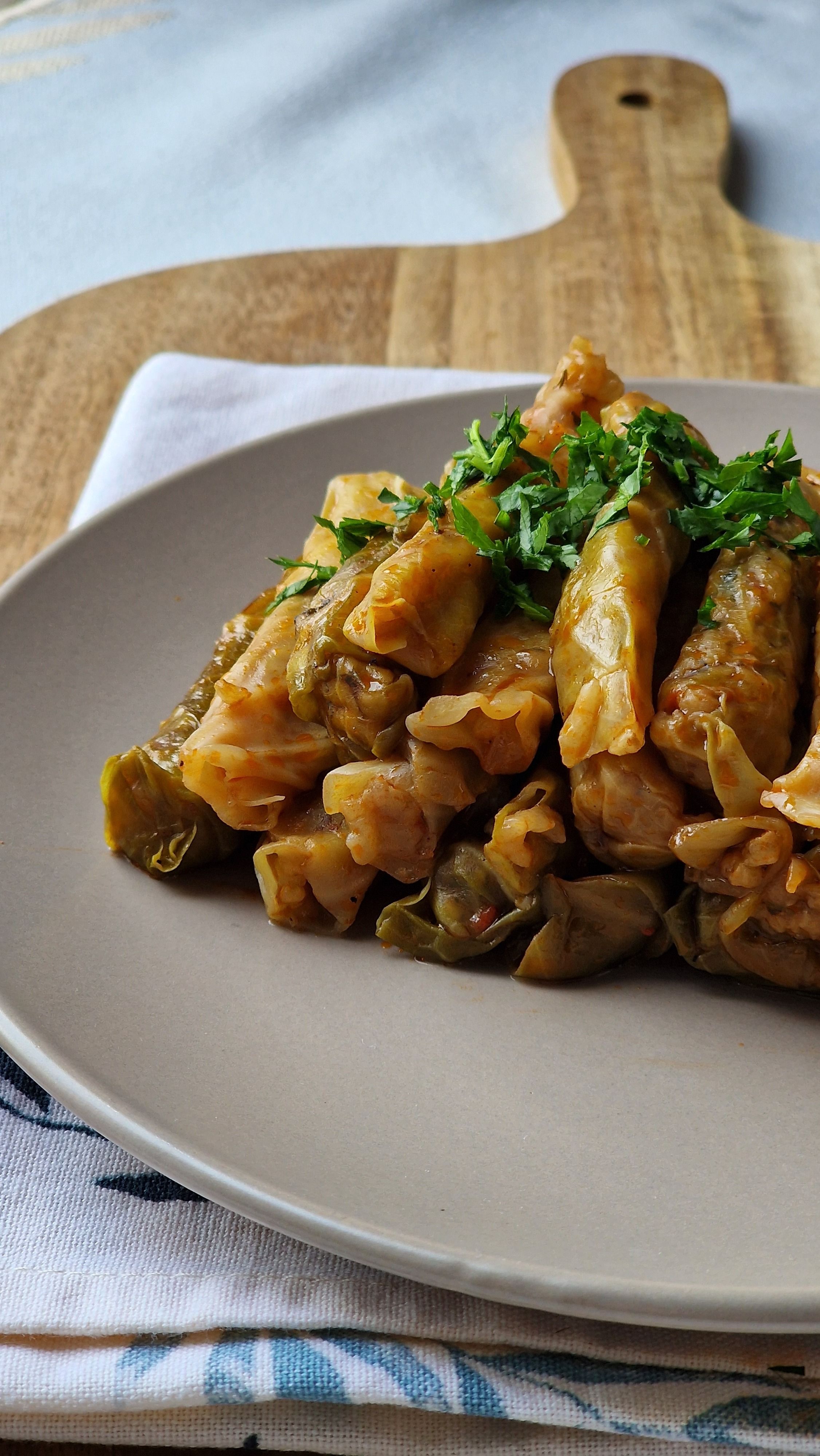
Photo: Nour Alhoda / Pexels
The diets react (see scores below)
Common Ingredients
- cabbage leaves
- ground pork
- rice
- onion
- paprika
- mint
- tomato
- black pepper
Specific recipes may vary.
Incompatible with 7 of 11 diets
Diet Ratings
Sarmi is a Bulgarian stuffed cabbage dish that is fundamentally incompatible with ketogenic eating due to the inclusion of rice as a primary ingredient. Rice is a high-glycemic grain that contributes significant net carbs — a standard serving of sarmi can easily contain 30-50g of net carbs from rice alone, which can exceed or consume the entire daily keto carb allowance in one dish. While cabbage leaves themselves are keto-friendly and ground pork is an excellent keto protein source, the rice filling is the disqualifying factor. The dish cannot be considered keto in its traditional form.
Sarmi contains ground pork as a primary ingredient, which is an animal product and categorically incompatible with a vegan diet. There is no ambiguity here — pork is meat, and meat is explicitly excluded from veganism under all definitions. The remaining ingredients (cabbage leaves, rice, onion, paprika, mint, tomato, black pepper) are all plant-based, but the dish as described cannot be considered vegan due to the pork.
Sarmi is a traditional Bulgarian dish of cabbage leaves stuffed with ground pork and rice. While several ingredients are paleo-compliant — cabbage, ground pork, onion, paprika, mint, tomato, and black pepper are all approved whole foods — rice is a grain and is explicitly excluded from the paleo diet. Rice is a core structural ingredient in this dish, not a minor additive, making the dish fundamentally non-paleo. The dish cannot simply be evaluated in a modified form; as traditionally prepared, it fails paleo criteria due to the grain content.
Sarmi is a traditional Bulgarian stuffed cabbage dish that centers on ground pork as the primary protein, which classifies it as a red meat dish. The Mediterranean diet limits red meat to a few times per month, making this a food to largely avoid or treat as a very rare indulgence. The cabbage, tomato, onion, and herbs (mint, paprika, black pepper) are excellent Mediterranean vegetables, and rice in moderation is acceptable, but the dominant pork content pulls the overall score firmly into the 'avoid' category. The dish also typically lacks olive oil as a featured fat, relying instead on the fat rendered from the pork itself.
Some Mediterranean diet interpretations, particularly those rooted in traditional Eastern Mediterranean and Balkan culinary practices, allow for occasional pork-stuffed cabbage rolls when portions are modest and the dish is vegetable-forward. Substituting the pork with lamb (also limited but more traditional in Mediterranean contexts) or replacing it entirely with a legume-rice filling would make sarmi a well-aligned Mediterranean dish.
Sarmi is a Bulgarian stuffed cabbage dish that is fundamentally incompatible with the carnivore diet. While it contains ground pork as the primary protein, the dish is built around multiple plant-based ingredients: cabbage leaves (the wrapper), rice (a grain), onion, paprika, mint, tomato, and black pepper. Rice alone is a high-carbohydrate grain that is strictly excluded from carnivore. Cabbage, tomato, onion, and the spices (paprika, mint) are all plant-derived and violate carnivore principles. The pork component is the only carnivore-compatible element, but it represents a small fraction of the dish's overall composition. There is no meaningful way to adapt this dish to carnivore without fundamentally deconstructing it — at which point it is no longer Sarmi.
Sarmi contains rice, which is a grain explicitly excluded from the Whole30 program. Rice is listed among the grains that must be eliminated for the 30 days. All other ingredients — cabbage leaves, ground pork, onion, paprika, mint, tomato, and black pepper — are Whole30-compliant, but the inclusion of rice makes this dish non-compliant in its traditional form.
Sarmi contains onion as a primary ingredient, which is one of the highest-FODMAP foods due to its very high fructan content. Onion is problematic even in small quantities and is a key flavoring component of this dish, not a minor garnish. The other ingredients are largely low-FODMAP: cabbage leaves are low-FODMAP at standard servings (up to 75g), ground pork is FODMAP-free, white rice is low-FODMAP, paprika (ground spice) is low-FODMAP in small amounts, tomato is low-FODMAP at one medium tomato, fresh mint is low-FODMAP, and black pepper is low-FODMAP. However, the presence of onion as a structural ingredient in the filling makes this dish unsuitable for the elimination phase. There is no practical way to remove onion from sarmi without fundamentally altering the recipe.
Sarmi (Bulgarian stuffed cabbage rolls) contains a mix of DASH-friendly and DASH-problematic ingredients. The cabbage, onion, tomato, paprika, mint, and rice are all DASH-compatible — vegetables and whole/refined grains are emphasized in the plan. However, ground pork is a red meat with moderate-to-high saturated fat content, which DASH explicitly limits. The key concern is the pork: traditional ground pork (especially fattier blends like 70-80% lean) contributes saturated fat and can be calorie-dense. Sodium depends heavily on preparation — no added salt is listed in the ingredients, which is favorable, but traditional recipes often include salt in cooking water or stuffing. If made with lean ground pork (93%+ lean) or substituted with lean turkey or chicken, this dish would score higher. The vegetable-forward base and moderate rice portion make it more DASH-compatible than many pork dishes, but the red meat classification and potential saturated fat content warrant a caution rating.
NIH DASH guidelines categorize red meat (including pork) as a food to limit due to saturated fat and recommend lean poultry or fish as preferred proteins. However, updated clinical interpretations note that lean cuts of pork (such as pork tenderloin or very lean ground pork) have a saturated fat profile comparable to chicken thighs, and some DASH-aligned dietitians permit lean pork in moderate portions within the weekly red meat allowance.
Sarmi (Bulgarian stuffed cabbage rolls) presents a mixed Zone Diet picture. The cabbage leaves are an excellent low-glycemic, high-fiber Zone-favorable carbohydrate. However, the dish combines two problematic elements from a Zone perspective: ground pork (a higher-fat, higher-saturated-fat protein compared to Zone ideals like skinless chicken or fish) and white rice (a high-glycemic, unfavorable Zone carbohydrate). The rice inside the rolls creates a rapid glycemic spike and counts as an 'unfavorable' carb block. The pork contributes saturated fat that skews away from the Zone's preference for lean protein (though it does contribute protein blocks). The onion, tomato, paprika, and mint are all Zone-favorable additions — tomatoes and onions are polyphenol-rich and anti-inflammatory, aligning with Sears' later writings. With careful portioning — reducing the rice significantly, choosing leaner ground pork (90%+ lean), and emphasizing the cabbage and vegetable components — sarmi can be worked into a Zone meal, but in its traditional form it leans toward carb-heavy and saturated-fat-heavy relative to Zone ideals. A typical serving would require significant block adjustments to hit 40/30/30.
Some Zone practitioners in Sears' later anti-inflammatory framework (Toxic Fat, The Mediterranean Zone) would be more lenient about the saturated fat in pork if the overall meal is polyphenol-rich, noting that tomatoes, paprika, and cabbage are excellent polyphenol sources. Additionally, if the rice portion is small (as in some traditional recipes where cabbage and pork dominate), the glycemic load may be manageable within a Zone block structure. A leaner ground pork or mixed pork-veal version could push the score toward a 6.
Sarmi is a traditional Bulgarian stuffed cabbage dish with a mixed anti-inflammatory profile. On the positive side, cabbage is a cruciferous vegetable rich in vitamin C, vitamin K, and glucosinolates with documented anti-inflammatory properties. Tomato provides lycopene and antioxidants. Onion contributes quercetin, a potent anti-inflammatory flavonoid. Paprika is rich in carotenoids and vitamin C. Mint and black pepper offer modest anti-inflammatory phytochemicals, and black pepper's piperine enhances curcumin absorption (though no turmeric is present here). Rice as a whole grain is neutral to mildly positive. The problematic element is ground pork, which is a red meat classified in the 'limit' category under anti-inflammatory guidelines due to saturated fat content and its association with elevated inflammatory markers (CRP, IL-6) in research. The dish lacks omega-3-rich ingredients, anti-inflammatory oils (no EVOO noted), or strongly anti-inflammatory spices like turmeric or ginger. The vegetable and spice components provide meaningful anti-inflammatory benefit, but the pork base prevents this from reaching 'approve' territory. If prepared with lean ground pork and cooked in EVOO, the profile improves slightly. Overall, this is an acceptable dish in moderation — a reasonable 'caution' rather than avoidance.
Bulgarian sarmi (stuffed cabbage rolls) is a mixed dish for GLP-1 patients. The cabbage leaves provide fiber and are easy to digest when cooked soft, and the tomato, onion, and herbs (mint, paprika) add micronutrients. However, ground pork is the primary protein, which typically carries moderate-to-high saturated fat depending on the cut used (e.g., 70/30 or 80/20 mince is common in traditional recipes). Rice adds refined carbohydrates with limited fiber and low protein density. The overall protein-to-fat ratio is less favorable than lean protein sources like chicken breast or turkey. Portion size matters significantly — one or two rolls as part of a balanced meal is manageable, but the fat content from pork can worsen GLP-1 side effects (nausea, bloating, reflux) if consumed in larger amounts or if fattier mince is used. The dish is slow-cooked and soft-textured, which is a digestibility advantage. A lean ground pork or mixed pork-and-turkey version would rate higher.
Some GLP-1-focused dietitians would accept sarmi as a culturally appropriate whole-food meal, noting that the cabbage provides meaningful fiber and the overall dish is less processed than many convenience foods — particularly if made with leaner mince. Others would flag the saturated fat from ground pork and the low protein density relative to calories as meaningful concerns for patients needing 100-120g of protein daily from limited caloric intake, and would recommend substituting lean ground turkey or chicken.
*See how scores were generated at our methodology page.
Nutritional profile
Six traits that cut across every diet.
Fiber & Plants
How much whole-plant food and fiber it delivers.
Healthy Fats
The quality of its fats (unsaturated, omega-3).
Whole / Unprocessed
How close it is to its natural, unprocessed form.
Gut Gentle
How easy it is on digestion (low FODMAP, few irritants).
Low Glycemic
How little it spikes your blood sugar.
Protein Density
How much protein it packs per calorie.
Controversy Index
Higher controversy = more disagreement between diets.
Diet-Specific Tips
 DASH — 4/10
View tips
- Ground pork is red meat, limited under DASH due to saturated fat content
- Cabbage, tomato, onion, and paprika are DASH-approved vegetables
- No high-sodium processed ingredients listed, though preparation sodium varies
- Rice provides carbohydrate energy but is a refined grain unless brown rice is used
- Portion control is critical — one serving of 1-2 rolls can be DASH-compatible
- Substituting lean ground turkey or chicken would make this dish more DASH-friendly
- Dish lacks explicit high-sodium additives like soy sauce or cured meats, which is favorable
 Zone — 5/10
View tips
- Cabbage leaves are Zone-favorable: low-glycemic, high-fiber, excellent carb block material
- White rice is an 'unfavorable' high-glycemic carbohydrate in Zone terminology — elevates score concern
- Ground pork is higher in saturated fat than Zone-ideal lean proteins (chicken, fish, egg whites)
- Tomato, onion, paprika, and mint are Zone-positive: polyphenol-rich and anti-inflammatory
- Dish is carbohydrate-heavy (rice + cabbage + tomato + onion) relative to protein, making 40/30/30 ratio difficult without portion adjustment
- Fat content depends heavily on pork fat percentage — traditional recipes often use fattier ground pork
- Portion control and ingredient swaps (cauliflower rice, leaner pork) could rehabilitate this dish for Zone compliance
 Anti-Inflammatory — 5/10
View tips
- Ground pork is a red meat — pro-inflammatory saturated fat, should be limited under anti-inflammatory guidelines
- Cabbage is a cruciferous vegetable with anti-inflammatory glucosinolates and antioxidants
- Onion provides quercetin, a well-researched anti-inflammatory flavonoid
- Tomato contributes lycopene and vitamin C
- Paprika is rich in carotenoids (beta-carotene, capsanthin)
- No omega-3 sources present
- Rice is neutral — refined white rice is less beneficial than whole grain brown rice
- Mint and black pepper add modest anti-inflammatory phytochemicals
- Overall vegetable and spice content partially offsets the pro-inflammatory red meat component
 GLP-1 Friendly — 5/10
View tips
- Ground pork carries moderate-to-high saturated fat depending on fat percentage of mince used
- Cabbage leaves provide fiber and are soft and easy to digest when cooked
- Rice contributes refined carbohydrates with low fiber and low protein density
- Protein per serving is moderate but protein-to-calorie ratio is not optimal
- Soft cooked texture supports easy digestibility — a GLP-1 advantage
- High-fat pork varieties can worsen nausea, bloating, and reflux on GLP-1 medications
- Culturally whole-food dish with no fried or ultra-processed components
- Portion-sensitive: one to two rolls manageable, larger servings increase fat load