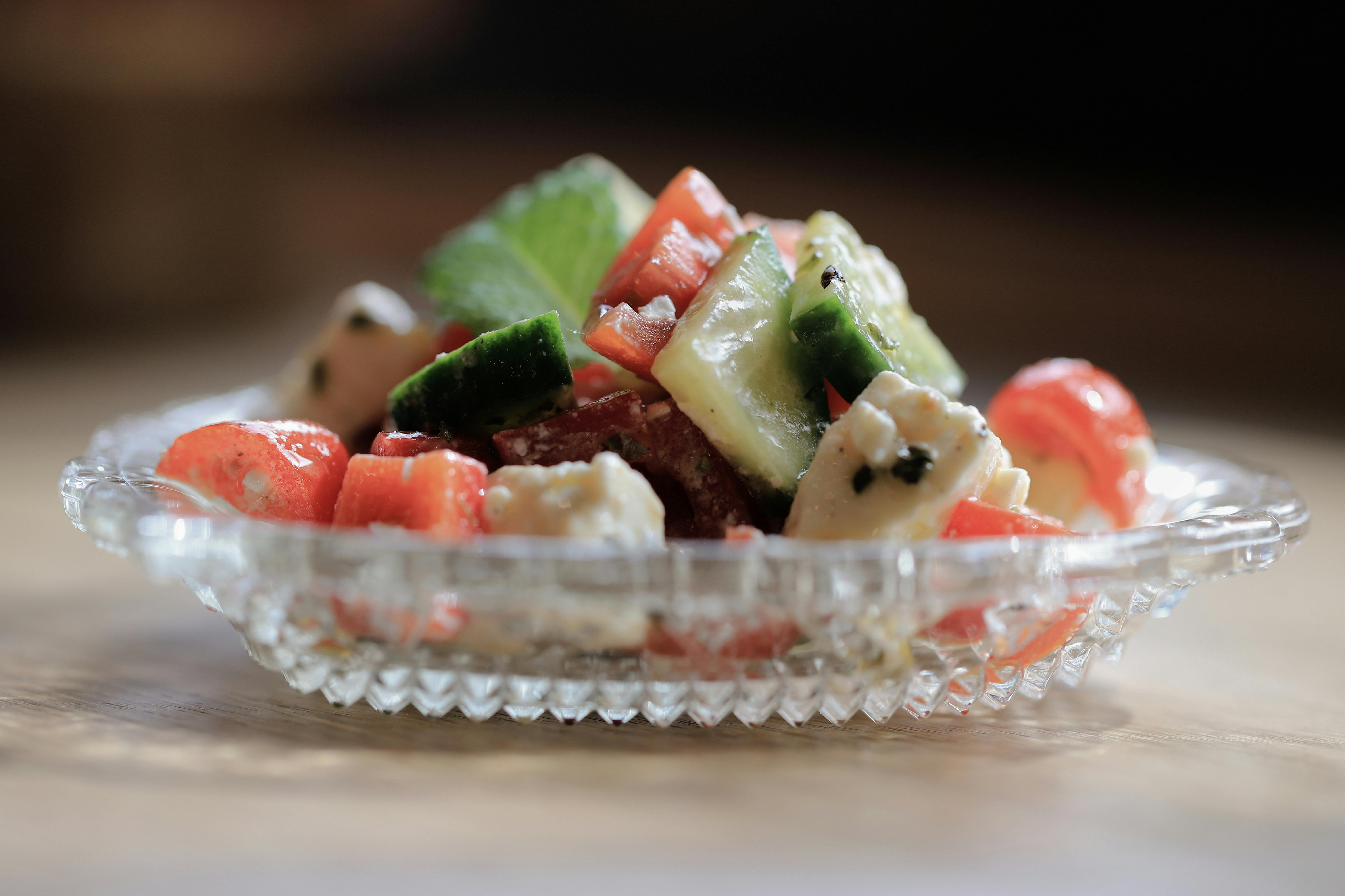
Photo: Christina & Peter / Pexels
Bulgarian
Shopska Salad
The diets react (see scores below)
Common Ingredients
- tomatoes
- cucumbers
- bell peppers
- onion
- white cheese
- parsley
- sunflower oil
- vinegar
Specific recipes may vary.
Incompatible with 5 of 11 diets
Diet Ratings
Shopska Salad is a mixed vegetable salad with moderate net carbs that requires portion awareness on keto. Tomatoes, bell peppers, and onion all contribute meaningful net carbs — a standard serving (roughly 200-250g of vegetables) could deliver 8-12g net carbs, which is manageable within a strict 20g daily budget but eats up a significant portion of it. Cucumbers are low-carb friendly. The white cheese (sirene, similar to feta) adds beneficial fat and protein with minimal carbs. Sunflower oil is a neutral fat source (though not ideal due to high omega-6 content). Vinegar is essentially carb-free. Overall, a modest portion fits keto, but the bell peppers and tomatoes are the limiting factors — generous restaurant servings could approach or exceed half the daily carb allowance.
Some strict keto practitioners consider bell peppers and tomatoes too carb-dense for regular inclusion, arguing that even moderate portions crowd out other nutrient sources within the tight 20g net carb ceiling, and would recommend swapping them for lower-carb vegetables like cucumber and leafy greens only.
Shopska Salad contains white cheese (sirene), a brined dairy cheese made from cow's, sheep's, or goat's milk, which is an animal-derived product and therefore incompatible with a vegan diet. All other ingredients — tomatoes, cucumbers, bell peppers, onion, parsley, sunflower oil, and vinegar — are fully plant-based. The dish could be made vegan by substituting the white cheese with a plant-based feta-style alternative (e.g., tofu-based or cashew-based), but as traditionally prepared, it is not vegan.
Shopska Salad contains two clear paleo violations: white cheese (dairy) and sunflower oil (a seed oil excluded from paleo due to its high omega-6 content and industrial processing). The vegetable base — tomatoes, cucumbers, bell peppers, onion, and parsley — is entirely paleo-approved, but the dish cannot be separated from its defining ingredients. Vinegar is a minor gray area but generally tolerated in the paleo community. The dairy and seed oil disqualifiers are unambiguous by virtually all paleo standards, pushing this dish firmly into avoid territory.
Shopska Salad is largely Mediterranean-friendly, built on a foundation of excellent whole vegetables — tomatoes, cucumbers, bell peppers, onion, and parsley — all of which are core to the Mediterranean diet. The white cheese (sirene/feta-style) is a moderate-use dairy item, acceptable in the Mediterranean pattern but not a daily staple. The main departure from strict Mediterranean principles is the use of sunflower oil rather than extra virgin olive oil as the fat source; sunflower oil is not the preferred fat in the Mediterranean diet and lacks the polyphenols and oleic acid profile of olive oil. Vinegar is fine. Overall a nutritious, plant-forward salad that earns approval on its vegetable base, but the sunflower oil and dairy cheese temper the score.
Some Balkan and Eastern Mediterranean regional traditions use sunflower or other vegetable oils routinely alongside olive oil, and a strict reading focused only on the vegetable-heavy composition could rate this dish higher. Additionally, white brined cheeses like sirene are closely analogous to Greek feta, which is an accepted moderate-consumption dairy in Mediterranean dietary guidelines.
Shopska Salad is almost entirely plant-based and fundamentally incompatible with the carnivore diet. The dish consists of tomatoes, cucumbers, bell peppers, onion, and parsley — all excluded plant foods — dressed with sunflower oil (a plant-derived oil) and vinegar (plant-derived). The only animal-derived ingredient is white cheese (sirene), which itself is a debated dairy product on carnivore. Even if the cheese were acceptable, it represents a minor component of an overwhelmingly plant-based dish. There is universal consensus across all carnivore authorities and protocols that this dish is off-limits.
Shopska Salad is a Bulgarian salad featuring tomatoes, cucumbers, bell peppers, onion, parsley, sunflower oil, and vinegar — all of which are fully Whole30 compliant. However, the defining ingredient of this dish is white cheese (sirene), a brined feta-style dairy cheese. Dairy (including all cheese) is explicitly excluded on Whole30. There is no compliant substitution that preserves the dish's identity; the white cheese is not incidental but central to what makes this a Shopska Salad. The dish as traditionally prepared cannot be considered Whole30 compatible.
Shopska Salad contains two significant FODMAP concerns that make it problematic during the elimination phase. First, onion is one of the highest-FODMAP foods tested by Monash University, containing large amounts of fructans at any typical serving size — even small amounts of raw onion can trigger symptoms and it is consistently rated high-FODMAP with no safe threshold for most people. Second, white cheese (sirene/feta-style brined cheese) contains lactose; while aged hard cheeses are low-FODMAP due to lactose fermentation, soft brined white cheeses like Bulgarian sirene or feta are moderate in lactose and Monash rates feta at a low-FODMAP portion of only 40g — a standard Shopska salad typically includes a generous, heavily grated or crumbled layer that easily exceeds this threshold. The remaining ingredients are generally low-FODMAP: tomatoes (safe up to ~65g per serve), cucumbers (safe up to 75g), green/red bell peppers (low-FODMAP), parsley (low-FODMAP as a garnish), sunflower oil (FODMAP-free), and vinegar (low-FODMAP). The dish could theoretically be modified (omit onion, limit white cheese to 40g) but in its standard form as served, the onion alone makes it unsuitable for the elimination phase.
Monash University does rate feta cheese as low-FODMAP at a 40g serving, and some FODMAP practitioners may approve a modified Shopska with spring onion greens substituted for onion and a carefully measured portion of white cheese. However, most clinical dietitians advise avoiding onion entirely during elimination — in its traditional form, this dish is not elimination-phase safe.
Shopska Salad is built on a strong DASH-friendly foundation: tomatoes, cucumbers, bell peppers, onion, and parsley are all core DASH vegetables rich in potassium, magnesium, fiber, and antioxidants. Sunflower oil is an acceptable vegetable oil, and vinegar adds flavor without sodium. The problematic element is the white cheese (sirene/feta-style brined cheese), which is typically high in sodium (600–900mg per 50g serving) and moderate in saturated fat. DASH specifically limits sodium and emphasizes low-fat dairy, so the cheese moves this dish from 'approve' to 'caution.' The salad is not avoid-territory because the overall vegetable base is exemplary and the cheese portion can be moderated. Using a reduced-sodium or smaller portion of white cheese would push this toward approve.
NIH DASH guidelines explicitly flag high-sodium cheeses as foods to limit due to their sodium load and saturated fat content. However, updated clinical interpretations note that when paired with a generous portion of potassium-rich vegetables (as in this dish), the overall sodium-to-potassium ratio may be more favorable, and some DASH-oriented dietitians allow small amounts of brined cheese as a flavor enhancer within a daily sodium budget rather than categorically restricting it.
Shopska Salad has a strong Zone foundation but falls short of a full 'approve' due to two notable issues. The vegetables (tomatoes, cucumbers, bell peppers, onion, parsley) are excellent low-glycemic, polyphenol-rich carbohydrate sources — exactly what Dr. Sears recommends. White cheese (sirene/feta-style) provides some protein, though it is a higher-fat, higher-saturated-fat dairy source rather than a lean protein, and the amount is typically insufficient to serve as a primary protein block for a complete Zone meal. The fat source is sunflower oil, which is high in omega-6 polyunsaturated fat — precisely the type of fat Sears discourages due to its pro-inflammatory arachidonic acid cascade potential. The Zone strongly prefers monounsaturated fats like olive oil. With olive oil substituted for sunflower oil and added lean protein (grilled chicken, tuna), this becomes a near-ideal Zone salad. As prepared, the omega-6 fat and incomplete protein profile require caution.
Some Zone practitioners note that small amounts of omega-6 oils are not categorically forbidden — the Zone framework is ratio-based, and if overall omega-3 intake is adequate (e.g., via fish oil supplementation, which Sears recommends), modest sunflower oil use may be acceptable. The white cheese does provide meaningful protein and fat content, and a generous portion of sirene can partially satisfy a protein block. In Sears' later writings (OmegaRx Zone, The Anti-Inflammation Zone), omega-3/omega-6 balance is emphasized as a continuum rather than a hard exclusion, so total dietary context matters more than any single dish's fat source.
Shopska Salad is built on a strong anti-inflammatory foundation of colorful vegetables — tomatoes (lycopene, vitamin C), cucumbers, bell peppers (vitamin C, carotenoids), onion (quercetin), and parsley (flavonoids, vitamin K) — all of which are well-supported anti-inflammatory foods. However, two ingredients pull the rating down from 'approve': (1) Sunflower oil is high in omega-6 linoleic acid and is flagged in anti-inflammatory protocols as a seed oil to avoid or minimize due to its pro-inflammatory omega-6 burden and oxidation potential — though the amount used as a dressing is typically small. Extra virgin olive oil would be the preferred substitute. (2) White cheese (sirene), a full-fat brined cheese similar to feta, falls into the 'limit' category as a full-fat dairy product. It's not strongly pro-inflammatory in modest quantities, but it does contribute saturated fat. The vinegar is neutral to mildly beneficial (acetic acid has some metabolic benefits). Overall, this is a vegetable-rich dish with meaningful anti-inflammatory components, but the sunflower oil and full-fat dairy prevent a full approval. Substituting EVOO would elevate this considerably.
Some anti-inflammatory practitioners (following Dr. Weil's broader framework) would rate this more favorably, arguing that the small amount of sunflower oil used as dressing is unlikely to meaningfully shift omega-6 balance, and that the vegetable density and polyphenol load dominate the overall profile. Conversely, stricter anti-inflammatory and AIP-aligned practitioners would flag both the seed oil and full-fat dairy (and potentially tomatoes and bell peppers as nightshades) as concerns, potentially pushing this toward a lower score.
Shopska Salad is a fiber-rich, hydrating, and nutrient-dense vegetable dish — the tomatoes, cucumbers, bell peppers, onion, and parsley all contribute meaningful fiber, vitamins, and high water content, which directly supports GLP-1 patients' needs around hydration, digestion, and constipation prevention. However, it falls short as a standalone meal for GLP-1 patients primarily due to low protein content. White cheese (sirene/feta-style) contributes some protein — roughly 4-6g per typical serving — but nowhere near the 15-30g per meal target. The cheese also adds saturated fat, which can worsen GLP-1 side effects like nausea and bloating in sensitive individuals. Sunflower oil is an unsaturated fat and acceptable in moderate amounts, but adds calorie density without protein. As a side dish or starter paired with a lean protein source, this salad is a strong complement to a GLP-1-friendly meal. As a standalone meal, it fails the protein priority test and offers limited satiety per calorie once the cheese portion is kept modest.
Some GLP-1-focused dietitians view vegetable-forward dishes like this favorably even with low protein, arguing that the fiber, water content, and micronutrient density make it a high-value component of a reduced-calorie diet where protein is obtained from other meals or snacks. Others flag white cheese more cautiously due to its saturated fat content and the heightened fat sensitivity many GLP-1 patients experience, particularly in the early weeks of treatment.
*See how scores were generated at our methodology page.
Nutritional profile
Six traits that cut across every diet.
Fiber & Plants
How much whole-plant food and fiber it delivers.
Healthy Fats
The quality of its fats (unsaturated, omega-3).
Whole / Unprocessed
How close it is to its natural, unprocessed form.
Gut Gentle
How easy it is on digestion (low FODMAP, few irritants).
Low Glycemic
How little it spikes your blood sugar.
Protein Density
How much protein it packs per calorie.
Controversy Index
Higher controversy = more disagreement between diets.
Diet-Specific Tips
 Keto — 5/10
View tips
- Bell peppers and tomatoes add 8-12g net carbs per standard serving
- Cucumbers are very low-carb and keto-friendly
- White cheese (sirene/feta-style) provides fat and protein with minimal carbs
- Sunflower oil is high in omega-6; not ideal but not a keto disqualifier
- Onion adds minor carbs but is typically used in small quantity
- Portion control is essential — a large serving risks exceeding daily carb limits
- No grains, added sugars, or high-starch ingredients present
 Mediterranean — 6/10
View tips
- Rich base of whole, fresh vegetables (tomatoes, cucumbers, bell peppers, onion, parsley) — core Mediterranean foods
- Sunflower oil used instead of extra virgin olive oil — a notable deviation from Mediterranean fat principles
- White cheese (sirene) is acceptable moderate dairy, similar to feta, but not a daily staple
- No refined grains, added sugars, or processed ingredients
- Vinegar is a benign acidulant consistent with Mediterranean cooking
 DASH — 6/10
View tips
- Vegetables (tomatoes, cucumbers, bell peppers, onion) are core DASH foods rich in potassium, fiber, and magnesium
- White/brined cheese is high in sodium (estimated 600–900mg per standard 50g serving) — a key DASH concern
- Sunflower oil is a DASH-approved vegetable oil
- No added sugars, processed meats, or trans fats
- Parsley adds micronutrients with negligible sodium
- Low-sodium cheese substitution would significantly improve DASH compatibility
- Portion control of the cheese component is critical for sodium management
 Zone — 6/10
View tips
- Excellent low-glycemic vegetable base (tomatoes, cucumbers, bell peppers, onion) — highly favorable Zone carbohydrate sources
- White cheese provides some protein but is relatively high in saturated fat and insufficient as a sole protein block for a complete Zone meal
- Sunflower oil is omega-6 dominant — pro-inflammatory and discouraged by Dr. Sears; substituting olive oil would significantly improve Zone compatibility
- No primary lean protein source — dish needs supplementation to meet Zone's ~25g protein per meal target
- High polyphenol content from colorful vegetables and parsley supports Sears' anti-inflammatory focus
- Vinegar has a negligible glycemic impact and is Zone-neutral
- Overall macronutrient ratio is carbohydrate-heavy without adequate protein or favorable fat to achieve 40/30/30 balance
 Anti-Inflammatory — 5/10
View tips
- Tomatoes, bell peppers, cucumbers, and onion provide strong antioxidant and polyphenol content (lycopene, quercetin, vitamin C, carotenoids)
- Parsley adds flavonoids and vitamin K — anti-inflammatory
- Sunflower oil is a high-omega-6 seed oil flagged in anti-inflammatory protocols — EVOO would be preferred
- White cheese (sirene/feta-style) is full-fat dairy — moderate consumption acceptable but classified as 'limit'
- Bell peppers and tomatoes are nightshades — generally anti-inflammatory for the population but debated in autoimmune contexts
- No added sugars, processed ingredients, or trans fats
- Small serving size of oil and cheese limits overall inflammatory impact
 GLP-1 Friendly — 5/10
View tips
- Low protein — white cheese provides only ~4-6g per serving, far below the 15-30g per meal target
- High fiber from vegetables supports digestion and helps prevent GLP-1-related constipation
- High water content in tomatoes and cucumbers supports hydration, critical on GLP-1 medications
- White cheese adds saturated fat, which may worsen nausea or bloating in GLP-1 patients
- Sunflower oil is an acceptable unsaturated fat but adds calorie density without protein
- Strong as a side dish paired with lean protein; weak as a standalone meal
- Nutrient-dense per calorie from vegetables, but overall caloric contribution is low without protein anchor