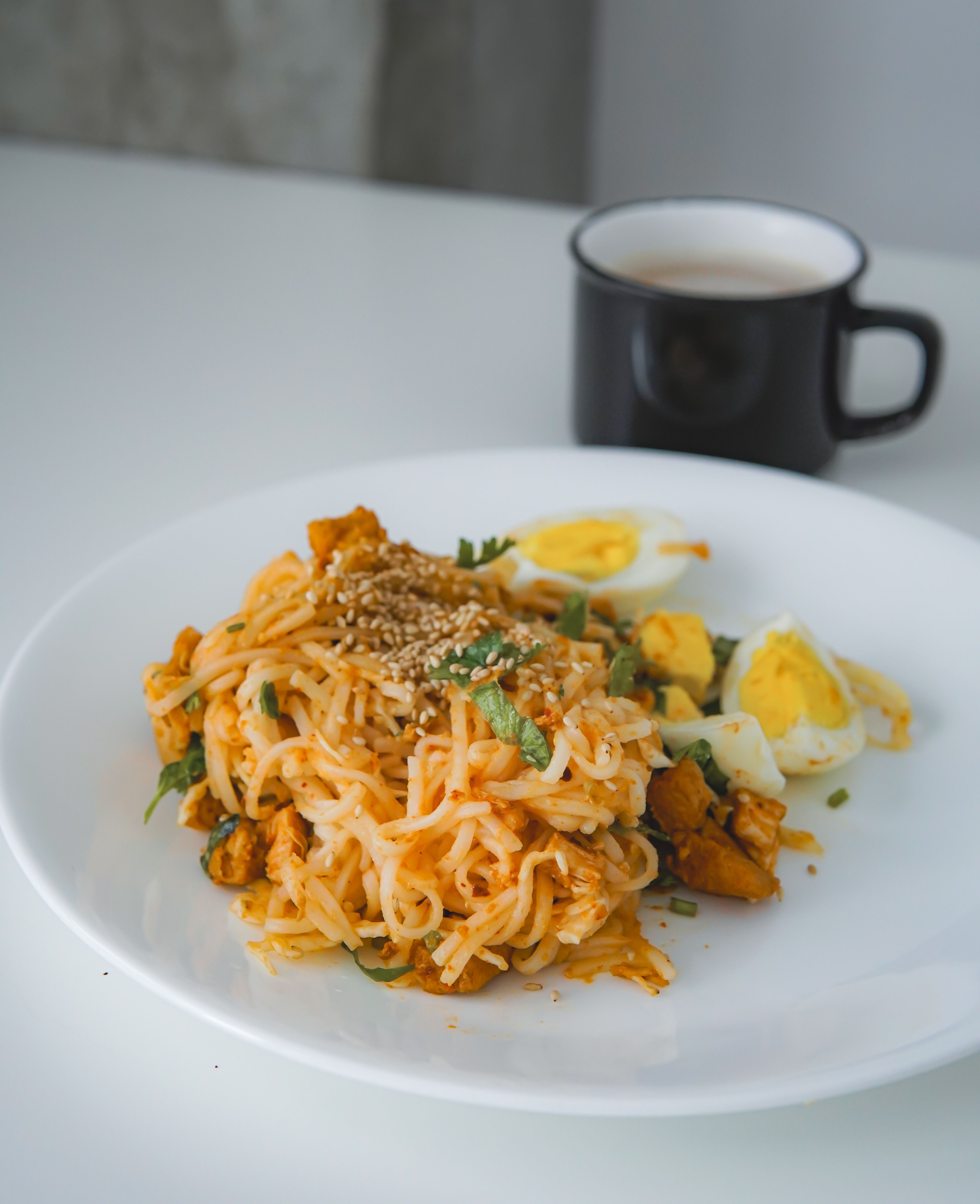
Photo: Su La Pyae / Pexels
Burmese
Nangyi Thoke
The diets react (see scores below)
Common Ingredients
- thick rice noodles
- chicken
- chickpea flour
- hard-boiled egg
- onion
- garlic
- turmeric
- fish sauce
- chili
Specific recipes may vary.
Incompatible with 6 of 11 diets
Diet Ratings
Nangyi Thoke is built on two high-carb foundations that make it fundamentally incompatible with ketogenic eating. Thick rice noodles are the primary bulk ingredient and carry a very high net carb load — a typical serving easily delivers 40–60g of net carbs from the noodles alone, exceeding most keto daily limits in a single dish. Chickpea flour (used to make the toasted chickpea fritter or sauce component) adds another significant carb source, contributing roughly 10–15g additional net carbs per serving. Together, these two ingredients alone would knock most individuals out of ketosis. The remaining ingredients — chicken, egg, fish sauce, onion, garlic, turmeric, and chili — are keto-friendly or acceptable in small amounts, but they cannot offset the core carb problem. There is no practical portion size of this dish that fits within a 20–50g daily net carb budget while leaving room for any other food during the day.
Nangyi Thoke contains multiple animal-derived ingredients that disqualify it from a vegan diet. Chicken is animal flesh, hard-boiled egg is an animal product, and fish sauce is derived from fermented fish — any one of these alone would be sufficient to render the dish non-vegan. There is no ambiguity here.
Nangyi Thoke contains multiple non-paleo ingredients that disqualify it outright. Thick rice noodles are a grain product (rice), which is excluded under strict paleo rules. Chickpea flour is a legume derivative, also firmly excluded. Fish sauce typically contains added salt and often sugar or preservatives, making it a processed condiment. These three ingredients alone — a grain, a legume, and a processed sauce — are clear violations with strong consensus in the paleo community. The remaining ingredients (chicken, hard-boiled egg, onion, garlic, turmeric, chili) are fully paleo-approved, but they cannot redeem a dish so fundamentally built around non-paleo staples.
Nangyi Thoke is a Burmese noodle salad with several Mediterranean-compatible elements alongside some concerns. Positives include chickpea flour (a legume, strongly encouraged), egg and chicken (acceptable in moderation as poultry/egg proteins), onion, garlic, turmeric, and chili (all plant-based aromatics and spices). Fish sauce, while not a Mediterranean staple, functions as a fermented condiment used sparingly, analogous to anchovy-based condiments in Mediterranean cooking. The main concern is the refined rice noodles — thick rice noodles are a refined starch, not a whole grain, and lack the fiber of whole grains preferred in Mediterranean guidance. There is no olive oil as the fat base, and the overall dish is not plant-forward in the Mediterranean sense. The chicken and egg together in one dish push this toward the upper edge of moderate animal protein. Overall, the dish is nutritionally reasonable but sits firmly in 'caution' territory due to refined noodles, absence of olive oil, and non-Mediterranean fat/cooking profile.
Some Mediterranean diet interpreters would note that chickpea flour and the vegetable-forward spice base are genuinely aligned with Mediterranean principles, and that modest portions of refined rice noodles are acceptable in traditional Mediterranean cuisines (e.g., white rice is common in Greek and Turkish traditions). From that lens, this dish could be seen as a close analog to acceptable Mediterranean grain dishes if olive oil were incorporated.
Nangyi Thoke is fundamentally incompatible with the carnivore diet. The dish is built primarily on thick rice noodles (a grain-based plant food) and chickpea flour (a legume-based plant food), both of which are strictly excluded on any tier of carnivore eating. Additionally, onion, garlic, turmeric, and chili are all plant-derived ingredients that violate carnivore rules. While the dish does contain carnivore-compatible components — chicken, hard-boiled egg, and fish sauce — these are completely outweighed by the numerous plant-based staples that form the dish's foundation. This is a plant-forward dish that happens to include some animal protein.
Nangyi Thoke contains two clearly excluded ingredients: thick rice noodles (made from rice, a grain explicitly banned on Whole30) and chickpea flour (derived from chickpeas, a legume explicitly banned on Whole30). Either of these alone would disqualify the dish. The remaining ingredients — chicken, hard-boiled egg, onion, garlic, turmeric, fish sauce, and chili — are generally Whole30-compatible, but the dish cannot be made in its traditional form without the excluded components.
Nangyi Thoke contains multiple high-FODMAP ingredients that make it unsuitable during the elimination phase. Onion is one of the highest-fructan foods tested by Monash University and is high-FODMAP at any cooking amount used as an ingredient. Garlic is similarly a very high fructan source and must be avoided entirely during elimination. Chickpea flour (made from ground chickpeas/legumes) is high in GOS and fructans and is high-FODMAP at typical serving quantities used in this dish. These three ingredients alone are sufficient to classify this dish as avoid. Thick rice noodles, chicken, hard-boiled egg, turmeric, fish sauce (in small amounts), and chili are all low-FODMAP, but they cannot offset the significant FODMAP load from onion, garlic, and chickpea flour.
Nangyi Thoke is a Burmese noodle salad with a mixed DASH profile. On the positive side, it includes lean chicken protein, chickpea flour (a legume source rich in fiber and potassium), egg (moderate protein), onion, garlic, and turmeric — all DASH-compatible ingredients. The chili adds flavor without sodium. However, fish sauce is the primary concern: it is extremely high in sodium, typically contributing 1,000–1,500mg per tablespoon, and is a staple flavoring in this dish. Even moderate use can push sodium content toward or beyond DASH thresholds. Thick rice noodles are refined carbohydrates offering little fiber compared to whole grains preferred by DASH. The hard-boiled egg is acceptable in most current DASH-aligned guidance but adds some dietary cholesterol. The dish is not inherently high in saturated fat, and with portion control and reduced fish sauce (or low-sodium substitution), it could be better tolerated. As commonly prepared, the sodium load from fish sauce places this in the 'caution' zone.
NIH DASH guidelines emphasize limiting sodium to under 2,300mg/day and avoiding high-sodium condiments like fish sauce; however, some DASH-aligned clinicians note that eggs are now well-tolerated per 2020–2025 Dietary Guidelines and that dishes like this, when prepared with reduced fish sauce or low-sodium alternatives and paired with vegetables, can fit within a broader DASH-compatible eating pattern.
Nangyi Thoke is a Burmese rice noodle salad that presents a mixed Zone picture. The dish has a solid lean protein foundation — chicken and hard-boiled egg together provide quality protein that fits Zone blocks well. However, the dominant carbohydrate source is thick rice noodles, which are a high-glycemic refined carbohydrate that Zone classifies as 'unfavorable.' The chickpea flour adds additional starchy carbs, further loading the glycemic burden. On the positive side, onion, garlic, turmeric, and chili are all Zone-favorable (turmeric is a polyphenol that Sears specifically endorses for its anti-inflammatory properties), and fish sauce is a low-calorie flavoring. The dish lacks a meaningful monounsaturated fat source, so fat balance would need supplementation (e.g., a drizzle of olive oil or some avocado). The fundamental challenge is the rice noodle base: a typical serving would deliver far more carbohydrate blocks than protein blocks, breaking the 40/30/30 ratio. With significant portion reduction of the noodles, aggressive addition of vegetables, and supplemental healthy fat, this dish can be brought into Zone range — but as traditionally served, it skews heavily carb-forward and glycemically unfavorable.
Some Zone practitioners following Sears' later writings on anti-inflammatory eating would note that the combination of turmeric, garlic, chili, and fish sauce makes this a polyphenol-rich dish, and that chickpea flour — while starchy — has a lower glycemic index than white rice noodles and contributes some protein. A practitioner might argue this is more Zone-compatible than a typical pasta dish, especially if noodle portions are modest, vegetables are added, and the chicken and egg portions are generous.
Nangyi Thoke is a Burmese noodle salad with a reasonably balanced anti-inflammatory profile. On the positive side, turmeric is one of the most well-studied anti-inflammatory spices (curcumin), garlic and chili pepper offer meaningful antioxidant and anti-inflammatory polyphenols, and chickpea flour contributes plant-based protein and fiber — both associated with reduced inflammatory markers. Lean chicken is acceptable in moderation under anti-inflammatory principles. Onions provide quercetin, a notable anti-inflammatory flavonoid. Fish sauce, while high in sodium, introduces fermented umami depth without significant inflammatory concern in typical serving quantities. The main neutral-to-cautionary element is the thick rice noodles: refined white rice noodles are a refined carbohydrate with a relatively high glycemic load, which can modestly promote inflammation compared to whole-grain alternatives. The hard-boiled egg is a mixed-evidence ingredient. Overall, this dish is far from pro-inflammatory — it leans anti-inflammatory due to its spice profile and plant ingredients — but the refined rice noodle base prevents a full approval.
Some anti-inflammatory practitioners, particularly those following an Autoimmune Protocol (AIP) or strict glycemic frameworks, would rate this lower due to the refined rice noodle base elevating blood sugar and potentially contributing to low-grade inflammation over time. Conversely, others may note that rice noodles are gluten-free and relatively clean, and that the overall dish's spice and plant composition makes it a net anti-inflammatory choice worthy of a higher score.
Nangyi Thoke is a Burmese noodle salad with a mixed nutritional profile for GLP-1 patients. On the positive side, it contains meaningful protein from chicken, hard-boiled egg, and chickpea flour (which also contributes fiber), plus anti-inflammatory turmeric and onion and garlic for micronutrient density. Fish sauce adds flavor with minimal fat or calories. However, the dish is dominated by thick rice noodles, which are refined carbohydrates with low fiber and low protein density per calorie — the opposite of what GLP-1 patients need to maximize from a reduced-appetite eating pattern. The chickpea flour component (likely toasted, used as a garnish or thickener) adds some fiber and protein but not in large enough quantity to offset the noodle base. The chili ingredient is a moderate concern — at typical Burmese salad levels it is unlikely to cause significant reflux or nausea, but GLP-1 patients with GI sensitivity may need to request a milder preparation. Overall the dish is not high-fat or fried, which keeps it out of avoid territory, but its caloric foundation in refined starch makes it a suboptimal choice when appetite is suppressed and every bite must earn its place nutritionally.
Some GLP-1-focused dietitians would view this more favorably if the dish is prepared with a generous chicken portion and the noodle volume is kept small, arguing that the egg and chickpea flour create a reasonable protein-fiber combination in a light, non-greasy format. Others would flag the refined noodle base as a significant concern regardless of portion size, since GLP-1 patients need high nutrient density per calorie and rice noodles deliver primarily simple carbohydrate.
*See how scores were generated at our methodology page.
Nutritional profile
Six traits that cut across every diet.
Fiber & Plants
How much whole-plant food and fiber it delivers.
Healthy Fats
The quality of its fats (unsaturated, omega-3).
Whole / Unprocessed
How close it is to its natural, unprocessed form.
Gut Gentle
How easy it is on digestion (low FODMAP, few irritants).
Low Glycemic
How little it spikes your blood sugar.
Protein Density
How much protein it packs per calorie.
Controversy Index
Higher controversy = more disagreement between diets.
Diet-Specific Tips
 Mediterranean — 5/10
View tips
- Chickpea flour is a Mediterranean-approved legume ingredient
- Chicken and egg are acceptable in moderation but combined here increase animal protein load
- Thick rice noodles are refined starch, not a whole grain — a moderate concern
- Fish sauce is a fermented condiment used sparingly, loosely analogous to anchovy condiments
- No olive oil present; cooking fat profile is non-Mediterranean
- Garlic, onion, turmeric, and chili are all Mediterranean-compatible aromatics
- Dish is not highly processed or high in added sugar or saturated fat
 DASH — 5/10
View tips
- Fish sauce is very high in sodium — major DASH concern
- Chickpea flour and lean chicken are DASH-positive protein/legume sources
- Thick rice noodles are refined grains, not preferred whole grains under DASH
- Egg is acceptable under current DASH-aligned guidance with moderate confidence
- Garlic, onion, turmeric, and chili are DASH-friendly flavorings
- Low-sodium fish sauce or soy sauce substitution would improve DASH score significantly
- Portion size of noodles should be controlled to limit refined carbohydrate load
 Zone — 5/10
View tips
- Thick rice noodles are a high-glycemic 'unfavorable' carbohydrate in Zone terminology, creating carb-block excess
- Chicken and hard-boiled egg provide quality lean protein that aligns with Zone block targets
- Chickpea flour adds additional starchy carbs but has a lower glycemic index than refined grains and contributes minor protein
- Dish lacks a significant monounsaturated fat source; fat balance must be added externally
- Turmeric, garlic, chili, and onion are Zone-favorable polyphenol-rich anti-inflammatory ingredients
- Fish sauce is low-calorie and Zone-neutral as a flavoring
- As traditionally served, the macro ratio is likely 60%+ carbohydrate by calories, requiring significant rebalancing to achieve 40/30/30
 Anti-Inflammatory — 6/10
View tips
- Turmeric: strong anti-inflammatory spice (curcumin content), well-supported by research
- Garlic and chili pepper: anti-inflammatory polyphenols and allicin
- Chickpea flour: plant-based protein and fiber, anti-inflammatory
- Onion: quercetin and other flavonoids with anti-inflammatory properties
- Lean chicken: acceptable under anti-inflammatory guidelines in moderation
- Thick rice noodles: refined carbohydrate with moderate glycemic load — primary limiting factor
- Hard-boiled egg: mixed evidence; choline is beneficial but arachidonic acid is debated
- Fish sauce: high sodium but no significant inflammatory concern at normal serving levels
 GLP-1 Friendly — 5/10
View tips
- Thick rice noodles are the dominant ingredient — refined carbohydrate, low fiber, low protein density
- Chicken and hard-boiled egg provide meaningful protein but total protein per serving depends heavily on preparation ratios
- Chickpea flour contributes modest fiber and protein as a garnish or coating element
- Not fried, not high-fat — favorable for GLP-1 GI tolerance
- Chili is a mild concern for patients with nausea or reflux sensitivity
- Fish sauce is low-calorie, low-fat, acceptable condiment
- Turmeric, garlic, onion add micronutrient value without GI risk
- Portion control critical — a large noodle-heavy serving worsens the nutritional profile significantly
- Could be improved by increasing chicken and egg portions and reducing noodle volume