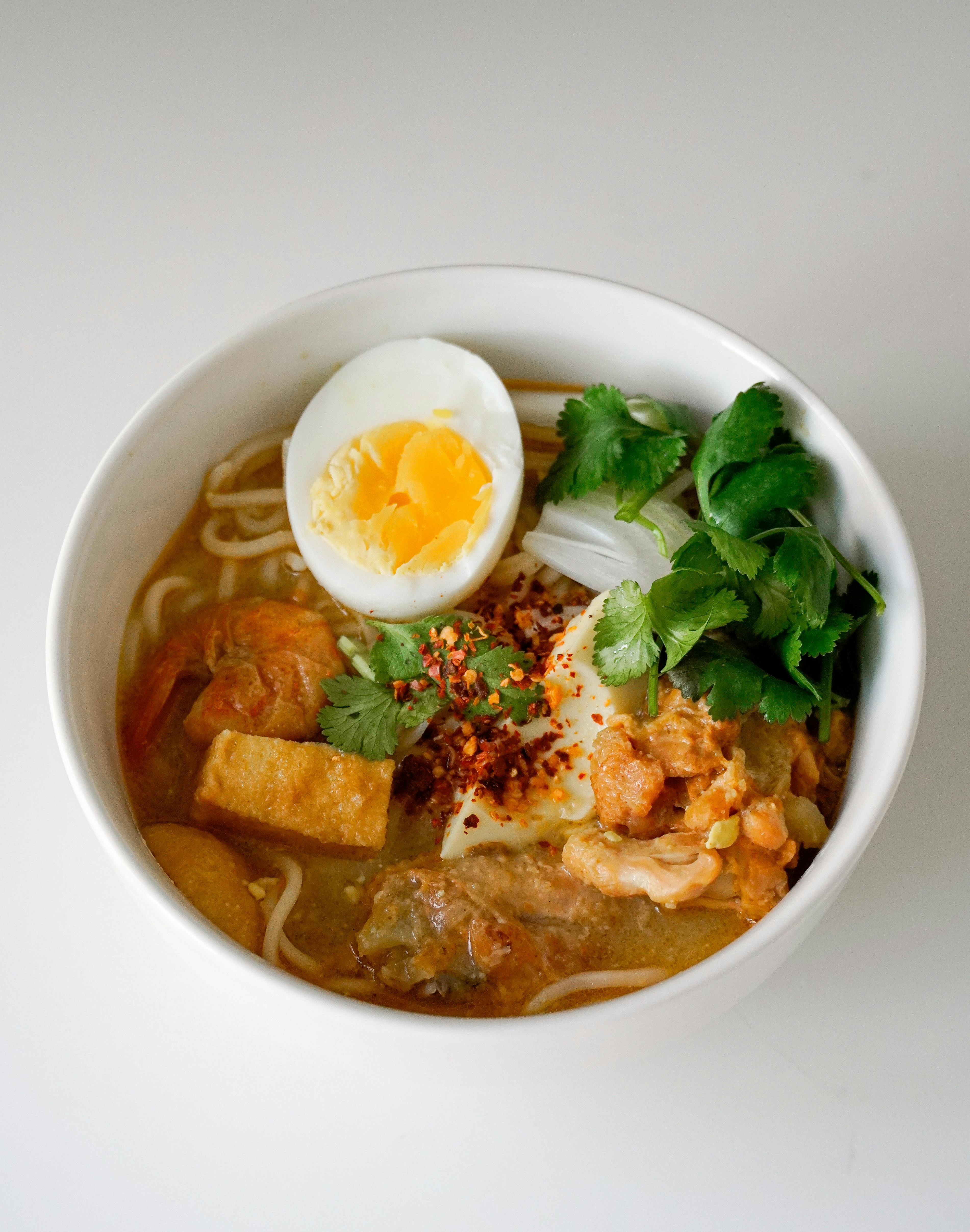
Photo: Su La Pyae / Pexels
Burmese
Ohn No Khauk Swe
The diets react (see scores below)
Common Ingredients
- chicken
- wheat noodles
- coconut milk
- chickpea flour
- onion
- garlic
- ginger
- turmeric
- fish sauce
- egg
Specific recipes may vary.
Incompatible with 7 of 11 diets
Diet Ratings
Ohn No Khauk Swe is fundamentally incompatible with a ketogenic diet. The dish's core components — wheat noodles and chickpea flour — are both high-carbohydrate ingredients that would blow a daily keto carb budget in a single serving. Wheat noodles are a grain-based food with roughly 40-50g of net carbs per serving, and chickpea flour adds another significant carb load (approximately 15-20g net carbs per quarter cup). Together, these two ingredients alone would far exceed the 20-50g daily net carb limit. While several individual ingredients are keto-friendly (chicken, coconut milk, egg, fish sauce, garlic, ginger, turmeric, onion in small amounts), the structural carbohydrate base of this dish cannot be mitigated by portion control — even a small serving would likely exceed daily limits.
Ohn No Khauk Swe is a Burmese coconut milk noodle soup that contains multiple animal-derived ingredients, making it entirely incompatible with a vegan diet. Chicken is a direct animal product (meat), fish sauce is derived from fermented fish, and eggs are an animal product explicitly excluded under vegan rules. Three separate animal-derived ingredients disqualify this dish unambiguously. While the base of wheat noodles, coconut milk, chickpea flour, onion, garlic, ginger, and turmeric are all plant-based, the dish as traditionally prepared cannot be considered vegan in any interpretation.
Ohn No Khauk Swe contains multiple hard paleo violations. Wheat noodles are a grain and strictly excluded under all paleo frameworks. Chickpea flour is derived from chickpeas, a legume, and is equally prohibited. Fish sauce often contains added salt and sometimes sugar or preservatives, making it a processed condiment that falls outside paleo guidelines. These are not debated edge cases — grains and legumes are among the most consistently rejected food categories across all major paleo authorities including Loren Cordain, Robb Wolf, and Mark Sisson. The dish's paleo-compatible elements (chicken, coconut milk, onion, garlic, ginger, turmeric, egg) are outnumbered and structurally overshadowed by its foundational non-paleo ingredients, which form the base and bulk of the dish.
Ohn No Khauk Swe presents a mixed Mediterranean diet profile. Positive elements include chicken (acceptable in moderation), egg, aromatic vegetables (onion, garlic, ginger), turmeric, fish sauce (fish-derived condiment), and chickpea flour (a legume-based ingredient that aligns well with Mediterranean principles). However, the dish has significant concerns: coconut milk is the primary fat source rather than extra virgin olive oil, and it is high in saturated fat, which directly conflicts with Mediterranean dietary fat principles. Wheat noodles are likely refined rather than whole grain. The overall fat profile is the primary issue — coconut milk-heavy dishes are not compatible with Mediterranean dietary fat guidance. Chicken and egg are moderate-category foods, keeping this from being a full avoid, but the coconut milk base and refined noodles prevent approval.
Some modern Mediterranean diet interpreters take a more permissive view of coconut milk as a plant-based fat, arguing that the broader pattern of eating matters more than any single ingredient. Additionally, the chickpea flour and aromatic vegetable base echo flavors and ingredients found in some Eastern Mediterranean and Middle Eastern cuisines, and a more flexible interpretation might rate this dish more favorably if coconut milk is viewed simply as a plant fat in moderation.
Ohn No Khauk Swe is fundamentally incompatible with the carnivore diet. The dish is built around wheat noodles (a grain) and coconut milk (a plant-derived fat), both of which are strictly excluded. Chickpea flour (a legume product) is another core ingredient and a major violation. Additional plant-based ingredients include onion, garlic, ginger, and turmeric — all excluded plant foods. While chicken, fish sauce, and egg are carnivore-compatible animal products, they are minor components in a dish dominated by plant-derived ingredients. This dish cannot be adapted to carnivore without being entirely reconstructed into a different recipe.
Ohn No Khauk Swe contains multiple Whole30-excluded ingredients. Wheat noodles are a grain product and explicitly fall under the 'no pasta or noodles' rule as well as the grain exclusion. Chickpea flour is derived from chickpeas, which are legumes and fully excluded from Whole30. These two ingredients alone make this dish non-compliant, and there is no compliant substitution that would still result in the same dish. The remaining ingredients (chicken, coconut milk, onion, garlic, ginger, turmeric, fish sauce, egg) are generally Whole30-compatible.
Ohn No Khauk Swe contains multiple high-FODMAP ingredients that make it unsuitable during the elimination phase. Wheat noodles are high in fructans — a primary FODMAP trigger. Onion and garlic are among the highest-FODMAP foods per Monash University, both rich in fructans and essentially unavoidable in meaningful amounts in this dish. Chickpea flour (besan) is high in GOS (galacto-oligosaccharides) and is used in substantial quantities as a thickener in this soup. These three ingredient categories alone — wheat, alliums, and legume flour — represent a triple FODMAP burden that cannot be mitigated by portion control when the dish is prepared traditionally. Coconut milk is low-FODMAP at ½ cup (125ml) and acceptable. Chicken, ginger (at small amounts), turmeric, fish sauce, and egg are all low-FODMAP. However, the safe ingredients do not offset the unavoidable high-FODMAP components central to this dish's identity.
Ohn No Khauk Swe presents several significant concerns for the DASH diet. The most problematic ingredient is coconut milk, a tropical oil-based product high in saturated fat, which DASH explicitly limits. Fish sauce is extremely high in sodium (one tablespoon contains roughly 1,000–1,400mg), making it very difficult to stay within DASH's 1,500–2,300mg daily sodium ceiling in a typical serving of this dish. The combination of these two ingredients alone largely disqualifies it as a DASH-compatible meal. On the positive side, the dish does include lean chicken protein, chickpea flour (a legume-based thickener rich in fiber and protein, which DASH encourages), and DASH-friendly aromatics like onion, garlic, ginger, and turmeric. Wheat noodles are refined carbohydrates rather than whole grains. Eggs are a moderate concern. Overall, the coconut milk and fish sauce create too large a nutritional barrier for regular DASH consumption without substantial recipe modification.
NIH DASH guidelines explicitly restrict both high-sodium condiments like fish sauce and saturated fat sources like coconut milk. However, some DASH-oriented clinicians note that coconut milk's medium-chain triglycerides (MCTs) may have a neutral or different metabolic effect compared to long-chain saturated fats, and that fish sauce can be used in very small quantities or substituted with low-sodium alternatives — a modified version of this dish with light coconut milk and low-sodium soy sauce could potentially reach 'caution' territory.
Ohn No Khauk Swe is a Burmese coconut milk chicken noodle soup with several Zone-compatible elements but notable challenges. On the positive side, chicken is an ideal Zone lean protein, eggs add further lean protein, and anti-inflammatory spices (turmeric, ginger, garlic, onion) align well with Sears' polyphenol emphasis. Fish sauce adds flavor with minimal macro impact. However, two ingredients create Zone friction: wheat noodles are a high-glycemic refined carbohydrate that Sears classifies as 'unfavorable,' and coconut milk is high in saturated fat, which the Zone traditionally limits in favor of monounsaturated fats. Chickpea flour is a more favorable carb source with protein and fiber that partially offsets the noodle concern. The fat ratio of the dish will likely be skewed heavily toward saturated fat from coconut milk, and carbohydrates from noodles will be high-glycemic, making the 40/30/30 block balance difficult to achieve without careful portioning — significantly reducing or eliminating noodles, and moderating coconut milk quantity. With portion modifications (small noodle serving, lightened coconut milk, generous chicken and vegetables), this dish can be worked into a Zone framework, but as traditionally prepared it runs over on unfavorable carbs and saturated fat.
Later Sears writings (The Mediterranean Zone, 2014) somewhat softened the stance on saturated fat in the context of an overall anti-inflammatory diet, and some Zone practitioners argue that coconut milk's medium-chain triglycerides have a distinct metabolic profile from long-chain saturated fats. Additionally, chickpea flour provides a meaningful protein and fiber contribution that lowers the net glycemic load of the carbohydrate component. Some Zone-aligned practitioners would rate this dish more favorably if prepared with reduced noodles and light coconut milk, treating it as a workable 'unfavorable' meal rather than a problematic one.
Ohn No Khauk Swe is a Burmese coconut milk chicken noodle soup with a genuinely mixed anti-inflammatory profile. On the positive side, it contains several strong anti-inflammatory ingredients: turmeric (curcumin), garlic, ginger, and onion are all well-supported anti-inflammatory spices and aromatics. Chicken is a lean protein classified as acceptable in the anti-inflammatory framework. Chickpea flour adds legume-based protein and fiber with a favorable inflammatory profile. Fish sauce, while high in sodium, contributes umami without significant inflammatory concern in typical amounts. The egg adds choline and selenium, which have anti-inflammatory roles. On the negative side, coconut milk is high in saturated fat (lauric acid), which is a point of contention — consumed regularly and in large quantities, it may raise LDL and contribute to inflammatory load, though some researchers argue its medium-chain triglycerides are metabolically distinct. Wheat noodles are refined carbohydrates, which anti-inflammatory guidelines recommend limiting; they lack the fiber and nutrient density of whole grain alternatives. The combination of full-fat coconut milk and refined wheat noodles as the two bulk ingredients tips this dish toward 'caution' rather than approval, despite the genuinely impressive spice profile. This is a dish that could be improved (whole grain noodles, light coconut milk) but as traditionally prepared sits in a neutral-to-slightly-cautionary zone.
Some anti-inflammatory practitioners, particularly those influenced by Dr. Weil's broader dietary philosophy, would view the turmeric-ginger-garlic combination as sufficiently potent to offset the coconut milk's saturated fat — especially given emerging research suggesting lauric acid in coconut milk behaves differently from animal saturated fats. Conversely, stricter anti-inflammatory protocols (such as those emphasizing low saturated fat intake) would rate this more negatively, flagging full-fat coconut milk as a meaningful pro-inflammatory driver when consumed regularly.
Ohn No Khauk Swe is a Burmese coconut milk noodle soup with a mixed nutritional profile for GLP-1 patients. On the positive side, chicken provides lean protein, eggs add additional protein and micronutrients, chickpea flour contributes some fiber and plant protein, and turmeric and ginger are anti-inflammatory and generally easy on digestion. The broth-based soup format is portion-friendly and hydrating. However, the dish is anchored by full-fat coconut milk, which is high in saturated fat and can worsen GLP-1 side effects like nausea, bloating, and reflux — this is the primary concern. Wheat noodles are refined carbohydrates with low fiber density. The overall fat content of a traditional preparation is likely too high for comfortable tolerance on GLP-1 medications, particularly early in treatment. A modified version using light coconut milk, reduced noodle portion, extra chicken and egg, and a larger broth-to-coconut ratio could push this toward approvable territory, but the traditional preparation as described sits in the caution zone.
Some GLP-1-focused dietitians would accept this dish in small portions given its protein from chicken and eggs and its soup format, which naturally limits volume; others would flag the full-fat coconut milk as a meaningful trigger for GI side effects and recommend avoiding coconut-milk-heavy dishes entirely, particularly around injection day or during dose escalation when side effects peak.
*See how scores were generated at our methodology page.
Nutritional profile
Six traits that cut across every diet.
Fiber & Plants
How much whole-plant food and fiber it delivers.
Healthy Fats
The quality of its fats (unsaturated, omega-3).
Whole / Unprocessed
How close it is to its natural, unprocessed form.
Gut Gentle
How easy it is on digestion (low FODMAP, few irritants).
Low Glycemic
How little it spikes your blood sugar.
Protein Density
How much protein it packs per calorie.
Controversy Index
Higher controversy = more disagreement between diets.
Diet-Specific Tips
 Mediterranean — 4/10
View tips
- Coconut milk is the primary fat — high in saturated fat, not aligned with olive oil-centered Mediterranean fat principles
- Chicken and egg are moderate Mediterranean foods, not core but acceptable
- Chickpea flour is a legume-based ingredient, a positive Mediterranean element
- Wheat noodles are likely refined, not whole grain — a mild negative
- Aromatic vegetables (onion, garlic, ginger) and turmeric are strongly Mediterranean-compatible
- Fish sauce adds umami and is fish-derived, a minor positive
- No red meat, processed ingredients, or added sugars
 Zone — 5/10
View tips
- Chicken is an ideal Zone lean protein source
- Wheat noodles are high-glycemic 'unfavorable' carbohydrates in Zone terminology
- Coconut milk is high in saturated fat, conflicting with Zone's preference for monounsaturated fats
- Chickpea flour provides a more favorable carb/protein profile with fiber
- Turmeric, ginger, and garlic offer anti-inflammatory polyphenols aligned with Zone principles
- Fat macros will be dominated by saturated fat, skewing away from Zone's monounsaturated fat preference
- Dish requires significant portioning adjustments (reduced noodles, lighter coconut milk) to approach 40/30/30
- Eggs add favorable lean protein contribution
 Anti-Inflammatory — 5/10
View tips
- Turmeric, ginger, and garlic: strong anti-inflammatory spice trio with curcumin, gingerols, and allicin
- Coconut milk: high in saturated fat (lauric acid), debated within anti-inflammatory nutrition
- Wheat noodles: refined carbohydrate with limited fiber, anti-inflammatory guidelines recommend whole grain alternatives
- Chickpea flour: legume-based, adds fiber and plant protein with favorable inflammatory profile
- Chicken: lean protein, acceptable in anti-inflammatory framework
- Egg: moderate inclusion, contributes beneficial micronutrients with mixed but generally acceptable inflammatory profile
- Fish sauce: high sodium but no significant inflammatory concern at typical culinary doses
 GLP-1 Friendly — 5/10
View tips
- Full-fat coconut milk is high in saturated fat — primary concern for GLP-1 GI side effects
- Chicken and egg provide meaningful protein but total protein density per serving may be moderate depending on ratio
- Wheat noodles are refined carbs with low fiber — chickpea flour adds modest fiber offset
- Soup format supports hydration and portion control
- Ginger and turmeric are digestion-friendly ingredients
- Traditional preparation fat content likely too high for comfortable GLP-1 tolerance
- Modifiable: light coconut milk and reduced noodle portion would significantly improve the rating