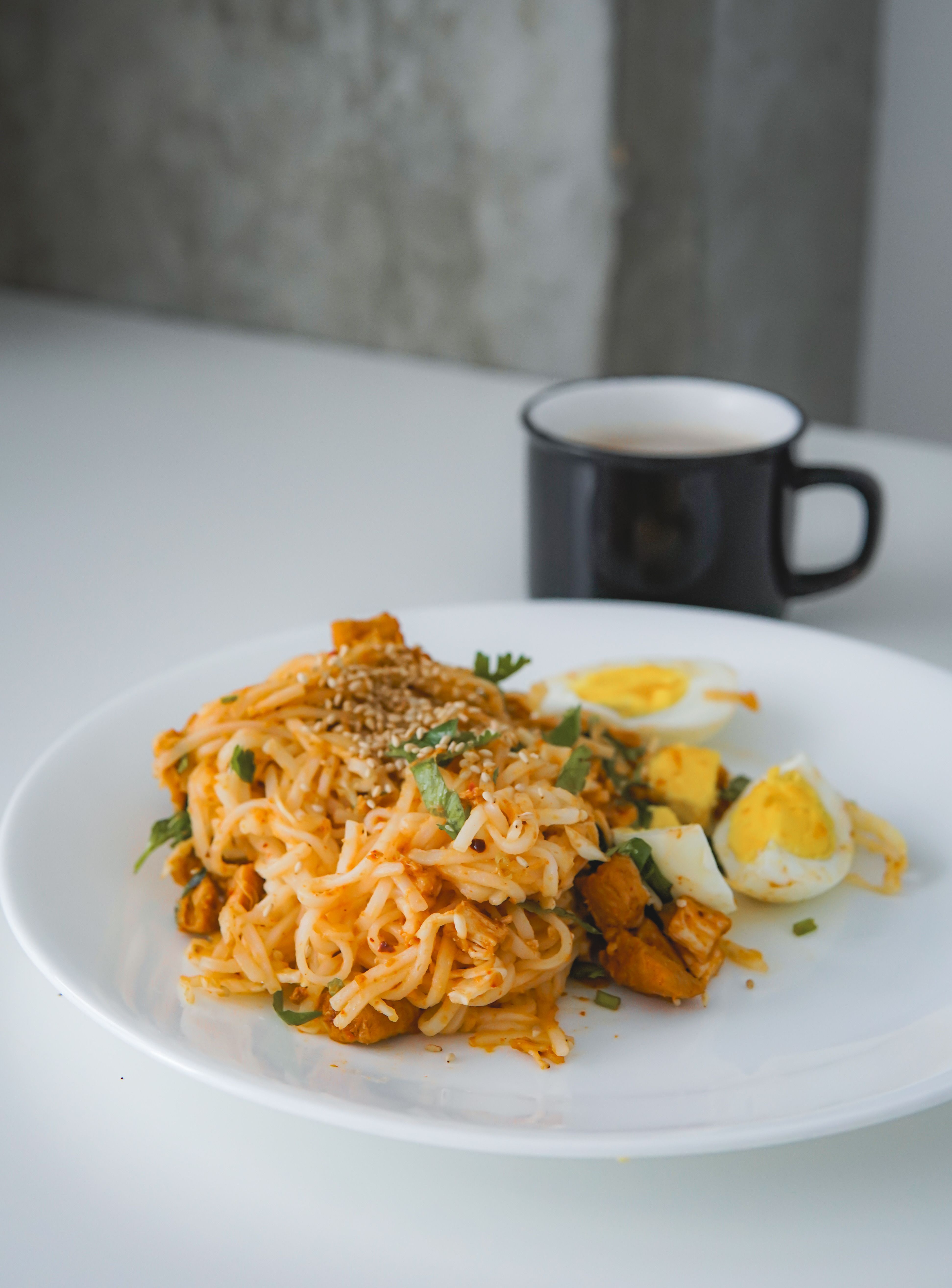
Photo: Su La Pyae / Pexels
Burmese
Shan Noodles
The diets react (see scores below)
Common Ingredients
- rice noodles
- chicken
- tomato
- peanuts
- garlic
- shallots
- soy sauce
- chili
- mustard greens
Specific recipes may vary.
Incompatible with 6 of 11 diets
Diet Ratings
Shan Noodles are built on a foundation of rice noodles, which are a high-glycemic grain-based carbohydrate and the dominant ingredient in the dish. A standard serving of rice noodles alone delivers 40-50g of net carbs, immediately exceeding or maxing out the entire daily keto carb allowance. The remaining ingredients — tomato, shallots, and peanuts — add further net carbs. While chicken, garlic, chili, mustard greens, and soy sauce are individually keto-compatible or low-carb, they cannot offset the fundamental incompatibility of rice noodles as the primary base. This dish is structurally incompatible with ketosis in any realistic serving size.
Shan Noodles as listed contains chicken, which is animal flesh and categorically excluded from a vegan diet. There is no ambiguity here — poultry is an animal product, making this dish incompatible with veganism. The remaining ingredients (rice noodles, tomato, peanuts, garlic, shallots, soy sauce, chili, mustard greens) are all plant-based, so a vegan adaptation would be straightforward by omitting the chicken or substituting tofu or tempeh.
Shan Noodles contains multiple paleo-excluded ingredients that make it incompatible with the paleo diet. Rice noodles are a grain-based product (rice is a grain, strictly excluded from paleo). Peanuts are legumes, not nuts, and are explicitly excluded. Soy sauce contains both soy (a legume) and wheat (a grain), making it doubly non-paleo. Mustard greens are paleo-friendly, and chicken, tomato, garlic, shallots, and chili are all approved paleo ingredients, but the foundational components of this dish — the noodles, peanuts, and soy sauce — are clear paleo violations with high consensus. This dish cannot be considered paleo-compatible in its traditional form without significant substitutions.
Shan Noodles contain several Mediterranean-friendly ingredients — tomatoes, garlic, shallots, peanuts, mustard greens, and chili are all plant-forward and aligned with Mediterranean principles. Chicken as the primary protein is acceptable in moderation (poultry fits within the 'caution' tier). However, rice noodles are refined grains lacking the fiber of whole grains preferred by Mediterranean guidelines, and soy sauce introduces significant sodium and is a processed condiment not traditional to the Mediterranean pattern. The dish lacks olive oil as the fat source. Overall, it is a reasonably vegetable-rich, lean-protein dish with some structural mismatches to Mediterranean ideals.
Some modern Mediterranean diet interpreters take a flexible, pattern-based view and would credit this dish for its abundance of vegetables, legumes (peanuts), and lean poultry, arguing the overall nutritional profile aligns well enough despite non-Mediterranean ingredients. Traditional Mediterranean guidelines, however, would flag refined rice noodles and soy sauce as departures from core principles.
Shan Noodles is almost entirely plant-based in its carbohydrate and flavoring components. Rice noodles are a grain-derived food, completely excluded on carnivore. Tomato, peanuts, garlic, shallots, soy sauce, chili, and mustard greens are all plant-derived ingredients — every single one is prohibited on a carnivore diet. Soy sauce is additionally a heavily processed, fermented plant product. The only carnivore-compatible ingredient in the entire dish is chicken, which makes up a minority of the dish's composition and character. This dish is fundamentally a plant-forward noodle bowl with a small amount of animal protein added, making it thoroughly incompatible with carnivore eating.
Shan Noodles contain multiple excluded ingredients. Rice noodles are a grain-based product (rice is explicitly excluded on Whole30). Peanuts are legumes, which are excluded. Soy sauce contains soy (a legume) and typically wheat (a grain), both of which are excluded. Any one of these three ingredients alone would disqualify the dish, and all three are present here.
Shan Noodles contains multiple high-FODMAP ingredients that make it unsuitable during the elimination phase. Garlic is one of the highest-FODMAP foods tested by Monash University, rich in fructans at any cooking amount. Shallots are similarly high in fructans and must be avoided entirely during elimination. These two ingredients alone disqualify the dish. Peanuts are moderate-FODMAP and become high-FODMAP above a small handful (~28g), and in a noodle dish the quantity is often generous. While rice noodles, chicken, tomato (in small amounts), chili, and soy sauce (small amounts of traditionally brewed soy) are generally low-FODMAP, the foundational aromatics — garlic and shallots — are unavoidable and pervasive in this dish. Mustard greens are not well-characterized by Monash but are generally considered low-risk. The dish cannot be considered safe during elimination without fundamentally reformulating it.
Shan Noodles contain several DASH-friendly components — rice noodles (refined but acceptable in moderation), lean chicken protein, tomatoes (rich in potassium), garlic, shallots, and mustard greens (a nutrient-dense leafy green high in potassium and calcium). Peanuts contribute healthy unsaturated fats and magnesium, aligning reasonably with DASH principles. However, soy sauce is the primary concern: a typical serving can contribute 600–900mg of sodium, pushing this dish toward or beyond DASH sodium thresholds in a single meal. Chili and mustard greens are positive inclusions, but the dish as traditionally prepared lacks low-fat dairy and whole grains emphasized by DASH. The peanut portion should also be controlled given caloric density. With a low-sodium soy sauce substitution, this dish could shift closer to an 'approve' rating.
NIH DASH guidelines emphasize strict sodium limits and would flag standard soy sauce as a significant concern. However, updated clinical interpretations of DASH note that dishes with strong vegetable, lean protein, and legume profiles (tomato, mustard greens, peanuts, chicken) can fit within a DASH pattern when low-sodium soy sauce is used and portion sizes are controlled — some DASH-oriented dietitians accept such adaptations.
Shan Noodles present a mixed Zone Diet profile. On the positive side, the dish features chicken (lean protein, Zone-favorable), tomato and mustard greens (low-glycemic vegetables, high in polyphenols), garlic and shallots (Zone-friendly aromatics), and chili (anti-inflammatory). However, the foundation of the dish — rice noodles — is a high-glycemic, refined carbohydrate that Dr. Sears classifies as 'unfavorable.' Rice noodles will spike blood sugar and insulin, working against the Zone's core anti-inflammatory goal. Peanuts introduce additional fat, but peanuts are technically a legume with a higher omega-6 profile compared to Zone-preferred monounsaturated fats like almonds, macadamia nuts, or olive oil — making them less ideal. Soy sauce is acceptable in small amounts (low caloric impact). The dish is structurally carb-heavy and fat-heavy in ways that make hitting a 40/30/30 ratio difficult without significant modification. With careful portioning — reducing noodle quantity, emphasizing the chicken and vegetables, and limiting peanuts — it can be partially Zone-compatible, but as typically served, the carb-to-protein-to-fat ratio skews unfavorably.
Some Zone practitioners, particularly those following Sears' later writing in 'The Zone Diet' updates, argue that rice-based noodles in moderate block portions (1-2 carb blocks) can fit within a Zone meal if the rest of the plate is heavy on low-GI vegetables and lean protein. The mustard greens and tomato in Shan Noodles actually help dilute the glycemic load, and the chicken provides a solid protein anchor. A disciplined Zone dieter could reduce the noodle portion to roughly 1/4 cup cooked and bulk up the vegetables to salvage the ratio.
Shan Noodles presents a genuinely favorable anti-inflammatory profile overall. Garlic and chili are well-supported anti-inflammatory spices. Tomatoes are rich in lycopene and antioxidants. Mustard greens are a cruciferous vegetable with strong anti-inflammatory credentials — high in vitamins K, C, and glucosinolates. Peanuts, while technically legumes, provide resveratrol, polyphenols, and monounsaturated fats with a reasonable omega-6 load in culinary quantities. Shallots contain quercetin, a notable anti-inflammatory flavonoid. Lean chicken as the protein source is moderate-category and unproblematic. Rice noodles are refined carbohydrates with a higher glycemic load than whole grains, which is the dish's main anti-inflammatory weakness — they lack the fiber and micronutrients of whole grain alternatives. Soy sauce adds sodium (excess sodium can promote inflammation) and small amounts of beneficial soy compounds, but the quantity used is typically modest. On balance, the abundance of vegetables, legumes, and anti-inflammatory aromatics outweighs the refined noodle concern, landing this dish in approve territory with a moderate score.
Some anti-inflammatory practitioners following stricter protocols (e.g., AIP or Dr. Gundry's lectin-avoidance approach) would flag both peanuts (high in lectins, omega-6 fatty acids relative to omega-3s) and tomatoes (nightshade, potential solanine sensitivity) as concerns, potentially downgrading this to caution. Mainstream anti-inflammatory authorities like Dr. Weil, however, include both tomatoes and moderate peanut consumption as acceptable or beneficial.
Shan Noodles is a moderately GLP-1-compatible dish with a mixed nutritional profile. The chicken provides lean protein, which is the top priority, but the overall protein density per serving is diluted by a significant base of rice noodles — a refined carbohydrate with low fiber content. Peanuts add healthy unsaturated fats but also increase fat load per serving, which can worsen nausea or bloating in GLP-1 patients. Tomato, mustard greens, garlic, and shallots are positives — they add micronutrients, some fiber, and are easy to digest. Soy sauce contributes high sodium, which is a concern for fluid retention and blood pressure. Chili is a moderate GLP-1 concern — mild amounts are generally tolerated, but it can worsen reflux or nausea in sensitive patients. The dish is not fried and is broth-adjacent in preparation, which supports digestibility. The core issue is the rice noodle base: refined, low-fiber, and filling in a way that crowds out more nutrient-dense calories — a meaningful drawback given reduced appetite on GLP-1s. If portioned small with emphasis on the chicken and vegetables, this dish becomes more acceptable. As typically served, it lands in caution territory.
Some GLP-1-focused dietitians may rate this more favorably, noting that rice noodles are easy to digest and gentle on a slowed GI tract — a real benefit when nausea or early satiety is dominant. Others would flag the peanuts and refined noodle base as crowding out protein and fiber per calorie, and recommend substituting shirataki or whole-grain noodles to improve the profile.
*See how scores were generated at our methodology page.
Nutritional profile
Six traits that cut across every diet.
Fiber & Plants
How much whole-plant food and fiber it delivers.
Healthy Fats
The quality of its fats (unsaturated, omega-3).
Whole / Unprocessed
How close it is to its natural, unprocessed form.
Gut Gentle
How easy it is on digestion (low FODMAP, few irritants).
Low Glycemic
How little it spikes your blood sugar.
Protein Density
How much protein it packs per calorie.
Controversy Index
Higher controversy = more disagreement between diets.
Diet-Specific Tips
 Mediterranean — 5/10
View tips
- Chicken is an acceptable moderate-frequency protein (poultry tier)
- Rice noodles are refined grains — whole grain alternatives preferred
- Tomatoes, garlic, shallots, mustard greens are strongly Mediterranean-compatible vegetables
- Peanuts provide plant-based fat and protein, a Mediterranean-friendly element
- Soy sauce is a processed, high-sodium condiment not typical of Mediterranean diet
- No olive oil present as primary fat source
- Overall dish is plant-rich but structurally mismatched to Mediterranean staples
 DASH — 5/10
View tips
- Soy sauce adds significant sodium (estimated 600–900mg+ per serving), the primary DASH concern
- Lean chicken protein is DASH-compatible
- Tomatoes and mustard greens provide potassium, calcium, and fiber — strongly DASH-positive
- Peanuts offer healthy fats and magnesium but require portion control
- Rice noodles are refined carbohydrates; whole-grain alternatives would better align with DASH
- No saturated fat or added sugar concerns
- Low-sodium soy sauce substitution would significantly improve DASH compatibility
 Zone — 5/10
View tips
- Rice noodles are high-glycemic, 'unfavorable' Zone carbohydrates that promote insulin spikes
- Chicken is a Zone-approved lean protein anchor
- Mustard greens and tomato are excellent low-glycemic, polyphenol-rich Zone carb sources
- Peanuts contribute fat but are omega-6 heavy compared to Zone-preferred monounsaturated fats (almonds, avocado, olive oil)
- As traditionally served, the dish is carb-heavy and difficult to balance to 40/30/30 without modification
- Garlic, shallots, and chili are Zone-neutral to Zone-positive anti-inflammatory ingredients
- Portion control of noodles is the critical variable for any Zone compatibility
 Anti-Inflammatory — 7/10
View tips
- Mustard greens: cruciferous vegetable high in glucosinolates and antioxidant vitamins — strongly anti-inflammatory
- Garlic and chili: well-established anti-inflammatory spices with polyphenol and capsaicin content
- Tomatoes: rich in lycopene and antioxidants; nightshade concern for autoimmune populations only
- Peanuts: provide polyphenols and monounsaturated fats but are relatively higher in omega-6 compared to walnuts or flaxseed
- Shallots: quercetin-rich, anti-inflammatory flavonoid source
- Rice noodles: refined carbohydrate with high glycemic load — the dish's primary anti-inflammatory weakness
- Lean chicken: moderate/neutral per anti-inflammatory framework
- Soy sauce: adds sodium; modest quantities in cooking are acceptable
 GLP-1 Friendly — 5/10
View tips
- Rice noodles are refined carbohydrates with low fiber — reduce nutrient density per calorie
- Chicken provides lean protein but total protein per serving may be low depending on portion ratio
- Peanuts add unsaturated fat (positive type) but increase overall fat load, risking GI side effects
- Mustard greens and tomato contribute fiber and micronutrients — positive
- Chili may worsen reflux or nausea in GLP-1 patients with GI sensitivity
- High sodium from soy sauce is a secondary concern
- Not fried and generally easy to digest — favorable for slowed gastric emptying
- Portion-sensitive: small servings weighted toward chicken and vegetables improve the rating