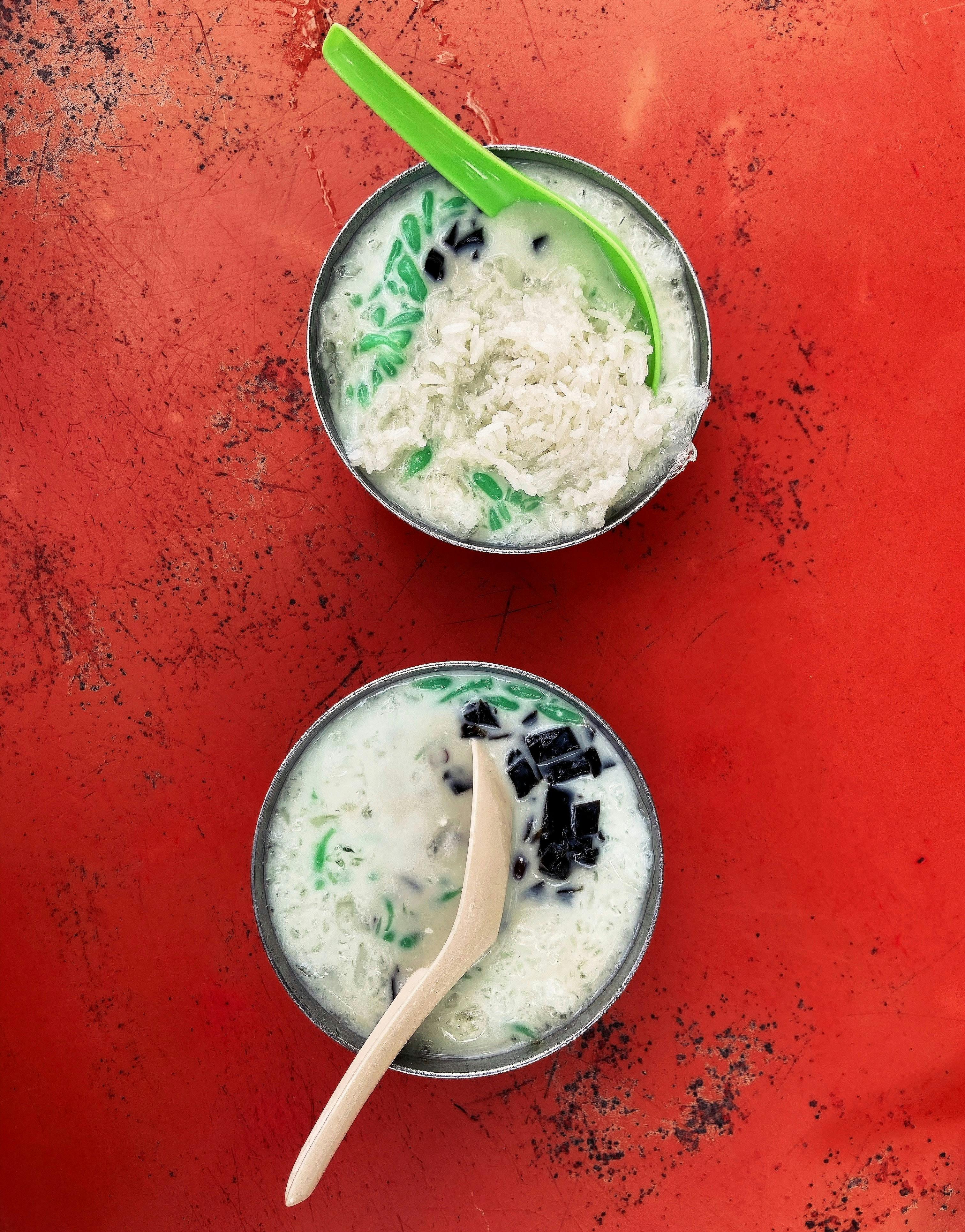
Photo: Aiman Baser / Pexels
Burmese
Shwe Yin Aye
The diets react (see scores below)
Common Ingredients
- coconut milk
- agar jelly
- sago pearls
- bread
- sticky rice
- shaved ice
- sugar syrup
- tapioca
Specific recipes may vary.
Incompatible with 10 of 11 diets
Diet Ratings
Shwe Yin Aye is fundamentally incompatible with a ketogenic diet. Nearly every ingredient is a high-carbohydrate offender: sago pearls, sticky rice, tapioca, and bread are all dense sources of net carbs that would individually blow past the daily 20-50g keto limit. The sugar syrup adds pure glucose/fructose on top of that. While coconut milk is keto-friendly and agar jelly is low-carb, they are minor components that cannot offset the overwhelming carbohydrate load of the rest of the dish. A single serving could easily contain 80-150g of net carbs, making ketosis impossible to maintain.
Shwe Yin Aye is a Burmese chilled dessert made entirely from plant-based ingredients. Coconut milk serves as the creamy base, replacing any dairy. Agar jelly is derived from seaweed (not gelatin), sago pearls and tapioca come from starch-bearing plants, sticky rice and bread are grain-based, and the sweeteners are plant-derived sugar syrup and shaved ice. No animal products or animal-derived ingredients are present in the standard preparation of this dish. The bread component warrants a minor note — most plain bread is vegan, but some varieties may contain milk or eggs; however, the default assumption is vegan-compliant. This is a relatively whole-food dessert with minimally processed ingredients, earning a solid approval score.
Shwe Yin Aye is heavily non-paleo across nearly every ingredient. Bread is a processed grain product (wheat), sticky rice is a grain, sago pearls are a starchy processed grain-like product, and tapioca (while derived from cassava, a tuber) is typically processed into pearls with added ingredients. Sugar syrup is refined sugar, which is explicitly excluded. Agar jelly, while derived from seaweed, is a processed additive. Coconut milk is the only paleo-approved ingredient, and shaved ice is neutral. This dish is fundamentally built on grains and refined sugar, making it incompatible with the paleo diet.
Shwe Yin Aye is a Burmese dessert drink that conflicts with Mediterranean diet principles on multiple fronts. It is built around coconut milk (a saturated fat source not used in traditional Mediterranean cooking, where extra virgin olive oil is the canonical fat), refined white bread, sticky rice (refined/high-glycemic grain), sugar syrup (added sugar), and sago/tapioca pearls (refined starches with minimal nutritional value). The dish is high in added sugars, saturated fat from coconut milk, and refined carbohydrates — all categories the Mediterranean diet explicitly minimizes. There is no olive oil, no vegetables, no legumes, no whole grains, and no lean protein. It is essentially a high-sugar, high-saturated-fat dessert snack with negligible alignment to Mediterranean principles.
Shwe Yin Aye is a Burmese dessert composed entirely of plant-derived and processed ingredients: coconut milk (plant fat), agar jelly (seaweed-derived gelling agent), sago pearls (palm starch), bread (wheat grain), sticky rice (grain), shaved ice, sugar syrup (processed sugar), and tapioca (cassava starch). There is not a single animal-derived ingredient in this dish. Every component violates carnivore diet principles — it contains grains, plant starches, plant-based fats, seaweed derivatives, and sugar. This is as far from carnivore-compatible as a food can get.
Shwe Yin Aye is a Burmese coconut milk dessert drink containing multiple excluded ingredients. Sugar syrup is added sugar, which is explicitly banned on Whole30. Bread is a grain-based product (wheat), which is excluded. Sticky rice is a grain, also excluded. Sago pearls are a starch derived from palm, which while not explicitly a grain, functions as a processed starch and is not a compliant whole food. Tapioca is similarly a processed starch not permitted on Whole30. This dish is fundamentally a sweet dessert built around excluded ingredients and cannot be made compliant without completely reconstructing it.
Shwe Yin Aye contains several high-FODMAP ingredients that make it problematic during the elimination phase. The most significant concern is bread, which is typically wheat-based and high in fructans — a clear high-FODMAP ingredient at any standard serving. Coconut milk can be low-FODMAP at small portions (up to 1/2 cup per Monash) but is often used generously in this dessert, risking excess. Sago pearls and tapioca are generally low-FODMAP. Agar jelly is low-FODMAP. Sticky rice (glutinous rice) is low-FODMAP. Sugar syrup made from plain sugar is low-FODMAP. Shaved ice is fine. However, the bread component alone disqualifies this dish during the strict elimination phase, as wheat bread is a high-fructan food regardless of portion. The combination also introduces cumulative FODMAP load risk. Even if the bread were replaced with gluten-free bread, the dish may pass, but as traditionally prepared it must be avoided.
Monash University rates wheat bread clearly as high-FODMAP due to fructans, so the bread component is unambiguous. However, some clinical practitioners note that the small amount of bread used as a garnish in Shwe Yin Aye might be below threshold — though this is speculative and not supported by Monash data, and elimination phase caution dictates avoiding wheat in any appreciable quantity.
Shwe Yin Aye is a Burmese dessert drink that conflicts with DASH diet principles on multiple fronts. Coconut milk is a tropical oil-based product high in saturated fat, which DASH explicitly limits. The dish is dominated by high-glycemic, refined carbohydrates with minimal nutritional value: white bread, sticky rice, sago pearls, and tapioca are all low in fiber and stripped of the nutrients DASH emphasizes. Sugar syrup adds significant amounts of added sugar, which DASH restricts. The dish provides virtually no potassium, calcium, magnesium, or dietary fiber in meaningful quantities, and contains no lean protein, vegetables, fruits, whole grains, or low-fat dairy — the cornerstones of the DASH eating plan. It is essentially a high-saturated-fat, high-added-sugar, high-refined-carbohydrate dessert with no redeeming DASH-aligned components.
Shwe Yin Aye is a Burmese dessert drink that is fundamentally incompatible with Zone Diet principles. The dish is built almost entirely from high-glycemic, nutritionally empty carbohydrates: sugar syrup (pure sugar), sago pearls (refined starch), tapioca (high-GI refined starch), sticky rice (high-GI refined grain), and bread — all of which are either 'unfavorable' or outright discouraged in Zone methodology. Coconut milk adds significant saturated fat with no lean protein to balance it. The dish contains no meaningful protein whatsoever (primary protein listed as 'none'), making it impossible to construct a Zone-balanced block ratio. There is no lean protein component, no monounsaturated fat, and no low-glycemic carbohydrate source. The sugar syrup alone would spike insulin dramatically, directly opposing the Zone's core goal of controlling eicosanoid balance through blood glucose stabilization. Even with extreme portioning, the absence of protein makes this a non-starter for Zone compliance. This is one of the rare cases where a food genuinely warrants an 'avoid' rating — it cannot be portion-controlled into a Zone block structure because the macronutrient profile is categorically imbalanced.
Shwe Yin Aye is a Burmese dessert drink that is essentially a sugar-forward treat with very little anti-inflammatory merit. The ingredient profile is dominated by pro-inflammatory or neutral-at-best components: added sugar syrup contributes significant refined sugar with no nutritional offset; white bread adds refined carbohydrates with a high glycemic index; sticky rice is another high-glycemic refined starch; sago and tapioca are nearly pure starch with minimal fiber, vitamins, or phytonutrients. Coconut milk does contain medium-chain triglycerides (MCTs) which have some mild neutral-to-mixed properties, but it is also high in saturated fat, and at the quantities used in a dessert drink it does not redeem the overall profile. Agar jelly is benign — a low-calorie seaweed-derived gel — but contributes nothing meaningful anti-inflammatory. There are no omega-3 sources, no meaningful antioxidants or polyphenols, no colorful vegetables, no beneficial spices, and no whole grains. The combination of refined carbohydrates, added sugars, and high-glycemic starches is precisely what anti-inflammatory frameworks consistently flag as promoting inflammatory markers such as CRP and IL-6. This dish is essentially a dessert confection and should be treated as an occasional indulgence rather than a regular dietary choice.
Shwe Yin Aye is a Burmese dessert drink built almost entirely around high-sugar, low-nutrient ingredients: sweetened coconut milk, sugar syrup, sticky rice, bread, sago, and tapioca. It delivers negligible protein (no meaningful protein source listed), minimal fiber, and a high glycemic load from multiple refined starch and sugar sources. The saturated fat content from coconut milk compounds the problem. For GLP-1 patients, this dish hits nearly every avoid criterion simultaneously: high sugar, empty calories, high saturated fat, low nutrient density per calorie, and no protein contribution. The sweet, sugar-syrup-driven composition offers no satiety value appropriate for the reduced appetite window these patients operate in. The shaved ice and high sugar content also risk worsening nausea in patients with slowed gastric emptying. There is no meaningful redeeming nutritional factor that would justify even occasional inclusion as a snack.
*See how scores were generated at our methodology page.
Nutritional profile
Six traits that cut across every diet.
Fiber & Plants
How much whole-plant food and fiber it delivers.
Healthy Fats
The quality of its fats (unsaturated, omega-3).
Whole / Unprocessed
How close it is to its natural, unprocessed form.
Gut Gentle
How easy it is on digestion (low FODMAP, few irritants).
Low Glycemic
How little it spikes your blood sugar.
Protein Density
How much protein it packs per calorie.
Controversy Index
Higher controversy = more disagreement between diets.
Diet-Specific Tips
 Vegan — 8/10
View tips
- Coconut milk is fully plant-based — no dairy involved
- Agar jelly is seaweed-derived, not gelatin-based — vegan-safe
- Sago pearls and tapioca are plant starches with no animal ingredients
- Sticky rice is a whole plant food
- Bread is typically vegan but could contain eggs or dairy in some preparations — standard version assumed vegan
- Sugar syrup: plain sugar is generally vegan; bone char processing is a minor concern for strict vegans but does not change the core verdict
- No meat, fish, eggs, dairy, or animal-derived additives present