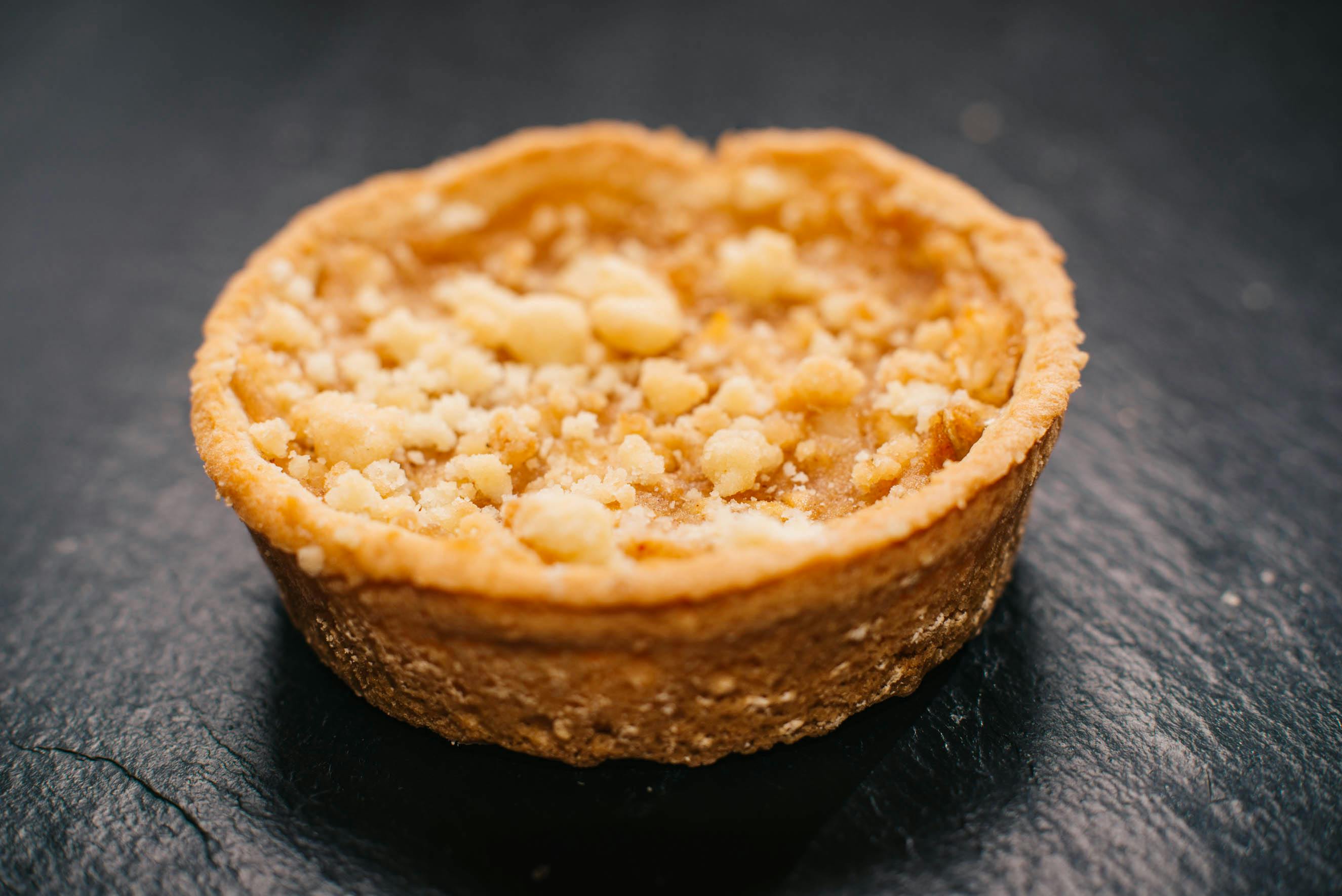
Photo: Novkov Visuals / Pexels
Canadian
Butter Tart
The diets react (see scores below)
Common Ingredients
- butter
- brown sugar
- eggs
- pie crust
- raisins
- salt
- vanilla extract
Specific recipes may vary.
Incompatible with 11 of 11 diets
Diet Ratings
Butter tarts are fundamentally incompatible with a ketogenic diet. The filling is built on brown sugar as a primary ingredient, which is pure sucrose with zero fiber, contributing massive net carbs. Raisins add concentrated fruit sugars (roughly 79g net carbs per 100g). The pie crust is made from refined wheat flour, a grain-based, high-carb ingredient that alone would exceed most people's daily keto carb limit. A single standard butter tart likely contains 35-50g of net carbs, which meets or exceeds the entire daily keto carb budget in one small snack. Even the butter content cannot offset these disqualifying ingredients.
Butter tarts contain multiple animal-derived ingredients that disqualify them from a vegan diet. Butter is a dairy product (animal fat from cow's milk), and eggs are a direct animal product. Both are explicitly excluded under vegan rules. The pie crust, as typically made, also contains butter or lard. There is no meaningful debate within the vegan community about these ingredients — dairy and eggs are universally rejected by vegans. A vegan version could theoretically be made by substituting plant-based butter and a flax or chia egg, but the traditional recipe as listed is clearly not vegan.
Butter tart is fundamentally incompatible with the paleo diet. The pie crust is made from wheat flour — a grain, which is explicitly excluded. Brown sugar is refined sugar, also excluded. Butter is a dairy product, excluded by strict paleo guidelines. Salt is an added ingredient excluded from paleo. Nearly every core ingredient in this dish violates paleo principles, making this one of the clearest possible avoid verdicts.
Butter tarts are a quintessentially Canadian dessert that fundamentally conflicts with Mediterranean diet principles across multiple dimensions. The dish centers on butter (saturated fat, not the preferred olive oil), brown sugar (added sugar), and a refined white flour pie crust (refined grain). Together these form a high-sugar, high-saturated-fat pastry with minimal nutritional value. While raisins and eggs offer minor redeeming qualities, they are overwhelmed by the unhealthy core ingredients. This dessert represents exactly the type of processed, sugar-laden, refined grain product the Mediterranean diet discourages.
Butter tarts are fundamentally incompatible with the carnivore diet. While butter and eggs are animal-derived ingredients, the dish is dominated by plant-based and processed components: pie crust (wheat flour), brown sugar (refined plant sugar), raisins (dried fruit), and vanilla extract (plant-derived). This is a dessert pastry built on a grain-based shell filled with sugar — the antithesis of carnivore eating. Even the butter and eggs are incidental ingredients that cannot redeem the overwhelming plant and sugar content. No variation of carnivore — not even the more permissive 'animal-based' approach championed by Paul Saladino — would include a sugar-and-grain pastry like this.
Butter Tarts contain multiple Whole30-excluded ingredients. Butter (dairy) is not allowed — only ghee or clarified butter is the dairy exception. Brown sugar is an added sugar, which is explicitly excluded. The pie crust is a grain-based product (wheat flour), which is excluded as a grain. Additionally, even if compliant ingredient substitutions were made, a butter tart is exactly the kind of baked pastry/dessert that Whole30 Rule 4 prohibits recreating, as it falls squarely into the 'baked goods' category alongside cookies, pastries, and similar items. This dish fails on multiple fronts: excluded ingredients and the 'no recreating baked goods/junk food' rule.
Butter tarts contain multiple high-FODMAP ingredients that make them unsuitable during the elimination phase. The two primary concerns are: (1) the traditional wheat-based pie crust, which is high in fructans — a major FODMAP trigger — and (2) raisins, which are high-FODMAP even in small quantities (Monash rates raisins as high-FODMAP at just 13g / about 1 tablespoon). Brown sugar is generally low-FODMAP in small amounts, eggs and butter are low-FODMAP, and vanilla extract is fine. However, the combination of a wheat crust and raisins makes this dish clearly unsuitable during elimination. Even a single tart would deliver meaningful fructan load from the crust and excess fructose/polyols from the raisins.
Butter tarts are a poor fit for the DASH diet on multiple fronts. The primary ingredients — butter and pie crust — contribute significant saturated fat, which DASH explicitly limits. Brown sugar is the dominant sweetener, making this a high-added-sugar food that DASH discourages. The pie crust is typically made with refined white flour (low in fiber) and shortening or butter, adding further saturated fat. Salt is included as an ingredient. While raisins provide some potassium and the eggs offer modest protein, these benefits are overwhelmed by the high sugar, saturated fat, and refined carbohydrate content. Butter tarts fall squarely into the 'sweets' category that DASH limits to 5 or fewer servings per week, and even within that allowance, lower-saturated-fat options are preferred. This is not a borderline case — it is a dessert/sweet snack built around ingredients DASH guidelines explicitly recommend limiting.
Butter tarts are essentially a concentrated delivery system for the most Zone-unfavorable macronutrients possible. The filling is dominated by brown sugar and raisins — both high-glycemic carbohydrates that Sears explicitly flags as unfavorable (raisins appear on Zone's 'avoid' list due to their concentrated sugar content). Butter contributes saturated fat rather than the preferred monounsaturated fat. The refined white flour pie crust is a high-glycemic carbohydrate with no nutritional value in Zone terms. Critically, the dish contains no meaningful lean protein, making it structurally impossible to build a Zone-balanced block meal around it without radical modification. The 40/30/30 ratio cannot be approximated — this is effectively a 70%+ carbohydrate item with the remaining calories coming from saturated fat. Even in the Zone's ratio-based philosophy where few foods are categorically excluded, a butter tart provides no favorable macronutrient anchor: no lean protein block, no monounsaturated fat, no low-glycemic carbohydrate. It would require enormous compensatory portioning of other foods to approach Zone balance, making practical inclusion essentially impossible as a snack.
A butter tart is a quintessentially pro-inflammatory treat by anti-inflammatory standards. Butter is a saturated fat explicitly listed in the 'limit' category, and here it serves as both a primary structural and flavor ingredient in significant quantity. Brown sugar (and likely refined white flour in the pie crust) represent the refined carbohydrates and added sugars that anti-inflammatory guidelines consistently flag as drivers of inflammatory markers like CRP and IL-6. The pie crust is almost certainly made from refined flour and likely contains additional butter or shortening, compounding the saturated fat and refined carbohydrate load. Raisins offer a small concession — dried fruit contains some polyphenols and fiber — but their concentrated natural sugars in this context do little to offset the overall profile. Eggs provide some nutritional value (choline, selenium) and are a moderate-tier food, but they are a minor positive in an otherwise strongly pro-inflammatory composition. Vanilla extract and salt are nutritionally negligible. This dish has no meaningful omega-3 content, no significant antioxidant or polyphenol load, is high in saturated fat, and is dominated by refined carbohydrates and added sugar — the exact combination anti-inflammatory nutrition research most consistently associates with increased systemic inflammation.
Butter tarts are a high-sugar, high-fat pastry with virtually no redeeming nutritional value for GLP-1 patients. The primary ingredients — butter, brown sugar, and pie crust — deliver a dense load of saturated fat, refined carbohydrates, and added sugar in a very small package. Protein content is negligible (a trace from egg, which is largely diluted by other ingredients). Fiber is minimal. The combination of high fat and high sugar is precisely what worsens GLP-1 side effects including nausea, reflux, and bloating. Slowed gastric emptying means this sugar-fat combination will sit heavily and uncomfortably. The raisins add a small amount of natural sugar and minimal fiber but do not meaningfully improve the nutritional profile. As a snack, it offers empty calories at a time when patients on GLP-1s have severely reduced caloric budgets — every bite must count nutritionally, and butter tarts fail that standard entirely.
*See how scores were generated at our methodology page.
Nutritional profile
Six traits that cut across every diet.
Fiber & Plants
How much whole-plant food and fiber it delivers.
Healthy Fats
The quality of its fats (unsaturated, omega-3).
Whole / Unprocessed
How close it is to its natural, unprocessed form.
Gut Gentle
How easy it is on digestion (low FODMAP, few irritants).
Low Glycemic
How little it spikes your blood sugar.
Protein Density
How much protein it packs per calorie.
Controversy Index
Higher controversy = more disagreement between diets.