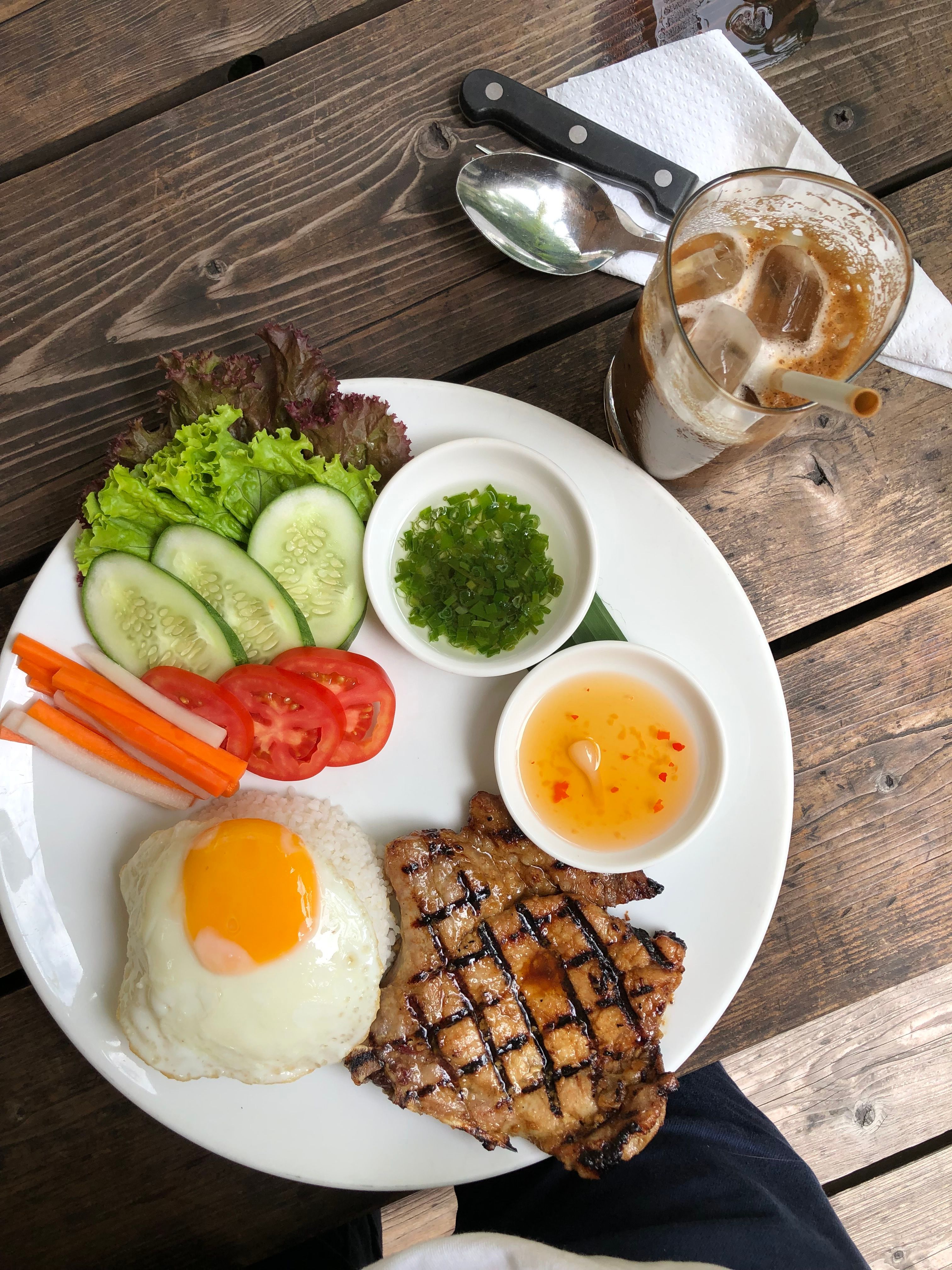
Photo: Nam Nguyen / Pexels
Cambodian
Bai Sach Chrouk
The diets react (see scores below)
Common Ingredients
- pork
- coconut milk
- garlic
- broken rice
- cucumber
- pickled vegetables
- scallions
- fish sauce
- sugar
Specific recipes may vary.
Incompatible with 8 of 11 diets
Diet Ratings
Bai Sach Chrouk is built around broken rice as its central component, which is a high-glycemic grain with approximately 45g of net carbs per standard serving. This alone disqualifies it from keto compatibility. The dish also contains added sugar (used in marinating the pork) and pickled vegetables that often carry additional sugars. While several ingredients are keto-friendly — pork, coconut milk, garlic, fish sauce, cucumber, and scallions — the foundational broken rice component makes this dish fundamentally incompatible with ketosis. There is no practical way to consume a standard serving without drastically exceeding the daily net carb limit.
Bai Sach Chrouk contains multiple animal products that are strictly excluded from a vegan diet. Pork is the primary protein — a direct animal flesh product. Fish sauce is derived from fermented fish and is a clear animal-derived ingredient. These two ingredients alone make this dish entirely incompatible with veganism, regardless of the plant-based components (coconut milk, garlic, broken rice, cucumber, pickled vegetables, scallions) present in the dish.
Bai Sach Chrouk is fundamentally incompatible with the Paleo diet. The dish's base is broken rice, a grain that is strictly excluded from all paleo frameworks. Additionally, sugar (refined) and fish sauce (typically contains added salt and sometimes additives) are non-paleo. Pickled vegetables are often processed with salt and vinegar additives. While several ingredients are paleo-approved — pork, coconut milk, garlic, cucumber, and scallions are all fine — the core grain component and multiple condiments disqualify the dish as a whole. This is not a borderline case; rice is a grain, and grains are universally excluded across all mainstream paleo interpretations.
Bai Sach Chrouk presents multiple significant conflicts with Mediterranean diet principles. Pork is a red meat, which should be limited to a few times per month under Mediterranean guidelines — serving it as a daily breakfast staple is contrary to the pattern. Coconut milk is a saturated fat source not aligned with the Mediterranean emphasis on extra virgin olive oil as the primary fat. Broken rice is a refined grain, whereas the Mediterranean diet strongly favors whole grains. Added sugar in the marinade further conflicts with Mediterranean principles. While the dish does include some positive elements (garlic, cucumber, pickled vegetables, scallions, fish sauce), these cannot offset the core issues: red meat as the primary protein, refined grain as the base, and coconut milk as the cooking fat. As a breakfast dish eaten regularly, this pattern is fundamentally at odds with Mediterranean dietary principles.
Bai Sach Chrouk is fundamentally incompatible with the carnivore diet. While it contains pork (carnivore-approved) and fish sauce (generally tolerated), the dish is built around broken rice — a grain that is strictly excluded from all tiers of the carnivore diet. Beyond the rice, the dish contains multiple plant-derived ingredients: coconut milk (plant fat), garlic, cucumber, pickled vegetables, scallions, and sugar. The pork itself may be marinated in coconut milk and garlic, meaning even the protein component is prepared with non-carnivore ingredients. There is unanimous consensus across all carnivore authorities that grains, vegetables, plant oils, and sugar are off-limits. No adaptation of this dish could be considered carnivore-compliant without stripping it down to essentially just the pork.
Bai Sach Chrouk contains multiple Whole30-excluded ingredients. 'Broken rice' is a grain (rice is explicitly excluded on Whole30), and 'sugar' is an added sweetener that is also explicitly excluded. Either of these alone would be sufficient to disqualify the dish. The pickled vegetables may also contain added sugar or sulfites (though sulfites are no longer excluded per 2024 rules, sugar in pickling brine remains a concern). The remaining ingredients — pork, coconut milk, garlic, cucumber, scallions, and fish sauce — are generally Whole30-compatible, but the dish as traditionally prepared cannot be made compliant without removing the rice and sugar, which are foundational to the dish's identity.
Bai Sach Chrouk contains two major high-FODMAP ingredients that make it unsuitable during the elimination phase. First, garlic is one of the highest-fructan foods tested by Monash University and is a clear avoid at any culinary quantity. Second, coconut milk is high-FODMAP at standard serving sizes (Monash rates it as high-FODMAP above 60ml, and typical marinades use significantly more). The pickled vegetables are also a concern depending on composition — if they contain onion or cabbage in significant amounts, they add further fructans. Scallions (green tops only) are low-FODMAP, but if bulb/white parts are used, that adds more fructans. Broken rice itself is low-FODMAP, plain pork is low-FODMAP, fish sauce in small amounts is generally low-FODMAP, cucumber is low-FODMAP, and small amounts of sugar are acceptable. However, the garlic alone disqualifies this dish during elimination phase, and coconut milk in marinade quantities compounds the problem significantly.
Bai Sach Chrouk presents multiple DASH diet concerns. The pork is marinated in coconut milk, which is high in saturated fat from a tropical oil — a category DASH explicitly limits. Fish sauce is extremely high in sodium (typically 1,000–1,500mg per tablespoon), making it a significant concern for DASH's sodium ceiling of 1,500–2,300mg/day. Pickled vegetables add further sodium load. Added sugar is used in the marinade, conflicting with DASH's limit on added sugars. While broken rice, cucumber, scallions, and garlic are DASH-compatible ingredients, the dish's flavor foundation relies on high-sodium condiments and high-saturated-fat coconut milk. Red/fatty pork as a primary protein is also discouraged under DASH, which emphasizes lean poultry and fish. The cumulative sodium from fish sauce plus pickling likely exceeds DASH daily limits in a single meal.
Bai Sach Chrouk is a Cambodian breakfast dish of grilled pork over broken rice with accompaniments. From a Zone perspective, it has several issues. The broken rice (oryza) is essentially white rice — a high-glycemic, unfavorable carbohydrate that spikes insulin rapidly and is difficult to balance in Zone blocks. The coconut milk used to marinate the pork adds saturated fat, which the Zone discourages in favor of monounsaturated fats. The sugar in the marinade adds empty glycemic load. On the positive side, the pork itself is a usable lean protein (especially if using pork loin), and the accompaniments — cucumber, pickled vegetables, and scallions — are favorable low-glycemic carbohydrate sources. Fish sauce is a negligible-calorie flavoring. The dish could theoretically be modified toward Zone compliance by dramatically reducing the rice portion, increasing the vegetable accompaniments, and substituting coconut milk with a smaller amount of a monounsaturated fat source. As served traditionally, however, the macronutrient ratio skews heavily carbohydrate (from rice) with saturated fat from coconut milk, making it a challenge to fit into the 40/30/30 framework without significant modification.
Some Zone practitioners and Sears' later writings acknowledge that the glycemic index of rice is context-dependent — broken rice consumed alongside protein and fat slows gastric emptying and blunts the glycemic response somewhat. Additionally, coconut milk's saturated fat (predominantly medium-chain triglycerides) has been reassessed more favorably in some anti-inflammatory nutrition frameworks. A practitioner using a very small rice block (½ block) while loading up on cucumber and pickled vegetables could construct a reasonable Zone meal from this dish's components.
Bai Sach Chrouk presents a mixed anti-inflammatory profile. On the positive side, garlic is a well-established anti-inflammatory ingredient, cucumber and pickled vegetables contribute some antioxidants and probiotics, and scallions provide quercetin and flavonoids. Fish sauce, while high in sodium, is a fermented condiment used in small amounts and contributes minimal inflammatory burden. However, several components pull the dish in a less favorable direction. Pork cooked in coconut milk is the primary concern: pork is a red/fatty meat generally categorized as 'limit' in anti-inflammatory frameworks, and coconut milk adds saturated fat (though medium-chain triglycerides in coconut are debated). Added sugar is explicitly flagged as a pro-inflammatory ingredient to limit. Broken rice is a refined grain with high glycemic index, offering little fiber compared to whole grains, and a glycemic spike can transiently raise inflammatory markers. The combination of refined rice, added sugar, saturated fat from coconut milk, and pork makes this a dish to consume with moderation rather than regularly. It is not as acutely inflammatory as processed foods or trans fat-laden dishes, but it lacks the omega-3s, fiber, and polyphenol density expected of an anti-inflammatory meal.
Some anti-inflammatory practitioners note that coconut milk's medium-chain triglycerides (MCTs) may have neutral or even modestly beneficial metabolic effects, and fermented/pickled vegetables provide probiotic value that supports gut-mediated inflammation reduction. Paleo and ancestral diet frameworks would rate this dish more favorably, viewing pork as a whole, unprocessed protein and coconut milk as a nourishing fat, while mainstream anti-inflammatory nutrition (Dr. Weil, IF Rating system) consistently flags saturated fat and refined refined carbohydrates as concerns.
Bai Sach Chrouk is a Cambodian breakfast of grilled pork marinated in coconut milk and garlic, served over broken rice with cucumber, pickled vegetables, scallions, and fish sauce. The dish has some redeeming qualities for GLP-1 patients — pork provides meaningful protein, pickled vegetables add digestive support and flavor without many calories, cucumber contributes hydration and fiber, and the portion is typically modest. However, several factors pull the rating down. The coconut milk marinade introduces significant saturated fat, which is a concern on GLP-1 medications both for side effect risk (nausea, reflux, delayed gastric emptying compounded by fat) and cardiovascular health. The pork cut used in traditional preparations (often pork shoulder or fatty slices) compounds this. Broken rice is a refined carbohydrate with low fiber density — it spikes blood sugar without contributing meaningfully to the protein or fiber targets. Fish sauce and sugar in the marinade add sodium and simple sugars, respectively, with limited nutritional upside. The dish is not fried, is relatively easy to digest in a small portion, and is not heavily spiced, which are positives. With modifications — leaner pork loin, reduced coconut milk, portion control on rice, and emphasis on the pickled vegetable side — this dish becomes more compatible. As presented in its traditional form, it warrants caution rather than approval.
Some GLP-1-focused dietitians would note that pork loin or tenderloin versions of this dish can deliver 20–25g of protein in a reasonable portion, making it a defensible breakfast choice in cultures where this is a staple — the concern is primarily about the fat load from coconut milk and the cut of pork used, which varies widely by preparation. Others flag that the refined broken rice displaces fiber-rich carbohydrate opportunities that are especially important for GLP-1 patients managing constipation.
*See how scores were generated at our methodology page.
Nutritional profile
Six traits that cut across every diet.
Fiber & Plants
How much whole-plant food and fiber it delivers.
Healthy Fats
The quality of its fats (unsaturated, omega-3).
Whole / Unprocessed
How close it is to its natural, unprocessed form.
Gut Gentle
How easy it is on digestion (low FODMAP, few irritants).
Low Glycemic
How little it spikes your blood sugar.
Protein Density
How much protein it packs per calorie.
Controversy Index
Higher controversy = more disagreement between diets.
Diet-Specific Tips
 Zone — 4/10
View tips
- Broken/white rice is a high-glycemic, unfavorable carbohydrate in Zone terminology — primary concern
- Coconut milk introduces saturated fat rather than preferred monounsaturated fat
- Added sugar in marinade increases glycemic load unnecessarily
- Pork is a usable Zone protein, especially leaner cuts
- Cucumber, pickled vegetables, and scallions are favorable low-glycemic Zone carbohydrate sources
- Dish is carbohydrate-heavy as traditionally served, skewing away from 40/30/30 balance
- Significant modification (reduce rice, increase vegetables, change fat source) needed for Zone compliance
 Anti-Inflammatory — 4/10
View tips
- Pork is a 'limit' protein in anti-inflammatory frameworks due to saturated fat content
- Coconut milk adds saturated fat; MCT content is debated but not a net anti-inflammatory benefit in mainstream guidance
- Broken rice is a refined, high-glycemic carbohydrate with minimal fiber
- Added sugar is explicitly pro-inflammatory and should be limited
- Garlic, scallions, and cucumber contribute beneficial antioxidants and anti-inflammatory compounds
- Pickled vegetables may offer probiotic benefits supporting gut-inflammation balance
- Fish sauce adds sodium but is used in small quantities and is fermented
- Dish lacks omega-3 fatty acids, leafy greens, or other strong anti-inflammatory components
 GLP-1 Friendly — 4/10
View tips
- Coconut milk marinade adds significant saturated fat, worsening nausea and reflux risk on GLP-1 medications
- Pork provides protein but fatty cuts reduce overall diet quality; lean loin is preferable
- Broken rice is a refined carbohydrate with minimal fiber, contributing to poor nutrient density per calorie
- Pickled vegetables support digestion and gut health — a genuine positive
- No frying, not heavily spiced — easier on GI tract than many breakfast alternatives
- Sugar in marinade adds unnecessary simple carbohydrates
- Small traditional portion size is compatible with GLP-1 appetite reduction
- Fish sauce is high in sodium — relevant for patients with hypertension comorbidity