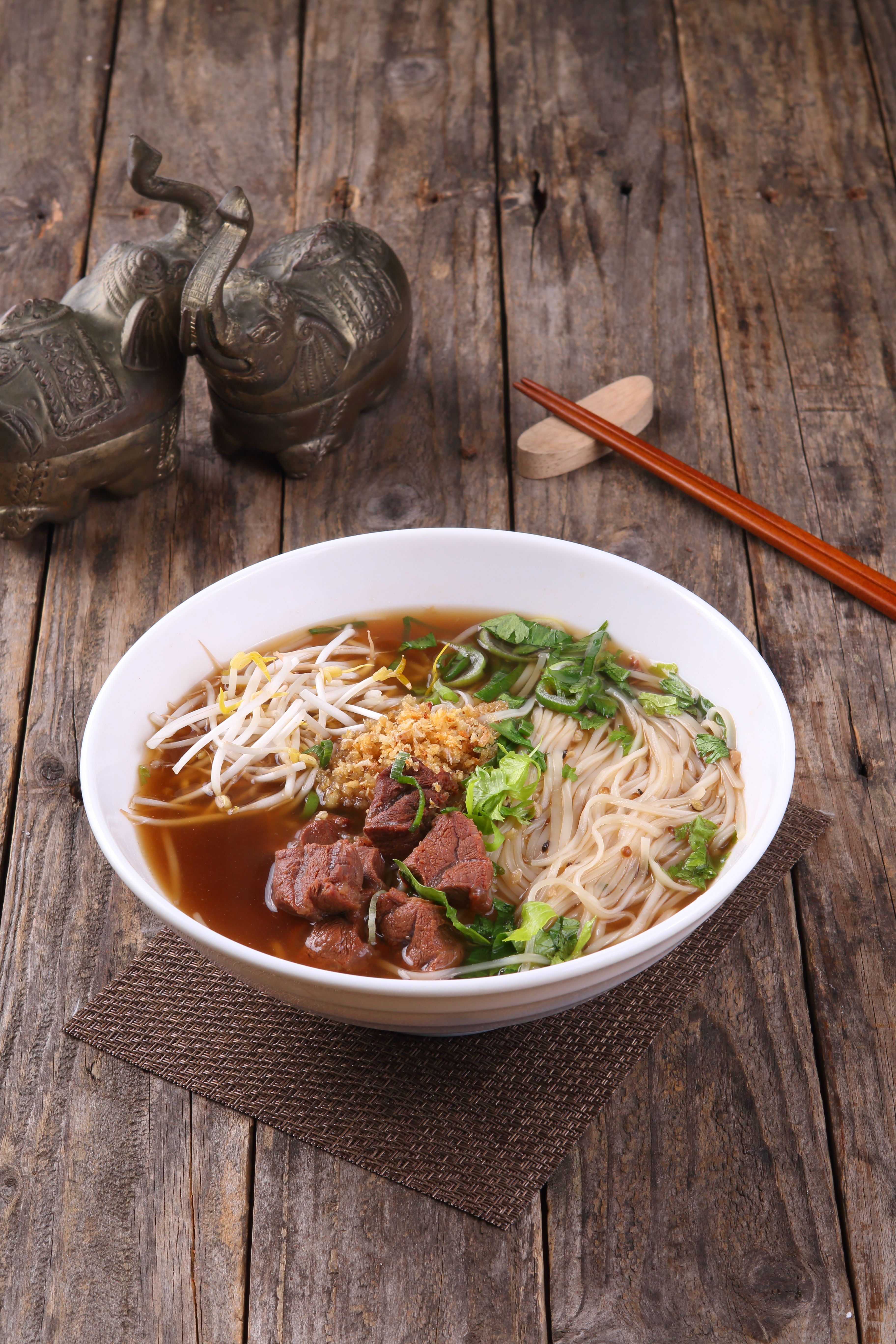
The diets react (see scores below)
Common Ingredients
- pork bones
- rice noodles
- pork
- bean sprouts
- garlic
- scallions
- fried shallots
- fish sauce
- lime
Specific recipes may vary.
Incompatible with 7 of 11 diets
Diet Ratings
Kuy Teav is a Cambodian rice noodle soup whose primary carbohydrate source — rice noodles — makes it fundamentally incompatible with a ketogenic diet. A standard serving of rice noodles (roughly 150-200g cooked) contributes approximately 35-45g of net carbs on its own, easily exceeding or maxing out the entire daily keto carb allowance in a single bowl. The broth base (pork bones, fish sauce, garlic, scallions) and protein (pork) are keto-friendly, as are the bean sprouts and lime in small amounts, but these keto-compatible elements cannot redeem the dish while rice noodles remain the central ingredient. There is no meaningful way to consume a standard serving of Kuy Teav without breaking ketosis.
Kuy Teav contains multiple animal products that are strictly excluded from a vegan diet. Pork bones and pork are direct animal flesh products forming the base and protein of the dish. Fish sauce is a fermented fish-derived condiment. These ingredients are unambiguously non-vegan, making this dish completely incompatible with vegan dietary standards.
Kuy Teav is a Cambodian rice noodle soup that contains two clear paleo violations: rice noodles (a grain-based product) and bean sprouts (a legume). Rice noodles are a processed grain product derived from rice, which is excluded from the paleo diet. Bean sprouts, typically from mung beans, are legumes and are excluded on paleo grounds. The remaining ingredients — pork bones, pork, garlic, scallions, lime, and fish sauce — are largely paleo-compatible or close to it, and fried shallots are generally acceptable. However, the rice noodles form the structural base of the dish, making it impossible to consider this dish paleo-compliant in its traditional form.
Kuy Teav is a Cambodian pork noodle soup that conflicts with several core Mediterranean diet principles. Pork (both as broth bones and as the primary protein) is red meat, which should be limited to only a few times per month under Mediterranean guidelines. Rice noodles are refined carbohydrates lacking the fiber and nutrients of whole grains. The dish has no olive oil and is not plant-forward in its protein sourcing. On the positive side, it does include some favorable components: bean sprouts, garlic, and scallions provide plant-based nutrition; lime adds brightness and vitamin C; fish sauce, while high in sodium, is a fermented condiment used in small amounts. However, the central role of pork and refined noodles places this dish outside what the Mediterranean diet encourages regularly.
Some Mediterranean diet interpreters take a more flexible, whole-food-friendly view: the broth-based cooking method is low in saturated fat compared to fried or processed pork dishes, and the vegetable garnishes (bean sprouts, scallions, garlic) add meaningful plant content. In this reading, an occasional bowl could be treated similarly to a small serving of red meat in a vegetable-rich context, especially if portion size of pork is modest.
Kuy Teav is fundamentally incompatible with the carnivore diet. While the pork bones and pork provide a carnivore-friendly base, the dish is built around rice noodles (a grain-based plant food), and includes multiple plant-derived ingredients: bean sprouts, garlic, scallions, fried shallots, and lime. These plant foods are categorically excluded on the carnivore diet. Fish sauce may contain added sugars or fermented plant derivatives depending on the brand. The dish cannot be considered carnivore in any meaningful sense — plant ingredients are structural and central to the dish, not minor additives.
Kuy Teav contains rice noodles, which are made from rice — a grain explicitly excluded on the Whole30 program. All grains, including rice and rice-derived products such as rice noodles, are off-limits for the full 30 days. The remaining ingredients (pork bones, pork, bean sprouts, garlic, scallions, fish sauce, lime) are generally Whole30-compatible, and fried shallots would need label-checking for compliant oil, but the rice noodles are a clear disqualifying ingredient with no workaround.
Kuy Teav contains multiple high-FODMAP ingredients that make it unsuitable during the elimination phase. Garlic is one of the highest-FODMAP foods tested by Monash University, being very high in fructans even in tiny amounts. Fried shallots are also very high in fructans and are typically used as a garnish in meaningful quantities. Scallion bulbs (white parts) are high in fructans, though the green tops are low-FODMAP. The pork broth made from pork bones is a concern if garlic or onion/shallot were used in its preparation, which is standard for Kuy Teav. Bean sprouts are low-FODMAP at a 104g serve, rice noodles are low-FODMAP, plain pork is low-FODMAP, fish sauce is low-FODMAP in typical amounts, and lime juice is low-FODMAP. However, the combination of garlic, fried shallots, and likely garlic/shallot-infused bone broth creates unavoidable high-FODMAP exposure that disqualifies this dish entirely during elimination.
Kuy Teav is a Cambodian noodle soup with a mix of DASH-compatible and problematic elements. On the positive side, it contains rice noodles (a refined but relatively low-sodium carbohydrate), bean sprouts (a DASH-friendly vegetable providing fiber and potassium), lean pork (acceptable in moderation on DASH as a lean protein), garlic and scallions (beneficial alliums), and lime (citrus fruit adding potassium and vitamin C with negligible sodium). However, the broth made from pork bones is typically high in sodium, and fish sauce is extremely high in sodium — just one tablespoon contains roughly 1,000–1,400mg of sodium, which alone can approach or exceed the DASH low-sodium daily limit of 1,500mg. Fried shallots add small amounts of saturated fat and calories. The overall dish as traditionally prepared likely delivers 1,500–2,500mg of sodium per serving, placing it in tension with DASH guidelines. A modified version using low-sodium broth and reducing or replacing fish sauce with herbs and lime could bring it closer to DASH compliance.
Standard NIH DASH guidelines would flag this dish primarily for its high sodium content from fish sauce and bone broth. However, some DASH-oriented dietitians note that the vegetable components (bean sprouts, garlic, scallions) and lean protein content align well with DASH principles, and argue that portion control of the broth and sodium-reduced fish sauce substitutes can make this dish acceptable within a DASH framework.
Kuy Teav is a Cambodian noodle soup that has both Zone-friendly and Zone-problematic elements. On the positive side, the broth is made from pork bones (collagen-rich, low in carbs), the dish includes lean pork as the primary protein, and several favorable Zone ingredients appear: bean sprouts (low-glycemic, high-fiber), garlic, scallions, lime (polyphenol-rich), and fish sauce (flavor without significant macros). These components align well with Zone principles — lean protein, low-glycemic vegetables, and anti-inflammatory aromatics. The main concern is rice noodles, which are a high-glycemic refined carbohydrate that the Zone classifies as 'unfavorable.' A typical serving of rice noodles (around 200g cooked) can deliver 40+ grams of net carbs, skewing the meal heavily toward carbohydrates and making it difficult to achieve the 40/30/30 ratio without significant adjustments. Fried shallots add a modest amount of fat but likely cooked in seed oils rather than monounsaturated fat. The pork itself may include fattier cuts depending on preparation, potentially adding saturated fat. With portion control — reducing noodles to a half-block serving and ensuring adequate lean pork — this dish can be adapted into Zone compliance, but as typically served it leans carb-heavy.
Some Zone practitioners would rate this more favorably, noting that rice noodles have a lower glycemic index than regular white rice or wheat noodles due to their structure, and that a broth-based soup naturally moderates portion sizes. Dr. Sears' later writings (The OmegaRx Zone, The Zone Diet) emphasize anti-inflammatory eating, and the polyphenol content from garlic, lime, scallions, and fish sauce fits that framework well. If noodle portions are kept small and lean pork is the dominant macro, some Zone coaches would consider this a reasonable restaurant option.
Kuy Teav is a traditional Cambodian noodle soup with a mixed anti-inflammatory profile. On the positive side, it contains several beneficial components: garlic (allicin, strong anti-inflammatory), scallions (quercetin, antioxidants), bean sprouts (fiber, vitamin C), lime (vitamin C, flavonoids), and a bone broth base which may provide collagen and glycine. Fish sauce, while high in sodium, contributes fermented umami without significant inflammatory load in small amounts. Rice noodles are a refined carbohydrate with a neutral-to-mildly-inflammatory profile — they lack fiber and nutrients but are less pro-inflammatory than wheat-based refined noodles. The primary concern is pork: pork bones for broth and pork as the protein source place this dish in the 'moderate' to 'limit' category, as pork can be higher in saturated fat than poultry or fish. Fried shallots introduce a small amount of oil-fried food, potentially adding oxidized fats depending on the oil used. The dish is whole-food-based with no processed additives, artificial ingredients, or trans fats, and portions of the anti-inflammatory aromatics (garlic, lime, scallions) are meaningful. Overall, this is a moderately acceptable dish — better than many restaurant soups due to its whole-food base and aromatic profile, but held back by pork as the primary protein and refined rice noodles.
Some anti-inflammatory practitioners, including those aligned with Dr. Weil's broader dietary approach, may find this dish acceptable as an occasional meal given its whole-food ingredients, bone broth base, and strong aromatic components. Others, particularly those following stricter anti-inflammatory or autoimmune protocols, would flag pork's saturated fat content and the refined rice noodles more strongly, preferring a dish built around fatty fish or legumes.
Kuy Teav is a Cambodian rice noodle soup with a bone broth base, making it generally light, brothy, and easy to digest — positives for GLP-1 patients. The soup format supports hydration, and bean sprouts, scallions, and lime add micronutrients and some fiber. However, the dish has meaningful drawbacks for GLP-1 patients: (1) Protein content is moderate but variable — typical street-style portions lean heavily on rice noodles with modest amounts of pork, making it easy to under-hit protein targets unless extra meat is requested. (2) Rice noodles are refined carbohydrates with low fiber and minimal nutritional density per calorie. (3) Fried shallots add saturated fat and are fried, which can worsen nausea and bloating on GLP-1 medications. (4) Pork cuts used in this dish are variable — lean pork loin is acceptable, but fattier cuts (shoulder, belly) are commonly used and would increase saturated fat load. (5) Fish sauce contributes significant sodium, which may matter for some patients. The dish is salvageable with modifications: skip or reduce fried shallots, request lean pork, and ask for extra protein if possible.
Some GLP-1-focused dietitians would rate this higher, arguing that broth-based soups are among the most GLP-1-friendly meal formats due to high water content, easy digestibility, and natural portion control — and that the fried shallot garnish is small enough in volume to be clinically insignificant. Others would rate it lower, emphasizing that refined rice noodles displace protein and fiber calories in an already calorie-limited patient, and that pork-bone-based dishes frequently include fattier cuts that are difficult to control in restaurant settings.
*See how scores were generated at our methodology page.
Nutritional profile
Six traits that cut across every diet.
Fiber & Plants
How much whole-plant food and fiber it delivers.
Healthy Fats
The quality of its fats (unsaturated, omega-3).
Whole / Unprocessed
How close it is to its natural, unprocessed form.
Gut Gentle
How easy it is on digestion (low FODMAP, few irritants).
Low Glycemic
How little it spikes your blood sugar.
Protein Density
How much protein it packs per calorie.
Controversy Index
Higher controversy = more disagreement between diets.
Diet-Specific Tips
 DASH — 4/10
View tips
- Fish sauce is extremely high in sodium (~1,000–1,400mg per tablespoon), a major DASH concern
- Pork bone broth adds additional significant sodium to the dish
- Bean sprouts and scallions are DASH-friendly vegetables providing fiber and potassium
- Lean pork is acceptable in moderation on DASH as a lean protein source
- Rice noodles are refined carbohydrates — not whole grain, but low in sodium
- Fried shallots contribute small amounts of saturated fat
- Lime juice adds potassium and acidity without sodium — can partially substitute for salt
- Total sodium per serving likely exceeds both standard (2,300mg) and low-sodium (1,500mg) DASH targets
- Low-sodium modifications (reduced fish sauce, homemade low-sodium broth) could significantly improve DASH compatibility
 Zone — 5/10
View tips
- Rice noodles are high-glycemic 'unfavorable' carbohydrates that dominate the carb block and skew the 40/30/30 ratio
- Lean pork is an acceptable Zone protein source if trimmed of excess fat
- Bean sprouts, garlic, scallions, and lime are Zone-favorable low-glycemic vegetables and flavor sources
- Fried shallots likely cooked in omega-6 seed oils, conflicting with Zone's monounsaturated fat preference
- Broth-based format is Zone-friendly and naturally moderates calorie density
- Fish sauce adds sodium but negligible macronutrient impact
- Portion control of noodles (reducing to 1 carb block equivalent) is necessary for Zone compliance
 Anti-Inflammatory — 5/10
View tips
- Pork is the primary protein — higher in saturated fat than preferred anti-inflammatory proteins like fatty fish or poultry
- Garlic is a potent anti-inflammatory ingredient with allicin and organosulfur compounds
- Bean sprouts add fiber and vitamin C with minimal inflammatory load
- Lime provides vitamin C and flavonoids with a mild anti-inflammatory benefit
- Rice noodles are refined carbohydrates — low fiber, moderate glycemic load, nutritionally neutral
- Bone broth base is whole-food, may provide glycine and collagen peptides
- Fried shallots introduce a small risk of oxidized fats depending on frying oil used
- Fish sauce adds sodium but no significant inflammatory compounds at culinary doses
- No processed additives, artificial ingredients, seed oils, or trans fats present
- Scallions contribute quercetin and other anti-inflammatory polyphenols
 GLP-1 Friendly — 5/10
View tips
- Broth-based format supports hydration and easy digestibility — a GLP-1 positive
- Rice noodles are refined carbohydrates with low fiber and low protein density
- Protein content is portion- and preparation-dependent; lean pork is acceptable, fatty cuts are not
- Fried shallots are a fried ingredient that may worsen nausea or bloating
- Bean sprouts and lime add micronutrients but minimal fiber
- High sodium from fish sauce — not a GLP-1-specific concern but worth noting
- Dish is modifiable: skip fried shallots, request lean pork, add extra protein