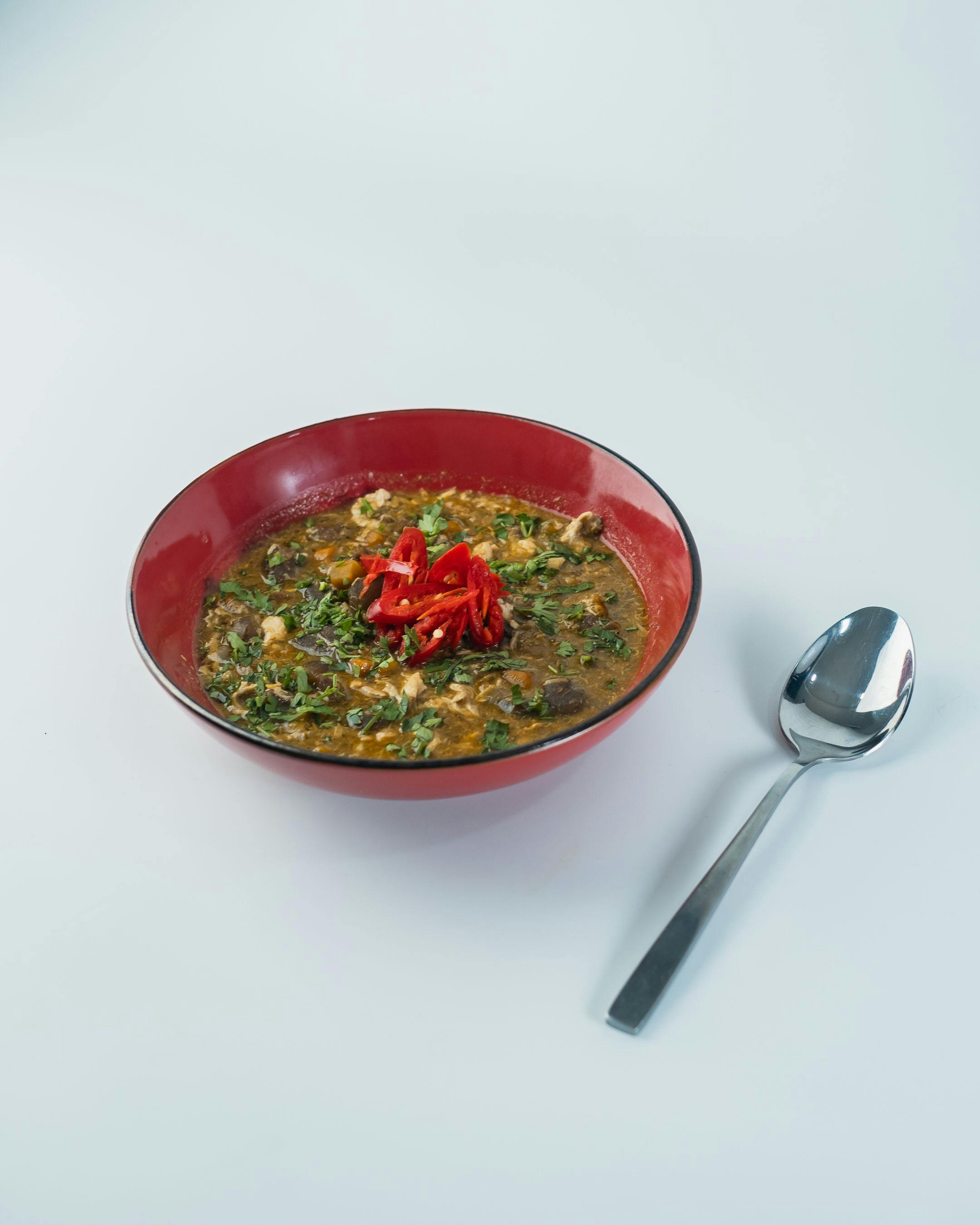
The diets react (see scores below)
Common Ingredients
- eru leaves
- waterleaf
- beef
- tripe
- smoked fish
- crayfish
- palm oil
- salt
Specific recipes may vary.
Incompatible with 5 of 11 diets
Diet Ratings
Eru is a traditional Cameroonian soup that aligns well with ketogenic principles. The base consists of eru leaves (Gnetum africanum) and waterleaf, both low-carb leafy greens. The protein sources — beef, tripe, and smoked fish — are keto-friendly, and crayfish adds flavor with negligible carbs. Palm oil is a highly keto-compatible fat source, rich in saturated fats. The dish is naturally grain-free, sugar-free, and starchy-vegetable-free. Net carbs are primarily from the leafy greens, which remain well within keto limits in standard serving sizes. This is essentially a high-fat, moderate-protein, low-carb soup that fits keto well without modification.
Some strict keto practitioners may flag waterleaf (Talinum triangulare) for its slightly higher moisture-bound carbohydrate content compared to typical keto greens, and question the cumulative carb load if eru is consumed in very large portions. Carnivore-adjacent keto followers may also avoid plant-heavy soups altogether.
Eru contains multiple animal products that are clearly incompatible with a vegan diet. Beef and tripe are mammalian meat, smoked fish is seafood, and crayfish is a crustacean. These ingredients are unambiguous animal products excluded by all vegan standards. While the base of eru leaves, waterleaf, and palm oil is plant-derived, the dish as traditionally prepared is heavily centered on animal proteins and cannot be considered vegan in any interpretation.
Eru is a traditional Cameroonian soup with several paleo-compliant ingredients — eru leaves (Gnetum africanum), waterleaf, beef, tripe, smoked fish, crayfish, and palm oil are all acceptable paleo foods. However, two ingredients disqualify the dish: added salt and palm oil. Salt is explicitly excluded under paleo rules as an added/processed seasoning unavailable in refined form to Paleolithic humans. Palm oil, while a natural plant fat, is considered a seed/tropical oil that falls outside the preferred paleo fats (animal fats, olive oil, coconut oil, avocado oil). Smoked fish may also introduce preservative concerns depending on preparation. The combination of these non-compliant ingredients, particularly salt as a direct rule violation, pushes the dish into avoid territory despite its largely whole-food base.
Eru contains several Mediterranean diet concerns that collectively push it toward 'avoid.' Palm oil is the primary fat, replacing extra virgin olive oil — it is high in saturated fat and entirely absent from Mediterranean traditions. Beef and tripe (organ meat) together represent significant red meat content, which the Mediterranean diet limits to a few times per month. On the positive side, eru leaves and waterleaf are nutrient-dense leafy greens strongly aligned with Mediterranean plant emphasis, smoked fish provides omega-3-rich protein consistent with Mediterranean seafood encouragement, and crayfish is a shellfish that fits the diet. However, the combination of palm oil as the dominant fat and a heavy red meat (including offal) base overrides these positives, making this dish incompatible as a regular feature of a Mediterranean eating pattern.
Some Mediterranean diet researchers adopting a broader 'traditional dietary patterns' lens might view Eru more charitably: the dish is built around dark leafy greens and includes seafood (smoked fish, crayfish), and palm oil — while not olive oil — is a minimally processed plant-derived fat used in traditional cooking, which certain inclusive interpretations acknowledge as preferable to highly refined industrial oils. In this reading, the dish could be rated 'caution' with guidance to reduce red meat and substitute olive oil.
Eru is a traditional Cameroonian soup that is fundamentally plant-based in its foundation. While it contains acceptable carnivore ingredients — beef, tripe, smoked fish, and crayfish — the dish is defined by eru leaves (Gnetum africanum) and waterleaf (Talinum triangulare), which are plant foods explicitly excluded from the carnivore diet. Palm oil, though often used in carnivore-adjacent cooking, is a plant-derived oil and not an animal fat. Crayfish is acceptable, but the overall dish cannot be modified into a carnivore-compliant meal without removing its core defining ingredients. The presence of multiple plant foods makes this a clear avoid.
Eru is a traditional Cameroonian soup made from eru leaves (Gnetum africanum), waterleaf, beef, tripe, smoked fish, crayfish, palm oil, and salt — all of which are Whole30-compliant ingredients. Meat, offal (tripe), seafood (smoked fish and crayfish), vegetables (eru leaves and waterleaf), natural fats (palm oil), and salt are all explicitly allowed. The main caution is practical: smoked fish can sometimes contain added sulfites or sugar in the curing/smoking process, but per the 2024 Whole30 rule updates, sulfites are no longer excluded. Sugar or other additives in smoked fish would still be a concern, so label-reading is advised if using packaged smoked fish. Otherwise, this dish as described is a clean, whole-food, protein- and vegetable-rich soup fully in the spirit of Whole30.
The medium confidence reflects a practical label-reading concern: commercially prepared smoked fish may contain added sugar or other non-compliant additives not reflected in the dish description. Melissa Urban and official Whole30 guidelines require checking all packaged/processed ingredients for hidden non-compliant additives, so the dish's compliance depends on sourcing.
Eru is a traditional Cameroonian soup made from eru (Gnetum africanum) leaves and waterleaf (Talinum triangulare) cooked with various proteins and palm oil. The protein ingredients — beef, tripe, smoked fish, and crayfish — are generally low-FODMAP and not a concern. Palm oil is a pure fat and is low-FODMAP. Salt is fine. The key uncertainty lies in the two primary vegetables: eru leaves (Gnetum africanum) and waterleaf (Talinum triangulare) have not been tested by Monash University for FODMAP content. These are West/Central African regional ingredients with no published FODMAP data. Eru leaves are a fibrous green leafy vegetable; leafy greens are often low-FODMAP, but without specific testing, their oligosaccharide or polyol content cannot be confirmed. Waterleaf similarly lacks FODMAP testing data. Smoked fish may also contain additives depending on preparation, though plain smoked fish is generally safe. Given the absence of known high-FODMAP ingredients alongside the lack of Monash testing for the primary vegetables, a cautious middle-ground rating is appropriate — this dish may well be low-FODMAP, but cannot be confirmed without data.
Monash University has not tested eru leaves (Gnetum africanum) or waterleaf (Talinum triangulare), so their FODMAP status is unknown. Some clinical FODMAP practitioners advise avoiding untested regional vegetables during the strict elimination phase until individual tolerance is established, while others consider plain leafy greens generally safe by category.
Eru is a traditional Cameroonian soup with several DASH-problematic components. Palm oil is a tropical oil high in saturated fat (about 50% saturated), which DASH explicitly limits — it falls in the same category as coconut oil that DASH discourages. Smoked fish and crayfish are typically high in sodium, and added salt further compounds the sodium load. Tripe (offal) and beef together represent both red meat and organ meat, which DASH advises limiting due to saturated fat and cholesterol content. On the positive side, eru leaves (Gnetum africanum) and waterleaf are nutrient-dense vegetables rich in fiber, potassium, calcium, and magnesium — core DASH nutrients — and smoked fish provides lean protein in principle. However, the combination of palm oil, smoked/salted seafood, added salt, and red/organ meats creates a high saturated fat and high sodium profile that conflicts with core DASH principles. The dish could be meaningfully improved by substituting palm oil with canola or olive oil, reducing or omitting added salt, using fresh or low-sodium fish, and replacing beef/tripe with lean poultry or fish.
NIH DASH guidelines explicitly restrict tropical oils like palm oil due to saturated fat content; however, some updated clinical interpretations note that palm oil's saturated fat (primarily palmitic acid) may behave differently from trans fats, and that the vegetable base of eru is nutritionally dense — a DASH-informed clinician might rate a modified version (olive oil substituted, low-sodium fish, lean protein) as 'caution' rather than 'avoid.'
Eru is a nutrient-dense Cameroonian soup with several Zone-compatible elements alongside one significant concern. The eru leaves (Gnetum africanum) and waterleaf are excellent low-glycemic, polyphenol-rich vegetables that align well with Zone's emphasis on colorful, fibrous carbs. The protein sources — beef, tripe, smoked fish, and crayfish — provide solid protein blocks, though beef and tripe carry moderate saturated fat loads, and smoked fish adds omega-3s which are actively encouraged by Sears' anti-inflammatory framework. The critical issue is palm oil, which is high in saturated fat (palmitic acid) and is the dominant fat source in this dish. Traditional Eru uses palm oil generously, which can easily push saturated fat well beyond Zone's preferred monounsaturated fat profile. However, palm oil is not a trans fat and is not as harmful as once thought, placing it in a gray zone in Sears' later writings. The dish also lacks meaningful carbohydrate blocks beyond the leafy greens, making the 40/30/30 macro ratio difficult to achieve without supplementary low-GI carbs. With palm oil moderated and served alongside a Zone-friendly carb source, Eru can be adapted into a reasonable Zone meal, but as traditionally prepared, the fat profile and macro imbalance warrant caution.
Sears' earlier Zone books (Enter the Zone, 1995) strictly discourage saturated fat sources including palm oil as they are seen as pro-inflammatory. However, Sears' later work (The Mediterranean Zone, 2014) adopts a more nuanced anti-inflammatory lens where the polyphenol richness of eru leaves and the omega-3 contribution of smoked fish and crayfish may partially offset palm oil's saturated fat concerns. Some Zone practitioners would treat a palm-oil-reduced version of this dish as a reasonable protein-and-vegetable Zone base.
Eru is a traditional Cameroonian soup with a mixed anti-inflammatory profile. On the positive side, eru leaves (Gnetum africanum) are nutrient-dense wild greens rich in antioxidants, fiber, and polyphenols — a genuine anti-inflammatory asset. Waterleaf (Talinum triangulare) similarly provides antioxidants, vitamins A and C, and omega-3 fatty acids in meaningful amounts for a leafy green. Smoked fish and crayfish contribute protein and some omega-3s. On the negative side, palm oil is a significant concern: it is high in saturated fat (palmitic acid), which is associated with pro-inflammatory signaling at higher intakes, and the anti-inflammatory framework consistently recommends limiting saturated fat sources. While palm oil does contain some vitamin E (tocotrienols) and is less harmful than trans fats, it is not equivalent to extra virgin olive oil and should be used sparingly. Beef and tripe are red meat and organ meat respectively — acceptable in moderation but flagged under anti-inflammatory guidelines for saturated fat and arachidonic acid content. The combination of beef, tripe, and palm oil as core components creates a meaningful pro-inflammatory burden that offsets the excellent vegetable base. Salt is not inflammatory per se but worth noting in a dish with already-salted smoked fish and crayfish (sodium load). Overall, the dish has genuinely beneficial ingredients (the greens) but the palm oil volume and red meat/organ meat combination push it to caution territory.
Some integrative nutrition researchers, particularly those focused on traditional African dietary patterns, argue that whole unrefined palm oil used in traditional cooking contexts delivers beneficial carotenoids and tocotrienols not found in refined versions, and that the overall dietary matrix of vegetable-rich soups like eru may offset saturated fat concerns — a position supported by some epidemiological data from West and Central African populations. By contrast, mainstream anti-inflammatory frameworks including Dr. Weil's pyramid and the IF Rating system consistently flag palm oil and red meat as foods to limit, recommending substitution with olive oil and leaner proteins where possible.
Eru is a nutrient-dense Cameroonian soup with a meaningful protein profile from multiple sources — beef, tripe, smoked fish, and crayfish — and genuine fiber value from eru leaves and waterleaf, both of which are leafy greens with solid micronutrient content. However, the dish is traditionally prepared with a substantial amount of palm oil, which is high in saturated fat and is the primary concern for GLP-1 patients. Palm oil worsens nausea, bloating, and reflux by slowing digestion further on top of GLP-1's already-reduced gastric emptying. Tripe is relatively lean and easy to digest in small portions, which is a mild positive. Smoked fish and crayfish add protein density and umami without significant fat. The leafy greens (eru/Gnetum africanum and waterleaf) provide fiber and hydration support. The critical variable is palm oil quantity — a lightly oiled preparation shifts this toward a cautious approve, while a traditionally generous palm oil base pushes it toward avoid territory. Rated as caution reflecting the typical home-cooked or restaurant version, which uses significant palm oil.
Some GLP-1-focused dietitians would argue that the high protein diversity (beef + tripe + smoked fish + crayfish) and genuine leafy green fiber content make eru a worthwhile meal if palm oil is deliberately reduced, potentially rating it a 6. Others would rate it lower (2-3) because palm oil volume in traditional preparations is difficult to control when eating outside the home, and high-saturated-fat meals are among the most reliable triggers for GLP-1 GI side effects.
*See how scores were generated at our methodology page.
Nutritional profile
Six traits that cut across every diet.
Fiber & Plants
How much whole-plant food and fiber it delivers.
Healthy Fats
The quality of its fats (unsaturated, omega-3).
Whole / Unprocessed
How close it is to its natural, unprocessed form.
Gut Gentle
How easy it is on digestion (low FODMAP, few irritants).
Low Glycemic
How little it spikes your blood sugar.
Protein Density
How much protein it packs per calorie.
Controversy Index
Higher controversy = more disagreement between diets.
Diet-Specific Tips
 Keto — 8/10
View tips
- Eru leaves and waterleaf are low-net-carb leafy greens suitable for keto
- Palm oil is an ideal keto fat source — high in saturated fat, zero carbs
- Multiple protein sources (beef, tripe, smoked fish, crayfish) fit keto macros
- No grains, starches, added sugars, or high-carb vegetables present
- Smoked fish and crayfish add negligible carbs with good protein and fat contribution
- Waterleaf has slightly more carbs than some greens — large portions warrant attention
 Whole30 — 8/10
View tips
- Eru leaves (Gnetum africanum) and waterleaf are Whole30-compliant vegetables
- Beef and tripe are compliant animal proteins
- Crayfish (dried) is a compliant seafood ingredient
- Palm oil is a compliant natural fat
- Salt is explicitly allowed on Whole30
- Smoked fish may contain added sugar or non-compliant curing agents — label verification required for packaged versions
- No grains, legumes, dairy, or other excluded ingredients present
- Dish honors the whole-food, unprocessed spirit of the Whole30 program
 Low-FODMAP — 5/10
View tips
- Eru leaves (Gnetum africanum) not tested by Monash University — FODMAP status unknown
- Waterleaf (Talinum triangulare) not tested by Monash University — FODMAP status unknown
- Beef, tripe, smoked fish, and crayfish are protein sources and generally low-FODMAP
- Palm oil is a pure fat and is low-FODMAP
- No high-FODMAP ingredients identified among the known components
- Low confidence due to absence of Monash data for the primary vegetable ingredients
 Zone — 5/10
View tips
- Eru and waterleaf are excellent low-glycemic, high-fiber, polyphenol-rich Zone carb sources
- Palm oil is high in saturated fat (palmitic acid), conflicting with Zone's monounsaturated fat preference
- Multiple protein sources (beef, tripe, smoked fish, crayfish) provide solid protein blocks but add saturated fat from beef and tripe
- Smoked fish and crayfish contribute beneficial omega-3 fatty acids aligned with Sears' anti-inflammatory focus
- Dish is very low in carbohydrates overall; achieving 40% carb ratio requires supplementary low-GI carbs
- Traditional preparation uses generous amounts of palm oil, making fat portioning difficult to control
- No high-glycemic ingredients or added sugars present
 Anti-Inflammatory — 5/10
View tips
- Eru leaves (Gnetum africanum) are antioxidant-rich wild greens — strong anti-inflammatory asset
- Waterleaf provides vitamins A and C, omega-3 fatty acids, and polyphenols
- Palm oil is high in saturated palmitic acid — pro-inflammatory at typical cooking volumes
- Beef and tripe are red meat/organ meat — linked to higher arachidonic acid and saturated fat intake
- Smoked fish and crayfish contribute omega-3s and protein but also sodium
- High sodium load from smoked fish, crayfish, and added salt may be a concern
- Traditional unrefined palm oil contains beneficial tocotrienols and carotenoids not present in refined versions
 GLP-1 Friendly — 4/10
View tips
- High palm oil content — significant saturated fat, primary concern for GLP-1 GI side effects including nausea and reflux
- Good protein diversity from beef, tripe, smoked fish, and crayfish — supports daily protein targets
- Eru leaves and waterleaf provide meaningful fiber and micronutrients — supports digestion and fullness
- Smoked fish adds sodium — fluid retention is a minor secondary concern
- Tripe is lean and relatively easy to digest in small portions — mild positive
- Portion sensitivity high — a small serving with reduced palm oil is significantly more GLP-1 compatible than a full traditional serving
- Gastric emptying concern — fat-heavy preparation will sit heavily in the stomach longer than usual on GLP-1 medication