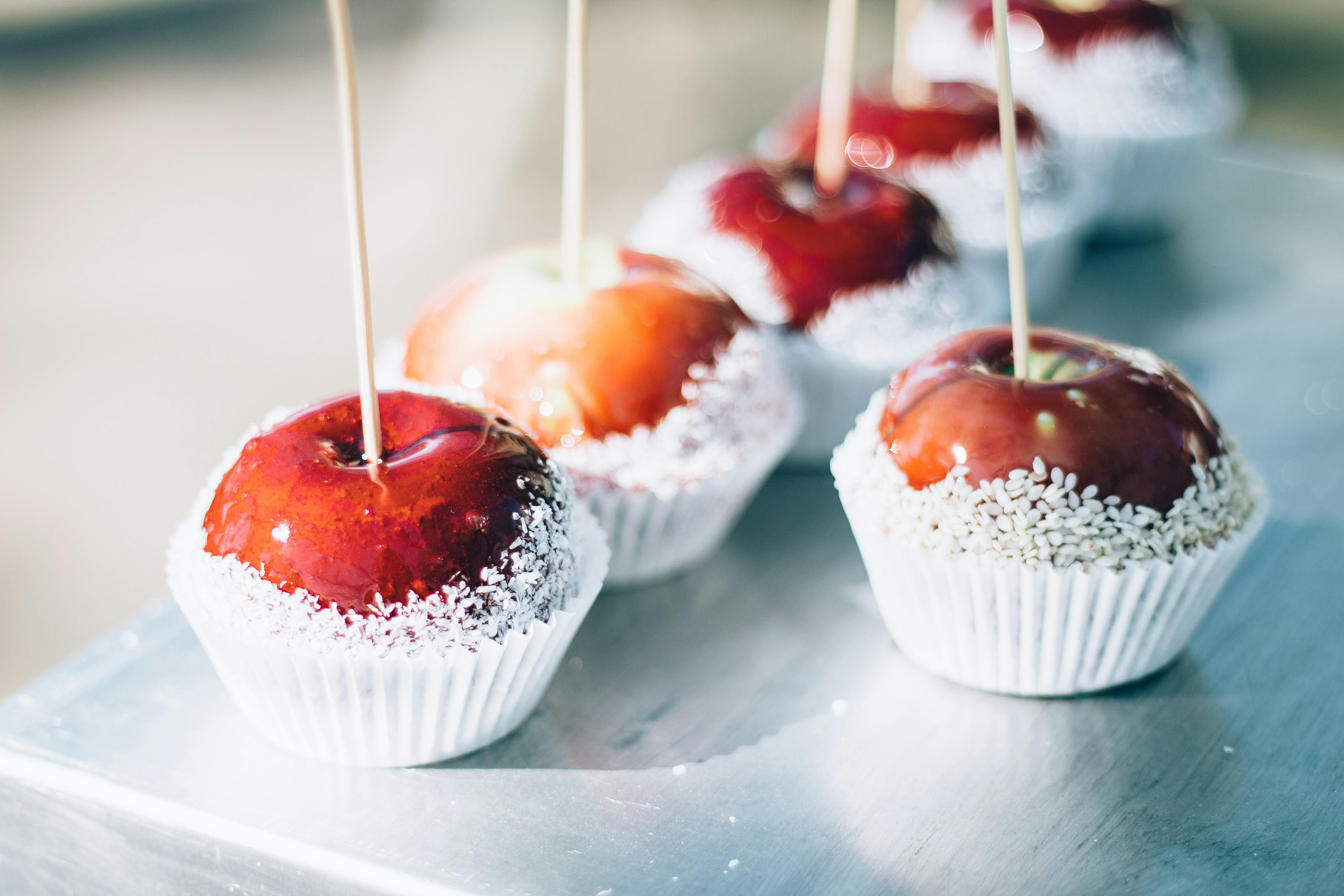
Photo: Maria Tyutina / Pexels
American
Candy Apple
The diets react (see scores below)
Common Ingredients
- apple
- sugar
- corn syrup
- water
- red food coloring
- butter
- vanilla extract
Specific recipes may vary.
Incompatible with 11 of 11 diets
Diet Ratings
A candy apple is one of the most keto-incompatible foods imaginable. The base is an apple, which already contains 20-25g of net carbs on its own — enough to exceed many people's entire daily keto allowance. This is then coated in a hardened shell of pure sugar and corn syrup, dramatically multiplying the carbohydrate load. A single candy apple can easily contain 50-70g or more of net carbs, which is 2-4x the entire daily keto limit. There are no redeeming keto qualities: no meaningful fat, no fiber offset, pure sugar delivery. This is fundamentally a confectionery item built around sugar and fruit.
This candy apple recipe contains butter, which is a dairy product derived from cow's milk and is therefore not vegan. All other ingredients — apple, sugar, corn syrup, water, red food coloring, and vanilla extract — are plant-based or synthetic. However, the presence of butter in the candy coating disqualifies the dish. A vegan version of candy apples is easily achievable by substituting the butter with a plant-based alternative such as vegan margarine or coconut oil, and by ensuring the red food coloring is not carmine-based (carmine is an animal-derived red dye, though many red food colorings are synthetic and vegan-friendly).
Candy apples are fundamentally incompatible with the paleo diet despite containing a paleo-approved base ingredient (apple). The coating is built almost entirely from non-paleo ingredients: refined sugar and corn syrup are processed sweeteners explicitly excluded from paleo, red food coloring is an artificial additive with no place in paleo eating, and butter is a dairy product. While vanilla extract is generally acceptable, it cannot redeem a dish where the majority of ingredients — and the entire defining characteristic of the food — are paleo violations. This is a heavily processed confection, not a whole food.
A candy apple is fundamentally a fruit coated in a shell of added sugars (sugar and corn syrup), which directly contradicts Mediterranean diet principles. While the apple itself is a wholesome, approved fruit, the overwhelming sugar and corn syrup coating transforms it into a high-sugar confection. Corn syrup is a refined, processed sweetener with no place in Mediterranean eating patterns. Butter adds saturated fat outside the olive oil-centered fat framework, and artificial food coloring is a processed additive. The minimal nutritional benefit of the apple is far outweighed by the sugar load. Added sugars and refined sweeteners are explicitly minimized in the Mediterranean diet.
Candy Apple is entirely incompatible with the carnivore diet. Every single ingredient is plant-derived or a processed additive: apple (fruit), sugar (refined plant-derived sweetener), corn syrup (processed plant sugar), water (neutral but irrelevant here), red food coloring (artificial additive), vanilla extract (plant-derived). The only marginally animal-derived ingredient is butter, which is a minor component in a dish that is fundamentally a sugar-coated fruit. This dish contains zero meaningful animal protein or fat, is loaded with sugar and processed sweeteners, and is built around a fruit — all of which are explicitly excluded on any tier of the carnivore diet.
Candy apples contain multiple explicitly excluded ingredients. Sugar is a direct violation of the Whole30 added sugar rule, and corn syrup is also an added sugar and excluded. Butter (non-clarified dairy) is excluded — only ghee and clarified butter are permitted. Red food coloring, while not explicitly named, is an artificial additive inconsistent with Whole30's whole-food philosophy. The dish is also a classic example of 'junk food recreation' — a confection designed to satisfy a candy/sugar craving, which Whole30 explicitly discourages. The only compliant ingredients are the apple and vanilla extract.
A candy apple is high-FODMAP for two compounding reasons. First, a whole apple is high in excess fructose and sorbitol (a polyol), both significant FODMAPs — Monash rates apple as high-FODMAP at any standard serving. A candy apple uses a whole apple, far exceeding any safe portion. Second, corn syrup is high in fructose (and often contains HFCS-like fructose levels), adding further excess fructose load. Sugar (sucrose) itself is balanced fructose-glucose and is low-FODMAP, and the remaining ingredients — water, red food coloring, butter, vanilla extract — are all low-FODMAP. However, the apple and corn syrup combination makes this dish clearly high-FODMAP and unsuitable during the elimination phase.
A candy apple is essentially a fruit (apple) coated in a thick shell of sugar, corn syrup, and butter — a confection that DASH explicitly discourages. While the apple itself is a DASH-approved food rich in fiber and potassium, the candy coating dominates the nutritional profile, delivering a heavy dose of added sugars and some saturated fat from butter. DASH guidelines specifically call for limiting sweets and added sugars to no more than 5 servings per week (and in small quantities), and a candy apple's coating far exceeds a reasonable 'sweet' serving. The corn syrup and sugar combination represents exactly the type of high-glycemic, nutrient-poor addition that DASH seeks to minimize. The underlying apple contributes some fiber and potassium, preventing a score of 1, but this dish as a whole is incompatible with DASH principles.
A candy apple is essentially a whole apple encased in a hard shell of sugar, corn syrup, and butter — a combination that is fundamentally incompatible with Zone Diet principles. While the apple itself is a moderately favorable Zone carbohydrate source (low-to-moderate glycemic index, provides polyphenols and fiber), the candy coating transforms it into a high-glycemic sugar bomb. The coating is composed almost entirely of sucrose and corn syrup — two of the highest-glycemic, most insulin-spiking carbohydrate sources that Dr. Sears specifically identifies as unfavorable. The sugar coating alone likely adds 30-40+ grams of rapidly absorbed simple sugars on top of the apple's ~20g of carbohydrates, making it impossible to fit into a Zone block structure without massively overshooting carbohydrate allowance. There is no protein component to balance the macronutrient ratio, no monounsaturated fat (butter provides saturated fat only), and no mechanism to achieve anything close to 40/30/30. This is one of the rare cases where the food genuinely cannot be incorporated into a Zone-balanced meal or snack — pure sugar delivery systems like this sit at the top of Dr. Sears' 'avoid' list alongside soda and candy.
A candy apple is essentially a whole apple encased in a hard shell of sugar, corn syrup, butter, and artificial food coloring — a combination that is strongly pro-inflammatory by virtually every anti-inflammatory framework. While the apple itself contains beneficial polyphenols, quercetin, and fiber, it is completely overwhelmed by the inflammatory coating. Sugar and corn syrup drive rapid blood glucose spikes, promote glycation, and directly elevate pro-inflammatory cytokines (IL-6, TNF-α, CRP). Corn syrup adds concentrated fructose, which is metabolized in the liver and associated with increased inflammatory markers. Butter adds saturated fat (a 'limit' ingredient), and artificial red food coloring (likely Red 40/Allura Red) is flagged by some research as potentially inflammatory and linked to gut microbiome disruption. The vanilla extract is negligible at the quantity used. There is essentially no meaningful anti-inflammatory benefit that survives the processing and added ingredients — the apple's beneficial compounds are present in a form that cannot redeem the dish overall.
A candy apple is essentially a high-sugar confection wrapped around fruit. The coating is composed almost entirely of sugar, corn syrup, and butter — delivering a rapid spike of empty calories with negligible protein and minimal fiber (the apple contributes a small amount, but it is largely offset by the candy shell). For GLP-1 patients, this is problematic on multiple fronts: the high sugar load conflicts with blood sugar stabilization goals, the butter adds saturated fat that can worsen nausea and GI side effects, and the candy shell provides virtually no nutritional value per calorie. The apple base offers some fiber and hydration, but those benefits are far outweighed by the sugar coating. With reduced appetite as the mechanism of GLP-1 medications, every calorie consumed needs to contribute meaningfully to protein, fiber, and micronutrient targets — a candy apple fails on all primary criteria.
*See how scores were generated at our methodology page.
Nutritional profile
Six traits that cut across every diet.
Fiber & Plants
How much whole-plant food and fiber it delivers.
Healthy Fats
The quality of its fats (unsaturated, omega-3).
Whole / Unprocessed
How close it is to its natural, unprocessed form.
Gut Gentle
How easy it is on digestion (low FODMAP, few irritants).
Low Glycemic
How little it spikes your blood sugar.
Protein Density
How much protein it packs per calorie.
Controversy Index
Higher controversy = more disagreement between diets.