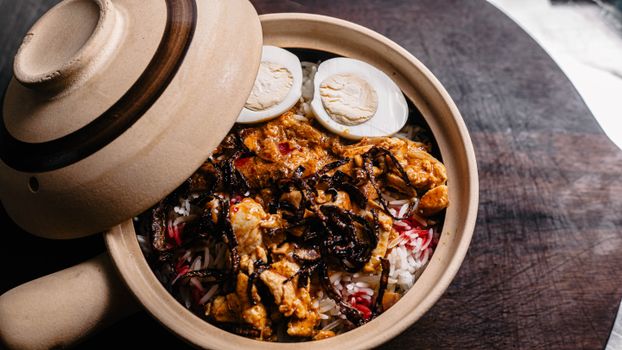
Photo: Ahmad salisu jaafar / Pexels
Chinese
Claypot Rice
The diets react (see scores below)
Common Ingredients
- rice
- chicken
- chinese sausage
- shiitake mushrooms
- ginger
- scallions
- dark soy sauce
- sesame oil
- oyster sauce
Specific recipes may vary.
Incompatible with 8 of 11 diets
Diet Ratings
Claypot Rice is fundamentally incompatible with a ketogenic diet. The primary ingredient is white rice, which is a high-glycemic grain containing approximately 45g of net carbs per cup of cooked rice — easily exceeding the entire daily keto carb budget in a single serving. Chinese sausage (lap cheong) adds additional sugar and carbs. The oyster sauce and dark soy sauce contribute further sugars and carbohydrates. There is no meaningful way to adapt this dish while retaining its identity, as rice is the structural and caloric foundation of the meal.
Claypot Rice as described contains multiple animal products, making it entirely incompatible with a vegan diet. Chicken is direct animal flesh, Chinese sausage is typically made from pork (an animal product), and oyster sauce is derived from oysters (a marine animal). Sesame oil and dark soy sauce are plant-derived and vegan-friendly, as are the rice, shiitake mushrooms, ginger, and scallions, but the presence of three distinct animal-derived ingredients disqualifies this dish entirely.
Claypot Rice contains multiple paleo-excluded ingredients that make it fundamentally incompatible with the paleo diet. Rice is a grain and a core exclusion in paleo. Chinese sausage is a processed meat product typically containing added sugar, salt, preservatives, and soy — all non-paleo. Dark soy sauce contains wheat (a grain) and added salt. Oyster sauce is a processed condiment with added sugar, salt, and starch. Sesame oil is a seed oil, excluded from paleo in favor of approved fats. The only paleo-compliant ingredients are chicken, shiitake mushrooms, ginger, and scallions. The dish's foundation (rice) and flavor base (soy sauce, oyster sauce, Chinese sausage, sesame oil) are all firmly in avoid territory, leaving no realistic paleo adaptation of this dish in its traditional form.
Claypot Rice presents several compatibility issues with Mediterranean diet principles. The dish centers on white rice (refined grain), which lacks the fiber and nutrients of whole grains preferred in the Mediterranean pattern. More significantly, Chinese sausage (lap cheong) is a processed, cured red meat high in saturated fat, sodium, and preservatives — directly contradicting the Mediterranean principle of limiting red and processed meats. Sesame oil replaces olive oil as the primary fat, and oyster sauce and dark soy sauce add significant sodium and processed condiments. The chicken and shiitake mushrooms are positive elements, but they cannot offset the refined grain base and processed sausage. This dish is largely incompatible with Mediterranean dietary principles.
Some modern Mediterranean diet practitioners take a broader view that mushrooms, ginger, scallions, and moderate chicken align well with plant-forward eating, and would suggest the dish could be adapted (substituting brown rice, eliminating sausage, using minimal soy sauce) to become more compatible — rating the base concept rather than the exact recipe as 'caution' territory.
Claypot Rice is fundamentally incompatible with the carnivore diet. The dish is built around rice, a grain, which is a core excluded food. It also contains shiitake mushrooms (plant fungi), ginger (plant), scallions (plant), dark soy sauce (fermented soy — a legume), sesame oil (plant oil), and oyster sauce (typically contains sugar and starch fillers). While chicken and Chinese sausage are animal-derived, the entire preparation is dominated by plant foods and plant-based condiments. Even the animal components are marinated in non-carnivore sauces. This dish cannot be modified to fit carnivore — it would need to be an entirely different dish.
Claypot Rice contains multiple excluded ingredients that disqualify it from the Whole30 program. Rice is a grain and explicitly excluded. Chinese sausage (lap cheong) typically contains soy, sugar, and often alcohol — all excluded. Dark soy sauce contains wheat (a grain) and soy (a legume), both excluded. Oyster sauce commonly contains added sugar and sometimes cornstarch or other additives. These are not edge cases or borderline ingredients — rice alone is a hard exclusion, and the soy-based sauces compound the disqualification significantly.
Claypot Rice contains several high-FODMAP ingredients that make it problematic during the elimination phase. Shiitake mushrooms are high in polyols (mannitol) and are rated high-FODMAP by Monash at typical serving sizes. Scallions/green onions: the white bulb portion is high in fructans (like onion), though the green tops are low-FODMAP — in restaurant-prepared dishes, both parts are typically used. Chinese sausage (lap cheong) often contains garlic and/or high-FODMAP additives, making it a fructan risk. Oyster sauce frequently contains garlic and/or onion powder, contributing fructans. Dark soy sauce is generally low-FODMAP in small amounts but some brands contain wheat. Rice is low-FODMAP, chicken is low-FODMAP, ginger is low-FODMAP in typical culinary amounts, and sesame oil is low-FODMAP. However, the combination of shiitake mushrooms, likely garlic-containing Chinese sausage, scallion white parts, and oyster sauce creates a significant cumulative FODMAP load from multiple sources (polyols + fructans stacking), making this dish a clear avoid during elimination.
Monash University rates dried shiitake mushrooms as low-FODMAP at 2 dried mushrooms (approx. 13g), and green scallion tops as low-FODMAP — if a home cook carefully uses only green scallion tops, low-FODMAP oyster sauce (some certified brands exist), and FODMAP-friendly sausage without garlic, and limits mushroom quantity, this dish could potentially be modified to a 'caution' level. Clinical FODMAP practitioners would still advise avoiding standard restaurant versions due to uncontrolled ingredients.
Claypot Rice contains multiple DASH-incompatible ingredients that make it a poor fit for the eating plan. Chinese sausage (lap cheong) is a processed, cured meat high in sodium and saturated fat — exactly what DASH explicitly limits. The combination of dark soy sauce, oyster sauce, and soy sauce-marinated ingredients stacks sodium rapidly, easily pushing a single serving well above 800–1,200mg of sodium, a large fraction of even the standard DASH limit of 2,300mg/day. Chinese sausage also contributes significant saturated fat. While several ingredients are DASH-friendly (chicken as lean protein, shiitake mushrooms as vegetables, ginger, scallions, and plain rice as whole grain carbohydrate), the high-sodium condiment base and processed meat content override these positives. This dish as traditionally prepared is incompatible with DASH goals of sodium reduction and limiting processed/cured meats.
Claypot Rice presents significant Zone Diet challenges primarily due to its carbohydrate composition and protein quality. White rice is the dominant ingredient and is a high-glycemic carbohydrate — precisely the type Dr. Sears classifies as 'unfavorable' and advises limiting. A typical claypot rice serving delivers a substantial carb load that would dominate the macronutrient ratio far beyond the 40% carb target, making it very difficult to achieve the 40/30/30 balance without radical portion reduction. Chinese sausage (lap cheong) adds saturated fat and is a processed meat — both problematic for Zone compliance. The chicken component is favorable as lean protein, and shiitake mushrooms, ginger, and scallions are excellent low-glycemic, polyphenol-rich Zone-friendly ingredients. Sesame oil provides some monounsaturated fat but is also higher in omega-6s than ideal. The dish could theoretically be adapted — using a very small portion of rice with a larger protein and vegetable ratio — but as traditionally prepared, the high-glycemic rice base and processed sausage make Zone balancing genuinely difficult rather than merely requiring careful portioning.
Claypot rice is a mixed dish from an anti-inflammatory standpoint. On the positive side, it contains shiitake mushrooms (an emphasized anti-inflammatory ingredient with beta-glucans and immune-modulating properties), ginger (a well-established anti-inflammatory spice with gingerols), scallions, and lean chicken as the primary protein. Sesame oil in small culinary amounts is generally acceptable. The problematic element is Chinese sausage (lap cheong), which is a processed, cured pork sausage high in saturated fat, sodium, and preservatives — falling squarely in the 'limit' to 'avoid' category due to its processed nature and inflammatory fat profile. White rice is a refined carbohydrate with a high glycemic index, contributing minimal fiber or antioxidants, which is neutral-to-mildly unfavorable. Dark soy sauce and oyster sauce contribute high sodium, and the latter typically contains additives, though in culinary quantities these are not major concerns. Overall, the dish has genuinely anti-inflammatory ingredients (mushrooms, ginger) undermined by processed cured meat and refined carbohydrates, placing it firmly in the 'caution' zone.
Some anti-inflammatory practitioners following a more lenient whole-foods approach (closer to Dr. Weil's Mediterranean-Asian hybrid model) would consider this a reasonable occasional meal given the mushroom and ginger content, with the suggestion to simply omit or reduce the Chinese sausage. Stricter anti-inflammatory protocols (e.g., those targeting autoimmune conditions or metabolic inflammation) would rate this closer to 'avoid' due to the processed meat and high-glycemic white rice, arguing both drive NF-kB inflammatory signaling.
Claypot rice presents a mixed nutritional profile for GLP-1 patients. The chicken provides a meaningful protein contribution, and shiitake mushrooms add some fiber and micronutrients. However, Chinese sausage (lap cheong) is a significant concern — it is high in saturated fat, sodium, and is a processed meat, all of which are problematic on GLP-1 medications. Sesame oil and oyster sauce add flavor but also fat and sodium. The base is white rice, a refined carbohydrate with low fiber and moderate glycemic impact, which is not ideal when every calorie needs to count nutritionally. The dish is also typically served in a single large portion rather than small, protein-forward servings. The combination of fatty processed sausage, refined rice, and multiple high-sodium condiments makes this a caution-level dish. It is not inherently unavoidable — a modified version with reduced sausage, smaller rice portion, and extra chicken could shift the profile — but as traditionally prepared it falls short of GLP-1 dietary priorities.
Some GLP-1-focused dietitians may permit claypot rice occasionally given that chicken and mushrooms do contribute real protein and micronutrients, and the dish is generally not fried or extremely greasy. However, the inclusion of Chinese sausage is a consistent concern across clinical guidance due to its saturated fat and processed meat status, and the white rice base limits its fiber and nutrient density per calorie.
*See how scores were generated at our methodology page.
Nutritional profile
Six traits that cut across every diet.
Fiber & Plants
How much whole-plant food and fiber it delivers.
Healthy Fats
The quality of its fats (unsaturated, omega-3).
Whole / Unprocessed
How close it is to its natural, unprocessed form.
Gut Gentle
How easy it is on digestion (low FODMAP, few irritants).
Low Glycemic
How little it spikes your blood sugar.
Protein Density
How much protein it packs per calorie.
Controversy Index
Higher controversy = more disagreement between diets.
Diet-Specific Tips
 Zone — 4/10
View tips
- White rice is a high-glycemic 'unfavorable' carbohydrate in Zone terminology, spiking insulin and disrupting eicosanoid balance
- Chinese sausage is a processed, high-saturated-fat meat — unfavorable on both Zone's fat and food quality axes
- Carbohydrate load from rice as primary ingredient makes achieving 40/30/30 ratio very difficult at normal serving sizes
- Chicken is a favorable lean Zone protein source
- Shiitake mushrooms, ginger, and scallions are Zone-positive low-glycemic, polyphenol-rich ingredients
- Sesame oil is acceptable in small quantities but higher in omega-6 relative to preferred monounsaturated fats like olive oil
- Could be partially adapted by drastically reducing rice portion and increasing vegetables, but this diverges significantly from the traditional dish
 Anti-Inflammatory — 5/10
View tips
- Shiitake mushrooms: strong anti-inflammatory ingredient with beta-glucans
- Ginger: well-established anti-inflammatory spice
- Chinese sausage (lap cheong): processed cured meat, high in saturated fat, sodium, and preservatives — pro-inflammatory
- White rice: refined carbohydrate, high glycemic index, minimal fiber
- Lean chicken: acceptable moderate protein source
- Dark soy sauce and oyster sauce: high sodium, minor additive concern at culinary amounts
- Sesame oil: acceptable in small culinary doses
 GLP-1 Friendly — 4/10
View tips
- Chinese sausage is high in saturated fat and is a processed meat — worsens GLP-1 GI side effects and lowers nutrient density
- White rice is a refined carbohydrate with minimal fiber — poor nutrient density per calorie for reduced-appetite patients
- Chicken and shiitake mushrooms are positive contributors — protein and micronutrients
- High sodium load from dark soy sauce, oyster sauce, and sausage — not a primary GLP-1 concern but worth noting
- Sesame oil adds fat, though in small amounts it is an unsaturated fat
- Dish is typically served in large single-portion format — not small-portion friendly
- Fiber content is low overall — does not support GLP-1 constipation prevention goals