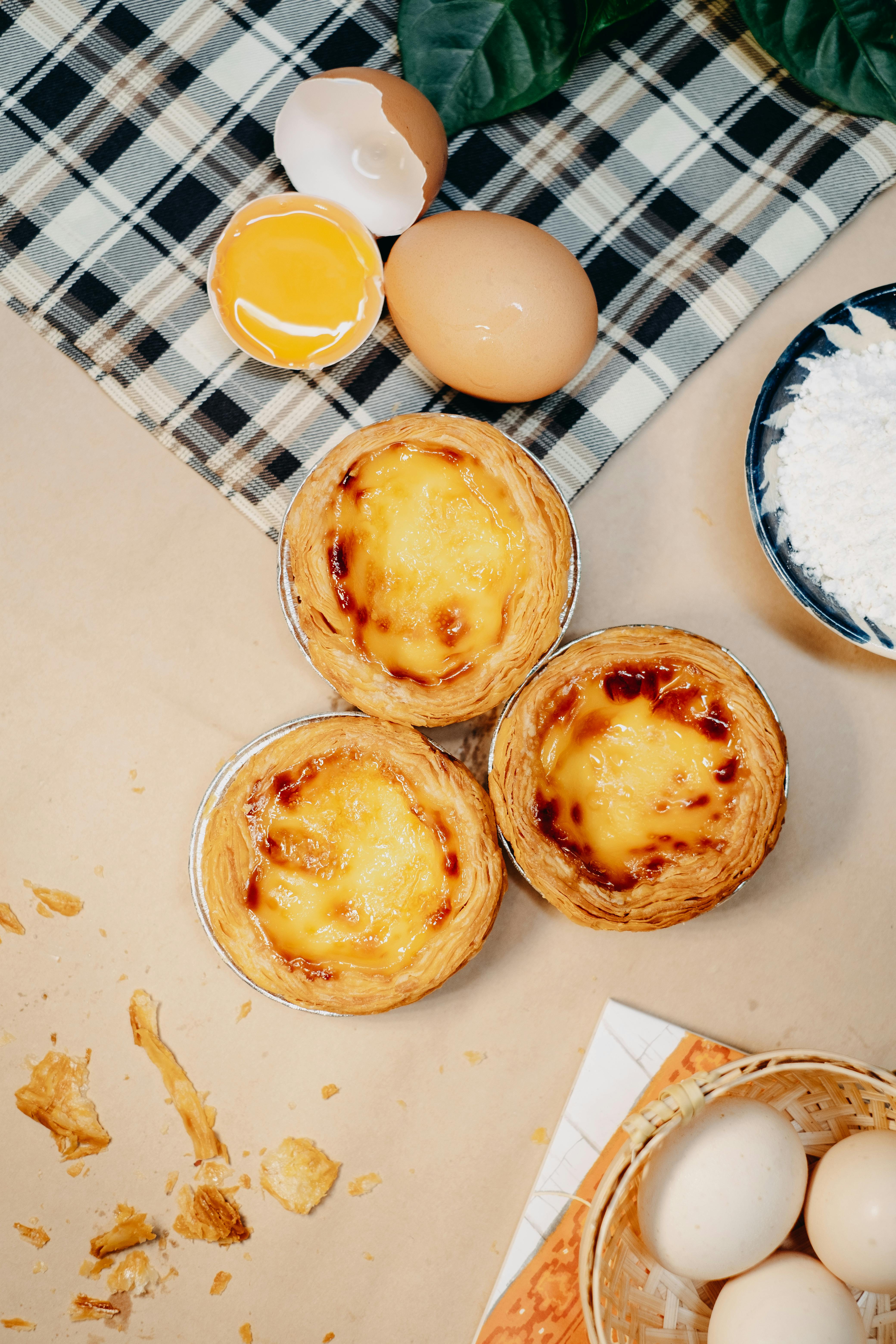
Photo: Pew Nguyen / Pexels
The diets react (see scores below)
Common Ingredients
- eggs
- flour
- butter
- sugar
- evaporated milk
- vanilla
- lard
Specific recipes may vary.
Incompatible with 10 of 11 diets
Diet Ratings
Chinese egg tarts are fundamentally incompatible with a ketogenic diet. The pastry shell is made from flour (wheat-based, high-carb) and lard/butter, while the custard filling contains significant added sugar and evaporated milk (which has naturally occurring lactose plus concentrated carbs). A single standard egg tart typically contains 25-35g of net carbs, which can single-handedly exceed or consume the entire daily keto carb budget. The combination of refined flour and added sugar represents two of the most prohibited ingredient categories in ketogenic eating. While the eggs, butter, and lard components are keto-friendly, they are heavily outweighed by the problematic ingredients.
Egg Tart contains multiple animal-derived ingredients that are strictly excluded from a vegan diet. Eggs are a direct animal product; butter and evaporated milk are dairy products derived from cows; and lard is rendered pig fat. There is no ambiguity here — every protein and fat source in this dish is of animal origin, making it entirely incompatible with vegan dietary standards.
Egg tarts contain multiple non-paleo ingredients that disqualify this dish outright. Flour (wheat) is a grain and strictly excluded from paleo. Sugar is refined and excluded. Evaporated milk is a dairy product and excluded. Butter is dairy and generally excluded (unlike ghee, it retains casein and lactose). While eggs and lard are paleo-approved, the combination of wheat flour, refined sugar, evaporated milk, and butter makes this dish fundamentally incompatible with paleo principles. There is no meaningful way to frame a traditional egg tart as paleo-friendly.
Egg tarts are a highly processed pastry snack that conflicts with Mediterranean diet principles on multiple fronts. The crust relies on refined white flour, butter, and lard as primary fats — none of which align with the Mediterranean emphasis on whole grains and extra virgin olive oil as the dominant fat. The filling contains added sugar and evaporated milk, contributing to the high refined sugar and saturated fat content. While eggs themselves are acceptable in moderation, they are not the dominant concern here. The overall profile — refined grains, animal-based saturated fats (butter and lard), added sugars, and no whole-food plant-based components — places this firmly in the 'avoid' category.
Egg tart is fundamentally incompatible with the carnivore diet. While it contains some animal-derived ingredients (eggs, butter, evaporated milk, lard), the dish is primarily built around flour — a grain-based plant food that is strictly excluded. Sugar is also a disqualifying ingredient, as are vanilla (a plant-derived flavoring). The majority of the dish's structure and caloric composition comes from plant-based sources. Even the animal-derived components (evaporated milk, butter) are in a processed, mixed context that carnivore practitioners would reject. This is a classic baked pastry snack, not an animal-based food.
Egg tarts contain multiple excluded ingredients that make them clearly non-compliant with Whole30. Flour (a grain product) is excluded, sugar (added sugar) is excluded, and butter (dairy) is excluded. Additionally, this dish is a baked pastry/tart — a dessert/baked good — which falls squarely under the 'no recreating baked goods/junk food' rule even if ingredient substitutions were attempted. Evaporated milk is also a dairy product, further compounding the violations. With at least four distinct excluded ingredients and the dish being a classic baked dessert, this is a clear avoid.
Chinese egg tarts contain two significant FODMAP concerns that together make this a high-FODMAP food at a standard serving. First, the pastry shell is made with regular wheat flour (and lard/butter), which is high in fructans — a major FODMAP trigger. A standard egg tart (~75-80g) will contain a meaningful amount of wheat-based pastry, well above any safe fructan threshold. Second, evaporated milk is a concentrated dairy product with significant lactose content; because water is removed during evaporation, lactose per gram is higher than regular milk, and the quantity used in egg tart custard is substantial. Eggs, butter, lard, sugar, and vanilla are all low-FODMAP and not problematic. However, the combination of wheat flour (fructans) and evaporated milk (lactose) in amounts typical of a single egg tart makes this food unsuitable during the elimination phase.
Monash University has not specifically tested Chinese egg tarts as a composite dish, so the verdict is inferred from its wheat flour and evaporated milk components. Some FODMAP practitioners might allow a very small portion (e.g., half a small tart) if lactase supplements are used, but this would not be standard elimination-phase guidance — the wheat fructans alone would remain problematic regardless.
Chinese egg tarts are fundamentally at odds with DASH diet principles. The pastry shell is made with refined white flour, butter, and lard — both butter and lard are high in saturated fat, which DASH explicitly limits. The filling contains added sugar and evaporated milk (typically full-fat), contributing additional saturated fat and significant caloric density with minimal nutritional benefit. There are no vegetables, whole grains, or meaningful sources of potassium, magnesium, calcium, or fiber. While eggs themselves have some protein value and are acceptable in moderation under modern DASH interpretations, the overall dish is a high-saturated-fat, high-sugar, refined-carbohydrate snack that offers little alignment with DASH dietary goals.
Chinese egg tarts are a pastry-heavy snack that presents significant Zone Diet challenges. The crust is made from refined white flour, butter, and lard — delivering high-glycemic, nutritionally empty carbohydrates alongside substantial saturated fat. The custard filling adds sugar and evaporated milk, further loading the glycemic response. The macronutrient profile is roughly skewed toward carbohydrates (high-GI) and saturated fat, with relatively little lean protein. This is essentially the opposite of a Zone-favorable food profile: the carbs are high-glycemic, the fat is saturated rather than monounsaturated, and the protein contribution from eggs is diluted by the surrounding pastry. While eggs are a Zone-approved protein source, they are a minor player here relative to the flour, butter, lard, and sugar. A single egg tart (~75-80g) contains roughly 20-25g carbs (almost all high-GI), 10-12g fat (primarily saturated from butter and lard), and only 3-4g protein — completely incompatible with a balanced Zone block ratio. It scores a 3 rather than 1-2 only because eggs provide some lean protein and the food is not nutritionally void in the way pure sugar or soda would be, but it is very difficult to incorporate into any Zone-balanced meal without extreme modification.
Chinese egg tarts are a pastry that combines multiple pro-inflammatory ingredients with virtually no redeeming anti-inflammatory components. The crust is made from refined white flour (refined carbohydrate with high glycemic load), butter (saturated fat), and lard (animal fat high in saturated fatty acids) — all of which are explicitly limited or avoided in anti-inflammatory frameworks. The filling contains added sugar and evaporated milk (full-fat dairy concentrate), further contributing to the pro-inflammatory load. Eggs are the only ingredient with any nutritional nuance, providing some choline and selenium, but their anti-inflammatory potential is completely overshadowed by the surrounding ingredients. The combination of refined flour, multiple saturated fat sources, and added sugar closely mirrors dietary patterns associated with elevated CRP and IL-6 in research. Lard in particular is a concentrated source of saturated fat that most anti-inflammatory protocols explicitly recommend limiting. This is a treat food with no meaningful anti-inflammatory properties.
Chinese egg tarts are a pastry-based snack with a buttery, lard-enriched shortcrust or puff pastry shell filled with a sweetened egg custard made from evaporated milk, sugar, and eggs. While eggs provide some protein, the overall nutritional profile is poorly suited for GLP-1 patients. The crust is made with both butter and lard — two saturated fats — making this a high-fat food that is likely to worsen GLP-1 side effects including nausea, bloating, and reflux due to slowed gastric emptying. The sugar content is significant, providing empty calories with no fiber. The refined flour shell contributes negligible fiber. Nutrient density per calorie is very low — most calories come from fat and sugar rather than protein or fiber. The small portion size does not redeem it: a single egg tart (~70-80g) delivers roughly 3-5g protein, 15-20g fat (much of it saturated), 20-25g refined carbohydrates, and minimal fiber. This is nearly the opposite of what GLP-1 patients need from a snack, which should prioritize protein and fiber with low saturated fat. Occasional consumption is not catastrophic, but this food offers no meaningful GLP-1-friendly nutritional benefit and actively risks GI side effects.
*See how scores were generated at our methodology page.
Nutritional profile
Six traits that cut across every diet.
Fiber & Plants
How much whole-plant food and fiber it delivers.
Healthy Fats
The quality of its fats (unsaturated, omega-3).
Whole / Unprocessed
How close it is to its natural, unprocessed form.
Gut Gentle
How easy it is on digestion (low FODMAP, few irritants).
Low Glycemic
How little it spikes your blood sugar.
Protein Density
How much protein it packs per calorie.
Controversy Index
Higher controversy = more disagreement between diets.
Diet-Specific Tips
 Zone — 5/10
View tips
- Crust made from refined white flour — high-glycemic, unfavorable Zone carbohydrate
- Butter and lard in crust provide saturated fat rather than Zone-preferred monounsaturated fat
- Added sugar in both crust and custard elevates glycemic load significantly
- Protein contribution from eggs is minimal relative to total macronutrient profile
- Macro ratio is heavily skewed toward carbs and saturated fat — opposite of 40/30/30 Zone target
- Evaporated milk adds additional sugar and some saturated fat
- No fiber, no polyphenols, no omega-3s — misses all Zone anti-inflammatory criteria