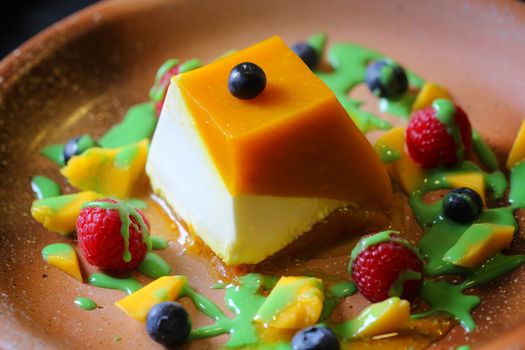
Photo: Shameel mukkath / Pexels
Chinese
Mango Pudding
The diets react (see scores below)
Common Ingredients
- mango
- gelatin
- sugar
- evaporated milk
- cream
- water
Specific recipes may vary.
Incompatible with 9 of 11 diets
Diet Ratings
Mango Pudding is fundamentally incompatible with a ketogenic diet. Mango is a high-sugar tropical fruit (~25g net carbs per 100g), and added sugar compounds the carbohydrate load dramatically. A typical serving of mango pudding could easily contain 30-50g of net carbs from mango and sugar alone, blowing the entire daily keto carb budget in a single snack. While gelatin, cream, and water are keto-friendly, they cannot offset the dominant carb sources. The evaporated milk also adds lactose-derived carbs. There is no realistic portion size that makes this dish compatible with ketosis.
This traditional Chinese Mango Pudding contains multiple animal-derived ingredients that disqualify it from a vegan diet. Gelatin is derived from animal collagen (typically pork or beef bones and connective tissue), evaporated milk is a dairy product, and cream is also dairy-derived. With three separate animal-product violations, this dish is firmly non-vegan. A vegan version could be made by substituting agar-agar or carrageenan for gelatin and using coconut milk or oat cream in place of the dairy components.
Mango Pudding contains multiple non-paleo ingredients that disqualify it. Sugar (refined) is explicitly excluded from the paleo diet. Evaporated milk and cream are dairy products, which are not permitted under paleo guidelines. While mango is paleo-approved and gelatin (from animal collagen) is generally accepted, the combination of refined sugar and dairy make this dish clearly non-compliant. There is no meaningful way to adapt the traditional recipe without replacing the majority of its core ingredients.
Mango Pudding is a dessert that conflicts with Mediterranean diet principles on multiple fronts. While mango itself is a fruit and would be welcomed, the dish is dominated by added sugar, heavy cream, and evaporated milk — all of which are either processed or high in saturated fat. The Mediterranean diet discourages added sugars and minimizes high-fat dairy, especially in the context of a sweetened, processed dessert format. Gelatin is a processed animal-derived ingredient with no role in traditional Mediterranean eating. This dish is essentially a sugar- and cream-laden confection with negligible fiber or whole-food benefit beyond the mango itself.
Mango Pudding is fundamentally incompatible with the carnivore diet. The primary ingredient is mango, a plant-derived fruit, which is strictly excluded. Sugar is added, further violating carnivore principles. While gelatin and cream are animal-derived ingredients, they are entirely overshadowed by the dominant plant-based and processed components. No version of the carnivore diet — from the broadest 'animal-based' approach to the strictest Lion Diet — would permit a fruit-and-sugar dessert like this.
Mango Pudding contains multiple Whole30-excluded ingredients. Sugar is explicitly prohibited as an added sweetener. Evaporated milk and cream are both dairy products, which are excluded from the Whole30 program (only ghee and clarified butter are permitted dairy exceptions). These violations make this dish clearly non-compliant regardless of the other ingredients.
Mango Pudding contains two significant FODMAP concerns that make it problematic during the elimination phase. First, mango is high in excess fructose and is rated high-FODMAP by Monash University at typical serving sizes (low-FODMAP only at a very small 40g/~1.4oz portion, well below what a standard dessert serving would contain). Second, evaporated milk is a concentrated dairy product high in lactose, which is a disaccharide FODMAP — a standard serving would exceed safe lactose thresholds. Cream is lower in lactose than milk and is generally considered low-FODMAP at small amounts (~2 tbsp), but the combination of high-fructose mango served in typical pudding portions alongside lactose-heavy evaporated milk makes this dish high-FODMAP overall. Gelatin, sugar, and water are FODMAP-free and pose no concern.
Monash University rates mango as low-FODMAP only at 40g, but a typical mango pudding serving contains substantially more — many FODMAP practitioners would flag this as avoid regardless of preparation. Some recipes substitute lactose-free evaporated milk, which would resolve the lactose issue but not the fructose concern from mango at standard serving sizes.
Mango Pudding contains mango, which is a DASH-friendly fruit rich in potassium, fiber, and vitamins. However, the dish also includes cream (high in saturated fat), evaporated milk (typically full-fat and calorie-dense), and added sugar — all of which conflict with core DASH principles that emphasize limiting saturated fat, full-fat dairy, and added sugars. The gelatin and water are neutral. The overall nutritional profile is significantly diluted from DASH ideals by the cream and sugar content, making this an occasional treat at best. Sodium content is low, which is a positive, but the saturated fat and added sugar burden keeps this in 'caution' territory rather than 'avoid,' since the mango base does provide some genuine DASH-compatible nutrition.
NIH DASH guidelines clearly limit full-fat dairy and added sugars, placing this dessert outside core recommendations. However, some updated clinical interpretations note that emerging research on full-fat dairy and cardiovascular outcomes is less clear-cut, and that a small portion of this dessert within an otherwise DASH-compliant diet is unlikely to be harmful — particularly given the beneficial mango content.
Mango Pudding is a problematic dish from a Zone Diet perspective across nearly every macro dimension. First, there is no meaningful protein source — gelatin provides minimal usable protein blocks and the dish is essentially categorized as 'none' for primary protein, making it impossible to construct a balanced 40/30/30 Zone snack without significant additions. Second, the carbohydrate profile is unfavorable: mango is a higher-sugar fruit that Zone methodology treats cautiously (it is borderline 'unfavorable' due to its glycemic load), and added sugar compounds this problem dramatically — refined sugar is one of the clearest 'avoid' items in Zone literature. Third, the fat sources are cream and evaporated milk, both saturated fat-heavy dairy products that Zone diet discourages in favor of monounsaturated fats. The overall macro ratio will be heavily skewed toward carbohydrates and saturated fat with virtually no lean protein, making this the antithesis of a Zone-balanced snack. While gelatin contributes trivially to protein, it lacks essential amino acids and does not count as a legitimate Zone protein block. The combination of added sugar, high-glycemic fruit, saturated fat, and absent lean protein means this dish cannot be reasonably incorporated into a Zone meal without a near-complete reformulation.
Mango pudding presents a mixed anti-inflammatory profile. On the positive side, mango is a colorful tropical fruit rich in antioxidants including beta-carotene, vitamin C, quercetin, and mangiferin — all compounds with documented anti-inflammatory properties. Gelatin itself is largely neutral. However, the dish is undermined by added sugar (a pro-inflammatory ingredient that raises blood glucose and can elevate inflammatory markers like CRP), cream (full-fat dairy, which is in the 'limit' category due to saturated fat content), and evaporated milk (concentrated dairy). The combination of added sugar and cream shifts this dessert from a fruit-forward anti-inflammatory snack toward a sugar- and saturated-fat-laden treat. It is not as egregious as a processed snack food — the mango provides real nutritional benefit — but the overall formula is not aligned with anti-inflammatory principles as written. Modifications such as reducing sugar, replacing cream with coconut milk or skipping heavy dairy, and using a smaller portion would improve the profile considerably.
Mango pudding is a poor fit for GLP-1 patients. It contains no meaningful protein, is high in added sugar, and derives most of its calories from cream and evaporated milk — both high in saturated fat. With slowed gastric emptying already a concern, the high fat content from cream increases the risk of nausea, bloating, and reflux. The added sugar provides empty calories with no fiber or protein to offset them. While mango itself offers some vitamin C and natural fiber, the quantity used in a pudding serving is insufficient to confer meaningful nutritional benefit. Every calorie on a GLP-1 diet needs to earn its place; this dessert fails on protein, fat quality, and sugar content simultaneously.
*See how scores were generated at our methodology page.
Nutritional profile
Six traits that cut across every diet.
Fiber & Plants
How much whole-plant food and fiber it delivers.
Healthy Fats
The quality of its fats (unsaturated, omega-3).
Whole / Unprocessed
How close it is to its natural, unprocessed form.
Gut Gentle
How easy it is on digestion (low FODMAP, few irritants).
Low Glycemic
How little it spikes your blood sugar.
Protein Density
How much protein it packs per calorie.
Controversy Index
Higher controversy = more disagreement between diets.
Diet-Specific Tips
 DASH — 4/10
View tips
- Mango provides potassium, fiber, and vitamins — DASH-positive
- Cream is high in saturated fat, conflicting with DASH limits on saturated fat
- Evaporated milk is typically full-fat, not aligned with DASH low-fat dairy guidance
- Added sugar conflicts with DASH recommendation to limit sweets
- Low sodium content is a positive attribute
- Small portions may be acceptable within an otherwise DASH-compliant diet
 Anti-Inflammatory — 4/10
View tips
- Mango provides antioxidants (beta-carotene, vitamin C, mangiferin, quercetin) with anti-inflammatory properties
- Added sugar is a primary pro-inflammatory concern — raises blood glucose and CRP
- Cream is full-fat dairy, categorized as 'limit' in anti-inflammatory frameworks due to saturated fat
- Evaporated milk adds further saturated fat and concentrated dairy
- Gelatin is nutritionally neutral
- Dessert context means relatively high sugar load per serving
- No omega-3s, herbs/spices, or other anti-inflammatory boosters present