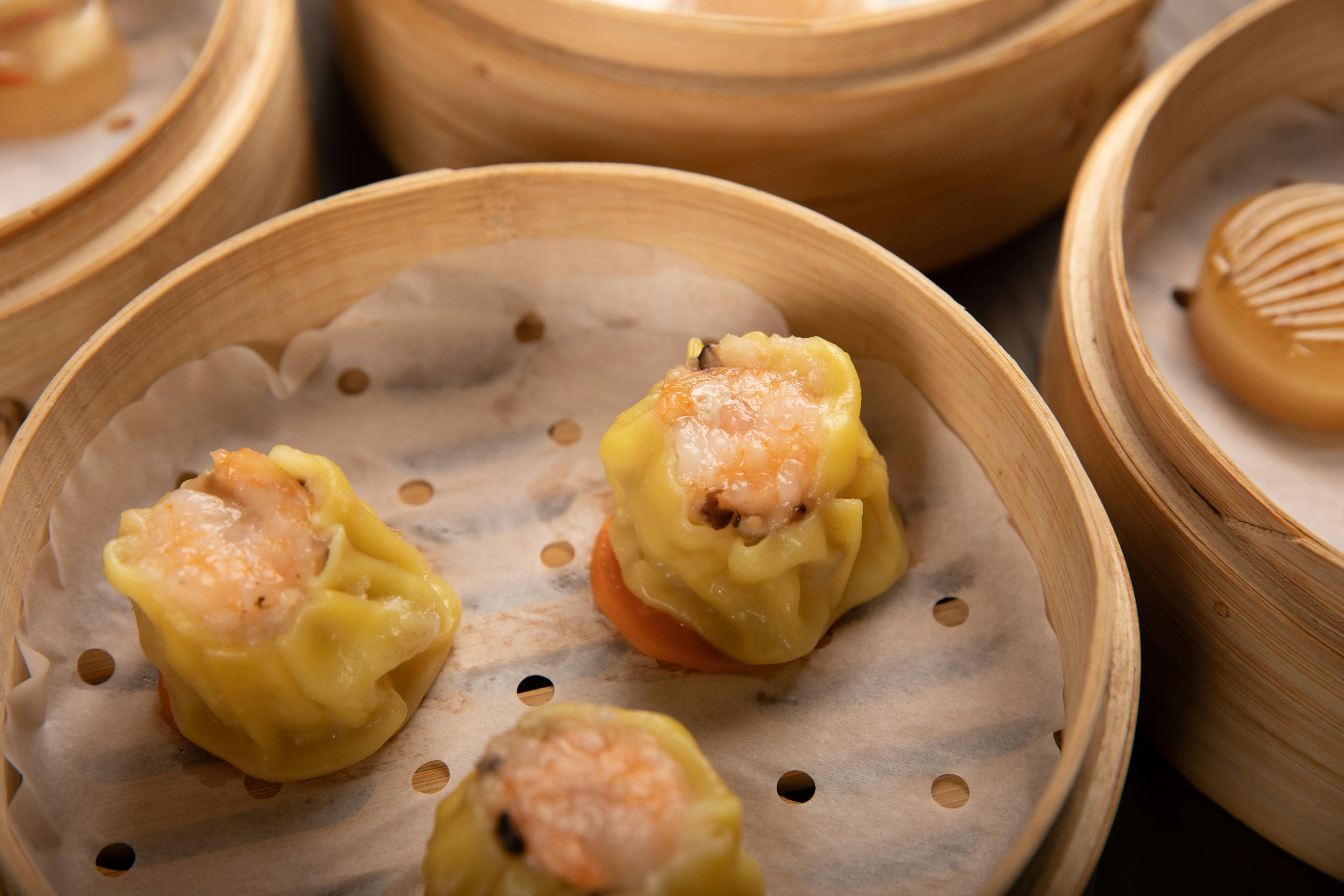
Photo: Change C.C / Pexels
The diets react (see scores below)
Common Ingredients
- pork
- shrimp
- wonton wrappers
- shiitake mushrooms
- sesame oil
- soy sauce
- oyster sauce
- ginger
- scallions
Specific recipes may vary.
Incompatible with 8 of 11 diets
Diet Ratings
Siu Mai is fundamentally incompatible with a ketogenic diet due to the wonton wrappers, which are made from wheat flour — a grain-based, high-carb ingredient. Each dumpling wrapper contributes roughly 3-5g of net carbs, and a standard serving of 4-6 pieces can easily deliver 15-30g of net carbs from the wrappers alone, before accounting for oyster sauce (which contains added sugar and starch). The pork and shrimp filling is inherently keto-friendly, but the dish as traditionally prepared cannot be consumed without busting daily carb limits. There is no meaningful portion size that makes traditional Siu Mai keto-compatible.
Siu Mai contains multiple animal products that are strictly excluded from a vegan diet. Pork is a direct animal meat, shrimp is seafood, and oyster sauce is derived from oysters — all clear animal-derived ingredients. There is no ambiguity here; this dish is fundamentally incompatible with veganism in its traditional form.
Siu Mai contains multiple non-paleo ingredients that disqualify it outright. Wonton wrappers are made from wheat flour, a grain explicitly excluded from the paleo diet. Soy sauce contains both wheat and soy (a legume), making it doubly non-compliant. Oyster sauce is a processed condiment typically containing sugar, modified starch, and additives. Sesame oil is a seed oil, which is excluded in favor of paleo-approved fats. While the core proteins (pork and shrimp) and aromatics (ginger, scallions, shiitake mushrooms) are individually paleo-friendly, the structural and flavoring components of this dish fundamentally violate paleo principles. There is no meaningful way to consider traditional Siu Mai paleo-compatible without reconstructing it entirely.
Siu Mai is a Chinese dim sum dumpling that conflicts with Mediterranean diet principles on multiple fronts. The primary protein is pork, which is red meat and should be limited to only a few times per month. The wonton wrappers are made from refined white flour, a refined grain that the Mediterranean diet discourages. The dish also relies on sesame oil rather than extra virgin olive oil as the fat source, and uses processed condiments like oyster sauce and soy sauce, which are high in sodium and additives. While shrimp and shiitake mushrooms are Mediterranean-friendly ingredients, and ginger and scallions are beneficial aromatics, the overall profile — refined grain wrapper, red meat base, non-olive oil fat, and processed sauces — makes this a poor fit for the Mediterranean dietary pattern.
Siu Mai is fundamentally incompatible with the carnivore diet. While it does contain animal proteins (pork and shrimp), the dish is loaded with multiple excluded ingredients: wonton wrappers are grain-based (wheat flour), shiitake mushrooms are fungi/plant kingdom, sesame oil is a plant-derived oil, soy sauce contains wheat and soy (both grains/legumes), oyster sauce typically contains sugar and starch thickeners, ginger is a plant root, and scallions are vegetables. The majority of the ingredient list consists of plant-derived or processed plant-containing components. This is not a carnivore-compatible dish in any tier of the diet — not even the more lenient 'animal-based' approach would sanction grain wrappers, soy sauce, and plant oils together.
Siu Mai contains multiple excluded ingredients that make it clearly non-compliant with Whole30. Wonton wrappers are made from wheat flour, a grain that is explicitly excluded. Soy sauce contains soy (a legume) and wheat (a grain), both excluded. Oyster sauce typically contains added sugar and sometimes wheat starch. These are not edge cases — grains and soy are core exclusions on the Whole30 program, and this dish cannot be made in its traditional form without them.
Siu Mai contains multiple high-FODMAP ingredients that make it unsuitable during the elimination phase. Shiitake mushrooms are high in polyols (mannitol) and are a clear avoid on the Monash app. Wonton wrappers are made from wheat flour, which is high in fructans — a major FODMAP trigger. Scallions (spring onions) contain fructans in the white/bulb portions, which are typically used in this dish. Oyster sauce often contains garlic and/or wheat, adding further fructan load. The combination of wheat-based wrappers, shiitake mushrooms, and scallion bulbs makes this dish high-FODMAP at any standard serving size.
Siu Mai contains multiple high-sodium ingredients that conflict directly with DASH diet principles. Soy sauce and oyster sauce are among the highest-sodium condiments used in cooking, with just one tablespoon of soy sauce containing approximately 900-1,000mg sodium — nearly half the standard DASH daily limit. Combined with the naturally moderate sodium content of shrimp and pork, this dish almost certainly exceeds DASH sodium thresholds in a typical serving. Additionally, pork is a red meat that DASH explicitly limits, and the dish contains saturated fat from the pork. While some ingredients are DASH-friendly (shrimp as lean protein, shiitake mushrooms, ginger, scallions), the overall sodium load from the sauce combination makes this incompatible with DASH guidelines. A low-sodium version using reduced-sodium soy sauce sparingly could improve the score to the 'caution' range, but the standard preparation as commonly consumed warrants an 'avoid' rating.
Siu Mai presents a mixed Zone Diet profile. The protein sources (pork and shrimp) provide solid lean-to-moderate protein, though pork is not as lean as skinless chicken or fish and carries more saturated fat. Shrimp is an excellent Zone protein. The wonton wrappers are refined wheat flour — a moderately high-glycemic carbohydrate that Zone methodology classifies as 'unfavorable,' though they are used in relatively small quantities per dumpling. Shiitake mushrooms are favorable low-glycemic carbs with polyphenol benefits. Sesame oil contains both mono- and polyunsaturated fats but is omega-6 heavy, which conflicts with Zone's anti-inflammatory emphasis. Soy sauce and oyster sauce add sodium and minor high-glycemic sugars. Ginger and scallions are Zone-favorable polyphenol-rich additions. In practical terms, a small portion (3-4 pieces as a snack) could fit into a Zone meal if paired with additional lean protein and low-GI vegetables to balance the ratio, but the refined wrappers and fatty pork make this a food requiring careful portioning rather than a Zone staple. The macronutrient ratio skews toward carbs and fat relative to protein, making it difficult to hit the 40/30/30 target without adjustments.
Some Zone practitioners note that the wonton wrappers per dumpling are quite thin and small (~3-4g carbs each), making the glycemic load per piece relatively modest. In Sears' later writings emphasizing polyphenols and omega-3 balance, the ginger and mushroom content are positives. A strict early Zone reading (Enter the Zone) would penalize the refined flour wrappers and pork fat more heavily, while later Zone 2.0 thinking might be more permissive if portions are tightly controlled.
Siu Mai presents a mixed anti-inflammatory profile. On the positive side, shiitake mushrooms are explicitly emphasized in anti-inflammatory frameworks for their beta-glucans and immune-modulating properties. Ginger is a well-established anti-inflammatory spice. Shrimp provides lean protein with some omega-3s. Scallions contribute quercetin and other flavonoids. Sesame oil, used in small amounts as a flavoring, contains sesamin and sesamol with modest antioxidant activity. On the cautionary side, pork is a red meat — not the worst offender but categorized under 'limit' in anti-inflammatory frameworks due to saturated fat content and arachidonic acid. Wonton wrappers are refined-carbohydrate wheat wrappers with minimal fiber. Soy sauce and oyster sauce contribute significant sodium, which while not directly inflammatory, is a practical health concern; both are also processed condiments. Sesame oil in larger cooking amounts has moderate omega-6 content. Overall, this is a moderately portioned snack (dim sum serving) where the pro-inflammatory signals — red meat base, refined wrappers, processed sauces — are partially offset by genuinely beneficial ingredients like shiitake, ginger, and shrimp. As an occasional snack in moderate portions, it sits in the middle ground rather than being clearly problematic or beneficial.
Some anti-inflammatory practitioners (aligned with Dr. Weil's broader framework) would rate this more favorably given the prominent shiitake mushrooms and ginger, and the relatively small portion size typical of dim sum service — arguing the anti-inflammatory ingredients meaningfully offset the pork. Stricter protocols, particularly those targeting autoimmune conditions or emphasizing red meat elimination (e.g., AIP-adjacent frameworks), would rate this lower due to the pork, refined wrappers, and high-sodium processed sauces.
Siu mai offers a moderate protein contribution from pork and shrimp, but the pork component introduces meaningful saturated fat that conflicts with GLP-1 dietary priorities. A typical serving of 3-4 pieces (roughly 90-120g) delivers approximately 12-16g of protein — useful but not high-density per calorie. The fat content is moderate to moderately high depending on the pork-to-shrimp ratio and how lean the pork is; ground pork belly, which is traditional, is significantly fattier than lean ground pork shoulder. Sesame oil and oyster sauce add small amounts of fat and sodium respectively, and high sodium can be a concern for some GLP-1 patients managing blood pressure alongside weight loss. The wonton wrappers are refined carbohydrates with minimal fiber, and the overall dish is low in fiber. On the positive side, siu mai is steamed — not fried — which significantly reduces fat compared to other dim sum items and supports digestibility. Shiitake mushrooms, ginger, and scallions contribute micronutrients and anti-inflammatory compounds in small amounts. Portion size is naturally small, which aligns with GLP-1 eating patterns. Overall this is an acceptable occasional protein source in a GLP-1 diet if made with lean pork or a heavier shrimp ratio, but it is not a high-priority food due to saturated fat content, low fiber, and refined wrapper carbohydrates.
Some GLP-1-focused dietitians would rate steamed siu mai more favorably, noting that the steaming method, built-in portion control, and dual pork-shrimp protein make it a practical real-world protein vehicle for patients navigating social eating situations. Others would rate it lower, emphasizing that traditional pork fat content and near-zero fiber make it a poor calorie investment when appetite is already suppressed.
*See how scores were generated at our methodology page.
Nutritional profile
Six traits that cut across every diet.
Fiber & Plants
How much whole-plant food and fiber it delivers.
Healthy Fats
The quality of its fats (unsaturated, omega-3).
Whole / Unprocessed
How close it is to its natural, unprocessed form.
Gut Gentle
How easy it is on digestion (low FODMAP, few irritants).
Low Glycemic
How little it spikes your blood sugar.
Protein Density
How much protein it packs per calorie.
Controversy Index
Higher controversy = more disagreement between diets.
Diet-Specific Tips
 Zone — 5/10
View tips
- Wonton wrappers are refined high-glycemic carbohydrates, classified as 'unfavorable' in Zone
- Pork carries moderate saturated fat, less ideal than chicken or fish but usable in controlled portions
- Shrimp is an excellent lean Zone protein source
- Shiitake mushrooms are Zone-favorable low-glycemic carbs with polyphenol benefits
- Sesame oil is omega-6 heavy, conflicting with Zone's anti-inflammatory focus
- Small per-piece carb load from thin wrappers makes moderate portions manageable
- Macro ratio skews away from ideal 40/30/30 without careful portioning
- Ginger and scallions add Zone-favorable polyphenols
 Anti-Inflammatory — 5/10
View tips
- Pork as primary protein adds saturated fat and arachidonic acid — categorized as 'limit' in anti-inflammatory diets
- Shiitake mushrooms are explicitly anti-inflammatory — emphasized in Dr. Weil's pyramid for immune-modulating beta-glucans
- Ginger is a well-established anti-inflammatory spice with COX-inhibiting gingerols
- Shrimp provides lean protein with modest omega-3 content
- Wonton wrappers are refined carbohydrates with minimal fiber — neutral to mildly pro-inflammatory
- Soy sauce and oyster sauce are processed, high-sodium condiments — not anti-inflammatory but not a primary concern in small amounts
- Small dim sum portion size limits overall inflammatory exposure
 GLP-1 Friendly — 5/10
View tips
- Steamed preparation is a meaningful advantage over fried dim sum — easier to digest and lower in fat
- Pork introduces saturated fat; rating improves significantly if lean pork shoulder or a higher shrimp ratio is used
- Moderate protein per serving (~12-16g for 3-4 pieces) — useful but not high-density
- Wonton wrappers are refined carbohydrates with negligible fiber
- Naturally small portion size aligns with GLP-1 reduced appetite
- Moderate to high sodium from soy sauce and oyster sauce — worth monitoring
- Shiitake mushrooms add modest micronutrient value but minimal fiber contribution
- Low fiber overall — does not support GLP-1 constipation prevention