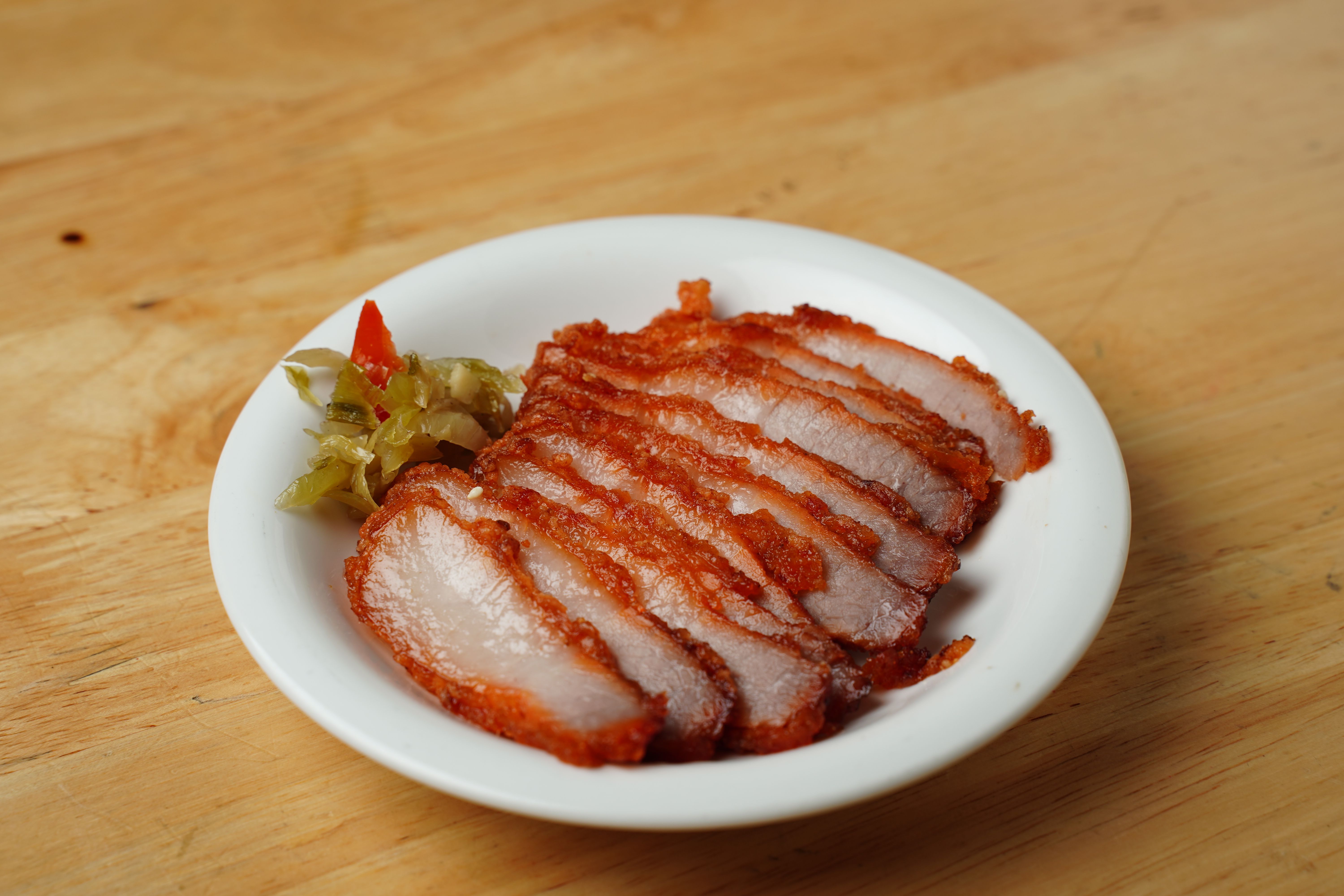
Photo: Kai-Chieh Chan / Pexels
The diets react (see scores below)
Common Ingredients
- pork belly
- salt
- five spice
- shaoxing wine
- white pepper
- sugar
- rice vinegar
Specific recipes may vary.
Incompatible with 8 of 11 diets
Diet Ratings
Siu Yuk (Chinese roast pork belly) is fundamentally keto-friendly — pork belly is one of the highest-fat cuts available, with excellent macros. However, the marinade contains sugar and Shaoxing wine, both of which contribute carbohydrates. The sugar is used in the marinade/rub and some is lost during the high-heat roasting process, but a meaningful amount remains in the crust. Shaoxing wine contains residual sugars and carbs (~5g carbs per 2 tbsp). Rice vinegar adds minimal carbs. The net carb impact per serving depends heavily on how much marinade is applied and retained, but it is unlikely to be zero. A typical restaurant portion may contain 2-5g net carbs, which is manageable within keto limits if monitored. The crispy skin (crackling) itself is pure fat and protein with no carbs. Home preparation with sugar substitutes and dry sherry or omitting Shaoxing wine would make this fully keto-approved.
Strict keto practitioners argue that any added sugar — even in small marinade quantities — should be avoided, and that Shaoxing wine introduces both sugar and alcohol-derived carbs that can disrupt ketosis in sensitive individuals. They recommend a modified version with erythritol and dry white wine or full omission.
Siu Yuk is Cantonese crispy roasted pork belly. The primary and defining ingredient is pork belly, which is an animal product (pig meat). This is unambiguously incompatible with a vegan diet under any interpretation of veganism. The remaining ingredients (salt, five spice, shaoxing wine, white pepper, sugar, rice vinegar) are plant-derived or mineral, but the dish is fundamentally built around pork and cannot be considered vegan in any form.
Siu Yuk (Chinese roast pork belly) contains several non-paleo ingredients that disqualify it despite the pork belly itself being paleo-approved. Salt is explicitly excluded under paleo rules as an added mineral not consistent with a hunter-gatherer diet. Sugar is a refined sweetener, also excluded. Shaoxing wine is a grain-based rice wine (fermented from rice), placing it in the grain-derived category. Five spice powder, while mostly spice-based, is often commercially blended with added salt and fillers. White pepper is technically paleo, and rice vinegar — derived from rice fermentation — is another grain-derived product excluded under strict paleo. The combination of added salt, refined sugar, and grain-derived alcohol and vinegar makes this dish clearly non-compliant.
Siu Yuk (Chinese roast pork belly) directly contradicts core Mediterranean diet principles. Pork belly is an extremely fatty cut of red meat, high in saturated fat, and the Mediterranean diet strictly limits red meat to a few times per month. The dish uses no olive oil, no vegetables, no legumes, and no whole grains — none of the plant-forward staples central to the diet. The inclusion of sugar and refined rice vinegar adds minimal concern but the foundational issue is the protein source and fat profile. This is not a Mediterranean food by tradition or composition.
Siu Yuk (Chinese roast pork belly) is built on a pork belly base, which would otherwise be carnivore-approved as a fatty cut. However, the marinade and seasoning include multiple plant-derived and non-carnivore ingredients: five spice (a blend of star anise, cloves, cinnamon, Sichuan pepper, fennel — all plant spices), shaoxing wine (fermented grain alcohol), white pepper (plant-derived spice), sugar (plant-derived sweetener), and rice vinegar (fermented grain product). These additives disqualify the dish from carnivore compliance. The only acceptable component is the pork belly itself with salt. As a prepared dish with this ingredient profile, it must be avoided.
Siu Yuk contains two excluded ingredients: sugar (an added sugar, explicitly banned on Whole30) and Shaoxing wine (an alcohol, explicitly banned on Whole30). Rice vinegar is compliant per the 2024 Whole30 rules, and salt, five spice, and white pepper are all allowed spices. However, the presence of both sugar and Shaoxing wine makes this dish non-compliant as traditionally prepared. There is no workaround that preserves the authentic character of the dish — Shaoxing wine is a defining ingredient and sugar is used in the marinade/rub. Omitting both would fundamentally alter the recipe.
Siu Yuk (Cantonese roast pork belly) is largely low-FODMAP in its traditional form. Pork belly is a plain protein/fat with no FODMAPs. Salt, white pepper, and rice vinegar are low-FODMAP. Sugar is low-FODMAP in typical small quantities used as a seasoning. Shaoxing rice wine is used in small amounts as a marinade and most of the alcohol evaporates during roasting; Monash has not specifically tested it, but in the small quantities typical of this dish (~1-2 tsp per serving equivalent) it is generally considered low-FODMAP. The main concern is five spice powder, which typically contains star anise, cloves, Chinese cinnamon, Sichuan pepper, and fennel seeds — Monash rates fennel seeds and most spices in small culinary amounts as low-FODMAP, and five spice is used in teaspoon-level quantities spread across an entire roast, making per-serving amounts minimal. No high-FODMAP ingredients like garlic, onion, or wheat are present in the traditional recipe listed. At a standard serving of ~150g pork belly, this dish is likely low-FODMAP.
Monash University has not specifically tested five spice powder as a blend, and some clinical FODMAP practitioners advise caution with spice blends during strict elimination due to potential cumulative FODMAP load or undisclosed ingredients. Additionally, commercial or restaurant versions of Siu Yuk may include garlic in the marinade, which would make the dish high-FODMAP.
Siu Yuk (Chinese roasted pork belly) is fundamentally incompatible with DASH diet principles. Pork belly is one of the fattiest cuts of meat available, extremely high in saturated fat and total fat — directly contradicting DASH's explicit guidance to limit saturated fat, total fat, and red/fatty meats. The skin, which is a defining feature of the dish, adds additional saturated fat and calories. Salt is applied liberally as a primary curing and flavoring agent, contributing substantial sodium that conflicts with both standard DASH (<2,300mg/day) and low-sodium DASH (<1,500mg/day) targets. The NIH/NHLBI DASH guidelines explicitly discourage full-fat, high-saturated-fat meats and high-sodium preparations. This dish hits multiple DASH 'avoid' criteria simultaneously: fatty red meat, high sodium, and high saturated fat content.
Siu Yuk (Chinese roasted pork belly) presents a significant challenge for Zone compliance primarily due to its fat profile. Pork belly is one of the fattiest cuts available, with roughly a 1:1 ratio of fat to protein by weight, and a substantial portion of that fat is saturated. A typical 3-4 oz serving could easily deliver 25-30g of fat (well above the Zone's 10-15g per meal target) alongside the desired ~25g protein. The sugar and rice vinegar in the marinade contribute minimal carbohydrate impact in the quantities used. Five spice and Shaoxing wine are Zone-neutral in small amounts. The core problem is that pork belly cannot be portioned down enough to hit Zone fat targets without also sacrificing the protein block requirement — you'd need to eat so little that the meal becomes impractical. That said, the Zone is ratio-based, not exclusionary: a very small portion (1-2 oz) of Siu Yuk could theoretically serve as a partial protein block within a larger meal built around lean proteins, low-GI vegetables, and minimal additional fat. The dish is not 'avoid' because it contains real protein and no refined starches, but it requires careful restriction to fit Zone parameters.
Some later Zone practitioners and Sears' anti-inflammatory framework acknowledge that not all saturated fat is equally problematic, and that whole-food pork in controlled portions is preferable to processed meats. In this view, a small serving of Siu Yuk alongside a large vegetable base and omega-3 sources could be considered acceptable within a broader anti-inflammatory Zone meal structure — pushing the score closer to 5-6. However, the classic Enter the Zone framework clearly categorizes high-fat red meat cuts as 'unfavorable' proteins, keeping this in caution territory.
Siu Yuk (Cantonese roast pork belly) is dominated by pork belly, one of the fattiest cuts of pork, with very high saturated fat content from both the thick fat cap and crispy skin. Saturated fat from full-fat animal products is consistently flagged as pro-inflammatory in anti-inflammatory nutrition frameworks. Pork belly also contains arachidonic acid, a precursor to pro-inflammatory eicosanoids. The roasting method renders the fat but does not reduce the overall saturated fat load, and the crispy skin represents concentrated animal fat. The remaining ingredients (five spice, white pepper, shaoxing wine, rice vinegar, salt, sugar) are largely neutral to mildly positive — five spice contains star anise and cloves which have antioxidant properties, and rice vinegar is benign — but these minor contributors cannot offset the dominant pro-inflammatory profile of pork belly as the primary ingredient in substantial quantity. The small amount of added sugar is a minor additional concern. This dish is categorically different from lean pork tenderloin or loin, which would rate more neutrally. Occasional consumption is not catastrophic, but as a regular main dish it is clearly inconsistent with anti-inflammatory principles.
Siu Yuk (Chinese roast pork belly) is a poor fit for GLP-1 patients. Pork belly is one of the fattiest cuts available, with a typical serving (100g) delivering roughly 35-40g of fat, much of it saturated, alongside only 15-18g of protein. The signature crispy skin is essentially rendered fat and salt. High fat content directly worsens the GLP-1 side effect profile: nausea, bloating, reflux, and prolonged gastric discomfort are all amplified because slowed gastric emptying means a high-fat meal sits in the stomach far longer than it would otherwise. The dish offers negligible fiber, and the calorie density is very high relative to protein yield — the opposite of what GLP-1 patients need. The seasoning profile (five spice, white pepper, rice vinegar, Shaoxing wine) is mild enough not to be independently problematic, but it does not offset the core issue, which is the fat content of the primary ingredient.
*See how scores were generated at our methodology page.
Nutritional profile
Six traits that cut across every diet.
Fiber & Plants
How much whole-plant food and fiber it delivers.
Healthy Fats
The quality of its fats (unsaturated, omega-3).
Whole / Unprocessed
How close it is to its natural, unprocessed form.
Gut Gentle
How easy it is on digestion (low FODMAP, few irritants).
Low Glycemic
How little it spikes your blood sugar.
Protein Density
How much protein it packs per calorie.
Controversy Index
Higher controversy = more disagreement between diets.
Diet-Specific Tips
 Keto — 6/10
View tips
- Pork belly is extremely high-fat and keto-ideal as a base protein
- Sugar in the marinade adds net carbs, partially burned off during roasting
- Shaoxing wine contributes residual sugars and carbohydrates
- Rice vinegar adds negligible carbs
- Net carbs per serving estimated 2-5g — manageable but not negligible
- Crackling/skin is pure fat and protein, zero carbs
- Home preparation can substitute sugar with erythritol for full keto compliance
 Low-FODMAP — 6/10
View tips
- Pork belly is FODMAP-free as a plain protein and fat source
- Five spice powder used in small culinary quantities is generally low-FODMAP per individual components
- Shaoxing wine used in small marinade amounts is unlikely to contribute significant FODMAPs
- No garlic or onion in the listed recipe — common high-FODMAP additions in restaurant versions
- Rice vinegar, salt, sugar, and white pepper are all low-FODMAP at culinary serving sizes
- Commercial or restaurant preparations may differ from the listed ingredient profile
 Zone — 4/10
View tips
- Pork belly is extremely high in fat — both total fat and saturated fat — far exceeding Zone fat block targets per serving
- Fat-to-protein ratio in pork belly is unfavorable; you cannot hit protein targets without also consuming excess fat
- Saturated fat content conflicts with Zone's preference for monounsaturated fats and anti-inflammatory eating
- Sugar and Shaoxing wine in marinade add negligible glycemic load in typical cooking quantities
- No low-GI carbohydrates or monounsaturated fats present — dish contributes nothing to Zone's preferred macro sources
- Could be used as a very small partial protein block in a carefully constructed Zone meal, but impractical as a primary protein source
- As a standalone main dish, it is structurally incompatible with a Zone-balanced plate without significant lean protein supplementation