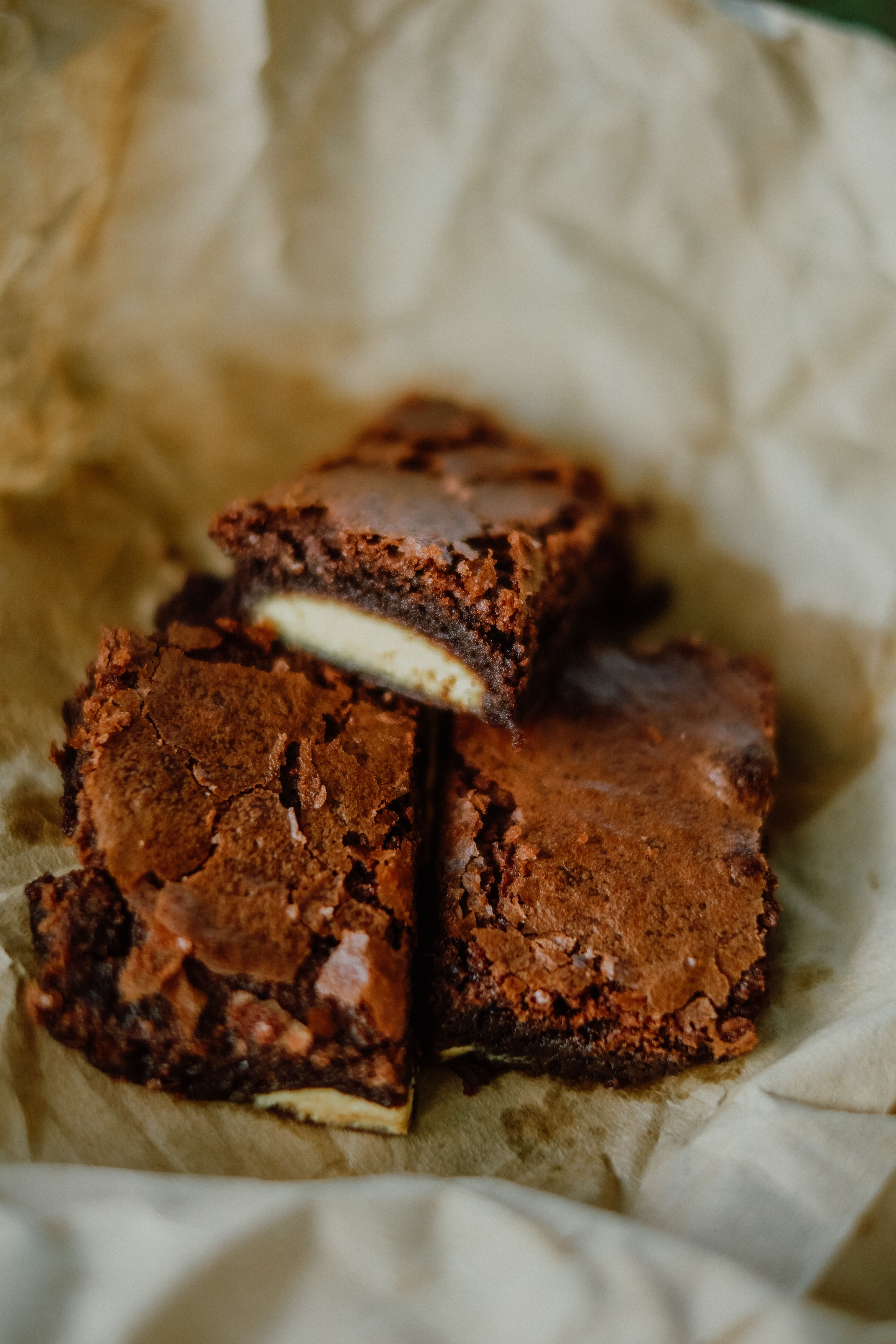
Photo: Gülşah Aydoğan / Pexels
American
Cheesecake Brownie
The diets react (see scores below)
Common Ingredients
- cream cheese
- butter
- chocolate
- sugar
- eggs
- flour
- cocoa powder
- vanilla extract
- salt
Specific recipes may vary.
Incompatible with 11 of 11 diets
Diet Ratings
Cheesecake Brownie contains two major keto-incompatible ingredients: sugar and flour. Sugar is a direct carbohydrate that spikes blood glucose and breaks ketosis, while wheat flour is a high-glycemic grain-based product. A standard serving of a cheesecake brownie would contain well over 30-40g of net carbs from these ingredients alone, far exceeding a single-serving's allowance on a ketogenic diet. While some ingredients like cream cheese, butter, eggs, and cocoa powder are individually keto-friendly, the combination of refined sugar and flour makes this dish fundamentally incompatible with ketogenic eating in its traditional form. No portion size adjustment can make this dish keto-safe without replacing the core problematic ingredients entirely.
Cheesecake Brownie contains multiple animal-derived ingredients that are categorically non-vegan. Cream cheese is a dairy product, butter is an animal fat derived from milk, and eggs are an animal product. These three ingredients alone make this dish entirely incompatible with a vegan diet under any interpretation. There is no meaningful debate within the vegan community about any of these ingredients.
Cheesecake Brownie is incompatible with the Paleo diet. The dish contains multiple non-Paleo ingredients: cream cheese (dairy), flour (grain), sugar (refined), and salt (added). Butter is also a dairy product discouraged in strict Paleo. While eggs, vanilla extract, and cocoa powder have some Paleo standing, the foundation of this dessert — grain-based flour, refined sugar, and dairy — firmly places it in the avoid category. There is no meaningful way to reconcile this dish with Paleo principles without completely reconstructing it.
Cheesecake Brownie is a highly processed American dessert that conflicts with nearly every core principle of the Mediterranean diet. It is built around butter (not olive oil), refined white flour, and large amounts of added sugar — three elements the Mediterranean diet explicitly minimizes. Cream cheese is a high-fat processed dairy product far removed from the fermented, moderate dairy (yogurt, small amounts of cheese) occasionally included in Mediterranean eating. Chocolate and cocoa powder in their whole forms have some antioxidant merit, but here they serve as vehicles for sugar and saturated fat. There are no vegetables, legumes, whole grains, or plant-forward elements present. This is an indulgent, nutrient-poor snack that would be categorized as an occasional treat at best, entirely inconsistent with Mediterranean dietary patterns.
Cheesecake Brownie is fundamentally incompatible with the carnivore diet. While it contains a few animal-derived ingredients (cream cheese, butter, eggs), the dish is overwhelmingly plant-based and processed: flour (grain), sugar, chocolate, cocoa powder, and vanilla extract are all plant-derived and explicitly excluded. Sugar alone is a disqualifying ingredient under any tier of carnivore eating. This is a classic baked dessert with no meaningful carnivore application — not even a 'dirty carnivore' edge case.
Cheesecake Brownies are excluded on multiple grounds. First, cream cheese and butter are dairy products, both explicitly excluded on Whole30 (only ghee/clarified butter is permitted). Second, sugar is an added sweetener, which is explicitly banned. Third, flour makes this a grain-containing food (wheat). Fourth, even if all ingredients were somehow made compliant, brownies fall squarely into the 'no recreating baked goods/junk food' rule — brownies are explicitly listed as a prohibited food form under Whole30 guidelines. This dish fails on at least four independent grounds.
This Cheesecake Brownie contains two significant high-FODMAP ingredients that make it unsuitable during the elimination phase. First, wheat flour is high in fructans, a key FODMAP that must be avoided. Second, cream cheese contains lactose — while hard/aged cheeses are low-FODMAP, cream cheese is a soft, fresh cheese with significant lactose content and is rated high-FODMAP by Monash at typical serving sizes. Together, these two ingredients alone disqualify this dish during elimination. The remaining ingredients (butter, chocolate in small amounts, sugar, eggs, cocoa powder, vanilla extract, salt) are generally low-FODMAP at standard servings, but they cannot offset the fructan load from flour and lactose from cream cheese.
Cheesecake Brownie is fundamentally incompatible with the DASH diet. It is a high-calorie, high-saturated-fat dessert made primarily from full-fat cream cheese, butter, and chocolate — all sources of significant saturated fat that DASH explicitly limits. The large amounts of added sugar violate DASH guidelines on sweets and contribute to poor cardiovascular outcomes. Butter is a saturated fat that DASH recommends minimizing, and full-fat cream cheese is not a low-fat dairy product as required by DASH. The combination of saturated fat, added sugar, refined flour, and caloric density places this firmly in the 'avoid' category with no meaningful offsetting DASH-friendly nutrients.
Cheesecake Brownie is a highly problematic food from a Zone Diet perspective. The macro profile is nearly the inverse of the 40/30/30 Zone target: it is dominated by high-glycemic refined carbohydrates (white flour, sugar) and saturated fat (butter, cream cheese), with negligible lean protein. Sugar and white flour are among the highest-glycemic ingredients possible, causing the rapid insulin spike that Zone Diet is specifically designed to prevent. The fat content is primarily saturated (butter, cream cheese) rather than the monounsaturated fats (olive oil, avocado, almonds) that Zone favors. Protein content from cream cheese and eggs is modest but insufficient relative to the caloric load of fat and carbohydrates, making it essentially impossible to balance this into a Zone block structure without consuming a nutritionally trivial portion. Even a small serving would deliver a large glycemic load with almost no favorable Zone nutrients. This is not a food that can be meaningfully incorporated into Zone eating — it is the archetype of what Zone seeks to eliminate.
Cheesecake brownies are a concentrated source of pro-inflammatory ingredients. Butter and cream cheese are high-fat dairy products loaded with saturated fat, which is explicitly limited on anti-inflammatory diets. Refined white sugar and white flour represent the refined carbohydrates that drive glycemic spikes and upregulate inflammatory cytokines like IL-6 and TNF-alpha. While the dish contains cocoa powder and chocolate, which carry some flavanols and antioxidants, these benefits are marginal and overwhelmed by the inflammatory load of the saturated fat, sugar, and refined carbohydrates present in large quantities. This dish has virtually no omega-3s, fiber, polyphenols, or other anti-inflammatory compounds in meaningful amounts. It is a classic indulgence food that sits squarely in the 'avoid' category for anyone following an anti-inflammatory dietary framework.
Cheesecake brownies are a high-calorie, high-fat, high-sugar dessert that is poorly suited for GLP-1 patients on nearly every relevant criterion. The primary ingredients — cream cheese, butter, and chocolate — are all high in saturated fat, which worsens GLP-1 side effects including nausea, bloating, and reflux. Sugar is the dominant caloric driver alongside fat, delivering empty calories with no fiber and negligible protein relative to calorie load. The flour base provides refined carbohydrates with minimal nutritional value. Eggs contribute some protein, but the overall protein density per calorie is very low. The combination of high fat and high sugar in a dense, rich format is one of the worst profiles for patients experiencing slowed gastric emptying — this food will sit heavily in the stomach and is likely to trigger or worsen GI discomfort. Nutrient density per calorie is extremely poor, which is a critical failure given that GLP-1 patients eat significantly less and cannot afford empty calories. Even a small portion provides limited nutritional return.
*See how scores were generated at our methodology page.
Nutritional profile
Six traits that cut across every diet.
Fiber & Plants
How much whole-plant food and fiber it delivers.
Healthy Fats
The quality of its fats (unsaturated, omega-3).
Whole / Unprocessed
How close it is to its natural, unprocessed form.
Gut Gentle
How easy it is on digestion (low FODMAP, few irritants).
Low Glycemic
How little it spikes your blood sugar.
Protein Density
How much protein it packs per calorie.
Controversy Index
Higher controversy = more disagreement between diets.