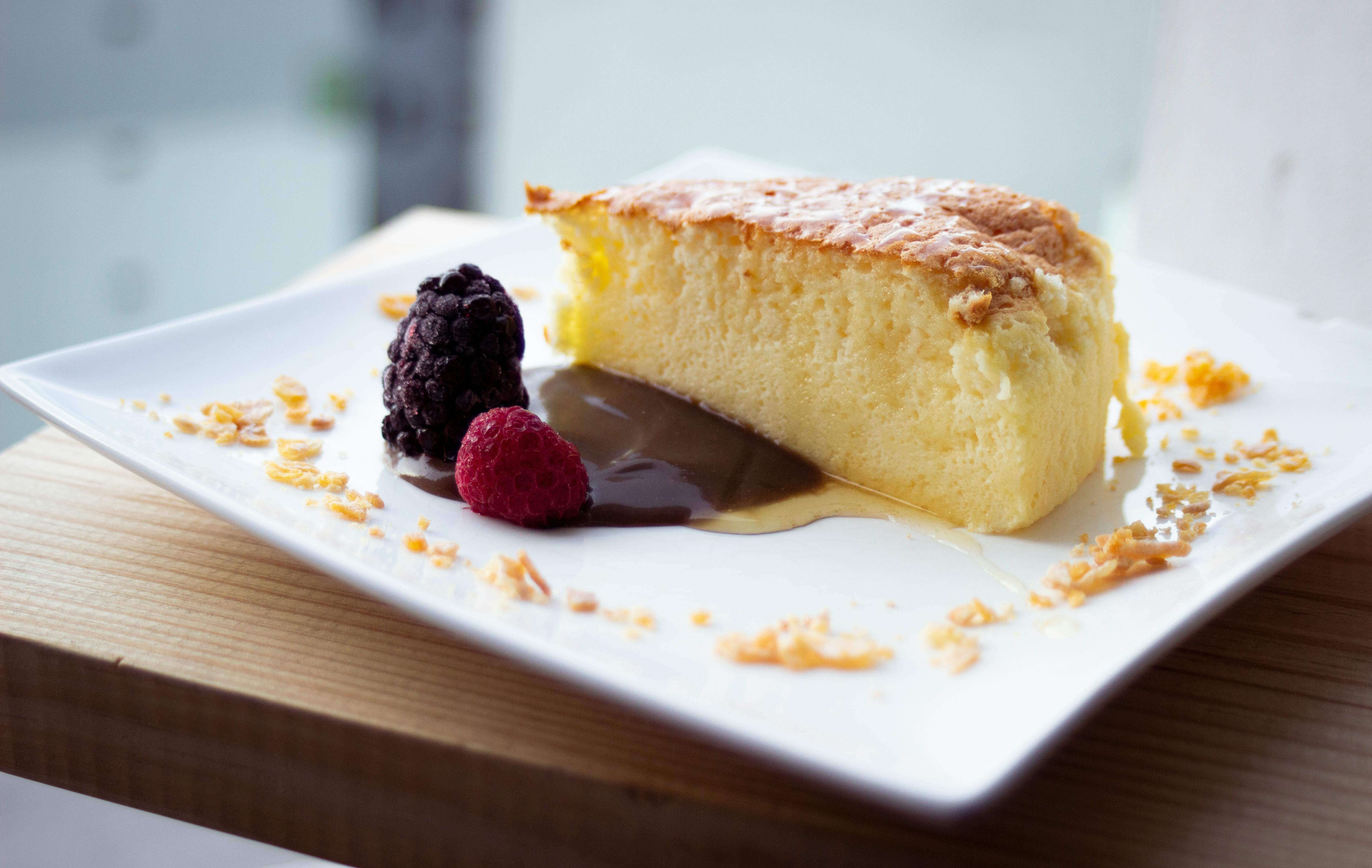
Photo: Wendy Laplume / Pexels
Japanese
Cheesecake Japonesa
The diets react (see scores below)
Common Ingredients
- cream cheese
- eggs
- sugar
- butter
- flour
- cornstarch
- milk
- lemon juice
Specific recipes may vary.
Incompatible with 11 of 11 diets
Diet Ratings
Japanese cheesecake (also known as Japanese cotton cheesecake or soufflé cheesecake) is fundamentally incompatible with ketogenic dietary guidelines. Despite containing keto-friendly base ingredients like cream cheese, eggs, and butter, it is structurally dependent on three major keto-incompatible ingredients: sugar (added sweetener), wheat flour (grain-based carbohydrate), and cornstarch (a high-glycemic starch used for its signature fluffy texture). These ingredients collectively contribute a substantial carbohydrate load — likely 25-40g+ net carbs per serving — far exceeding the daily keto threshold on their own. There is no meaningful portion size that would make this dish keto-compatible without fundamentally reformulating it into an entirely different recipe.
Japanese cheesecake contains multiple animal-derived ingredients that are explicitly excluded from a vegan diet. Cream cheese, butter, and milk are dairy products; eggs are an animal product. This dish is fundamentally incompatible with veganism at its core ingredient level — not a borderline case. There is no plant-based version of this specific recipe being evaluated.
Japanese cheesecake contains multiple paleo-excluded ingredients. Cream cheese and milk are dairy products explicitly excluded from the paleo diet. Flour (wheat) and cornstarch are grains/grain derivatives, also strictly excluded. Refined sugar is a processed food with no place in paleo eating. Butter is a dairy product (debated in paleo but generally excluded by strict interpretations). The dish is essentially built on non-paleo foundations — there are no ingredient substitutions that could make this recognizable as the same dish within paleo guidelines.
Japanese cheesecake is a dessert built around cream cheese, butter, sugar, and refined flour — a combination that directly contradicts Mediterranean diet principles. It is high in saturated fat from dairy fat sources, contains added sugar, and uses refined grains (flour and cornstarch). None of the core ingredients are plant-forward staples of the Mediterranean pattern. While eggs and dairy in small amounts are acceptable occasionally, here they form the caloric base of a processed, sugar-laden dessert with no redeeming whole-food components. This is not a food encouraged at any frequency in the Mediterranean diet.
Japanese cheesecake is fundamentally incompatible with the carnivore diet. While it contains some animal-derived ingredients (cream cheese, eggs, butter, milk), the dish is primarily defined by its plant-based components: flour and cornstarch (grains), sugar (processed carbohydrate), and lemon juice (plant-derived). These are not incidental trace ingredients — flour and cornstarch form the structural base of the cake, and sugar is a primary flavor component. No amount of animal-derived ingredients redeems a dish whose core identity is built on excluded foods. This is a processed baked good, not an animal product.
Cheesecake Japonesa contains multiple Whole30-excluded ingredients: cream cheese (dairy), butter (dairy — only ghee/clarified butter is allowed), sugar (added sugar), flour (grain), cornstarch (excluded starch), and milk (dairy). Even setting aside the excluded ingredients, this dish is a baked good — a cheesecake — which falls squarely under the Whole30 rule prohibiting the recreation of desserts, sweets, and baked goods, even when made with compliant ingredients. This dish fails on nearly every Whole30 criterion simultaneously.
Japanese cheesecake contains multiple high-FODMAP ingredients that make it unsuitable during the elimination phase. Cream cheese is high-FODMAP at typical serving sizes (low-FODMAP only at ≤2 tablespoons per Monash, but a slice of cheesecake easily exceeds this). Milk contributes lactose, which is a key FODMAP disaccharide. Regular wheat flour contains fructans, making it high-FODMAP. The cumulative FODMAP load from cream cheese, milk, and wheat flour in a standard slice makes this dish clearly high-FODMAP. While eggs, butter, sugar, lemon juice, and cornstarch are individually low-FODMAP, they do not offset the problematic ingredients.
Monash University rates cream cheese as low-FODMAP at small portions (≤2 tbsp) and some FODMAP practitioners argue that baked goods dilute lactose and fructan content enough to tolerate small slivers. However, most clinical FODMAP dietitians advise avoiding wheat-flour-based and cream-cheese-heavy desserts entirely during the elimination phase due to the stacking effect of multiple FODMAP sources.
Japanese cheesecake is a dessert composed primarily of cream cheese (full-fat, high in saturated fat and sodium), butter (saturated fat), sugar (added sugar), and refined flour/cornstarch. These ingredients directly conflict with core DASH principles: DASH limits saturated fat, added sugars, full-fat dairy, and refined grains while emphasizing low-fat dairy, whole grains, fruits, and vegetables. Cream cheese alone is not a DASH-approved dairy — DASH specifies fat-free or low-fat dairy such as skim milk, low-fat yogurt, or low-fat cheese. The high sugar content places this squarely in the 'sweets' category that DASH limits to 5 or fewer servings per week. While eggs and milk are acceptable DASH ingredients, they are minor components here and do not redeem the overall nutritional profile of this dessert. This dish provides negligible potassium, magnesium, or fiber relative to its saturated fat and sugar load.
Japanese cheesecake is a dessert built primarily around high-glycemic, nutritionally poor carbohydrates (sugar, refined flour, cornstarch) combined with high-saturated-fat dairy (cream cheese, butter, whole milk). The macronutrient profile is the opposite of Zone targets: it is calorie-dense from saturated fat and simple/refined carbs, with very little lean protein per serving. Sugar and refined flour spike insulin rapidly, which is exactly what the Zone seeks to prevent. The small amount of egg provides some protein, but it is overwhelmed by the dessert matrix. Even with strict portion control, a meaningful serving cannot be made to approach a 40/30/30 ratio — you would get a tiny sliver that contributes negligible nutrition while delivering a disproportionate insulin load. This is a treat food with no Zone-favorable building blocks in its base composition. It falls clearly in the 'avoid' category alongside other desserts built on sugar and refined starch.
Japanese cheesecake (Cheesecake Japonesa) is a dessert composed primarily of cream cheese, butter, sugar, refined flour, cornstarch, eggs, and milk. From an anti-inflammatory standpoint, this dish presents multiple concerns: (1) Cream cheese and butter are high-fat dairy products rich in saturated fat, which is associated with increased inflammatory markers at elevated intake levels and explicitly placed in the 'limit' category under anti-inflammatory guidelines. (2) Added sugar is a key pro-inflammatory driver, directly linked to elevated CRP and IL-6 in research — and sugar is a primary structural ingredient here, not a trace element. (3) Refined flour and cornstarch are refined carbohydrates with high glycemic impact, contributing to insulin spikes and downstream inflammatory signaling. (4) The dish offers no meaningful anti-inflammatory offsetting factors — no omega-3s, no polyphenols, no antioxidant-rich vegetables, no anti-inflammatory spices. The small amount of lemon juice provides negligible benefit in this context. While eggs contribute some choline and selenium, and milk provides some protein, these positives are overwhelmed by the saturated fat, sugar, and refined carbohydrate load. This is an occasional indulgence food, not compatible with an anti-inflammatory eating pattern.
Japanese cheesecake is a high-sugar, high-fat dessert with very low protein density per calorie. The primary ingredients — cream cheese, butter, sugar, and refined flour/cornstarch — combine to create a food that is calorie-dense, nutritionally sparse, and poorly suited for GLP-1 patients. Fat content from cream cheese and butter is predominantly saturated, which can worsen GLP-1 side effects such as nausea, bloating, and reflux, especially given slowed gastric emptying. Sugar content is high with no fiber to offset the glycemic impact. Refined flour and cornstarch contribute empty carbohydrate calories. While eggs provide some protein, the overall protein-to-calorie ratio is very low for a snack — a standard serving delivers minimal protein relative to its caloric cost. This is essentially a dessert masquerading as a snack, and every calorie a GLP-1 patient consumes must work hard nutritionally. This one does not.
*See how scores were generated at our methodology page.
Nutritional profile
Six traits that cut across every diet.
Fiber & Plants
How much whole-plant food and fiber it delivers.
Healthy Fats
The quality of its fats (unsaturated, omega-3).
Whole / Unprocessed
How close it is to its natural, unprocessed form.
Gut Gentle
How easy it is on digestion (low FODMAP, few irritants).
Low Glycemic
How little it spikes your blood sugar.
Protein Density
How much protein it packs per calorie.
Controversy Index
Higher controversy = more disagreement between diets.