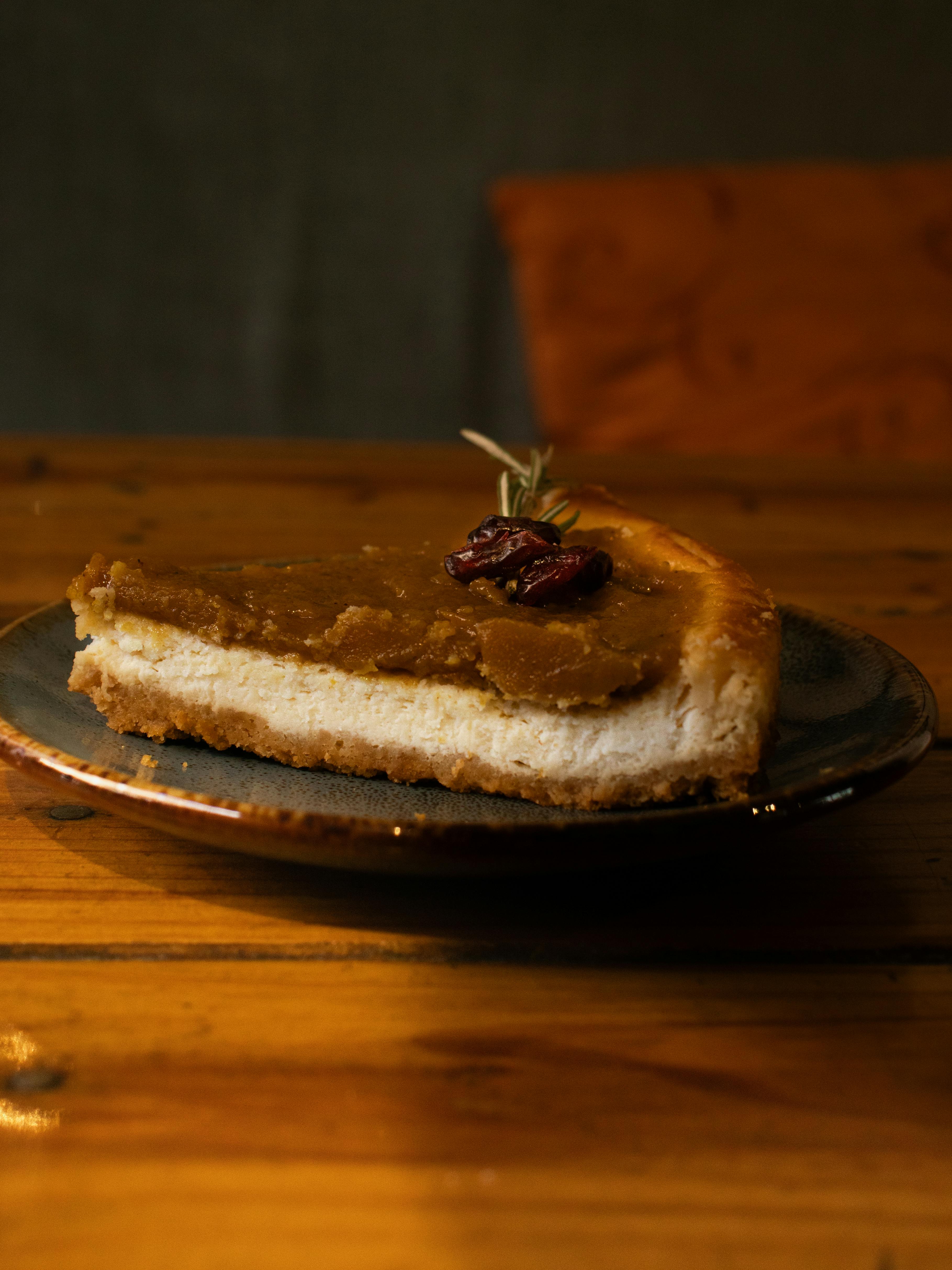
Photo: Miguel Romero / Pexels
The diets react (see scores below)
Common Ingredients
- eggs
- sugar
- butter
- vinegar
- pie crust
- salt
Specific recipes may vary.
Incompatible with 11 of 11 diets
Diet Ratings
Chess Pie is fundamentally incompatible with a ketogenic diet. The two primary filling ingredients — sugar and pie crust (wheat flour) — are both major sources of net carbohydrates. A standard slice of chess pie contains roughly 40-60g of net carbs, primarily from large amounts of sugar in the filling and refined grain-based crust. This single serving would exceed or completely consume an entire day's keto carb allotment. There is no meaningful way to consume this dish in a traditional form while maintaining ketosis. While keto-adapted versions exist (using almond flour crust and sugar substitutes), the dish as described with its standard ingredients is a clear avoid.
Chess Pie contains multiple animal-derived ingredients that are explicitly excluded from a vegan diet. Eggs are a direct animal product, butter is a dairy derivative, and the traditional pie crust typically contains butter or lard. This dish is fundamentally incompatible with veganism in its standard form. There is no ambiguity here — all three of these ingredients (eggs, butter, and animal-fat pie crust) are clearly non-vegan by any definition used by major vegan organizations.
Chess Pie contains multiple non-paleo ingredients that make it fundamentally incompatible with the paleolithic diet. The pie crust is made from grain-based flour (typically wheat), which is explicitly excluded as a grain product. Refined sugar is a processed sweetener with no place in paleo eating. Butter is a dairy product excluded under strict paleo guidelines. Salt (added) is also discouraged. While eggs are paleo-approved and vinegar is generally tolerated, the dish as a whole is dominated by disqualifying ingredients. This is a heavily processed, grain-and-sugar-based dessert with no meaningful paleo adaptation possible without a complete reconstruction of the recipe.
Chess Pie is a classic American Southern dessert that fundamentally contradicts Mediterranean diet principles. It is built on large quantities of added sugar and butter (saturated fat), uses a refined grain pie crust, and offers little nutritional value beyond calories. While eggs are acceptable in moderation on the Mediterranean diet, they are not the dominant issue here — the high sugar content and butter base are the primary problems. Processed sweets and desserts high in added sugar and saturated fat are explicitly discouraged in the Mediterranean dietary pattern, which reserves sweets for rare, occasional treats.
Chess Pie is fundamentally incompatible with the carnivore diet. While it contains eggs and butter (animal-derived ingredients), the dish is dominated by non-carnivore components: sugar (a processed plant-derived sweetener), pie crust (grain-based, made from flour), and vinegar (plant-derived). These ingredients are explicitly excluded from the carnivore diet. The dish is essentially a sugar-and-grain dessert with minor animal product content. No carnivore variation or interpretation would permit this food.
Chess Pie contains multiple excluded ingredients that make it clearly non-compliant with Whole30. Sugar is explicitly excluded as an added sugar. Butter (regular, not ghee or clarified butter) is excluded as a dairy product. Pie crust is a grain-based baked good, violating both the grain exclusion and the 'no recreating baked goods' rule. Additionally, Chess Pie itself is a classic dessert/sweet baked good, which falls squarely into the category of junk food recreation that Whole30 prohibits even when using compliant ingredients.
Chess Pie's primary FODMAP concern is the traditional wheat-based pie crust, which contains wheat flour — a significant source of fructans. Fructans are one of the most problematic FODMAPs and wheat-based pastry crusts are firmly in the 'avoid' category during the elimination phase. The filling ingredients themselves are largely low-FODMAP: eggs are low-FODMAP, butter is low-FODMAP (fat, not protein/carbohydrate), white sugar (sucrose) is low-FODMAP at normal serving sizes, white vinegar is low-FODMAP, and salt is FODMAP-free. However, the wheat pie crust is a hard barrier to making this dish elimination-phase compliant in its standard form. A slice of chess pie includes a meaningful quantity of wheat pastry, making the fructan load significant and unavoidable in this dish as prepared. The dish could theoretically be made low-FODMAP with a gluten-free crust (e.g., rice flour or almond flour base), but as traditionally described with a standard pie crust, it must be avoided.
Chess Pie is a traditional Southern dessert consisting primarily of sugar, butter, eggs, and a refined flour pie crust — a combination that directly conflicts with core DASH diet principles. It is high in added sugar (the primary ingredient after eggs), high in saturated fat from butter and shortening-based pie crust, made with refined grains rather than whole grains, and provides virtually no potassium, magnesium, fiber, or other DASH-emphasized nutrients. The DASH diet explicitly limits sweets, added sugars, saturated fat, and refined carbohydrates. As a snack category item, this offers no nutritional redemption typical of DASH-friendly snacks such as nuts, fruits, or low-fat dairy. There is no low-sodium or modified version that would substantially improve its DASH compatibility given that the foundational ingredients (sugar and butter) are the primary concerns, not just sodium.
Chess pie is fundamentally incompatible with Zone Diet principles. Its primary ingredients are sugar and butter — high-glycemic carbohydrates and saturated fat — with eggs providing minimal lean protein relative to the dominant macronutrient profile. A typical slice is dominated by refined sugar and white flour-based pie crust, both of which are among the most unfavorable carbohydrate sources in Zone terminology due to their extremely high glycemic index and lack of fiber. The fat profile is primarily saturated (butter, egg yolks) rather than the monounsaturated fats Sears recommends. While eggs technically provide protein, the ratio in chess pie is wildly skewed — the dish delivers massive carbohydrate and saturated fat calories with comparatively negligible lean protein. There is no practical portioning adjustment that could bring this dessert into Zone balance while still constituting a meaningful snack, as even a small slice would overwhelm any accompanying protein source. This dish is nutritionally empty from a Zone perspective: no polyphenols, no omega-3s, no low-glycemic carbs, no monounsaturated fats.
Chess pie is a classic Southern dessert built almost entirely on pro-inflammatory ingredients. Sugar is the dominant ingredient by volume after eggs, providing a heavy refined sugar load that drives glycemic spikes and elevated inflammatory markers (CRP, IL-6). Butter contributes significant saturated fat, which in the quantities used in this dessert exceeds what anti-inflammatory guidelines consider acceptable even in a 'moderate' context. The pie crust is typically made from refined white flour — a refined carbohydrate with negligible fiber or micronutrient value — plus more butter or shortening. There are no anti-inflammatory counterweights in this dish: no omega-3s, no polyphenols, no antioxidant-rich vegetables, fruits, or spices. Eggs provide some modest nutritional value (choline, selenium) but are entirely overshadowed by the surrounding ingredients. The vinegar is present in a trivial quantity (a teaspoon or two) and does not meaningfully alter the inflammatory profile. As a dessert high in added sugar, saturated fat, and refined carbohydrates — the three pillars of pro-inflammatory eating — chess pie clearly falls into the 'avoid' category under any mainstream anti-inflammatory framework.
Chess pie is a Southern dessert composed almost entirely of sugar, butter, and a refined pastry crust, with eggs providing only a modest structural role rather than meaningful protein density per serving. A standard slice delivers roughly 400-500 calories, the majority from refined sugar and saturated fat, with minimal protein (3-5g), negligible fiber, and very high fat content from both butter and shortening-based pie crust. This profile is essentially the opposite of what GLP-1 patients need: it is calorie-dense with almost no nutritional return, high in saturated fat which worsens GLP-1 GI side effects (nausea, bloating, reflux), high in refined sugar which spikes blood glucose and contributes empty calories, and low in both protein and fiber. The small appetite window GLP-1 patients have should not be spent on foods like this. There is no meaningful redeeming nutritional factor for this population.
*See how scores were generated at our methodology page.
Nutritional profile
Six traits that cut across every diet.
Fiber & Plants
How much whole-plant food and fiber it delivers.
Healthy Fats
The quality of its fats (unsaturated, omega-3).
Whole / Unprocessed
How close it is to its natural, unprocessed form.
Gut Gentle
How easy it is on digestion (low FODMAP, few irritants).
Low Glycemic
How little it spikes your blood sugar.
Protein Density
How much protein it packs per calorie.
Controversy Index
Higher controversy = more disagreement between diets.