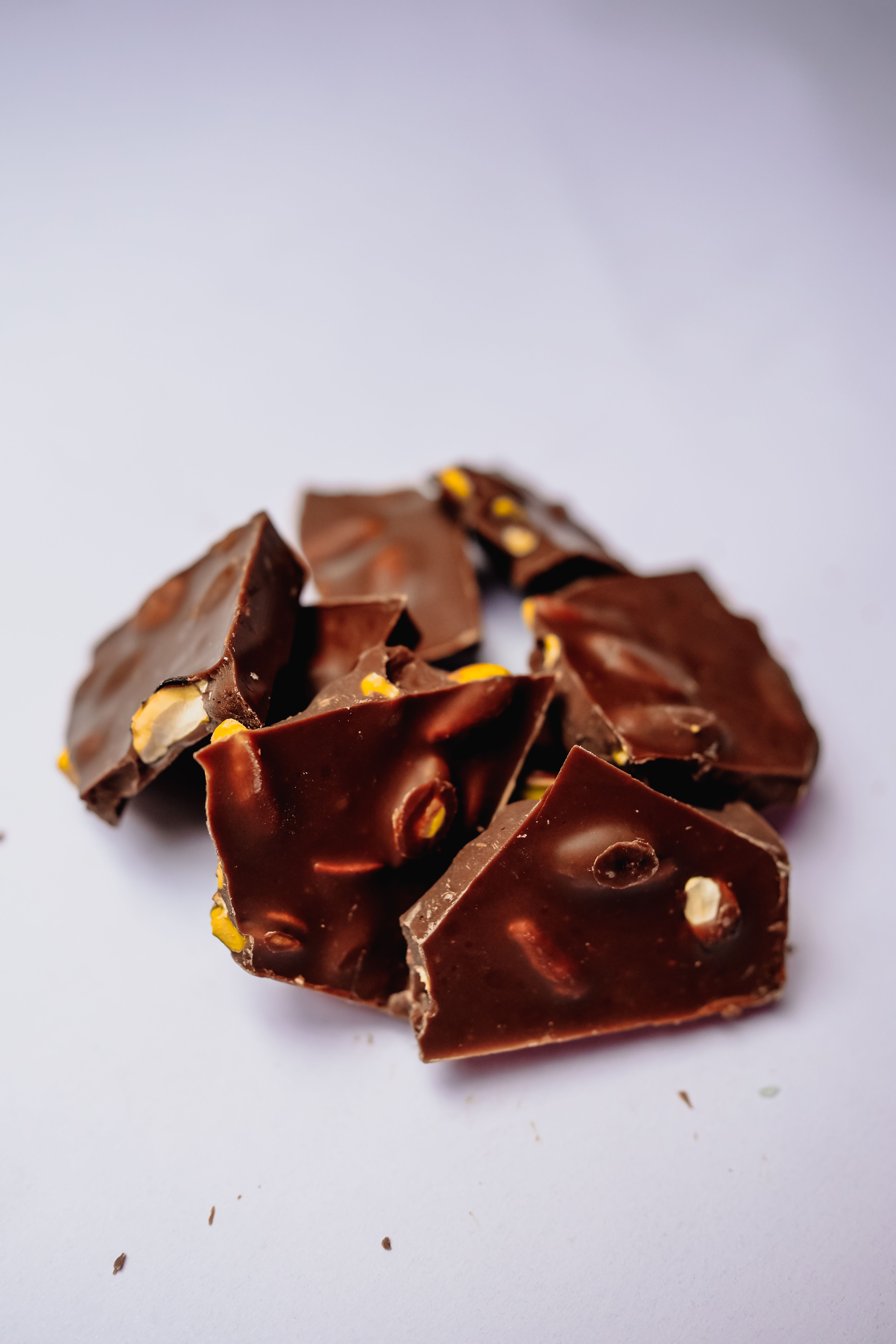
Photo: Tuğçe Açıkyürek / Pexels
American
Chocolate Bark
The diets react (see scores below)
Common Ingredients
- chocolate
- nuts
- dried fruit
- sea salt
Specific recipes may vary.
Incompatible with 5 of 11 diets
Diet Ratings
Standard chocolate bark as typically made is problematic for keto due to multiple high-carb components. Conventional chocolate (milk or semi-sweet) is high in sugar. Dried fruit is one of the worst keto offenders — it is essentially concentrated sugar with most water removed, delivering very high net carbs per small serving (e.g., raisins ~79g net carbs/100g, cranberries often sweetened). Even nuts, while generally keto-friendly, add carbs in aggregate. The combination of sugary chocolate plus dried fruit makes this dish very likely to exceed daily net carb limits in a single serving. Only a heavily modified version — 90%+ dark chocolate, zero dried fruit, keto-friendly nuts only — would be acceptable.
Some lazy keto or flexible keto practitioners argue that a version using 85%+ dark chocolate and minimal dried fruit (e.g., a few unsweetened tart cherries) in very small portions could fit within a daily carb budget, and that nuts provide fat and fiber that partially offset the carb load. However, strict and standard keto protocols would reject any dried fruit outright.
Chocolate bark made with nuts, dried fruit, and sea salt is potentially vegan, but the verdict hinges entirely on the type of chocolate used. Dark chocolate is typically vegan, but milk chocolate contains dairy (milk solids, milk fat) and is non-vegan. White chocolate also contains dairy. The 'chocolate' ingredient is unspecified, and in American snack contexts, milk chocolate is extremely common in bark recipes. Assuming dark/vegan chocolate is used, the remaining ingredients (nuts, dried fruit, sea salt) are fully plant-based and whole-food. The dish earns a caution rating because the chocolate type is ambiguous and many commercial versions use milk chocolate, making the category conditionally vegan rather than reliably so.
Strict whole-food plant-based advocates may further caution against even dark chocolate bark due to the high sugar content and processed nature of chocolate, arguing it doesn't align with a health-centered WFPB approach despite being technically vegan.
Chocolate bark contains several problematic ingredients from a strict paleo perspective. Chocolate (even dark chocolate) is a processed product — while cacao itself is a seed available to Paleolithic humans, most commercial chocolate contains added sugar, emulsifiers, and dairy. Even high-quality dark chocolate (70%+ cacao) sits in a gray zone: widely embraced by the modern paleo community but excluded by strict Cordain-school interpretations. Nuts are fully paleo-approved. Dried fruit is paleo in principle but calorie-dense and high in sugar, warranting moderation. Sea salt is the most contested ingredient here — added salt of any kind, including sea salt, is excluded under strict paleo rules (Paleolithic humans did not add salt to food), though many modern paleo practitioners and protocols accept it as a natural, unrefined seasoning. The combination of these gray-area ingredients — processed chocolate, dried fruit sugar load, and added salt — keeps this dish firmly in caution territory rather than outright avoid, since no grains, legumes, dairy, or seed oils are present.
Strict Cordain-school paleo would push this toward avoid: Loren Cordain excludes all processed cacao products, added salt, and flags dried fruit for its concentrated sugar content. Conversely, Mark Sisson and many modern paleo bloggers treat 85%+ dark chocolate as a paleo staple, which would nudge compliant versions of this dish closer to an approve rating.
Chocolate bark presents a mixed Mediterranean diet profile. The nuts are a Mediterranean staple, providing healthy fats, protein, and fiber — strongly encouraged. Dried fruit offers natural sugars and micronutrients but is calorie-dense and can contain added sugars. The critical variable is the chocolate: dark chocolate (70%+ cacao) is consumed in modest amounts in Mediterranean traditions and contains beneficial polyphenols and antioxidants, whereas milk chocolate is more processed and higher in added sugar and saturated fat. Sea salt is neutral. Overall, if made with high-quality dark chocolate, this is an occasional treat that fits within Mediterranean principles — not a staple, but not a violation. It lands in the caution range as a sometimes food, with quality of ingredients being determinative.
Some Mediterranean diet authorities and traditional Southern European practices do include small amounts of dark chocolate as an acceptable indulgence rich in flavonoids, which would push this closer to a mild approval when made with quality dark chocolate and unsalted nuts. Conversely, stricter clinical Mediterranean diet protocols flag any confection with added sugar as an avoid, regardless of nut content.
Chocolate Bark is entirely plant-derived and incompatible with the carnivore diet. Chocolate is derived from cacao beans (a plant), nuts and dried fruit are plant foods explicitly excluded from carnivore, and sea salt — while acceptable as a mineral — cannot redeem the dish. There is no animal-derived component whatsoever. This food violates every core principle of the carnivore diet: it contains plants, sugar (from chocolate and dried fruit), and no animal protein or fat. Even the most permissive 'animal-based' practitioners following Saladino's approach would not include chocolate bark, as it is a processed confection with nuts and dried fruit rather than a simple honey or fruit addition.
Chocolate bark as commonly made contains chocolate, which in virtually all commercial forms includes added sugar (and often dairy in the form of milk chocolate). Standard chocolate bars and chips contain cane sugar or other excluded sweeteners, making this dish non-compliant. Even if 100% cacao or unsweetened chocolate were used, chocolate bark is essentially a confection — a junk food recreation that violates the spirit of Whole30's rule against recreating sweets and treats with compliant ingredients. The nuts, dried fruit (if unsweetened and unsulfited), and sea salt are individually compliant, but the chocolate base disqualifies the dish in its typical form. A compliant version would be nearly impossible to find in a standard preparation.
Chocolate bark contains several ingredients with variable FODMAP status depending on type and quantity. Dark chocolate is low-FODMAP at around 30g per Monash, but milk chocolate contains lactose and becomes problematic at larger servings. Nuts vary widely: macadamias, pecans, and walnuts are low-FODMAP at standard servings, while cashews and pistachios are high-FODMAP even in small amounts. Dried fruit is the most significant concern — most dried fruits (raisins, dates, cranberries, apricots) are high-FODMAP due to concentrated fructose and polyols, though dried cranberries in small amounts (1 tablespoon) may be tolerated. Sea salt itself is FODMAP-free. The vague ingredient list (just 'nuts' and 'dried fruit') means this dish could be low-FODMAP with careful ingredient selection (dark chocolate, low-FODMAP nuts, minimal low-FODMAP dried fruit like a small amount of dried cranberries) or high-FODMAP with poor choices. As typically prepared and purchased, most chocolate bark recipes use dried fruits like raisins or cranberries in generous amounts, which pushes this into caution territory.
Monash University has approved specific components (dark chocolate at ≤30g, certain nuts) individually, but clinical FODMAP practitioners often advise avoiding commercially prepared chocolate bark during elimination because the types and quantities of nuts and dried fruit are unknown and portion control is difficult. A homemade version with verified low-FODMAP ingredients could achieve a higher score.
Chocolate bark occupies a middle ground in DASH diet compatibility. The nuts provide heart-healthy unsaturated fats, magnesium, and potassium — all DASH-favorable nutrients. Dried fruit contributes fiber and potassium but is calorie-dense and high in natural (and sometimes added) sugars. Dark chocolate in small amounts has been associated with cardiovascular benefits and contains some magnesium and flavonoids, and DASH does allow limited sweets. However, chocolate — especially milk chocolate — contains saturated fat and added sugar, both of which DASH limits. Sea salt adds sodium, though typically in modest amounts for a snack portion. The overall profile is a mixed bag: some DASH-positive components (nuts, dried fruit) combined with DASH-limited components (sugar, saturated fat from chocolate). As an occasional small-portion treat using dark chocolate (70%+), it is borderline acceptable, but it is not an emphasized DASH food and can easily exceed sugar and saturated fat targets if portions are not controlled.
NIH DASH guidelines categorize sweets and added sugars as foods to limit (≤5 servings/week of sweets), which would make chocolate bark a marginal choice. However, updated clinical interpretations note that dark chocolate (≥70% cacao) in small amounts may confer cardiovascular benefit via flavanols and magnesium, and some DASH-oriented dietitians permit it as an occasional treat when nuts are the dominant ingredient and portions are controlled.
Chocolate bark is a mixed bag from a Zone perspective. The nuts (almonds, macadamia, walnuts) are actually ideal Zone fat sources — monounsaturated and anti-inflammatory — and dark chocolate (70%+) carries polyphenols that Sears explicitly endorses in his later anti-inflammatory writings. However, this snack has several structural problems for Zone compliance: (1) No meaningful protein source — a Zone snack requires protein to anchor the 30/30/40 ratio, and 'none' here means the macro balance is fundamentally off; (2) Dried fruit is a high-glycemic, high-sugar carbohydrate — concentrated sugars without fiber benefit, classified as 'unfavorable' in Zone terminology; (3) Chocolate itself contains sugar, pushing glycemic load higher. The overall macro profile skews heavily toward fat and carbohydrate with virtually no protein, making it structurally incompatible with a proper Zone block snack. It's not a catastrophic food — dark chocolate and nuts have genuine Zone merit — but without protein and with the dried fruit inclusion, it cannot function as a standalone Zone snack without significant modification (e.g., adding a protein source, using minimal dried fruit).
Sears' later work (The OmegaRx Zone, Zone Perfect Meals in Minutes) placed increasing emphasis on polyphenol-rich foods, and dark chocolate is explicitly cited as a high-polyphenol food beneficial for eicosanoid balance and anti-inflammatory signaling. Some Zone practitioners argue that a small portion of dark chocolate bark with nuts functions reasonably as a Zone-friendly treat when consumed alongside a protein source, and that the nuts' monounsaturated fat profile partially offsets the glycemic concerns. In this reading, the dish earns a 'caution' rather than trending toward 'avoid.'
Chocolate bark made with dark chocolate (>70% cacao), nuts, dried fruit, and sea salt has a genuinely favorable anti-inflammatory profile in principle, but the final verdict depends heavily on the specific ingredients used. High-cacao dark chocolate is explicitly endorsed by Dr. Weil's Anti-Inflammatory Food Pyramid for its flavanols, polyphenols, and antioxidants that reduce inflammatory markers like CRP. Nuts (particularly walnuts, almonds, or pecans) contribute omega-3s, vitamin E, and anti-inflammatory polyphenols. Sea salt is nutritionally neutral. The concern lies in variability: if the chocolate is milk chocolate or lower-cacao dark chocolate, it contributes more added sugar and saturated fat with fewer polyphenols. Dried fruit is concentrated in natural sugars and sometimes contains added sugars or preservatives — a meaningful caution since excess sugar is pro-inflammatory. Portion size also matters significantly here; this is a snack that can easily be overconsumed. Made with >70% dark chocolate, unsalted nuts like walnuts, and minimally processed dried fruit (no added sugar), this skews toward 'approve.' Made with standard semi-sweet or milk chocolate and sweetened dried fruit in generous portions, it skews toward 'caution' or mild concern. Rating as 'caution' to reflect the realistic range of preparations.
Some anti-inflammatory practitioners would approve this outright if made with >70% dark chocolate and walnuts, citing strong polyphenol and omega-3 content — Dr. Weil explicitly includes dark chocolate as an anti-inflammatory food. However, stricter AIP or low-sugar anti-inflammatory approaches would flag the dried fruit's sugar concentration and the saturated fat in chocolate as concerns, even in dark varieties, and would recommend limiting this even as an occasional treat.
Chocolate bark is a poor fit for GLP-1 patients. It is high in fat (from chocolate and nuts), high in sugar (chocolate and dried fruit), low in protein, and low in fiber relative to its calorie density. The fat and sugar combination is likely to worsen GLP-1 side effects including nausea, bloating, and reflux, as slowed gastric emptying means high-fat, high-sugar foods linger longer and cause greater discomfort. Dried fruit contributes concentrated sugar with minimal fiber benefit. Chocolate (especially milk chocolate) is also a common reflux and nausea trigger in GLP-1 patients. The nuts provide some unsaturated fat and minimal protein, but not in quantities meaningful enough to offset the overall nutritional profile. This is essentially an empty-calorie snack with no satiety value per calorie — the opposite of what GLP-1 patients need when appetite and caloric intake are already severely reduced. Even a small portion delivers significant fat and sugar with negligible protein or functional fiber.
*See how scores were generated at our methodology page.
Nutritional profile
Six traits that cut across every diet.
Fiber & Plants
How much whole-plant food and fiber it delivers.
Healthy Fats
The quality of its fats (unsaturated, omega-3).
Whole / Unprocessed
How close it is to its natural, unprocessed form.
Gut Gentle
How easy it is on digestion (low FODMAP, few irritants).
Low Glycemic
How little it spikes your blood sugar.
Protein Density
How much protein it packs per calorie.
Controversy Index
Higher controversy = more disagreement between diets.
Diet-Specific Tips
 Vegan — 6/10
View tips
- Chocolate type is the critical variable — dark chocolate is typically vegan, milk and white chocolate are not
- Nuts and dried fruit are fully plant-based whole foods
- Sea salt is vegan
- Many American commercial chocolate bark products default to milk chocolate, making the category unreliable without label-checking
- Vegan dark chocolate versions of this dish exist and are widely available
 Paleo — 4/10
View tips
- Chocolate is a processed food; paleo status depends heavily on cacao percentage and absence of dairy/refined sugar
- Dark chocolate (70%+ cacao, no dairy) is widely accepted in modern paleo but excluded by strict Cordain interpretation
- Nuts are fully paleo-approved
- Dried fruit is paleo-permissible but high in natural sugar — moderation advised
- Sea salt (added salt) is excluded under strict paleo rules but accepted by many modern paleo practitioners
- No grains, legumes, dairy, or seed oils present
 Mediterranean — 5/10
View tips
- Nuts are a core Mediterranean staple and the most diet-compatible ingredient
- Dark chocolate (70%+ cacao) is tolerated in moderation; milk chocolate would lower the score
- Dried fruit contributes natural nutrients but also concentrated sugars — check for added sugars
- No refined grains or red meat; the dish is plant-based in composition
- American snack context suggests possible use of lower-quality chocolate and sweeter formulation
- Portion size is critical — this is an occasional treat, not a daily food
 DASH — 4/10
View tips
- Chocolate contains saturated fat and added sugar, both limited on DASH
- Nuts are DASH-approved and provide magnesium, potassium, and healthy fats
- Dried fruit adds fiber and potassium but also concentrated sugar and calories
- Sea salt adds sodium, though modest in a typical portion
- Dark chocolate (70%+ cacao) is preferable to milk chocolate under DASH principles
- Portion control is critical — this food is calorie-dense and easy to overconsume
- DASH limits sweets to ≤5 servings per week, so this qualifies only as an occasional treat
 Zone — 4/10
View tips
- No protein source — violates the core 40/30/30 Zone block structure for snacks
- Dried fruit is a high-glycemic, concentrated sugar carbohydrate classified as 'unfavorable' in Zone
- Nuts (if almonds/macadamia/walnuts) are ideal monounsaturated Zone fat blocks
- Dark chocolate is a recognized high-polyphenol food endorsed in Sears' anti-inflammatory framework
- High combined fat + carbohydrate load with no protein anchor makes Zone balancing difficult
- Could be made Zone-compatible by pairing with lean protein and eliminating or minimizing dried fruit
 Anti-Inflammatory — 6/10
View tips
- Dark chocolate (>70% cacao) contains flavanols and polyphenols with demonstrated anti-inflammatory effects
- Nuts (especially walnuts) provide omega-3 fatty acids, vitamin E, and anti-inflammatory phytonutrients
- Dried fruit adds concentrated natural sugars — a potential inflammatory concern in large amounts or if sweetened
- Quality of chocolate is critical: milk chocolate or lower-cacao varieties significantly reduce anti-inflammatory benefit and increase sugar/saturated fat load
- Portion-sensitive: beneficial ingredients become problematic when overconsumed
- No seed oils, trans fats, or artificial additives in the listed ingredients — a positive