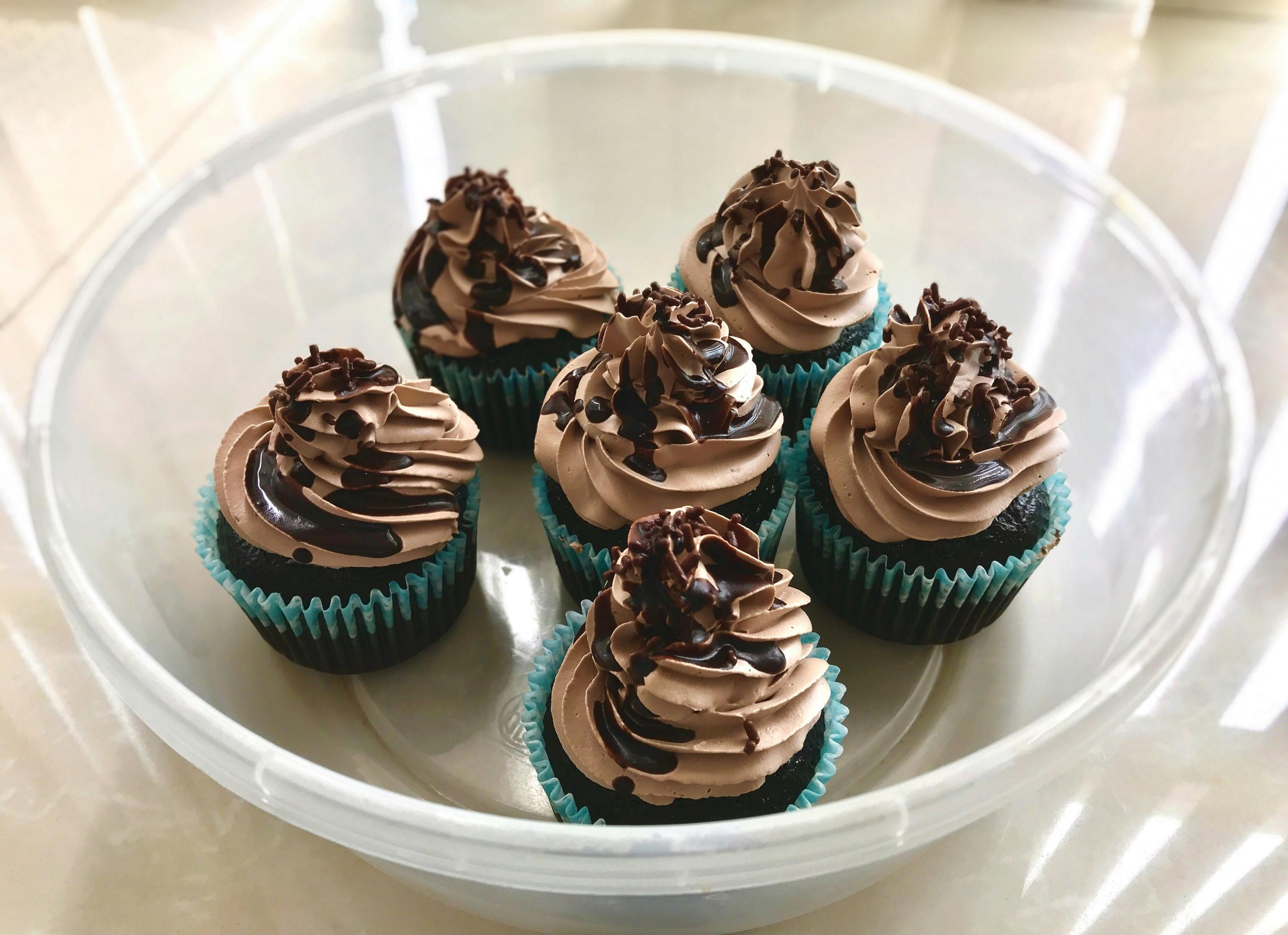
Photo: Rony Stephen Chowdhury / Pexels
American
Chocolate Cupcake
The diets react (see scores below)
Common Ingredients
- flour
- cocoa powder
- sugar
- eggs
- butter
- baking powder
- baking soda
- salt
- vanilla extract
- milk
Specific recipes may vary.
Incompatible with 11 of 11 diets
Diet Ratings
A chocolate cupcake is fundamentally incompatible with a ketogenic diet. The two primary ingredients — wheat flour and sugar — are among the most keto-incompatible foods possible. A standard cupcake contains roughly 30-45g of net carbs, which alone can exceed or completely consume an entire day's carb allowance on keto. Flour is a refined grain, and sugar is a direct disqualifier under keto rules. Milk adds additional lactose-derived carbs. While eggs and butter are keto-friendly, they are minor contributors here and cannot offset the carbohydrate load of the other ingredients. There is no portion size small enough to make a standard chocolate cupcake keto-compatible.
This chocolate cupcake contains multiple animal-derived ingredients that disqualify it from a vegan diet. Eggs are a direct animal product (poultry-derived), butter is a dairy product made from cow's milk, and milk is itself a dairy product. All three are explicitly excluded under vegan dietary rules. The remaining ingredients — flour, cocoa powder, sugar, baking powder, baking soda, salt, and vanilla extract — are plant-based and would be compatible with a vegan diet. However, the presence of three distinct animal products makes this recipe clearly non-vegan. Vegan versions of chocolate cupcakes do exist and are widely popular, substituting eggs with flax eggs, chia eggs, or applesauce; butter with vegan margarine or coconut oil; and milk with plant-based milks (oat, almond, soy). Note also that refined white sugar is sometimes processed using bone char, which is a secondary concern some ethical vegans flag, though this applies to the plant-based ingredients already present and does not change the primary verdict here.
Chocolate cupcakes are fundamentally incompatible with the paleo diet. The ingredient list contains multiple non-paleo foods: flour (wheat grain, strictly excluded), sugar (refined sugar, strictly excluded), butter (dairy, excluded), baking powder and baking soda (processed leavening agents with additives), salt (added salt, excluded), and milk (dairy, excluded). Nearly every core ingredient violates paleo principles. While eggs and vanilla extract are paleo-compliant, and cocoa powder exists in a gray area, the overall dish is a highly processed, grain-and-dairy-heavy baked good that is entirely at odds with the Paleolithic dietary framework. There is no meaningful paleo modification possible without replacing almost every ingredient.
A chocolate cupcake is a highly processed American dessert that contradicts Mediterranean diet principles on multiple fronts. It is built primarily on refined white flour and added sugar — two ingredients the Mediterranean diet explicitly minimizes. Butter is used as the primary fat rather than olive oil, adding saturated fat without the cardiovascular benefits of extra virgin olive oil. The dish contains no vegetables, legumes, whole grains, or other plant-forward components that define Mediterranean eating. While eggs and milk are present and acceptable in moderation, they are here in service of a sugar-and-refined-grain vehicle that provides little nutritional value. Occasional indulgence in sweets is not strictly forbidden in Mediterranean culture, but this cupcake as a food category is not compatible with the diet's core principles.
Chocolate cupcakes are entirely incompatible with the carnivore diet. The majority of ingredients are plant-derived or heavily processed: flour (grain), cocoa powder (plant), sugar (processed plant), baking powder and baking soda (non-animal leavening agents), and vanilla extract (plant-derived). While eggs, butter, and milk are animal-derived, they are minor components in a dish that is fundamentally a grain- and sugar-based baked good. The combination constitutes a highly processed, carbohydrate-dense food with sugar — everything the carnivore diet explicitly excludes. There is no meaningful carnivore-compatible version of this dish without a complete reconstruction.
Chocolate cupcakes are excluded on multiple grounds. First, the dish contains several explicitly banned ingredients: flour (a grain), sugar (added sugar), butter (dairy), and milk (dairy). Second, and independently, cupcakes are explicitly named in Whole30 Rule 4 as a prohibited food form — even if every ingredient were somehow compliant, recreating cupcakes violates the spirit of the program. This is about as clear-cut an 'avoid' as exists on Whole30.
This chocolate cupcake contains two major high-FODMAP ingredients that make it unsuitable during the elimination phase. Regular wheat flour is high in fructans, a key FODMAP that must be avoided. Milk contributes lactose, another significant FODMAP. Together, these two ingredients at standard cupcake-serving quantities would deliver a substantial FODMAP load. While cocoa powder is low-FODMAP at small amounts (1 tablespoon), sugar, eggs, butter, baking powder, baking soda, salt, and vanilla extract are all low-FODMAP. However, the wheat flour and milk are disqualifying at any realistic serving size. A low-FODMAP version could be made by substituting gluten-free flour and lactose-free milk or a suitable plant milk.
Chocolate cupcakes are a classic example of a food the DASH diet explicitly discourages. They are high in added sugar, saturated fat (from butter and whole milk), and refined carbohydrates (white flour), while offering virtually no nutritional benefit in terms of potassium, magnesium, calcium, or fiber. The DASH eating plan specifically limits sweets and added sugars to 5 or fewer servings per week, and a single cupcake can easily represent an entire week's allowance in one sitting. The butter contributes significant saturated fat, directly conflicting with DASH's directive to limit saturated fat intake. Baking soda and salt also add sodium. This food aligns with essentially none of the core DASH dietary pillars.
A chocolate cupcake is a highly problematic food from a Zone Diet perspective. The macronutrient profile is essentially the inverse of what Zone targets: it is dominated by high-glycemic refined carbohydrates (white flour, sugar) and saturated fat (butter), with negligible lean protein. The primary carbohydrate sources — white flour and sugar — are among the most unfavorable in Zone terminology, causing rapid blood glucose spikes and the resulting insulin surge that Sears' entire framework is designed to prevent. Butter contributes saturated fat rather than the preferred monounsaturated fats (olive oil, avocado, almonds). There is no meaningful lean protein component. Even with careful portioning, a single cupcake cannot be balanced into a Zone block structure without adding substantial lean protein and favorable carbs on the side, making the cupcake itself a net-negative addition to any Zone meal or snack. While pure sugar or soda would score a 1, this scores a 2 because cocoa powder does provide polyphenols (which Sears values in his anti-inflammatory framework) and eggs contribute some protein — but these positives are overwhelmed by the overall macro imbalance.
A chocolate cupcake made with refined flour, sugar, butter, and milk is a textbook pro-inflammatory food. Refined white flour is a rapidly digested refined carbohydrate that spikes blood glucose and promotes inflammatory signaling. Added sugar is one of the most consistently identified pro-inflammatory dietary components, driving increases in CRP, IL-6, and AGE (advanced glycation end-products) formation. Butter contributes saturated fat, which is flagged as a food to limit under anti-inflammatory guidelines. Whole milk adds additional saturated fat. The cocoa powder is the sole potentially redeeming ingredient — raw/dark cocoa contains flavanols (epicatechin, catechins) with genuine anti-inflammatory and antioxidant properties — but in the context of a cupcake, cocoa is a minor ingredient by weight, and its benefits are overwhelmed by the sugar, refined flour, and saturated fat surrounding it. This is fundamentally different from dark chocolate (>70% cacao), where the cocoa-to-sugar ratio is favorable. Vanilla extract is benign. Eggs offer some nutritional value (choline, selenium) but do not shift the overall profile. The overall dish is a refined-carbohydrate, high-sugar, saturated-fat delivery vehicle with negligible fiber, omega-3s, or meaningful antioxidant load relative to its inflammatory burden.
A chocolate cupcake is a poor fit for GLP-1 patients on virtually every relevant criterion. It is high in refined sugar and simple carbohydrates (flour, sugar as primary ingredients), contains saturated fat from butter, offers negligible protein and fiber, and delivers almost entirely empty calories. GLP-1 patients have dramatically reduced appetite, making every calorie count nutritionally — a cupcake provides little to no return on that calorie investment. The slowed gastric emptying caused by GLP-1 medications means high-sugar, high-fat foods like this are more likely to cause nausea, bloating, and prolonged GI discomfort. The butter content adds saturated fat, which is specifically flagged as worsening GLP-1 side effects. With no meaningful protein to support muscle preservation and no fiber to support digestion or blood sugar stability, this food works against the core goals of GLP-1 therapy.
*See how scores were generated at our methodology page.
Nutritional profile
Six traits that cut across every diet.
Fiber & Plants
How much whole-plant food and fiber it delivers.
Healthy Fats
The quality of its fats (unsaturated, omega-3).
Whole / Unprocessed
How close it is to its natural, unprocessed form.
Gut Gentle
How easy it is on digestion (low FODMAP, few irritants).
Low Glycemic
How little it spikes your blood sugar.
Protein Density
How much protein it packs per calorie.
Controversy Index
Higher controversy = more disagreement between diets.