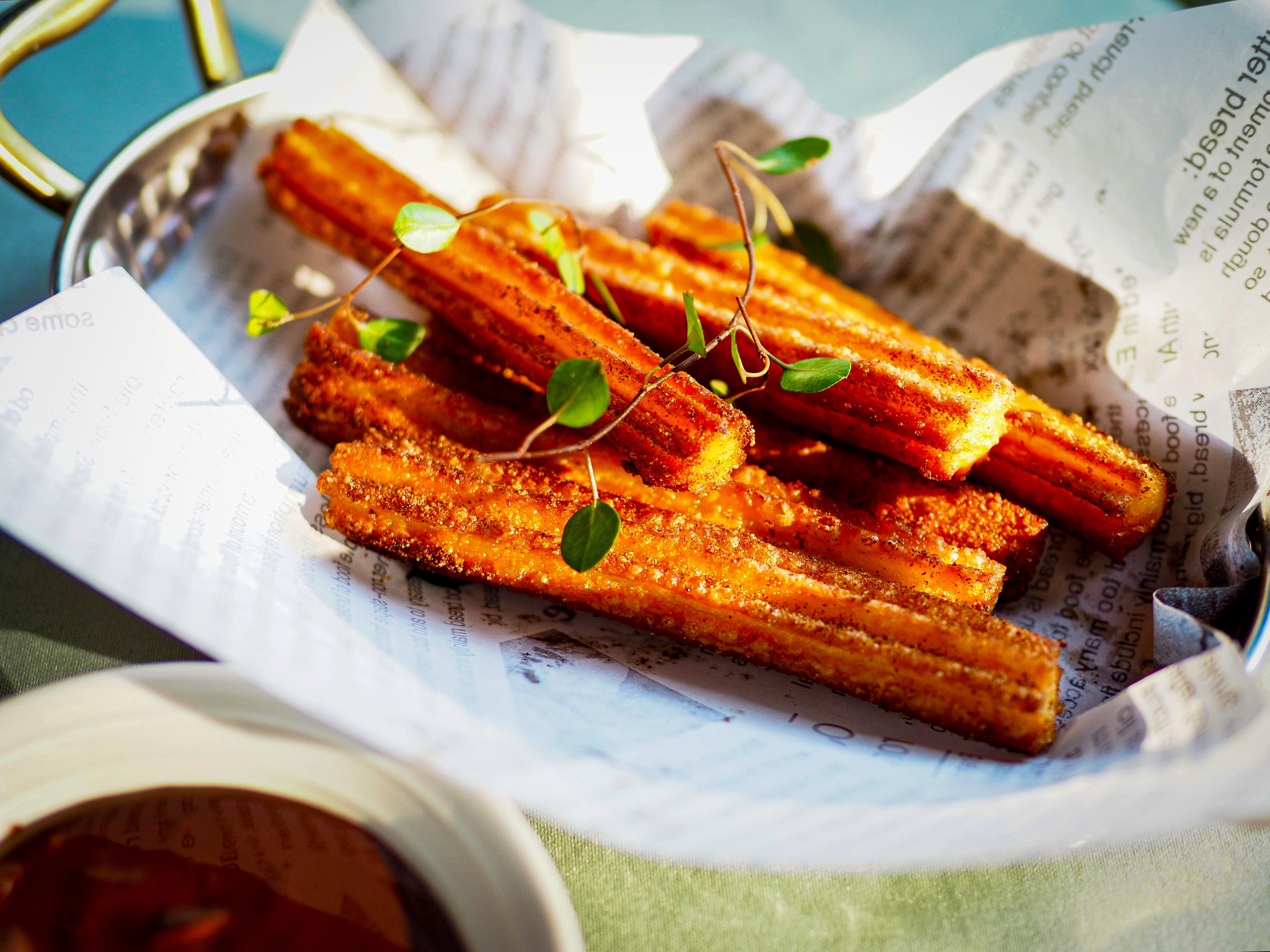
Photo: Teresa Wang / Pexels
The diets react (see scores below)
Common Ingredients
- wheat flour
- water
- salt
- vegetable oil
- sugar
- cinnamon
Specific recipes may vary.
Incompatible with 10 of 11 diets
Diet Ratings
Churros are fundamentally incompatible with a ketogenic diet. The primary ingredient is wheat flour, a high-glycemic grain that is strictly off-limits on keto. Combined with added sugar and typically served with a chocolate dipping sauce, a standard serving of churros can contain 40-60g of net carbs — potentially exceeding an entire day's keto carb budget in one snack. There is no meaningful way to consume churros within ketogenic macros in their traditional form.
The listed ingredients — wheat flour, water, salt, vegetable oil, sugar, and cinnamon — are all plant-based, making this version of churros technically vegan-compliant. However, traditional Spanish churros recipes frequently include eggs, and the dipping sauce (chocolate con churros) commonly contains dairy milk. As a processed fried snack high in refined carbohydrates and oil, whole-food plant-based advocates would rate it poorly from a nutritional standpoint. The listed ingredient set is vegan, but real-world churros very often contain eggs or are served with dairy-based accompaniments, so care is warranted when ordering outside the home.
Whole-food plant-based (WFPB) advocates argue that deep-fried refined flour snacks, even without animal products, undermine the health goals of a plant-based diet and should be treated as occasional indulgences rather than approved foods. Additionally, some ethical vegans note that commercially produced white sugar may be processed through bone char filtration, making it technically non-vegan in their view.
Churros are fundamentally incompatible with the paleo diet. The dish is built almost entirely on non-paleo ingredients: wheat flour (a grain, explicitly excluded), vegetable oil (a seed oil, excluded), refined sugar (excluded), and added salt (excluded). Cinnamon is the only paleo-approved ingredient in the recipe. There is no version of a traditional churro that can be considered paleo, and no meaningful substitution could be made without creating an entirely different food.
Churros are a fried dough snack made from refined wheat flour and added sugar, placing them firmly outside Mediterranean diet principles. They combine two major red flags: refined/processed grains and added sugar, while being deep-fried in vegetable oil rather than consumed with extra virgin olive oil as a primary fat. They offer minimal nutritional value — no fiber from whole grains, no plant-forward nutrients, and no protein. Although churros originated in Spain, a country central to Mediterranean cuisine, the dish represents an occasional indulgence rather than a dietary staple, and Mediterranean diet guidelines explicitly minimize refined grains, added sugars, and fried processed foods.
Churros are entirely plant-based and processed, containing zero animal products. Every single ingredient — wheat flour, water, salt, vegetable oil, sugar, and cinnamon — is either plant-derived or a plant-based additive. Wheat flour is a grain (explicitly excluded), vegetable oil is a plant oil (excluded), sugar is a processed plant-derived sweetener (excluded), and cinnamon is a plant spice (excluded). This food is fundamentally incompatible with the carnivore diet at every level, from the macronutrient profile (high-carbohydrate, no animal protein or fat) to the ingredient list. There is no carnivore-compatible component whatsoever.
Churros are excluded from Whole30 on multiple grounds. First, wheat flour is a grain and explicitly prohibited. Second, sugar is an added sweetener, also explicitly excluded. Third, churros fall squarely into the 'no recreating baked goods/junk food' rule — they are a fried dough snack analogous to the exact category of foods (chips, fried treats, pastry-like snacks) the program prohibits even if made with compliant ingredients. There is no version of a traditional churro that can be made Whole30-compliant.
Churros are made primarily from wheat flour, which is high in fructans — one of the main FODMAP triggers. Wheat flour is a well-established high-FODMAP ingredient per Monash University, and churros contain it as the dominant ingredient with no fermentation process (unlike sourdough) to reduce fructan content. A standard serving of churros (3–5 pieces) would deliver a significant fructan load, making this food unsuitable during the elimination phase. The remaining ingredients — water, salt, vegetable oil, sugar, and cinnamon — are all low-FODMAP and pose no concern. However, the wheat flour alone is sufficient to classify this dish as high-FODMAP at any reasonable serving size.
Churros are a deep-fried sweet pastry made from refined wheat flour, fried in vegetable oil, and coated with sugar and cinnamon. They are directly contrary to DASH diet principles on multiple fronts: they are made from refined (not whole-grain) flour, are deep-fried adding significant fat calories, and contain added sugar. DASH explicitly limits sweets and added sugars, discourages refined grains in favor of whole grains, and emphasizes nutrient-dense foods rich in potassium, calcium, magnesium, and fiber — all of which churros lack. While the vegetable oil used for frying is not a saturated fat per se, the overall frying process creates a high-fat, high-calorie, low-nutrient snack that has no meaningful place in a DASH eating pattern. Typically served with chocolate dipping sauce, the nutritional profile worsens further.
Churros are a poor fit for the Zone Diet across virtually every dimension. The dish is composed almost entirely of high-glycemic refined wheat flour and sugar, with no protein to speak of and fat coming from vegetable oil (likely omega-6-heavy seed oil). This creates a massive carbohydrate spike with no Zone-balancing protein or favorable fat to moderate the glycemic response. There is no practical way to portion churros into a Zone-compliant snack block: the carbohydrate load is dense and high-glycemic, protein is essentially zero (making the 40/30/30 ratio unachievable from this food alone or in any reasonable pairing that doesn't dwarf the churro portion into irrelevance), and the fat source conflicts with Sears' anti-inflammatory emphasis on monounsaturated fats and omega-3s. As a snack — a category where Zone blocks are smaller and balance is especially important — churros offer nothing of Zone value. They fall into the same category as candy or pastries: processed, high-glycemic, nutritionally empty from a Zone perspective.
Churros are a deep-fried pastry made from refined wheat flour and sugar — two hallmarks of a pro-inflammatory dietary pattern. Refined white flour is a high-glycemic carbohydrate that spikes blood glucose and promotes insulin-driven inflammatory signaling. Added sugar compounds this effect. Deep-frying in vegetable oil (typically high-omega-6 oils such as sunflower or corn oil) adds oxidized lipids and further tips the omega-6:omega-3 ratio in a pro-inflammatory direction. The only redeeming ingredient is cinnamon, which contains cinnamaldehyde and has documented anti-inflammatory properties — but as a light dusting on a fried dough snack, its contribution is negligible in this context. Churros have no meaningful fiber, no omega-3s, no polyphenols beyond trace cinnamon, and no vegetables or whole foods. They represent essentially everything the anti-inflammatory framework advises against: refined carbohydrates, added sugar, and fried in potentially oxidized seed oils.
Churros are a deep-fried, sugar-coated refined carbohydrate snack with essentially no redeeming nutritional value for GLP-1 patients. They provide negligible protein, minimal fiber, high refined carbohydrates, added sugar, and significant fat from deep frying. The combination of high fat and high simple carbohydrates is precisely what worsens GLP-1 side effects including nausea, bloating, and reflux. Slowed gastric emptying means greasy, heavy foods like churros sit in the stomach far longer, amplifying discomfort. With dramatically reduced caloric intake on GLP-1 medications, every bite must deliver nutritional value — churros deliver almost none. The refined flour spikes blood sugar rapidly with no fiber buffer, and the frying oil adds saturated and potentially trans fats depending on the oil used. This is a textbook empty-calorie food that runs counter to every GLP-1 dietary priority.
*See how scores were generated at our methodology page.
Nutritional profile
Six traits that cut across every diet.
Fiber & Plants
How much whole-plant food and fiber it delivers.
Healthy Fats
The quality of its fats (unsaturated, omega-3).
Whole / Unprocessed
How close it is to its natural, unprocessed form.
Gut Gentle
How easy it is on digestion (low FODMAP, few irritants).
Low Glycemic
How little it spikes your blood sugar.
Protein Density
How much protein it packs per calorie.
Controversy Index
Higher controversy = more disagreement between diets.
Diet-Specific Tips
 Vegan — 4/10
View tips
- All listed ingredients are plant-derived — no animal products present
- Traditional churros recipes often include eggs; this version omits them, making it vegan as specified
- Deep-fried refined flour snack — low nutritional value by WFPB standards
- Commonly served with dairy-based chocolate dipping sauce, which is not vegan
- White sugar may be bone-char processed — a minority vegan concern
- Confidence is medium because real-world churros frequently contain eggs despite the plant-based ingredient list provided