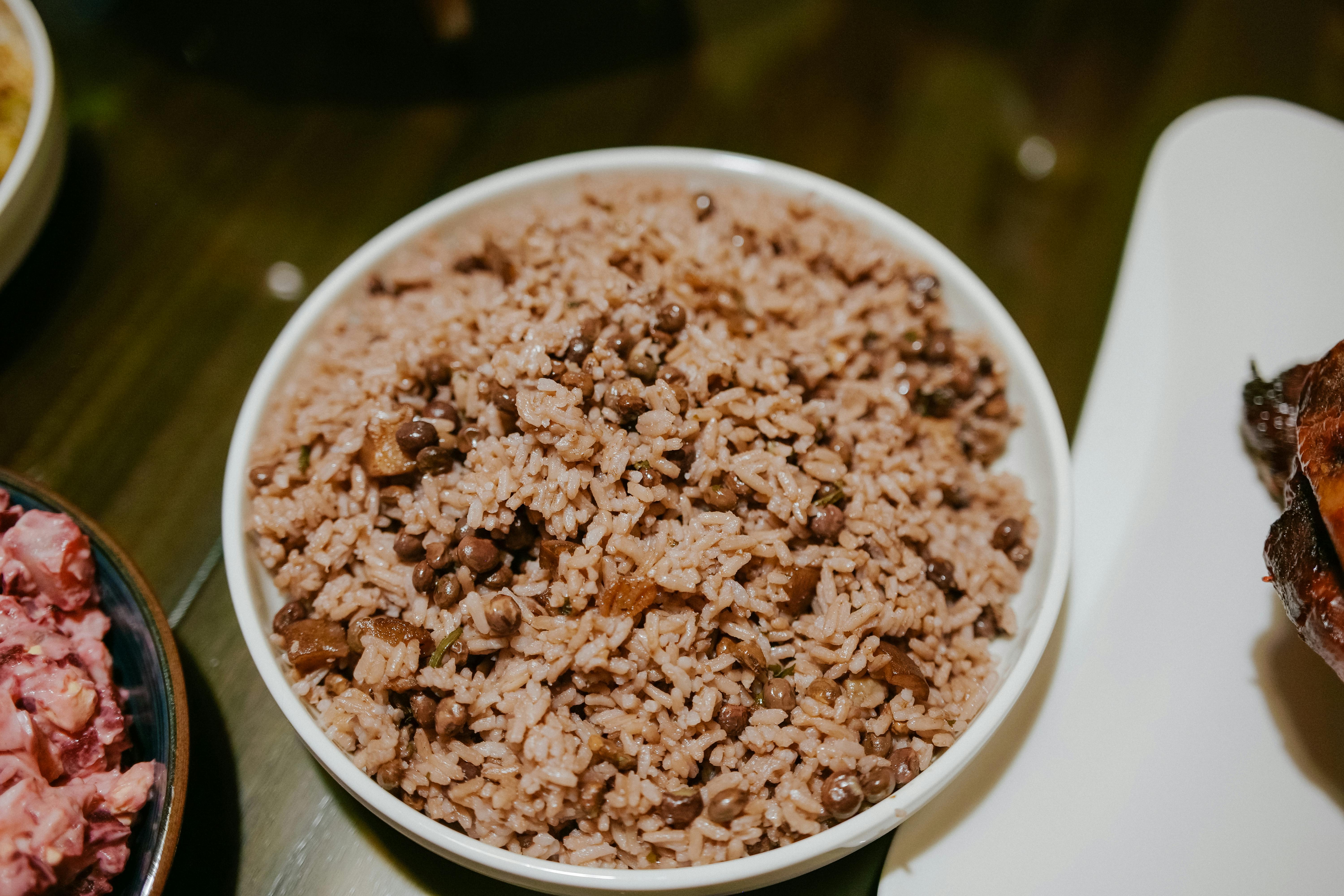
Photo: Luis Quintero / Pexels
Colombian
Arroz con Coco
The diets react (see scores below)
Common Ingredients
- rice
- coconut milk
- sugar
- raisins
- salt
- oil
Specific recipes may vary.
Incompatible with 9 of 11 diets
Diet Ratings
Arroz con Coco is fundamentally incompatible with a ketogenic diet. Rice alone contains approximately 45g of net carbs per cooked cup, which single-handedly exceeds the entire daily net carb limit for ketosis. On top of that, the dish includes added sugar and raisins, both of which are high-glycemic carbohydrate sources that would spike blood sugar and immediately disrupt ketosis. While coconut milk does provide beneficial fats and is generally keto-friendly, it cannot offset the massive carbohydrate load from the rice, sugar, and raisins. This dish has virtually no redeeming keto properties beyond the coconut milk component.
Arroz con Coco is a traditional Colombian coconut rice dish made entirely from plant-based ingredients. Rice, coconut milk, sugar, raisins, salt, and oil are all vegan-compliant. Coconut milk is a whole-food plant-based ingredient derived from coconuts, not an animal product. The dish is relatively whole-food in nature with minimal processing. No animal products or animal-derived ingredients are present.
Arroz con Coco is fundamentally incompatible with the paleo diet. Rice is a grain — one of the most clearly excluded food categories in paleo. Beyond rice, the dish also contains refined sugar (excluded as a processed sweetener), added salt (excluded), and unspecified oil (likely a seed oil such as vegetable or canola, also excluded). Raisins are technically paleo-compliant in moderation, and coconut milk is paleo-approved, but these two ingredients cannot redeem a dish built on a grain foundation with multiple other violations. This is not a borderline case.
Arroz con Coco is a Colombian coconut rice dish that conflicts with Mediterranean diet principles on multiple fronts. It is built on white refined rice (a refined grain discouraged in favor of whole grains), sweetened with added sugar, studded with raisins that add concentrated sugar, and cooked in coconut milk whose primary fat is saturated fat rather than the preferred extra virgin olive oil. The combination of refined grain, added sugar, and saturated fat from coconut milk places this dish firmly outside Mediterranean diet guidelines. It is not a traditional Mediterranean preparation and offers no meaningful alignment with the diet's core pillars of whole grains, olive oil, and plant-forward eating.
Arroz con Coco is entirely plant-based and contains multiple foods that are strictly prohibited on the carnivore diet. Rice is a grain, coconut milk is a plant-derived liquid, sugar is a refined carbohydrate, raisins are fruit, and the oil is plant-based. Every single ingredient violates carnivore principles. There is no animal product whatsoever in this dish. This is as far from carnivore-compatible as a food can get.
Arroz con Coco contains two clearly excluded ingredients: rice (a grain, explicitly banned on Whole30) and sugar (added sugar, explicitly banned on Whole30). Either one alone would disqualify this dish. Together, they make this firmly non-compliant with no path to approval in its traditional form.
Arroz con Coco contains several ingredients that require individual FODMAP scrutiny. White rice is definitively low-FODMAP at standard servings. Coconut milk is dose-dependent: Monash rates canned coconut milk as low-FODMAP at 1/2 cup (125ml) but high-FODMAP at larger amounts due to polyols (sorbitol). Sugar (sucrose) is low-FODMAP in normal culinary quantities. Salt and oil are FODMAP-free. The critical problematic ingredient is raisins — Monash rates raisins as high-FODMAP at even a small serving (1 tablespoon/13g) due to excess fructose and fructans. Raisins are a traditional and prominent ingredient in Arroz con Coco, not a trace garnish, making their inclusion a significant FODMAP concern. The coconut milk quantity in the dish may also exceed the low-FODMAP threshold depending on serving size. These two factors combined push the dish into the caution zone — it could be made low-FODMAP with raisin omission and controlled coconut milk, but as traditionally prepared it poses real risk.
Monash University clearly flags raisins as high-FODMAP (excess fructose) at typical culinary portions, and some FODMAP practitioners would rate this dish 'avoid' outright due to raisins being a key, non-trace ingredient. The coconut milk serving size ambiguity adds additional uncertainty — clinical practitioners often advise limiting coconut milk to small amounts during strict elimination.
Arroz con Coco is a Colombian coconut rice dish that conflicts with DASH diet principles on multiple fronts. Coconut milk is high in saturated fat from a tropical oil source, which DASH explicitly limits. The dish also contains added sugar (and raisins add further natural sugars), uses white rice rather than a whole grain, and includes added salt. The combination of saturated fat from coconut milk, added sugars, refined carbohydrates, and sodium makes this dish poorly aligned with DASH guidelines. DASH specifically calls out tropical oils (coconut, palm, palm kernel) as foods to limit, and this dish is built around coconut milk as a primary ingredient.
Arroz con Coco is a near-perfect storm of Zone-unfavorable ingredients. White rice is a high-glycemic carbohydrate that Sears explicitly classifies as unfavorable, spiking insulin rapidly. Added sugar compounds the glycemic problem significantly. Raisins are explicitly called out in Zone methodology as an unfavorable, high-sugar fruit to avoid. Coconut milk adds substantial saturated fat with no lean protein or monounsaturated fat to compensate. The dish is pure carbohydrate and saturated fat — essentially the inverse of a Zone-favorable macro ratio. There is no protein component, no low-glycemic carb source, and no monounsaturated fat. As a side dish, it would devastate any meal's 40/30/30 ratio by loading it with high-GI carbs and saturated fat simultaneously. Even in very small portions, the ingredient quality is so Zone-unfavorable across the board that it earns a low score. This is not a case of portion control solving the problem — the foundational ingredients are all problematic from a Zone standpoint.
Arroz con Coco is a traditional Colombian sweet rice dish that presents several anti-inflammatory concerns. White rice is a refined carbohydrate with a high glycemic index, which can trigger inflammatory responses through blood sugar spikes and advanced glycation end products (AGEs). Added sugar compounds this glycemic burden. Raisins add natural fruit sugars on top of the added sugar, further elevating the glycemic load of the dish. Coconut milk contains medium-chain triglycerides (MCTs) and lauric acid, which occupy a contested space — lauric acid raises LDL but also HDL, and some research suggests anti-inflammatory properties, but its high saturated fat content is generally cautioned in anti-inflammatory frameworks. The unspecified 'oil' adds further uncertainty. There are no meaningful anti-inflammatory contributors — no omega-3s, no polyphenols, no fiber-rich whole grains, no antioxidant-rich vegetables or spices. The overall profile is a high-glycemic, moderate-saturated-fat dish with added sugar and no redeeming anti-inflammatory qualities to offset these concerns.
Arroz con Coco is a Colombian coconut rice dish built almost entirely around refined carbohydrates, added sugar, and saturated fat from coconut milk — the opposite of what GLP-1 patients need. It provides negligible protein, minimal fiber, and derives most of its calories from white rice, sugar, and raisins (additional simple sugars). Coconut milk is high in saturated fat, which worsens GLP-1 side effects including nausea, bloating, and reflux. The added sugar spikes blood glucose and contributes empty calories. As a side dish with no protein anchor, it offers very poor nutrient density per calorie at a time when every bite needs to count. There is no meaningful redeeming nutritional feature for a GLP-1 patient.
*See how scores were generated at our methodology page.
Nutritional profile
Six traits that cut across every diet.
Fiber & Plants
How much whole-plant food and fiber it delivers.
Healthy Fats
The quality of its fats (unsaturated, omega-3).
Whole / Unprocessed
How close it is to its natural, unprocessed form.
Gut Gentle
How easy it is on digestion (low FODMAP, few irritants).
Low Glycemic
How little it spikes your blood sugar.
Protein Density
How much protein it packs per calorie.
Controversy Index
Higher controversy = more disagreement between diets.
Diet-Specific Tips
 Vegan — 9/10
View tips
- Rice is fully plant-based
- Coconut milk is plant-derived, not a dairy product
- Sugar is generally vegan (though some refined white sugars are processed with bone char — this is a minor concern held by a small subset of strict vegans but does not affect the high-confidence verdict)
- Raisins, salt, and oil are all plant-based
- No animal proteins, dairy, eggs, or animal-derived additives present
- Dish qualifies as largely whole-food plant-based
 Low-FODMAP — 5/10
View tips
- Raisins are high-FODMAP even at small servings (1 tbsp) due to excess fructose — a prominent ingredient in this dish
- Canned coconut milk is low-FODMAP at ≤125ml but becomes high-FODMAP at larger quantities (polyols/sorbitol)
- White rice is low-FODMAP at standard servings — a safe base ingredient
- Sugar, salt, and oil are FODMAP-free
- As traditionally prepared, raisin content likely exceeds safe FODMAP threshold
- Dish could be modified to low-FODMAP by omitting raisins and controlling coconut milk portion